
日本汽车制造商

Search documents
全球媒体聚焦 |英媒:三分之二日企认为日中关系紧张伤害日本经济
Sou Hu Cai Jing· 2026-01-15 13:41
路透社1月15日公布的一项调查显示,超过三分之二的日本企业预计,日中关系紧张将对日本经济造成冲击,近一半企业已经感受到或预计将 面临直接的经营冲击。 一名铁路运营企业的管理人员在调查中表示,赴日中国游客数量下降已经开始拖累旗下酒店业务的入住率和客房平均单价收入。 一家电子制造企业的负责人则表示,中国在关键矿产政策方面的动向对公司而言是"生死攸关"的问题。 调查还显示,约43%的受访企业认为,如果日中关系长期处于紧张状态,企业将不得不重新评估其涉华业务安排。 一名运输设备制造企业的管理人员指出,如果日本汽车制造商在中国市场的销量受到冲击,其公司销售也将随之下滑,甚至可能被迫退出中 国市场。 来源:环球资讯广播 △路透社报道截图 调查显示,约9%的受访企业表示其业务已经受到相关影响,另有35%的企业预计将面临不同程度的冲击。 ...

新技术影响力有限,日本产业界反思
Huan Qiu Shi Bao· 2026-01-08 22:40
Group 1 - The core viewpoint of the articles is that by 2025, Chinese automotive manufacturers are expected to surpass Japan in global sales, reaching approximately 27 million units, marking a 17% year-on-year growth [1][2] - Japanese media has extensively reported on this development, highlighting the competitive edge of Chinese companies in the automotive sector, particularly in production equipment, supply chains, and technology systems [1] - Chinese enterprises have established advantages in large integrated casting equipment for vehicle body manufacturing, which enhances production efficiency and reduces the number of components, becoming crucial in electric vehicle manufacturing [1] Group 2 - In terms of technology, Chinese companies are making significant advancements in autonomous driving and related software, with some cities already operating unmanned taxis and buses, which contrasts with Japan's limited international influence in these new fields [1] - The current situation in the Japanese automotive industry is attributed to multiple factors, including Japan's continued competitiveness in hybrid technology, while the global market shifts towards electrification and software integration [2] - Chinese automotive firms have made notable progress in sales scale, overseas expansion, and the application of new technologies, while Japan lacks competitiveness in areas such as power batteries and autonomous driving [2]
对美出口八个月来首现回升 日本11月出口增长6.1%超预期
Zhi Tong Cai Jing· 2025-12-17 02:25
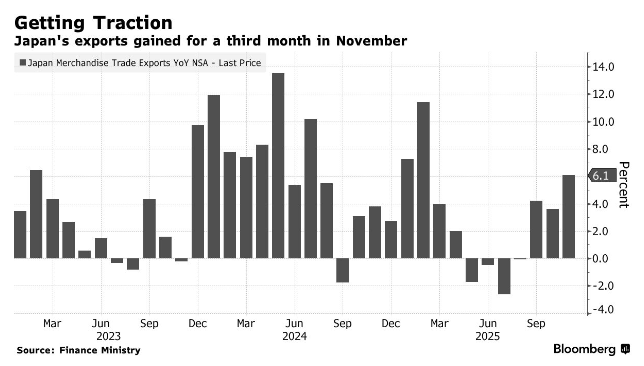
Group 1 - Japan's exports increased by 6.1% year-on-year in November, driven primarily by semiconductor components and medical supplies, exceeding economists' expectations [1][3] - Exports to the United States and the European Union saw significant growth, with increases of 8.8% and 19.6% respectively [1][3] - The trade surplus for Japan was recorded at 322.3 billion yen (approximately 2.1 billion USD), with imports rising by 1.3%, slightly below general expectations [3] Group 2 - The rebound in exports to the U.S. is seen as a positive signal for the Bank of Japan, which is expected to raise the benchmark interest rate to its highest level since 1995 [3][4] - Japan's trade with China declined by 2.4%, influenced by issues related to semiconductor manufacturing machinery and non-ferrous metals, as well as diplomatic tensions following comments made by Japan's Prime Minister [3][4] - The increase in exports of automobiles and parts to the U.S. was noted after the reduction of tariffs from 27.5% to 15%, with a 1.5% increase in export value and a 7.7% increase in export quantity [4]
布米普特拉北京投资基金管理有限公司:日本家庭消费连续五月保持增势
Sou Hu Cai Jing· 2025-11-08 12:12
Core Insights - Japan's household consumption expenditure for two or more person households reached 303,000 yen in September, marking a year-on-year increase of 1.8% after adjusting for price changes, indicating positive growth for five consecutive months [1] Group 1: Consumption Trends - The primary driver of Japan's consumption growth is a significant rebound in automobile purchasing expenditures, attributed to a low comparative base from last year due to production halts caused by recalls [3] - Expenditures in transportation and communication also showed an upward trend, contributing to overall consumption growth [3] - In contrast, food-related spending continues to decline, influenced by last year's panic buying of rice and ongoing price increases, reflecting a cautious consumer behavior in daily necessities [3] Group 2: Income and Wage Analysis - The actual income of Japanese employee households was 511,000 yen, with consumption expenditure increasing by 6.6% year-on-year to 339,800 yen [6] - However, due to inflation outpacing nominal wage growth, real wage levels have been in negative growth for nine consecutive months, with a 1.4% year-on-year decline in September [6] - Despite nominal wages increasing by 1.9% to 297,000 yen, they lag behind the 3.4% rise in consumer prices [6] Group 3: Market Outlook - Market experts suggest that Japan's overall consumption remains stable, with inflation expected to gradually ease by the end of the year, potentially bringing real wage levels closer to zero growth by next year [7] - The narrowing price increase in food and the effects of adjustments in gasoline taxes and energy subsidies are anticipated to manifest [7] - Although the actual growth in September was slightly below market expectations, the impacts of spring wage increases and summer bonuses are expected to support year-end consumption, with a moderate upward trend in future consumption growth anticipated [7]

攸关日本央行加息路径!明年“春斗”前哨:日本最大工会拟寻求5%加薪
智通财经网· 2025-10-23 09:51
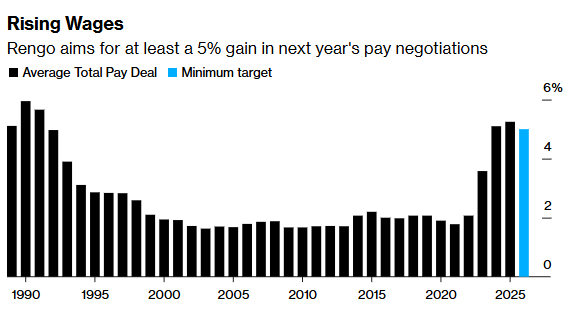
Group 1 - The Japanese Trade Union Confederation (Rengo) aims for at least a 5% wage increase in the upcoming negotiations, with a target of a 3% rise in base salary [1][2] - Last year's negotiations resulted in an average overall wage increase of 5.25% by 2025, indicating a consistent push for wage growth [1] - The Japanese government is under pressure to maintain wage growth momentum, as stagnant real wages could lead to public dissatisfaction and impact monetary policy [1][2] Group 2 - Despite achieving the largest nominal wage increase in over 30 years, real wages have not kept pace due to ongoing inflation, with only two months of real wage growth in the past year [2][3] - The government is expected to implement measures to support wage growth and alleviate inflationary pressures, including enhancing small business profitability [2] - There is a widening wage growth gap between large and small enterprises, with small subcontractors struggling to pass on higher costs to clients [2][3] Group 3 - Rengo's goal for small and medium-sized enterprises is to increase employee wages by at least 6%, with last year's average increase for smaller firms at 4.65% [3] - The Bank of Japan emphasizes the importance of wage growth for achieving a healthy economic cycle, which is a prerequisite for tightening monetary policy [3] - Economists predict that the upcoming wage negotiations will yield lower increases than the previous year, with an average expected increase of 4.81% [4]
日本出口连降四月 对美贸易创四年最大跌幅
智通财经网· 2025-09-17 03:33
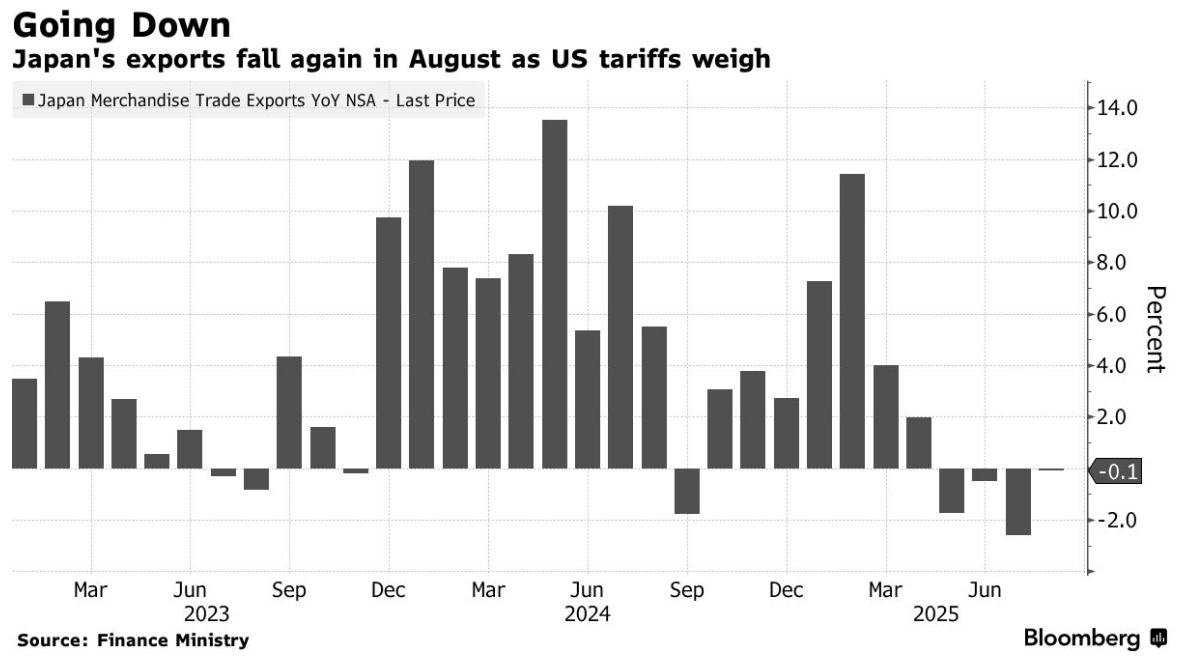
Core Viewpoint - Japan's exports have declined for the fourth consecutive month, primarily due to the impact of U.S. tariffs under President Trump's trade policies, particularly affecting trade with the U.S. [1][3] Export Performance - In August, Japan's export value decreased by 0.1% year-on-year, with automobiles and steel being the main contributors to this decline [1] - Exports to the U.S. saw a significant drop of 13.8%, with automobile exports falling by 28.4% and export volume down by 9.5% [3][4] - Exports to China decreased by 0.5%, while exports to Europe increased by 5.5% [3] Trade Balance - Japan's trade balance recorded a deficit of 242.5 billion yen (approximately 1.7 billion USD) [3] - The import value fell by 5.2%, which was worse than the consensus expectation of a 4.1% decline [3] Economic Implications - The ongoing decline in exports poses risks to Japan's fragile economic growth, potentially disrupting the desired cycle of inflation, wage growth, and overall economic expansion [3] - The impact of U.S. tariffs on Japanese companies, particularly in the automotive sector, may lead to cost-cutting measures that could suppress profit margins and wage growth [3][4] U.S. Trade Relations - Japan's trade surplus with the U.S. was 324 billion yen, indicating ongoing pressure from the U.S. to reduce this gap [5] - The recent trade agreement, which includes a reduction of tariffs on Japanese automobiles, may provide some relief, but its effectiveness will depend on Japan's commitment to invest 5.5 trillion yen as part of the agreement [4]
对美出口下降明显,经济增长受到拖累,日本7月出口降幅达4年新高
Huan Qiu Shi Bao· 2025-08-20 22:38
美国4月对日本汽车及零部件加征25%关税,多数其他商品加征10%关税。6月初钢铁进口关税翻倍至 50%。汽车及零部件约占日本对美出口的1/3。根据日美7月底达成的贸易协议,日本对美出口的汽车及 其他商品关税将降至15%,但该税率的实施尚需时日。 凯投宏观亚太区主管马塞尔·蒂利安特在报告中指出,数据表明"美国加征关税开始产生实质影响"。鉴 于"日本出口结构严重偏向资本品",他预测海外投资增长乏力也将冲击出口。路透社援引分析人士的话 表示,在出口额暴跌的同时,日本出口商的出货量相对稳定,但他们最终不得不将成本转嫁给美国消费 者,而这将进一步影响未来数月的销售。 日本对其他贸易伙伴的出口同样疲软。对中国出口下降3.5%,对欧盟出口下滑3.4%,对东南亚国家出 口减少2.9%。 今年4至6月日本经济年化环比增长1%,主要得益于出口的带动,但7月贸易数据公布后,不少媒体对日 本经济能否保持增长感到担忧。 【环球时报特约记者 李明 严格】日本财务省20日发布的7月份贸易统计数据显示,当月日本整体出口额 同比下降2.6%,降幅超出路透社经济学家调查预测的2.1%,是4年多来的最大降幅。其中对美出口额同 比减少10.1%,连 ...
【环球财经】日本对美出口连续4个月同比下降
Xin Hua Cai Jing· 2025-08-20 05:24
当月,受汽车、钢铁、汽车部件等出口减少影响,日本整体出口额同比下降2.6%至9.34万亿日元,连续 3个月同比下降。由于日元贬值情况较去年同期缓解,原油、煤炭、液化天然气进口额同比下降,当月 日本进口总额同比减少7.5%至9.48万亿日元。7月贸易逆差为1175亿日元。 分析认为,汽车及汽车零部件出口约占日本对美出口总额的三分之一,美国对汽车类产品加征25%关税 对日本出口影响巨大。为了对冲关税政策影响,日本汽车制造商被迫降价严重挤压厂商的盈利空间。 新华财经东京8月20日电(记者刘春燕)日本财务省当天公布7月贸易统计结果显示,受特朗普关税政策 影响,日本对美出口额连续4个月同比下降。 数据显示,由于对美国汽车、汽车零部件和半导体制造设备等出口显著下降,日本7月对美国出口额同 比减少10.1%至1.73万亿日元。其中,汽车出口额降幅达28.4%。截至7月,日本对美出口额连续4个月同 比下降。 (文章来源:新华财经) ...
日本对美出口连续4个月同比下降
Sou Hu Cai Jing· 2025-08-20 05:17
汽车及汽车零部件出口约占日本对美出口总额的三分之一,美国对汽车类产品加征25%关税对日本出口 影响巨大。据日媒报道,为了对冲关税政策影响,下一步日本汽车制造商有可能被迫降价,或优先出口 低价车型。(完) 数据显示,当月,受汽车、钢铁及汽车零部件等出口减少影响,日本出口总额同比下降2.6%至9.34万亿 日元,连续3个月同比下降;受原油、煤炭、液化天然气进口减少影响,日本当月进口总额同比下降 7.5%至9.48万亿日元。当月日本贸易逆差为1175亿日元。 中新社东京8月20日电 (记者 朱晨曦)日本财务省20日公布的贸易统计数据显示,受美国政府关税政策的 影响,7月日本对美出口额连续4个月同比下降。 数据显示,7月日本对美汽车出口额同比下降28.4%,对美汽车零部件出口额同比下降17.4%。受此影 响,当月日本对美国出口额同比下降10.1%至1.73万亿日元(1美元约合148日元),连续4个月同比下降。 ...
日本政要警告央行加息需谨慎 警惕经济降温风险
Jin Tou Wang· 2025-08-19 03:43
Group 1 - The USD/JPY exchange rate is currently trading around 147, showing a slight decline of 0.07% from the previous close of 147.86 [1] - Japanese political figure Saito Ken emphasized the need for caution in the Bank of Japan's interest rate hikes due to potential economic cooling from increased US tariffs [1] - Saito Ken's comments indicate that the Bank of Japan may face political pressure if it resumes interest rate hikes, as rising US tariffs could weaken corporate profits and wage growth in Japan [1] Group 2 - The USD/JPY is in a corrective channel since the low of 147.05 on August 5, with a potential bearish flag pattern forming [2] - A break below the August 7 and 8 lows of 146.75 would confirm the bearish pattern, with the next target being the July 25 low of 145.85 [2] - Immediate resistance is noted at the intraday high of 148.10, with further resistance at 148.50 and the upper boundary of the bullish channel currently at 148.60 [2]