
沐曦

Search documents
半导体产业链午后爆发,科创芯片设计ETF广发、科创芯片ETF广发、科创人工智能ETF广发盘中最高涨超2%,一键投资芯片产业链
Sou Hu Cai Jing· 2026-02-26 07:15
此外,当地时间2月25日,韩国存储芯片巨头SK海力士表示,计划到2030年前在韩国龙仁市投资21.6万 亿韩元(约150.7亿美元),新建芯片生产线,以满足日益增长的半导体需求。 AI基建正引发上游材料"超级周期",电子布因织布机紧缺及产能向Low-Dk/Low-CTE高阶产品倾斜,大 陆市场2月提价斜率明显加大,台湾厂商计划月度调涨10%–15%;与此同时,HBM对DRAM晶圆产能形 成倍数级挤占,普通存储器短缺预计于2026年第三季度随新产能释放逐步缓解。 在AI及算力发展浪潮的驱动下,自2025年第三季度起,全球存储市场迎来涨价行情。业内人士普遍预 计,全球存储芯片涨价将持续2026年一整年。2025年底以来,中微半导、必易微、国科微、英集芯、美 芯晟、欧姆龙、ADI、英飞凌等多家国内外公司,已经宣布了产品涨价。涨价主要原因是上游原材料成 本上涨,导致制造成本上升。 天风证券认为,数字芯片设计行业在科技板块中前景明朗,其预收账款和合同负债指标持续高增,表明 订单需求强劲,AI服务器和高效能运算的长期需求将支撑行业增长确定性。业界普遍预测,在资本市 场的加持下,中国存储芯片产能有望在2026年下半年至20 ...


资金抢筹港股科技,南方基金旗下恒生科技ETF南方(520570)近10天获得连续净流入,备受资金青睐
Xin Lang Cai Jing· 2026-02-25 06:37
Core Insights - The Hang Seng Technology ETF (520570) has seen a trading turnover of 2.56% with a transaction value of 741.93 million yuan, indicating active investor interest in the technology sector [1] - The Hang Seng Technology Index has experienced a "buy the dip" strategy from investors, with continuous net inflows over the past 10 days, reflecting a positive sentiment towards technology stocks [1] - Recent advancements in AI models from various companies, including Google and domestic firms, signal a turning point in both technology and commercialization, with significant support from domestic chip manufacturers [1] Group 1: Market Performance - The Hang Seng Technology ETF has gained traction with significant net inflows, particularly in the technology sector, which has become a focal point for investors during market adjustments [1] - The recent performance of newly listed AI model stocks, such as MINIMAX-WP and Zhipu, contrasts with the decline in traditional internet giants, highlighting a shift in market dynamics [2] - The Hang Seng Technology Index is characterized by a combination of oversold valuations, counter-cyclical capital inflows, and an upward trend in AI fundamentals, suggesting a favorable risk-reward ratio for long-term investments [2] Group 2: Investment Strategy - The Hang Seng Technology ETF closely tracks the Hang Seng Technology Index, which includes 30 major tech companies listed in Hong Kong, making it a vital tool for capturing the sector's performance [2] - The index's current valuation remains at a historical low, with ongoing inflows from southbound capital and accelerating AI commercialization, indicating potential for long-term recovery [2] - Recommended investment strategy includes prioritizing allocations in companies that integrate internet leadership, AI applications, and computing power across the technology sector [2]
2025中国算力产业实录:狂热、阵痛与价值回归丨年度盘点
雷峰网· 2026-02-19 03:32
Group 1 - The core viewpoint of the article emphasizes the transformation of the AI computing power industry, driven by the emergence of DeepSeek, which optimizes computing efficiency and breaks down barriers for deploying large models, marking a significant moment for China's AI industry [2][6] - The article highlights the rapid rise and subsequent decline of integrated machines within four months, illustrating the struggles faced by intelligent computing centers amid idle computing power and the need to sell cards for survival [3][10] - A year-long investigation into the industry reveals the underlying factors that will support the scaling and ecological development of China's AI computing power, emphasizing the importance of endurance, ecology, and trust in this ongoing battle [4][25] Group 2 - DeepSeek's explosive popularity catalyzed a transformation in the AI computing power industry, prompting domestic chip manufacturers to accelerate adaptation processes, benefiting companies like Huawei and Cambricon [7][8] - The article discusses the structural contradictions in the AI computing market, where demand for computing power is surging while many intelligent computing centers face low utilization rates, leading to a paradox of computing shortages on one side and idle resources on the other [10][11] - The article notes that the AI computing power industry is entering a mature phase, with a shift from speculative profits to a focus on core business principles, as evidenced by various industry challenges such as contract breaches and fraudulent activities [12][13] Group 3 - The article outlines the emergence of domestic inference chips, driven by urgent demands for autonomy and rapid growth in inference needs, with several companies like Moore Threads and Nuxi going public [16][17] - It highlights the competitive landscape where domestic chips are attempting to challenge Nvidia's dominance, with the inference segment becoming a critical breakthrough point for domestic computing power [19][20] - The storage sector is experiencing a price surge due to increased demand, significantly impacting the AI server industry and creating survival challenges for smaller manufacturers [21][23] Group 4 - The article reflects on the key developments in 2025, from the initial excitement surrounding DeepSeek to the industry's entry into a more complex phase characterized by chaos and bubble clearing [25] - It notes the collective market entry of several domestic GPU companies, referred to as the "Four Little Dragons," which has expanded the competitive landscape for domestic computing power [25] - Looking ahead to 2026, the article emphasizes the need to focus on the real adaptation progress in AI chips and storage, tracking technological breakthroughs and capital market dynamics to witness the evolution of domestic computing power from mere usability to leadership [25]

千问3.5引爆全球AI产业链,英伟达、华为昇腾、AMD、苹果等第一时间适配
Ge Long Hui· 2026-02-18 08:11
Core Viewpoint - The release of Qwen 3.5 has sparked significant interest in the global AI industry, showcasing advancements in model efficiency and cost-effectiveness [1] Group 1: Model Performance and Features - Qwen 3.5 has a total of 397 billion parameters, with only 17 billion activated, outperforming the previous trillion-parameter model Qwen 3-Max [1] - The deployment memory usage has decreased by 60%, while the maximum inference throughput has increased by 19 times [1] - The innovative underlying model architecture allows Qwen 3-Plus to offer competitive performance at a low cost of 0.8 yuan per million tokens on Alibaba Cloud's Bailian API, achieving high performance comparable to Gemini 3 at less than 5% of the price [1] Group 2: Industry Adoption and Compatibility - Major international hardware manufacturers such as NVIDIA, AMD, and Apple have adapted their development frameworks and chips for Qwen 3.5 [1] - Domestic GPU and platform providers, including Huawei Ascend, Moore Threads, and others, have also announced Day 0 compatibility with the new model [1] - Various platforms, both domestic and international, including National Supercomputing Internet Platform, Shuguang Cloud, and others, have quickly integrated the Qwen 3.5 model, offering API services or experience interfaces [1]


AIDC订单疯涨,哪些赛道受益?
Xin Lang Cai Jing· 2026-02-15 11:42
Core Insights - The article discusses the increasing demand for AI Data Centers (AIDC) driven by the exponential growth in computing power requirements due to generative AI advancements and supportive government policies like "East Data West Computing" [5][32] - Major tech companies are ramping up investments in AI infrastructure, with ByteDance planning to increase its capital expenditure to approximately 160 billion RMB in 2026, while Alibaba aims to invest over 380 billion RMB in technology R&D and infrastructure over the next three years [7][34] - The article highlights the penetration of AIDC into traditional industries, evidenced by significant procurement projects such as China Mobile's purchase of 7,499 AI servers for 2025-2026 [8][35] AIDC Types and Characteristics - AIDC is categorized into three types: General Data Centers, Intelligent Computing Data Centers (AIDC), and Supercomputing Data Centers, each serving different computational needs [4][30] - General Data Centers focus on traditional data storage and management using CPU servers, while AIDC leverages AI chips like GPUs for large-scale model training, and Supercomputing Data Centers support advanced scientific research [4][30] Five-Layer Cake Theory - NVIDIA's CEO proposed a "Five-Layer Cake" structure for AI infrastructure, which includes Energy Layer, Chip and Computing Layer, Infrastructure Layer, AI Model Layer, and Application Layer [10][37] - The Energy Layer is crucial for providing stable power to AIDC, while the Chip and Computing Layer focuses on high-performance hardware [11][39] - The Infrastructure Layer integrates energy and chip resources to deliver intelligent computing services, and the AI Model Layer is essential for developing models that drive AI applications [13][41] Industry Ecosystem and Opportunities - The AIDC industry's growth is a result of the synergy between computing power demand and technological advancements, benefiting various sectors [18][45] - The transition to high-voltage and direct current power systems is becoming mainstream, with NVIDIA introducing an 800V DC power architecture to meet the power demands of next-gen AI facilities [19][46] - Liquid cooling systems are gaining traction due to the high power consumption of AI servers, leading to increased market demand for cooling technologies [20][47] Domestic AI Chip Market - The domestic AI chip market is diversifying, with multiple brands achieving significant sales volumes, indicating a shift from technology development to large-scale delivery [25][52] - The price range for domestic AI inference chips is between 30,000 to 200,000 RMB, with a notable increase in production expected as manufacturing capacity improves [25][52] Conclusion - The article emphasizes that while China has advantages in energy resources and computing infrastructure, breakthroughs in high-end chip development and core technology innovation are still needed [26][53] - The ultimate winners in the AI industry will be those who can integrate full-stack technologies and foster collaborative industrial advancements [26][53]
中科蓝讯2025年业绩预增超3.6倍,投资GPU公司贡献显著
Jing Ji Guan Cha Wang· 2026-02-14 02:43
Core Viewpoint - Zhongke Lanyun (688332) has significantly increased its performance forecast, drawing market attention due to fluctuations in investment portfolio value and progress in its main business [1] Group 1: Performance Overview - The company announced on January 7, 2026, that it expects a net profit attributable to shareholders for 2025 to be between 1.4 billion to 1.43 billion yuan, representing a year-on-year increase of 366.51% to 376.51%, primarily due to fair value changes from investments in Moer Thread and Muxi Co., Ltd [2] - The official annual report will provide more detailed financial data, which will be crucial for assessing the final results [2] Group 2: Company Status - Zhongke Lanyun directly holds 0.43% of Moer Thread and 0.21% of Muxi Co., Ltd, indicating that the stock price changes of these GPU companies may continue to impact the company's non-operating gains and losses [3] - Future attention should be directed towards the performance and market behavior of the invested enterprises [3] Group 3: Business Progress - The company's wireless audio SoC chip business has entered the supply chains of Xiaomi and Honor, and it is deepening its AI edge layout, such as collaborating with Volcano Engine to launch solutions compatible with Doubao large models [4] - The rollout of new products, such as Wi-Fi chips, is worth monitoring [4] Group 4: Capital Movement - On February 9, 2026, the main capital saw a net inflow of 28.8525 million yuan, with the stock closing at 136.1 yuan, reflecting short-term market interest [5] - Future capital movements may be influenced by industry policies and sector rotations [5]

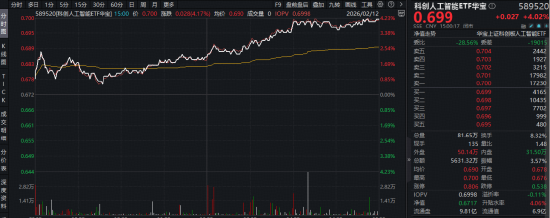
智谱GLM-5引爆行情!国产大模型再获突破!科创人工智能ETF(589520)猛拉4%,马斯克:模型发展速度太快!
Xin Lang Cai Jing· 2026-02-12 11:37
Group 1 - The core viewpoint of the article highlights the rapid development of domestic AI models, particularly the launch of Seedance 2.0 and GLM-5, indicating a competitive edge in the global AI landscape [1][3][10] - The performance of the Huabao AI ETF (589520) has been impressive, with a 4.02% increase, recovering above the 20-day moving average, reflecting strong investor interest in the domestic AI sector [1][7][8] - Key stocks within the ETF, such as Yuke (20% limit up), Jingchen (over 15% increase), and Xinyuan (over 12% increase), have shown significant gains, indicating a bullish trend in the AI and semiconductor sectors [8][10] Group 2 - The GLM-5 model, previously known as "PonyAlpha," has been recognized for its advanced capabilities, positioning China among the top tier in sparse architecture and AI model development [3][10] - The model has been optimized for compatibility with major domestic chip platforms, showcasing the capability of Chinese chip clusters to support large-scale generative models, which is a significant step towards a mature ecosystem [10] - According to CITIC Securities, the domestic computing power sector is expected to thrive, with potential for a long-term bullish market similar to the US stock market in 2023, driven by the urgency for domestic semiconductor and AI chip development [3][10]
上海国际信托党委书记、总经理陈兵发表新春畅想
Xin Lang Cai Jing· 2026-02-12 11:37
Core Insights - The trust industry is responding to the complexities of the modern world by addressing specific human needs through innovative financial solutions [4][11] - Trust is seen as a means of instilling confidence and supporting creative destruction by investing in innovative companies and platforms [4][11] Group 1: Investment Strategies - The company has invested nearly 40 billion yuan in technology equity, with a 30% success rate in the listing and exit of self-invested tech enterprises [5][12] - Investments include domestic AI chip clusters, the first quadrivalent influenza vaccine, and advanced treatments for diabetes, bridging the gap between technological innovation and practical human needs [5][12] Group 2: Services Offered - The trust provides a range of services for entrepreneurs, including asset management, wealth inheritance, and family governance, aimed at facilitating their entrepreneurial journeys [5][12] - For ordinary individuals, the trust offers low-volatility asset management solutions and various types of trusts, such as real estate family service trusts and special needs trusts for families with disabilities [5][12][13] Group 3: Social Impact - The trust acts as a connector between individuals, businesses, and society, promoting security and stability through various trust projects, including prepayment funds and risk management services [6][13] - The company emphasizes the importance of investing in people and reform, aiming to integrate trust services into various sectors and households as it approaches its 45th anniversary [6][13]
一级市场的新时代
FOFWEEKLY· 2026-02-12 10:00
Core Viewpoint - The primary conclusion is that the era of pre-sale housing in technology investment has become a certainty, indicating a prosperous future for the primary market over the next decade, with venture capital (VC) having two paths: maintaining integrity and taking risks [6][17][27]. Group 1: Changes in the Primary Market - By December 2025, a consensus among RMB primary market investors was formed, with significant changes observed in the investment landscape, particularly after the re-launch of the STAR Market's fifth set of standards in June 2025 [10][11]. - The market saw a rapid increase in enthusiasm, with companies like Moer Technology and Muxi achieving substantial market valuations shortly after their IPOs, indicating a shift in investment dynamics where the ability to go public is more about national necessity than profitability [11][12][13]. Group 2: Structural Differences from Previous Years - The year 2026 marks a fundamental shift compared to 2021, characterized by a genetic transformation and rule restructuring of state-owned capital, allowing for a long-term investment approach in strategic emerging industries [16][19][20]. - The investment duration for strategic emerging industries has been extended to 15-17 years, providing a more stable foundation for RMB technology investments and enabling state-owned capital to support innovation without the pressure of short-term profitability [20][21]. Group 3: The Invitation System for IPOs - The IPO process has transitioned into an "invitation system," where the allocation of IPO quotas is centrally planned and distributed, significantly enhancing the influence of state-owned capital in the investment landscape [22][23]. - In 2025, the total asset value of state-owned shares from 116 IPOs was estimated to be between 350 billion to 380 billion RMB, with the potential to generate an asset scale of 3.5 to 3.8 trillion RMB through leverage in the financial system [25][27]. Group 4: The Era of Pre-sale Housing in Technology Investment - The pre-sale housing model, which has driven China's economy for 20 years, is now mirrored in technology investment, where state-owned capital supports original innovation, leading to rapid commercialization and local economic development [28][29]. - The transition to this model is expected to be predictable, with macroeconomic conditions unlikely to reverse in the short term, although the inherent uncertainties in scientific research present additional complexities compared to real estate [31][33]. Group 5: Strategies for Venture Capital - Two strategies for VC in this new era are identified: "maintaining integrity" by competing on the right side through strength and "taking risks" by making bold predictions on the left side [34][39]. - The success of technology commercialization hinges on the ability to secure orders, making it crucial for early-stage investors to focus on commercial viability rather than just technological potential [36][37]. Group 6: Demand-Side Opportunities - The expansion of the benefits chain is essential for the sustainability of technology investment, as the lack of consumer-driven innovations could weaken the entire ecosystem [58][59]. - The ability to identify and create consumer demand for technological innovations is critical for the long-term success of China's technology investment landscape, especially in the context of increasing competition with the U.S. [60][61].

恒生科技ETF鹏华(520590)交投活跃,回撤后短期可能存在向上修复空间
Xin Lang Cai Jing· 2026-02-12 06:22
Group 1 - The AI industry chain in Hong Kong is strengthening, with the recent launch of the GLM-5 model by Zhipu, which has been optimized for major domestic chip platforms [1] - CICC notes that the recent decline in the Hang Seng Tech Index is due to weak fundamentals, concerns over tightening liquidity, and a reassessment of AI capital expenditure narratives [1] - The market may experience short-term adjustments, but there is potential for upward correction after a pullback, with a mid-term forecast of a 3-4% profit growth for Hong Kong stocks [1] Group 2 - The Hang Seng Tech ETF has shown active trading, with a turnover of 18.38% and a transaction volume of 40.04 million yuan [2] - As of February 11, the top ten weighted stocks in the Hang Seng Tech Index account for 69.32% of the index, including Alibaba, SMIC, BYD, Meituan, Xiaomi, Tencent, NetEase, Kuaishou, JD.com, and Baidu [2]