Ginkgo Bioworks Holdings, Inc.

Search documents
Ginkgo Bioworks Q4 Earnings Call Highlights
Yahoo Finance· 2026-02-28 05:07
Kelly spent part of his remarks explaining the company’s plan to divest its biosecurity business, which he said grew out of work begun during COVID. He highlighted the company’s monitoring efforts—distinct from diagnostic testing—including initiatives that helped reopen “5,000 schools nationwide,” as well as ongoing monitoring work at airports in partnership with the CDC, including wastewater testing from planes and related programs in other locations such as Doha, Qatar.Demonstrate capabilities in Boston b ...

Morning Market Movers: NGNE, DUOL, XPOF, EBS See Big Swings
RTTNews· 2026-02-27 11:29
At 6:22 a.m. ET on Friday, premarket trading is seeing notable activity in several stocks, with early price movements signaling potential opportunities before the opening bell.For active traders, premarket trading offers a head start in spotting potential breakouts, reversals, or sharp price swings. These early moves often indicate where momentum may carry into the regular session, making premarket analysis a key part of the trading day.In the Green - Premarket GainersThe following stocks are trading highe ...








好文推荐!谭天伟院士等:中国生物制造关键技术进展与未来趋势
synbio新材料· 2026-02-11 23:02
Core Viewpoint - Biomanufacturing is a crucial technology path for achieving green, low-carbon, and sustainable development, evolving rapidly across the entire industry chain from raw materials to products [3][4]. Group 1: Key Technological Development Trends in Biomanufacturing - Biomanufacturing is transitioning from traditional fermentation-driven methods to intelligent and bio-design-driven manufacturing paradigms [4]. - The raw material system in biomanufacturing is diversifying from grain dependence to non-grain biomass, alleviating competition for land and resources [8]. - High-performance strains and enzymes are evolving towards precision and intelligence, with advancements in gene editing technologies like CRISPR facilitating rapid development [9][10]. Group 2: Challenges in China's Biomanufacturing - China's biomanufacturing heavily relies on starch-based food resources, with about 90% of primary raw materials sourced from crops like corn, leading to resource conflicts [17]. - There is a significant shortfall in the autonomous control of microbial strains, with a high dependency on foreign resources for key industrial strains and enzyme preparations [18]. - The design of biocatalysts and underlying technologies in China is lagging, relying on foreign-developed algorithms and platforms for enzyme design [20]. Group 3: Future Key Technological Development Directions - Focus on developing efficient conversion technologies for one-carbon raw materials and utilizing non-grain biomass resources [26]. - Emphasize intelligent design and creation of industrial enzymes and strains, leveraging AI and big data for precise discovery and development [28]. - Establish smart cell factories and precise bioprocessing technologies, integrating real-time monitoring and AI-driven decision-making [30]. Group 4: Product System Expansion Driven by Biomanufacturing - Biomanufacturing is expected to drive the development of high-energy-density biofuels, sustainable materials, and innovative food products, contributing to economic benefits and social value [32]. - In the energy sector, focus on renewable alternatives like bio-aviation fuel and bio-hydrogen [33]. - In the chemical sector, breakthroughs in bio-based platform compounds are essential for supporting decarbonization efforts in the chemical industry [33].

数字经济双周报(2026年第3期):智能体开启AI从工具到伙伴新时代-20260210
Yin He Zheng Quan· 2026-02-10 06:52
Core Insights - The report highlights the transition of AI Agents from tools to partners, marking a new era in digital economy [2][4] - The AI Agent market is projected to grow significantly, with an expected increase from $8.2 billion in 2023 to $14.1 billion by 2033, representing a growth rate of 68.18% [4] - The report emphasizes the importance of regional collaboration and ecosystem construction in accelerating AI industry transformation in China [11][12] Section Summaries 1. Focus of the Report: AI Agents Transitioning to Partners - The evolution of AI technology can be categorized into three stages, with AI Agents now entering a phase of explosive growth [4] - The AI Agent market is expected to grow from $12 billion in 2023 to $20.55 billion by 2033, indicating a compound annual growth rate (CAGR) of 5.5% [4] 2. China Dynamics: Accelerating AI Industry Transformation - Central government policies are increasingly focused on integrating AI into various sectors to promote high-quality development [11][12] - Local governments are implementing tailored policies to foster AI integration, leveraging regional strengths [12] - Significant capital inflows into leading AI companies reflect market confidence in technological advancements [12] 3. U.S. Dynamics: Intensifying Capital and Commercialization - Major AI companies are attracting substantial investments, with valuations and funding targets on the rise [13][14] - Strategic investments by tech giants are enhancing their integration with key AI firms, reinforcing their positions in the industry [13] - The competition in AI commercialization is heating up, with diverse revenue models being explored [14] 4. European Dynamics: Balancing Regulation and Industry Competitiveness - The UK is collaborating with tech giants to develop frameworks addressing new digital threats like deepfakes [16] - Regulatory bodies are investigating the misuse risks of generative AI applications, focusing on data protection and online safety [17] - The EU is initiating investigations to ensure fair competition in the AI sector, emphasizing interoperability and data access [17] 5. Other Countries: Strengthening AI Infrastructure - AI demand is driving a supercycle in the storage industry, with South Korean firms enhancing their market positions [18] - Storage chip prices are rising due to AI needs, leading to record performances for major manufacturers [18] - The global semiconductor landscape is shifting, with a focus on diversifying supply chains to meet AI demands [19]



未来产业周报第 9 期(2026/2/1-2026/2/7):量子互联网可扩展性进步;侵入式脑机迈入商业化阶段-20260209
Shenwan Hongyuan Securities· 2026-02-09 09:52
Quantum Technology - The team from the University of Science and Technology of China achieved significant breakthroughs in scalable quantum networks, including the construction of a basic module for scalable quantum repeaters, which realized an entanglement lifetime of 550 milliseconds, surpassing the establishment time of 450 milliseconds, thus overcoming a core bottleneck in quantum network expansion [4][5] - The team also achieved device-independent quantum key distribution (DI-QKD) over a 100-kilometer fiber link, improving the distance by over 100 times compared to previous best experimental levels, marking a milestone in quantum communication and expanding China's international leading position in this field [4][5] Biomanufacturing - The Shenzhen Advanced Institute of Technology developed a programmable integration platform for functional molecules, enabling applications in biomanufacturing, biosensing, and flexible electronics. This platform combines metabolic sugar engineering with click chemistry, allowing for precise covalent integration of various functional molecules [6][7] - OpenAI partnered with Ginkgo Bioworks to create an AI-driven automated experimental system that reduced the production cost of cell-free protein synthesis (CFPS) by approximately 40% and reagent costs by 57% [8] Hydrogen Energy and Nuclear Fusion - The Zhongneng Construction's Songyuan Hydrogen Energy Industrial Park project has produced over 10,000 tons of green ammonia and received EU certification, validating the integrated commercial loop of green electricity, green hydrogen, and green ammonia [9][10] - Shenzhen University's team achieved important breakthroughs in the preparation of key materials and components for fusion reactors, mastering mature technology for the first wall of fusion reactors, which will support domestic fusion reactor construction and development [10] Brain-Computer Interface - Borui Kang initiated the listing guidance process, marking a shift from research investment to market expansion for brain-computer interface technology. The company’s NEO product has completed over 32 implant surgeries with no adverse reactions, demonstrating the safety and feasibility of its minimally invasive implantation method [12][14] - Research from the Chinese Academy of Sciences established a new optogenetic technology for visual brain-computer interfaces, allowing for high-precision, long-term optical stimulation of the visual cortex, representing a significant advancement in sensory information input technology [15][17] Embodied Intelligence - Microsoft Research released a new robot model, Rho-alpha, which integrates multimodal perception capabilities, including visual, language, and tactile data, aimed at enhancing the application of embodied intelligence in unstructured environments [19] 6G and Commercial Space - The Beijing University of Posts and Telecommunications made significant progress in 6G channel modeling, with their model being included in the international 6G standard system by 3GPP [20] - The FCC accepted SpaceX's application for an orbital data center, which aims to create a satellite constellation of up to 1 million satellites to support advanced AI models and applications, indicating rapid regulatory progress [22]

未来产业周报第9期(2026、2、1-2026、2、7):量子互联网可扩展性进步,侵入式脑机迈入商业化阶段-20260209
Shenwan Hongyuan Securities· 2026-02-09 05:30
Group 1: Quantum Technology - The team from the University of Science and Technology of China achieved significant breakthroughs in scalable quantum networks, including the construction of a basic module for scalable quantum repeaters and the realization of device-independent quantum key distribution (DI-QKD) over a distance of 100 kilometers, improving previous international experimental levels by over two orders of magnitude [4][5]. - The successful implementation of a quantum repeater with an entanglement lifetime of 550 milliseconds, exceeding the entanglement establishment time of 450 milliseconds, marks a critical advancement in quantum communication, enabling the construction of a kilometer-scale quantum internet [5]. Group 2: Biomanufacturing - The Shenzhen Advanced Institute of Technology developed a programmable integration platform for functional molecules, which opens up new applications in biomanufacturing, biosensing, and flexible electronics [6][7]. - OpenAI partnered with Ginkgo Bioworks to create an AI-driven automated experimental system that significantly reduces the production costs of cell-free protein synthesis (CFPS) by approximately 40% and reagent costs by 57% [8]. Group 3: Hydrogen Energy and Nuclear Fusion - The China Energy Construction Group's Songyuan hydrogen energy industrial park project has produced over 10,000 tons of green ammonia and received EU certification, validating the integrated commercial model of "green electricity - green hydrogen - green ammonia" [9][10]. - Shenzhen Energy signed a contract for a 505MW wind-solar hydrogen project with a total investment of approximately 8 billion, covering both upstream and downstream sectors [12]. Group 4: Brain-Computer Interfaces - The company Borui Kang has initiated the process for its initial public offering (IPO), marking a transition of invasive brain-computer interface technology from research to commercialization [13][15]. - A research team from the Chinese Academy of Sciences developed a novel optogenetic technique for visual brain-computer interfaces, enabling high-precision, long-term optical stimulation of the visual cortex, representing a significant advancement in sensory information input [16][18]. Group 5: Embodied Intelligence - Microsoft Research introduced a new robot model, Rho-alpha, which integrates multimodal perception capabilities, including visual, language, and tactile data, aimed at enhancing the application of embodied intelligence in unstructured environments [21]. Group 6: 6G and Commercial Space - A research team from Beijing University of Posts and Telecommunications made significant progress in 6G channel modeling, with their work being included in the international 6G standard framework by 3GPP [22]. - The U.S. Federal Communications Commission (FCC) accepted SpaceX's application for an orbital data center, which aims to establish a satellite constellation of up to 1 million satellites to support advanced AI models and applications [25]. Group 7: Future Industry Catalysts - A table summarizing key catalytic events for six future industries in 2026 was provided, highlighting important milestones and conferences that investors should track [26][27].
GPT-5.3上线Codex,OpenAI回应Claude新模型只用了15分钟
3 6 Ke· 2026-02-06 08:40
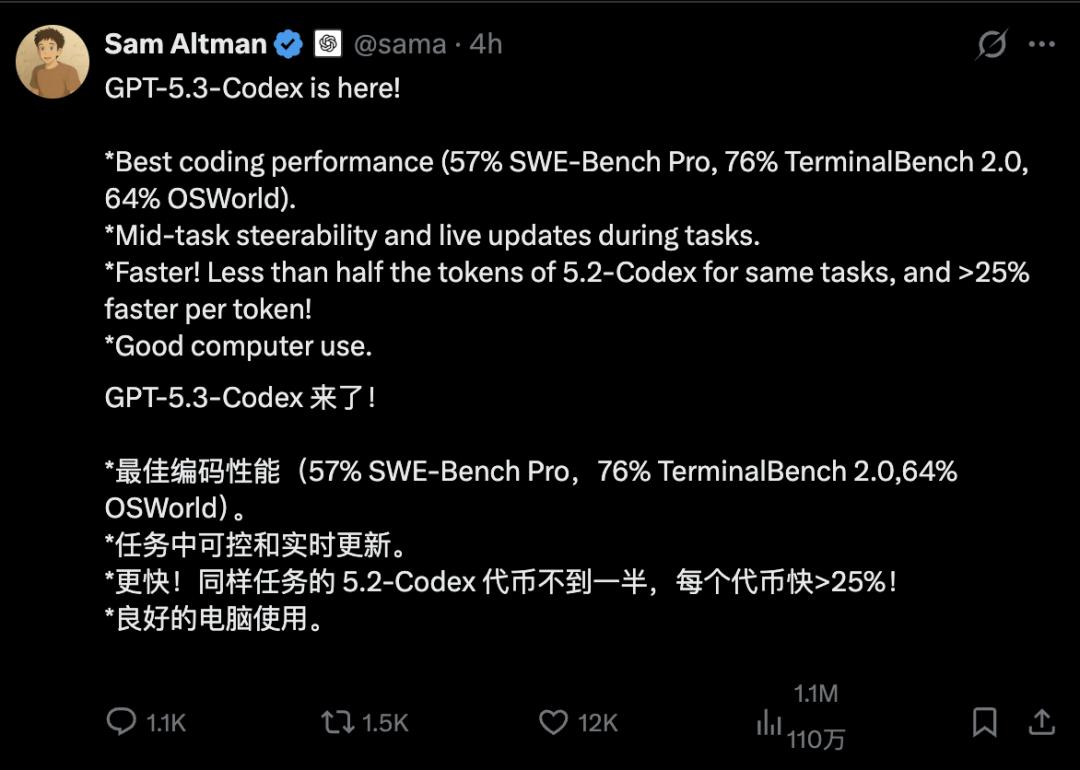
火星撞地球,新模型大战! Claude Opus 4.6发布仅仅15分钟,OpenAI也甩出了自己最新最强编程模型—— GPT-5.3-Codex。 最直观的感受是,这个新模型终于有点美学品味了。 官方展示了两个Demo:一个赛车游戏、一个潜水游戏。还蛮有风格的。 据说,GPT-5.3-Codex在几乎没有人工干预的情况下,持续迭代这些游戏,累计消耗了数百万token。 在网页开发上,除了UI更好看,对「意图」的理解也更强了。 即便Prompt给得不清楚,它也能自动补全逻辑,生成一个功能齐全的网站。 就这些Demo来看,设计感确实比之前强了一截。 Computer use能力同样拉满,现在已经能用来帮金融从业者直接做PPT。 其他职场工作也能覆盖,尤其是在专业知识密集型任务上,写文档、做电子表格都没什么问题。 | Home Insert | Draw Design | Layout | References >> | Comments | | 日 | | B | | | | --- | --- | --- | --- | --- | --- | --- | --- | --- | --- | --- | | ...
GPT-5.3上线Codex!OpenAI回应Claude新模型只用了15分钟
量子位· 2026-02-06 02:30
Core Viewpoint - The article discusses the release of OpenAI's latest programming model, GPT-5.3-Codex, which competes with Anthropic's Claude Opus 4.6, highlighting significant improvements in coding capabilities and user interface design [1][13]. Group 1: Model Improvements - GPT-5.3-Codex shows enhanced aesthetic appeal and design in its demos, including a racing game and a diving game [2][6]. - The model has demonstrated superior performance in various benchmarks, achieving 57% in SWE-Bench Pro, 76% in TerminalBench 2.0, and 64% in OSWorld [11][12]. - It has improved efficiency, requiring less than half the tokens compared to its predecessor for the same tasks, with a speed increase of over 25% [11][22]. Group 2: Functional Capabilities - GPT-5.3-Codex excels in computer use, assisting financial professionals in creating presentations and handling complex tasks like document writing and spreadsheet management [9][23]. - The model's ability to self-accelerate during its training process marks a significant advancement, allowing it to monitor and debug its own training tasks [28][29]. Group 3: Business Applications - OpenAI is launching Frontier, a platform aimed at integrating AI into corporate workflows, with notable companies like HP and Uber already adopting it [34][38]. - The AI4S initiative, in collaboration with Ginkgo, aims to reduce protein synthesis costs by 40% using GPT-5, showcasing the model's application in synthetic biology [39][41].

Ginkgo Bioworks' Autonomous Laboratory Driven by OpenAI's GPT-5 Achieves 40% Improvement Over State-of-the-Art Scientific Benchmark
Prnewswire· 2026-02-05 19:00
Core Insights - Ginkgo Bioworks, in collaboration with OpenAI, has developed an AI system that autonomously designs and executes biological experiments, achieving a 40% reduction in cell-free protein synthesis reaction costs compared to the current state of the art [1][4][7] Group 1: AI and Autonomous Lab Integration - The study showcases a practical application of Ginkgo's autonomous lab, utilizing OpenAI's GPT-5 model to design, execute, and analyze experiments in a closed-loop workflow [3][5] - The autonomous lab executed over 36,000 experimental conditions across six iterative cycles, generating nearly 150,000 experimental data points [5][7] - Human involvement was limited to reagent preparation and system oversight, while the AI handled experimental design and data interpretation [5][6] Group 2: Cost Reduction and Efficiency - The autonomous lab produced a benchmark protein, superfolder green fluorescent protein (sfGFP), at a cost of $422 per gram, down from the previously reported $698 per gram, marking a 40% cost reduction [4][7] - The integration of AI in the lab is expected to lead to more experiments being conducted, as lower reagent costs will facilitate increased data generation and scientific progress [4][8] Group 3: Commercial Potential - Ginkgo is now offering the AI-optimized reaction mix for sale in its reagents store, indicating the commercial viability of AI-driven scientific advancements [7][8] - The Pydantic model used for validating experiments will be released as open source, further promoting transparency and collaboration in scientific research [6][8]

中金 • 全球研究 | 特朗普政府药价改革背后的因与果
中金点睛· 2026-01-27 23:50
Core Viewpoint - The article discusses the ongoing efforts by the Trump administration to lower drug prices in the U.S., highlighting the strong pricing power of pharmaceutical companies and the complexities of the healthcare payment system, which includes private insurance and pharmacy benefit managers (PBMs) [2][35]. Summary by Sections U.S. Healthcare System Overview - The U.S. healthcare system is characterized by high medical service costs and low insurance coverage rates compared to other developed countries, with total healthcare spending reaching approximately $4.9 trillion in 2023, accounting for 17.6% of GDP [4][5]. - From 1960 to 2023, per capita national health expenditure in the U.S. increased from $146 to $14,570, a 99-fold increase with a compound annual growth rate of 7.6% [4]. Insurance Coverage and Efficiency - The U.S. insurance coverage rate is relatively low among developed nations, with 2023 coverage at 92.4%, lower than most OECD countries [9]. - The efficiency of healthcare services is also a concern, with the U.S. showing only an 8.8% decrease in all-cause mortality from 1999 to 2022, compared to a 25.9% decrease in the UK during the same period [7]. Medicare and Medicaid - Medicare, the primary public insurance program, covers approximately 65 million elderly and disabled individuals, while Medicaid covers about 91.7 million low-income individuals, with a compound annual growth rate of 7.0% in spending from 2013 to 2023 [18][19]. - Private insurance dominates the U.S. healthcare system, covering about 207 million people, or 62% of the population, with employer-sponsored plans being the most common [19]. PBM Role and Pricing Mechanisms - Pharmacy Benefit Managers (PBMs) play a crucial role in the drug supply chain, managing drug formularies and negotiating prices, but their profit mechanisms, including rebate retention and price differentials, contribute to high drug prices [26][28]. - The consolidation of PBMs has raised concerns about their influence on drug pricing and transparency, prompting regulatory scrutiny at both state and federal levels [30]. Drug Pricing Reforms - The Trump administration has initiated several measures to reduce drug prices, including the Inflation Reduction Act, which allows for direct price negotiations for Medicare-covered drugs [33][35]. - The administration's efforts include setting price caps on insulin and negotiating discounts with pharmaceutical companies, with significant reductions observed in negotiated drug prices [33][39]. Pharmaceutical Pricing Trends - According to ICER, the median list price of new drugs is projected to increase by 24% and the net price by 51% from 2022 to 2024, indicating the continued strong pricing power of pharmaceutical companies [2][40]. - The article concludes that the interplay of the healthcare payment system, PBM profit mechanisms, and pharmaceutical pricing power complicates the effectiveness of drug price reform initiatives [39][40].