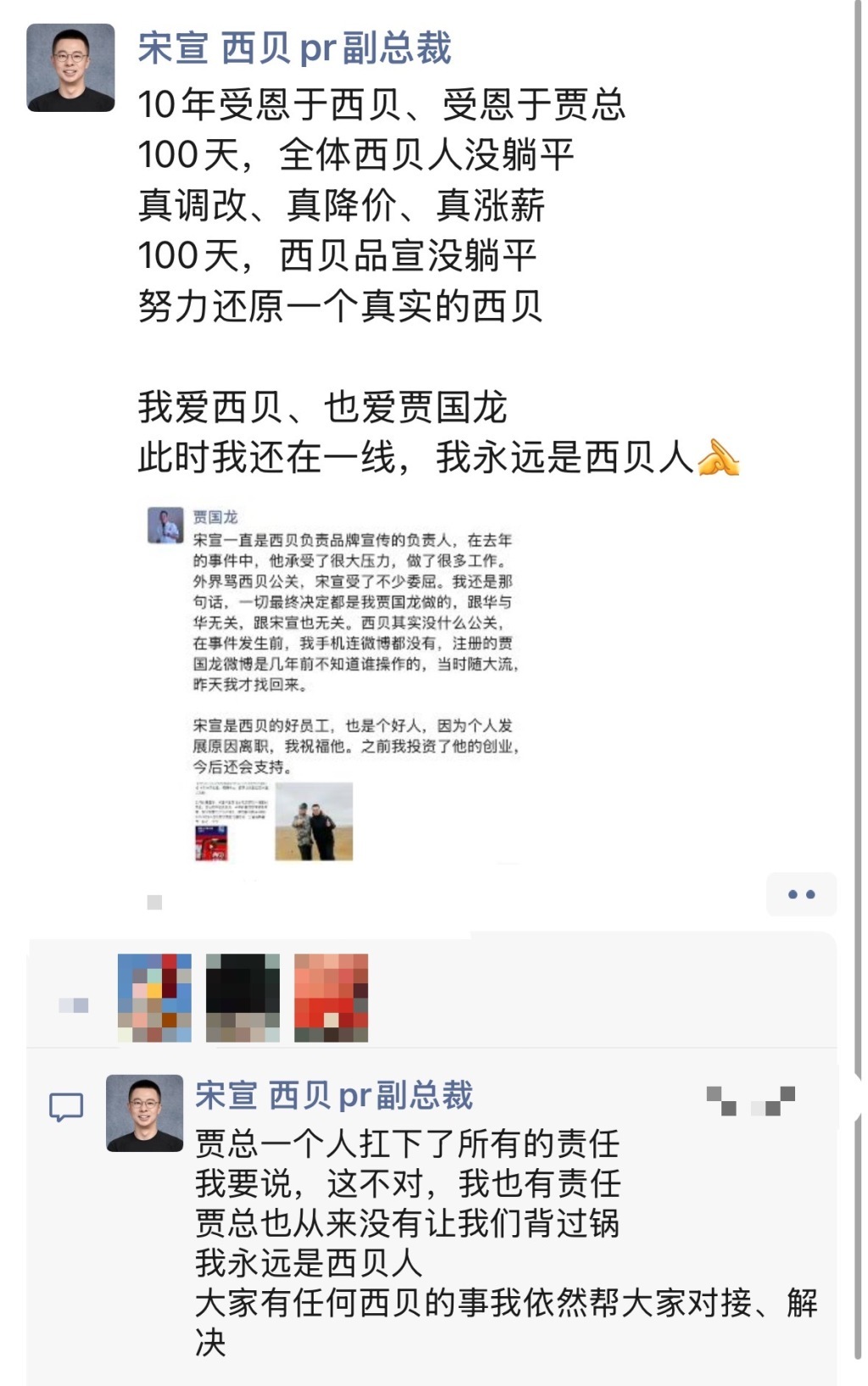
公关

Search documents
公关这个事,还是得学学人家刘强东
Xin Lang Cai Jing· 2026-02-02 09:36
Group 1 - Liu Qiangdong, the founder of JD.com, has consistently sent New Year gifts to his hometown in Guangming Village, Suqian City, for several years, receiving widespread praise from the community [28][31][39] - The gifts include practical items such as food, household appliances, and cash red envelopes for elderly villagers, showcasing his commitment to supporting his hometown [31][34][39] - This annual tradition has been ongoing since 2015, reflecting Liu's genuine and humble character, as he often engages with the community in various ways [12][39] Group 2 - The public's reaction to Liu Qiangdong's generosity highlights a contrast between successful entrepreneurs and ordinary workers, with many expressing admiration for his consistent support [36][41] - The narrative surrounding Liu Qiangdong serves as a reminder of the importance of emotional connection and community engagement for business leaders in today's social climate [42][51] - The article emphasizes that genuine actions and emotional resonance are crucial for maintaining public trust and positive sentiment towards businesses [45][49][54]


最适合接任西贝公关部的,也许是张丽平
Ge Long Hui· 2026-01-20 12:58
Core Viewpoint - The article discusses the ongoing challenges faced by the restaurant chain Xibei, particularly focusing on its founder Jia Guolong's controversial decisions and public relations missteps, which have led to significant operational and reputational issues for the company. Group 1: Company Operations and Challenges - Jia Guolong has chosen to address issues related to competitor Luo Yonghao instead of focusing on Xibei's operational and reputation problems, reflecting a preference for personal vendettas over business strategy [2][6] - Xibei has announced the closure of 4,000 stores, raising questions about its financial viability, especially given its claims of low profit margins and recent employee salary increases [7][9] - The company has been criticized for its contradictory actions, such as raising employee salaries while simultaneously planning mass layoffs, which is unusual in the restaurant industry [9][10] Group 2: Public Relations and Image Management - Jia Guolong's disdain for public relations is evident, as he frequently questions the necessity of understanding PR, equating it with negative connotations [16][18] - The article highlights the importance of public relations in Xibei's past successes, particularly in promoting its children's meals, which accounted for a significant portion of sales [22] - The failure to effectively manage public relations has led to a negative perception of Xibei, with the company being seen as out of touch with modern marketing and consumer expectations [22]
从道歉到硬刚:贾国龙的“真性情”,正在杀死西贝
Ge Long Hui· 2026-01-18 20:56
Core Viewpoint - The article discusses the recent public statements and behavior of Jia Guolong, the CEO of Xibei, highlighting a shift from a conciliatory approach to a more confrontational stance, which raises concerns about the company's future and public perception [2][3][5]. Group 1: Jia Guolong's Public Statements - Jia Guolong initially apologized for past mistakes but later expressed anger over online insults directed at Xibei, indicating a return to a more aggressive demeanor [2][3][5]. - He distanced himself from the controversies involving Luo Yonghao, asserting that the issues were solely his responsibility and not related to his company [4][5]. - Jia's emotional outburst and refusal to engage in public relations strategies may undermine the company's recovery efforts [12][14]. Group 2: Company Performance and Public Perception - Xibei had been recovering from the "Luo Yonghao incident," with reports of increased customer traffic and positive sales trends, but recent developments have cast doubt on this recovery [13][15]. - The company is facing significant challenges, with reports indicating a 50% year-on-year decline in store sales expected by January 2026 [15][17]. - The perception of Xibei's quality and service may be jeopardized by Jia's inconsistent public behavior, leading consumers to question the authenticity of the company's previous apologies and corrective measures [15][16][20]. Group 3: Importance of Public Relations - The article emphasizes the critical role of public relations for companies, especially those with brand premiums like Xibei, which relies on maintaining a positive public image [28][24]. - Jia's dismissal of public relations as unnecessary could be detrimental, as effective communication is essential for brand reputation and consumer trust [29][24]. - The article suggests that both Jia Guolong and Lei Jun face similar challenges in adapting to the current public sentiment and managing their companies' images effectively [30][36].
125天后再探西贝:贾国龙不服,员工怎么想?
Feng Huang Wang· 2026-01-17 10:22
Core Viewpoint - The restaurant chain Xibei is facing significant challenges, including the closure of 102 stores in over 30 cities, which accounts for nearly 30% of its total outlets, due to a combination of public relations mismanagement and a disconnect between operational logic and consumer demand [1][2][17]. Group 1: Store Closures and Employee Sentiment - Xibei has announced the closure of 102 stores, nearly 30% of its total, indicating severe operational challenges [1]. - Employees express mixed feelings, with some showing dedication to customer service while others voice concerns about increased workload and uncertainty regarding job security [3][4]. - The reliance on takeout orders has increased, with some employees noting that dine-in customers have significantly decreased [3]. Group 2: Public Relations Mismanagement - Founder Jia Guolong's response to the crisis has been characterized by emotional reactions rather than strategic public relations, leading to further escalation of the situation [2][11][12]. - The initial consumer complaints about the quality of food were misinterpreted as personal attacks, which shifted the focus from addressing consumer concerns to a defensive stance [9][15]. - Jia's refusal to acknowledge the importance of effective public relations has resulted in a failure to rebuild consumer trust and address the core issues of pricing and product quality [6][8][20]. Group 3: Consumer Expectations and Market Position - Consumers are dissatisfied not with the concept of pre-prepared meals but with the perceived mismatch between the high prices and the quality of food served, which they feel does not meet the expectations set by the brand [20][21]. - Despite attempts to mitigate the situation through discounts and promotions, these measures have not effectively restored consumer confidence or resolved underlying operational issues [22][23]. - The disconnect between the brand's high-end positioning and the actual dining experience has led to a significant decline in customer traffic [5][22].
贾国龙的“我不认”与诺基亚的“我们没做错什么”
Sou Hu Cai Jing· 2026-01-17 00:17
Core Viewpoint - The recent turmoil surrounding Xibei's prepared dishes has been reignited by CEO Jia Guolong's emotional response, revealing the company's dire situation as it plans to close 102 stores, accounting for 30% of its total, and faces a 50% year-on-year decline in business [1][6][12] Group 1: Company Situation - Xibei is planning to close 102 stores in the first quarter of 2026, affecting approximately 4,000 employees, which represents 30% of its total store count [6] - The company has experienced a significant drop in profits, with a 50% year-on-year decline in store business as of January 2026 [5][12] - Despite efforts to adapt, including a nearly 20% price reduction on over 30 dishes and an average salary increase of 500 yuan for frontline employees, consumer response has not improved [5][8] Group 2: Public Relations and Consumer Perception - Jia Guolong's insistence that Xibei has not made mistakes and his emotional outbursts have not garnered public sympathy, leading to widespread criticism on social media [10][12] - The initial criticism from a consumer regarding the taste of prepared dishes escalated into a brand trust crisis due to Jia's aggressive response, which was perceived as a failure to engage in effective public relations [11][12] - The core issue is not the concept of prepared dishes itself but rather the mismatch between high pricing and consumer expectations for value, highlighting a disconnect between Xibei's positioning and market trends [16][17]
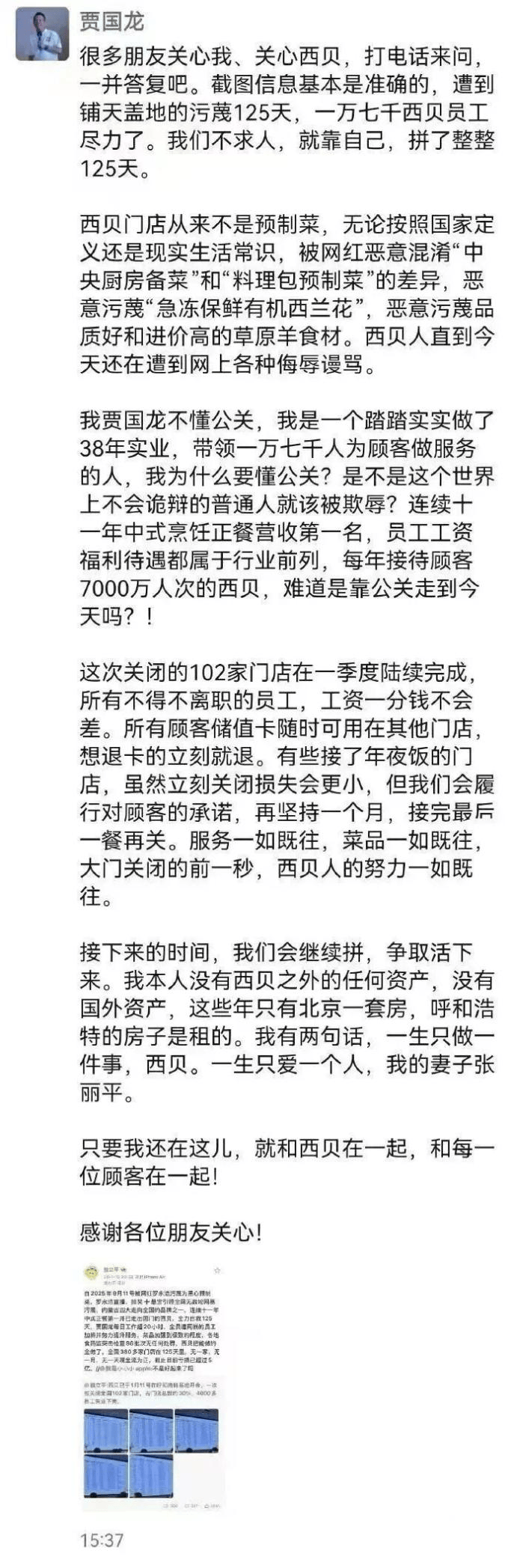
贾国龙没搞懂的,不只是公关
Feng Huang Wang Cai Jing· 2026-01-16 11:11
Core Viewpoint - The closure of 102 stores, nearly 30% of the total, reflects deeper issues within the company rather than just external criticism, highlighting a disconnect between operational logic and consumer demand [1][9]. Group 1: Misunderstanding Public Relations - The founder's misunderstanding of public relations led to a misalignment with consumer relationships, viewing public relations as adversarial rather than a means to communicate and build trust [2][8]. - The initial consumer complaint about high-priced pre-made dishes was misinterpreted as an attack, escalating the situation instead of addressing the underlying consumer dissatisfaction [3][4]. Group 2: Emotional Decision-Making - The emotional response from the founder, labeling critics as "network black mouths," exemplified a loss of control under public pressure, which further exacerbated the crisis [5][6]. - The hasty decision to open the kitchen to prove quality without proper planning resulted in a food safety trust crisis, shifting the focus from the original complaint to broader operational issues [6][11]. Group 3: Misattribution of Blame - The founder attributed the closure of stores to "125 days of online slander," deflecting attention from significant operational flaws that existed prior to the public outcry [9][10]. - The real consumer dissatisfaction stemmed from a perceived mismatch between high prices and the quality of pre-made dishes, rather than the use of pre-made ingredients themselves [12][13]. Group 4: Consumer Expectations - Consumers were not opposed to pre-made dishes but were frustrated by the perception of being misled about freshness and quality, which contradicted the brand's high-end positioning [12][13]. - Despite attempts to remedy the situation through price reductions and vouchers, these measures failed to restore consumer trust or address the fundamental operational issues [13][16]. Group 5: Need for Reflection - The founder's insistence on his approach and failure to acknowledge consumer expectations hindered the company's ability to navigate the crisis effectively [15][16]. - True brand responsibility involves recognizing mistakes and listening to consumer feedback rather than blaming external factors for internal challenges [16].
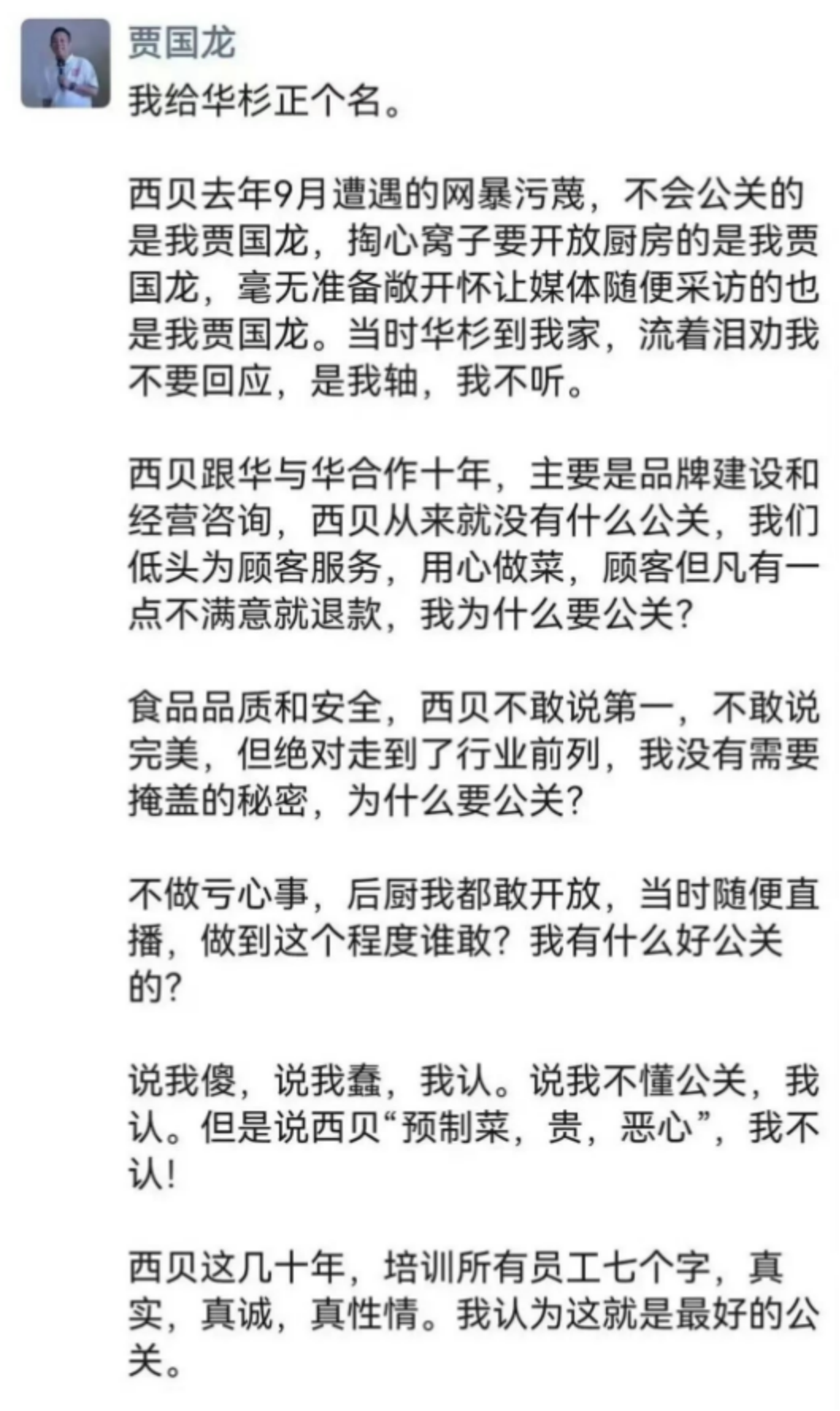
贾国龙没搞懂的,不只是公关
凤凰网财经· 2026-01-16 10:51
Core Viewpoint - The closure of 102 stores, nearly 30% of the total, reflects deeper issues within the company rather than just external criticism [2][24]. Group 1: Misunderstanding Public Relations - The founder's misunderstanding of public relations led to a misalignment with consumer relationships, viewing public relations as an adversarial concept rather than a tool for communication and trust-building [5][20]. - The initial consumer complaint about high-priced pre-made dishes was misinterpreted as an attack, escalating the situation instead of addressing the underlying consumer dissatisfaction [10][13]. - Emotional responses to criticism resulted in poor decision-making, exacerbating the crisis rather than resolving it [16][19]. Group 2: Misattributing Causes of Closure - The founder attributed the store closures to "125 days of online slander," deflecting from operational issues that were already present [23][25]. - The real consumer dissatisfaction stemmed from a perceived mismatch between high prices and the quality of food, not from the use of pre-made ingredients themselves [26][29]. - The company failed to address the core issue of price versus quality, instead getting caught up in semantic debates about what constitutes pre-made food [29]. Group 3: Consumer Expectations and Brand Integrity - Consumers expect fresh, high-quality food at premium prices, and when this expectation is not met, dissatisfaction arises [29]. - The company's attempts to remedy the situation, such as a 20% price reduction and issuing vouchers, only provided temporary relief without addressing the fundamental trust issues [29]. - True brand integrity involves acknowledging mistakes and understanding consumer expectations rather than blaming external factors [29].

贾国龙,依旧“天真”
2 1 Shi Ji Jing Ji Bao Dao· 2026-01-16 09:21
Core Viewpoint - The founder of Xibei, Jia Guolong, demonstrates a mix of idealism and self-reflection in managing the company's recent challenges, including the closure of 102 stores and the impact on employees and customers [1][3][10]. Company Management and Operations - Jia Guolong emphasizes responsibility by ensuring that all employees affected by the store closures receive their salaries and that customer prepaid cards remain valid at other locations [1]. - The company has faced significant operational pressures, with the restaurant industry experiencing a slowdown in revenue growth and profit margins, as highlighted by the China Cuisine Association [5][6]. - Xibei's revenue was already in decline before the recent controversies, with Jia admitting that the company was in a downward trend as of May 2025 [6][10]. Market Challenges - The restaurant sector is witnessing increased competition and declining customer spending, leading to a general trend of lower average transaction values across the industry [5][8]. - Xibei's higher price point has made it more vulnerable to market pressures, especially as consumer expectations shift towards value for money [8]. Public Relations and Brand Image - Jia Guolong's approach to public relations has been criticized as lacking, with his insistence that Xibei does not engage in public relations efforts raising concerns about the company's image management [4][11]. - The controversy surrounding the "pre-prepared dishes" debate has damaged Xibei's brand, with customers feeling misled about the quality and freshness of ingredients [7][9]. - The company has made efforts to address these issues by reducing prices on over 30 menu items by 20% in response to public sentiment [10]. Employee Impact - The closure of stores has resulted in job losses for employees, highlighting the real-world consequences of market dynamics and operational decisions [12]. - Jia Guolong's entrepreneurial success should come with an understanding that market conditions do not guarantee positive outcomes solely based on past achievements [12][13].
贾国龙证实西贝公关副总裁已离职:“他受了不少委屈”
Xin Lang Cai Jing· 2026-01-16 06:51
Core Insights - The Vice President of Public Relations at Xibei, Song Xuan, has resigned due to personal development reasons, as confirmed by the founder, Jia Guolong [1][7] - Jia Guolong emphasized that all final decisions are made by him and not influenced by external parties or Song Xuan, who he previously supported in his entrepreneurial endeavors [4][10] - Xibei will close 102 stores, accounting for approximately 30% of its total outlets, affecting around 4,000 employees, primarily in first and second-tier cities [5][11] Summary by Sections Leadership Changes - Song Xuan has left Xibei, citing personal development as the reason, and expressed gratitude towards the company and its founder [1][7] - Jia Guolong acknowledged the pressure Song faced during recent events and reiterated his commitment to support him in future endeavors [4][10] Company Operations - Xibei is set to close 102 stores, which will be completed in the first quarter, with a focus on fulfilling customer commitments before shutting down certain locations [6][11] - Employees affected by the closures will receive their full wages, and customers with stored value cards can use them at other locations or request refunds [6][11] Brand and Public Relations - Jia Guolong defended the company's approach to public relations, stating that Xibei focuses on customer service and product quality rather than traditional PR tactics [5][11] - He highlighted the company's commitment to authenticity and sincerity as the best form of public relations, rejecting negative perceptions about their products [11]
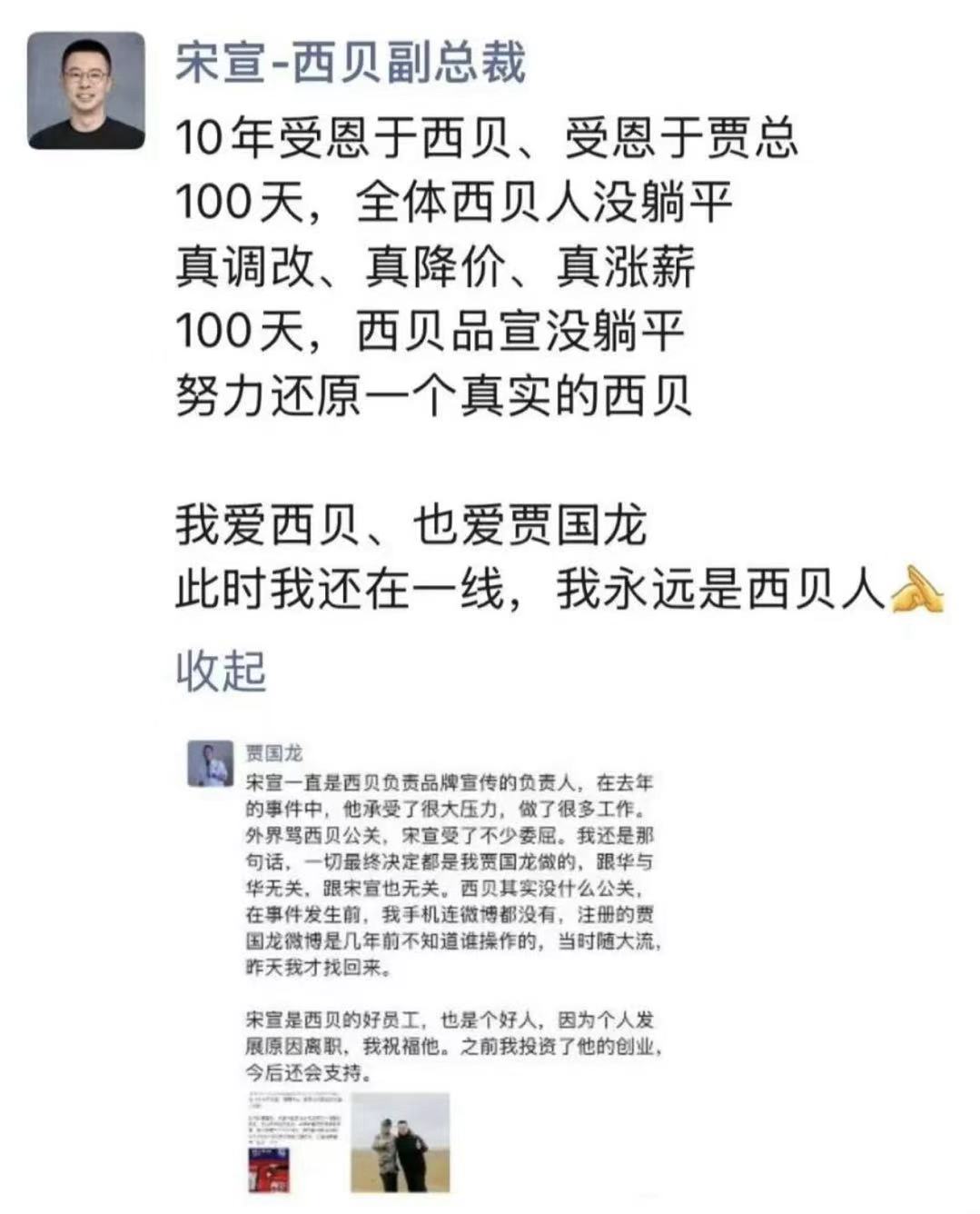
西贝公关负责人离职,贾国龙:去年事件他受了不少委屈,一切最终决定都是我做的
Feng Huang Wang· 2026-01-16 05:47
Core Viewpoint - The recent statements from Xi Bei Group's founder, Jia Guolong, and Vice President, Song Xuan, highlight the company's commitment to transparency and customer service amidst challenges related to public perception and operational adjustments following controversies surrounding pre-prepared dishes [1][2][3][4]. Group 1: Company Response to Controversy - Xi Bei Group confirmed the closure of 102 stores, representing 30% of its total locations, with a commitment to ensure that all departing employees receive their full wages and that customer prepaid cards remain valid at other locations [3]. - Jia Guolong emphasized that the company has never engaged in public relations in the traditional sense, focusing instead on genuine customer service and product quality, which he believes has contributed to the brand's success [4]. - The company has implemented measures such as price reductions, issuing coupons, and increasing employee salaries to mitigate the impact of declining customer traffic and sales following the controversy [4]. Group 2: Leadership Statements - Song Xuan expressed his ongoing commitment to Xi Bei and acknowledged shared responsibility for the company's challenges, distancing himself from the blame placed on Jia Guolong [2]. - Jia Guolong defended Song Xuan's role in the company, stating that he has faced significant pressure and criticism during the recent events, and reiterated that all decisions ultimately rest with him [2][3]. - Jia Guolong criticized the negative portrayal of Xi Bei in the media, asserting that the company maintains high standards for food quality and safety, and that accusations of using pre-prepared dishes are unfounded [4].