牛市格局

Search documents
量化择时周报:牛市格局仍在延续,主题投资重回主线-20260125
ZHONGTAI SECURITIES· 2026-01-25 13:29
Quantitative Models and Construction Methods 1. **Model Name**: Timing System Model **Model Construction Idea**: The model uses the distance between the short-term moving average (20-day) and the long-term moving average (120-day) of the WIND All A Index to determine the market trend[2][7] **Model Construction Process**: - Define the short-term moving average (20-day) and long-term moving average (120-day) of the WIND All A Index - Calculate the difference between the two moving averages - If the short-term moving average is above the long-term moving average and the absolute difference exceeds 3%, the market is considered to be in an upward trend - Latest data: 20-day moving average = 6668, 120-day moving average = 6245, difference = 6.78%[2][7] **Model Evaluation**: The model effectively captures the market's upward trend and provides a clear signal for timing decisions[2][7] 2. **Model Name**: Industry Trend Allocation Model **Model Construction Idea**: This model identifies industry opportunities based on medium-term reversal expectations and performance trends[6][7] **Model Construction Process**: - Use medium-term reversal expectation signals to identify industries with potential recovery, such as innovative healthcare - Apply the TWO BETA model to recommend sectors like technology, commercial aerospace, space photovoltaics, and stablecoin concepts - Use performance trend signals to highlight opportunities in semiconductors, industrial metals, and chemicals[6][7] **Model Evaluation**: The model provides actionable insights into sector allocation, focusing on industries with strong growth potential or recovery signals[6][7] 3. **Model Name**: Position Management Model **Model Construction Idea**: This model determines the recommended equity allocation based on valuation levels and market trends[8] **Model Construction Process**: - Assess the valuation levels of the WIND All A Index using PE and PB ratios - Combine valuation levels with short-term trend signals to recommend an equity allocation - Current recommendation: 80% equity allocation for absolute return products based on the WIND All A Index[8] **Model Evaluation**: The model provides a systematic approach to managing equity exposure, balancing valuation and trend considerations[8] --- Model Backtesting Results 1. **Timing System Model**: - Moving average distance: 6.78% (absolute value > 3%, indicating an upward trend)[2][7] - Profitability effect: 2.7% (positive, supporting the upward trend)[2][7] 2. **Industry Trend Allocation Model**: - Recommended sectors: Innovative healthcare, technology, commercial aerospace, space photovoltaics, stablecoin concepts, semiconductors, industrial metals, and chemicals[6][7] 3. **Position Management Model**: - Recommended equity allocation: 80%[8] --- Quantitative Factors and Construction Methods No specific quantitative factors were explicitly mentioned in the report. The analysis primarily focuses on models rather than individual factors. --- Factor Backtesting Results No specific factor backtesting results were provided in the report. The focus remains on model-level performance and recommendations.
量化择时周报:短期调整不改牛市格局-20260118
ZHONGTAI SECURITIES· 2026-01-18 07:26
- The report introduces a **market timing system** that uses the distance between the 20-day moving average and the 120-day moving average of the WIND All A Index to determine market trends. The system identifies an uptrend when the short-term moving average is above the long-term moving average, with a significant distance threshold of 3%[2][6][11] - The **industry trend allocation model** is highlighted, which signals opportunities in specific sectors. For the medium term, the "distressed reversal expectation model" suggests focusing on innovative healthcare. The "TWO BETA model" continues to recommend the technology sector, particularly AI applications and commercial aerospace after adjustments. In the short term, the "earnings trend model" points to opportunities in computing power (e.g., Sci-Tech Chip ETF, code 588200) and energy storage batteries (e.g., Energy Storage Battery ETF, code 159566)[2][5][7] - The **position management model** is used to determine stock allocation levels. Based on the WIND All A Index's valuation and trend, the model recommends an 80% stock allocation for absolute return products[5][7] - The **valuation indicators** for the WIND All A Index are also discussed. The PE ratio is at the 90th percentile, indicating a relatively high valuation, while the PB ratio is at the 50th percentile, representing a medium level[5][7][11]
量化择时周报:牛市格局,聚焦哪些板块?-20260111
ZHONGTAI SECURITIES· 2026-01-11 11:40
- The report introduces a **market timing system** based on the distance between the short-term moving average (20-day) and the long-term moving average (120-day) of the WIND All A Index. The system identifies market trends by observing whether the short-term moving average is above the long-term moving average and the absolute difference exceeds 3%. The latest data shows the 20-day moving average at 6394 and the 120-day moving average at 6142, with a difference of 4.10%, indicating an upward trend[6][11]. - The **profitability effect** is used as a core indicator to assess market conditions. The current profitability effect is 5.28%, which is significantly positive, suggesting that the market is likely to continue its upward trend[6][11]. - The **industry trend allocation model** highlights sectors with strong upward trends, including AI applications, commercial aerospace, computing power, industrial metals, and energy storage. Additionally, the **mid-term reversal expectation model** signals opportunities in media and innovative healthcare sectors[6][11]. - The **TWO BETA model** recommends focusing on technology sectors, particularly AI applications and commercial aerospace[6][11]. - The **valuation metrics** for the WIND All A Index show that the PE ratio is near the 90th percentile, indicating a relatively high valuation, while the PB ratio is at the 50th percentile, reflecting a moderate valuation level. Based on these metrics and the market trend, the allocation model suggests an 80% equity position for absolute return products[7][11]. - Backtesting results for the market timing system show that the WIND All A Index increased by 5.11% over the past week, with small-cap stocks (CSI 1000) rising by 7.03%, mid-cap stocks (CSI 500) by 7.92%, and large-cap indices (HS300 and SSE50) by 2.79% and 3.4%, respectively. Sector-wise, defense and media performed strongly, with defense rising by 14.56%, while banking and transportation lagged, with banking declining by 1.88%[2][5][6].
沪指14连阳!两市场成交额再超2.8万亿元 | 华宝3A日报(2026.1.7)
Xin Lang Cai Jing· 2026-01-07 09:30
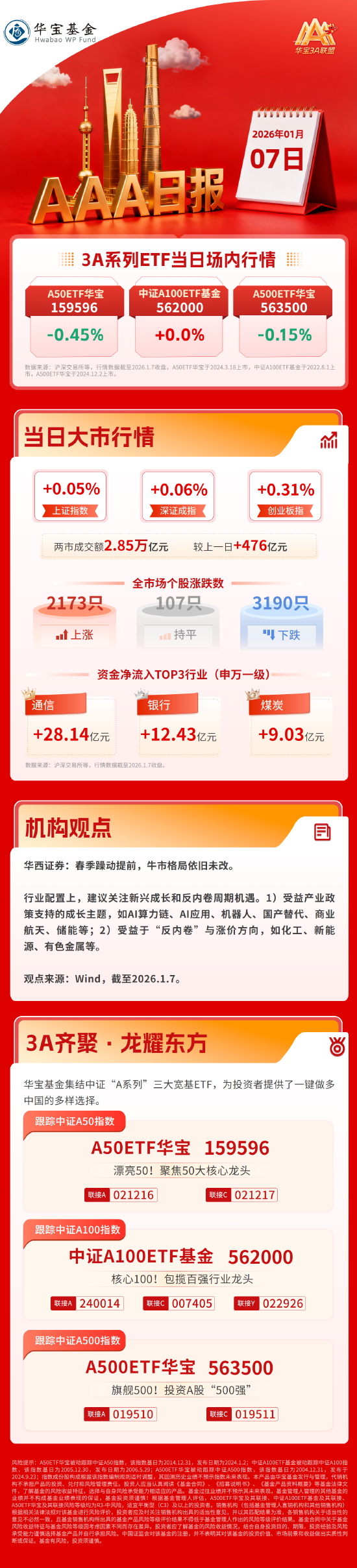
Group 1 - The market showed a slight increase with the total trading volume reaching 2.85 trillion yuan, an increase of 476 billion yuan compared to the previous day [6][2] - The number of stocks that rose, remained flat, and fell in the market was 3190, 107, and 2173 respectively [6][2] - The top three sectors with net capital inflow were banking (+28.14 billion yuan), coal (+12.43 billion yuan), and telecommunications (+9.03 billion yuan) [6][2] Group 2 - Huaxi Securities suggests that the spring market rally has started early, maintaining a bullish outlook [2][6] - The report emphasizes focusing on emerging growth sectors and opportunities related to the "anti-involution" trend, including AI computing power chains, AI applications, robotics, domestic substitution, commercial aerospace, and energy storage [2][6] - The report also highlights sectors benefiting from price increases, such as chemicals, new energy, and non-ferrous metals [2][6] Group 3 - Huabao Fund has launched three major broad-based ETFs tracking the China A50, A100, and A500 indices, providing investors with diverse options for investing in China [2][6] - The A50 ETF focuses on the top 50 core leading companies, while the A100 ETF encompasses the top 100 industry leaders [2][6]

A股午评:沪指微涨0.29%逼近4100点,创业板指涨0.41%创逾4年新高,光刻胶及脑机接口概念股爆发,半导体股活跃
Jin Rong Jie· 2026-01-07 03:48
Market Overview - The A-share market opened high on January 7, with the Shanghai Composite Index rising by 0.29% to 4095.54 points, the Shenzhen Component Index up by 0.35% to 14071.35 points, and the ChiNext Index increasing by 0.41% to 3332.74 points, marking a four-year high [1] - The total trading volume in the Shanghai and Shenzhen markets reached 1.84 trillion yuan, an increase of 53.8 billion yuan compared to the previous trading day [1] Sector Performance - The photolithography concept stocks surged, with Guofeng New Materials hitting the limit up for two consecutive days, and several other stocks like Nanda Optoelectronics and Tongcheng New Materials also reaching the limit up [1] - The controllable nuclear fusion concept showed strong performance, with stocks like Wangzi New Materials and China First Heavy Industries hitting the limit up [1] - The brain-computer interface concept continued its strong trend, with stocks such as Innovation Medical and Nanjing Panda achieving three consecutive limit ups [1] - Semiconductor equipment stocks were actively traded, with stocks like Chip Source Microelectronics and Hengkun New Materials hitting the limit up by 20% [1] - The electric grid equipment sector showed strength, with Sanbian Technology and China West Electric reaching the limit up [1] - In contrast, oil and gas stocks performed poorly, with China National Offshore Oil Corporation experiencing a decline [1] Hot Sectors - The storage chip concept was strong, with stocks like Yingxin Development achieving two consecutive limit ups, and others like Puran Shares and Jiangbolong also rising [2] - The nickel concept stocks saw a rally, with stocks like Greeenmei hitting the limit up, supported by a significant increase in nickel prices [3] - The controllable nuclear fusion concept stocks rose, with breakthroughs in experimental methods reported, indicating long-term growth potential for the industry [4] Institutional Insights - Huaxi Securities noted that the spring market rally has started early, maintaining a bullish outlook, and suggested focusing on emerging growth sectors and anti-involution opportunities [5] - Shenwan Hongyuan Securities emphasized that the spring market structure remains unchanged, with high elasticity in thematic opportunities, particularly in AI and cyclical sectors [5] - Dongfang Securities indicated that the Shanghai Composite Index is approaching the 4100-point mark, predicting a slowdown in upward momentum and potential volatility [6]

A股开盘速递 | 创业板指涨0.36% 存储芯片等涨幅居前
智通财经网· 2026-01-07 02:59
Group 1 - The core viewpoint is that the spring market rally has started early, and the bull market pattern remains intact, with 2026 expected to be a significant year due to multiple positive factors [1] - Macro policy cycles indicate that 2026 will be the start of the "14th Five-Year Plan," with various departments intensifying the introduction of supporting industrial policies and investment plans, creating a favorable liquidity environment for the market [1] - Institutional funds, particularly from stock ETFs, have shown early entry into the market, with additional inflows expected from insurance funds and foreign capital due to currency appreciation, which may strengthen the spring market trend [1] Group 2 - The spring market is expected to have depth, with the Shanghai Composite Index showing continuous upward movement, indicating a robust spring theme with high elasticity in thematic opportunities [2] - Key themes to focus on include industrial themes (commercial aerospace, robotics, nuclear fusion), funding themes (high dividend recovery and core asset recovery), and policy themes (service consumption, Hainan) [2] - The investment focus is on AI computing power chains and cyclical opportunities, which are expected to have high institutional attention, although their weight in the spring market may be relatively low [2] Group 3 - From a technical perspective, after a significant rebound, the Shanghai Composite Index is approaching the 4100-point mark, and the upward momentum is expected to slow down, with potential for significant fluctuations [3] - Future industry focus remains critical, but caution is advised regarding the risk of significant adjustments following substantial speculation in individual stocks, with attention to high-low switches within sectors [3]



“春季躁动”提前启动,上证指数再次突破4000点
Sou Hu Cai Jing· 2026-01-05 09:36
Group 1 - The core viewpoint is that the A-share market is experiencing an early "spring rally," with a bullish trend expected to continue due to favorable macroeconomic conditions and liquidity support [2][3]. - The Shanghai Composite Index rose by 1.07%, closing at 4011 points, while the Sci-Tech Innovation 50 Index increased by 4.05%, closing at 1399 points, indicating strong market performance [2]. - Factors contributing to the positive market outlook include a stable RMB exchange rate, domestic liquidity easing, and improving economic recovery expectations, with institutional investors showing a willingness to increase positions [2][3]. Group 2 - Analysts suggest that the current A-share fundamentals remain robust, supported by a favorable policy environment and liquidity conditions, which are expected to bolster market confidence [2][3]. - The anticipated influx of new capital into the market is driven by year-end fund flows, improved corporate profit expectations, and supportive policies, with a focus on emerging sectors such as semiconductors, artificial intelligence, and new energy [2][3]. - The year 2026 is highlighted as a pivotal year for multiple positive factors, including coordinated fiscal and monetary policies, which are expected to create a friendly liquidity environment for the market [3].
A股新年开门红,上证指数盘中重回4000点|快讯
Hua Xia Shi Bao· 2026-01-05 04:57
Core Viewpoint - The A-share market has shown a positive start to 2026, with the Shanghai Composite Index surpassing 4000 points for the first time since mid-November 2022, indicating a bullish sentiment in the market [2][4]. Market Performance - As of the midday close on January 5, 2026, the Shanghai Composite Index rose by 1.07% to 4011.45 points, while the Shenzhen Component Index increased by 1.87% to 13777.32 points, and the ChiNext Index climbed by 2.15% to 3272.07 points [2][3]. - Over 4000 stocks in the market experienced gains, with a total trading volume exceeding 1.6 trillion yuan across the Shanghai, Shenzhen, and Beijing exchanges [4]. Sector Performance - Among the 31 primary industry sectors, most showed an upward trend, with the pharmaceutical, electronics, and non-bank financial sectors leading in gains [4]. Economic Outlook - Analysts from Jinyuan Unified Securities express confidence in a "bull market" outlook for the capital market in 2026, citing China's transition to high-quality economic development, proactive policies, and robust technological innovation as key factors [4]. - The report highlights a significant shift in residents' asset allocation towards equity, suggesting a solid foundation for market valuation recovery after reaching a low point [4]. - Additionally, the increasing interest of overseas capital in Chinese assets and expectations of loose monetary policy in both China and the U.S. are seen as supportive elements for long-term growth in equity assets [4].

【机构策略】春季躁动提前 牛市格局依旧未改
Zheng Quan Shi Bao Wang· 2026-01-05 02:15
Group 1 - The core viewpoint is that the bull market remains intact, with an early onset of spring rally driven by multiple positive factors leading into 2026, which is expected to be a significant year for the market [1] - Macro policy cycles indicate that 2026 marks the beginning of the "14th Five-Year Plan," with various departments actively rolling out supportive industrial policies and investment plans, creating a favorable liquidity environment [1] - Institutional funds, particularly represented by stock ETFs, have shown signs of early entry into the market, with foreign capital expected to return due to currency appreciation, enhancing the spring market trend [1] Group 2 - The A-share market showed mixed performance last Wednesday, with the Shanghai Composite Index experiencing narrow fluctuations, while the Shenzhen Component and ChiNext Index initially opened high but later retreated [2] - Certain sectors such as aerospace, software development, non-ferrous metals, and internet services performed well, while industries like pharmaceutical commerce, precious metals, shipbuilding, and batteries lagged [2] - The market anticipates that the Federal Reserve will continue its interest rate cut cycle in 2026, contributing to a more accommodative global liquidity environment [2] Group 3 - The A-share market's three major indices exhibited mixed results last Wednesday, with total trading volume exceeding 2 trillion yuan, a decrease of over 100 billion yuan from the previous trading day [3] - Technical analysis indicates that the Shanghai Composite Index is in a state of indecision, yet remains within a bullish range, with key support levels not breached [3] - The market has shown signs of liquidity-driven characteristics, and while there may be fluctuations at the beginning of the year, the overall market is expected to maintain upward potential before the Spring Festival [3]
李立峰、张海燕:春季躁动提前启动,牛市格局依旧未改
Sou Hu Cai Jing· 2026-01-04 12:53
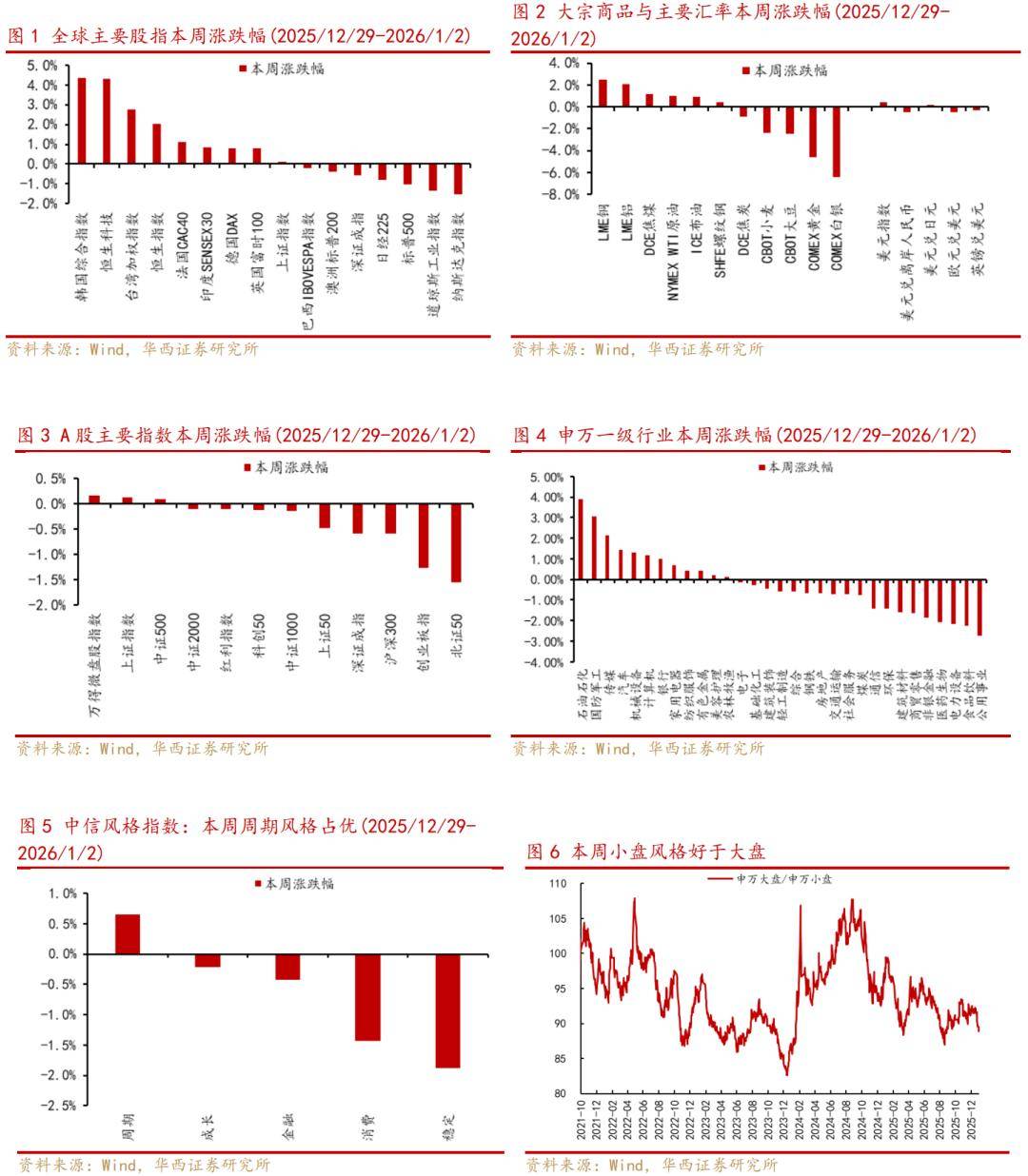
Market Review - The South Korean Composite Index, Hong Kong's Hang Seng Tech Index, and Taiwan Weighted Index led global gains, while US stock indices declined during the week of December 29, 2025, to January 2, 2026. In the A-share market, cyclical and growth sectors performed well, with oil and petrochemicals, military industry, and media leading gains, while utilities lagged behind. On January 2, 2026, the Hong Kong stock market opened strong, with the Hang Seng Tech Index surging 4%, particularly in semiconductor, AI computing, and internet giants, indicating a recovery in market risk appetite. In commodities, base metals and crude oil rose, while precious metals fell, with COMEX silver and gold down 6.39% and 4.63%, respectively. The offshore RMB strengthened against the US dollar, surpassing 6.97 on Friday [1][2][3]. Market Outlook - The market is expected to maintain a bullish trend into 2026, driven by several positive factors. The macro policy cycle is favorable, with multiple departments rolling out supportive industrial policies and investment plans as 2026 marks the start of the 14th Five-Year Plan. Coordinated fiscal and monetary policies are creating a friendly liquidity environment. Institutional funds, particularly in stock ETFs, have shown significant inflows, indicating a strong willingness to invest as foreign capital returns due to currency appreciation. The narrowing decline in PPI suggests a mild recovery in corporate profits, which will support market sentiment [2][4][5]. Key Focus Areas 1. **Overseas Developments**: The selection of a new Federal Reserve Chair is a key focus, with the December meeting minutes indicating a majority support for further rate cuts, though there are significant policy path divergences. The probability of a rate cut in January is low at 17%, with potential candidates like Hassett and Waller advocating for further easing [2][3]. 2. **PMI Data**: Both manufacturing and non-manufacturing PMIs returned to expansion territory in December 2025, with manufacturing PMI at 50.1% and non-manufacturing PMI at 50.2%. This improvement in production and new orders supports the spring market rally [3][4]. 3. **Policy Measures**: The government has implemented a series of targeted policies to boost market confidence, including a 295 billion yuan investment plan and early release of subsidies and local debt limits. The real estate sector is also seeing policy adjustments to lower transaction costs, which may stabilize market expectations [4][5]. 4. **Institutional Investment Trends**: There has been a notable net inflow of institutional funds into stock ETFs, particularly those related to the A500 index, indicating a proactive approach to the upcoming spring market rally. The favorable policy outlook and stable currency are expected to attract further foreign investment [5]. Industry Focus - The focus for industry investment should be on emerging growth sectors supported by policy, such as AI computing, robotics, and energy storage, as well as sectors benefiting from price increases and "anti-involution" trends, including chemicals and non-ferrous metals [5].