
负利率

Search documents
美国家庭疯狂收割华尔街,新的一年,我们该如何闷声发大财?
Sou Hu Cai Jing· 2026-02-07 11:13
Core Insights - The article emphasizes the importance of understanding macro trends and market dynamics rather than relying on luck for investment success [1][4] - It highlights the shift from a single market logic to a "multi-fork global game" where investors need to adapt their strategies accordingly [3][12] Group 1: Investment Strategies - Many investors are turning to overseas allocations as domestic markets struggle, with QDII funds providing a legal avenue for international investment [3][12] - The article suggests a diversified investment approach across different markets and asset classes, advocating for a mix of U.S. tech stocks, gold ETFs, and emerging market funds [14][16] Group 2: Market Dynamics - The article discusses the disparity in investment outcomes between U.S. households and Chinese retail investors, attributing it to different systemic structures [4][10] - It notes that global debt has surpassed $345 trillion, with negative interest rates benefiting the wealthy while disadvantaging lower-income individuals [8][10] Group 3: Historical Context - The GameStop incident in 2021 is cited as a significant event where retail investors successfully challenged Wall Street, showcasing the power of collective action [6][10] - The article reflects on how U.S. households capitalized on government stimulus during the pandemic, leading to substantial savings and investment opportunities [10][12] Group 4: Future Outlook - The article encourages investors to focus on long-term strategies and to be aware of different economic cycles, rather than short-term speculation [14][16] - It stresses the need for investors to develop a comprehensive understanding of market trends and to avoid being overly focused on individual stock performance [16][17]


避险属性托底 瑞士法郎高位震荡
Jin Tou Wang· 2026-02-06 02:44
Core Viewpoint - The Swiss Franc continues to show strength at the beginning of 2026, supported by its safe-haven status amid global risk volatility and the uncertain U.S. dollar performance [1][2] Exchange Rate Performance - As of 10:10 AM, the USD/CHF exchange rate was around 0.7770, down 0.1285% from the previous trading day, while the CHF/CNY rate was 8.9412, down 27 points, indicating a balanced market [1] - The Swiss Franc has appreciated over 3% against the U.S. dollar since the start of 2026, with a total increase of 12.7% in 2025, marking the highest level in 11 years since 2015 [1] Core Drivers - The primary driver of the Swiss Franc's strength is its safe-haven appeal, bolstered by global geopolitical tensions and uncertainty in U.S. policies, leading to continued inflows into the Swiss Franc [1] - Switzerland's long-standing political neutrality, substantial current account surplus, and low government debt levels further support the Franc's strength, alongside the historical high of gold prices [1] Swiss National Bank Policy Dilemma - The Swiss National Bank (SNB) maintains a 0% benchmark interest rate, with inflation at only 0.1%, nearing deflation, which pressures export industry profits due to a strong Franc [2] - The SNB has indicated readiness for negative interest rates and potential market interventions, but no actual actions have been taken yet, leading to a wait-and-see market attitude [2] Technical Analysis and Outlook - The USD/CHF pair is currently in a triangular consolidation pattern, with moderate bullish momentum; key support is at 0.7750, and a rebound could test resistance at 0.7945 [2] - A break below 0.7705 could open up further downside potential, while the Swiss Franc is expected to continue high-level fluctuations, with its safe-haven status as the core support [2]
全球“最强货币”瑞郎触及11年高位,瑞士经济陷入困境
Xin Lang Cai Jing· 2026-01-30 09:26
Core Insights - The Swiss Franc is widely regarded as a safe-haven asset, often appreciating during geopolitical or macroeconomic uncertainties [1][9] - The strong performance of the Swiss Franc against the US dollar complicates the monetary policy formulation for the Swiss National Bank (SNB) [1][9] - Switzerland is on the brink of deflation and negative interest rates, severely limiting the operational space for the central bank [1][9] Economic Context - In early 2026, safe-haven assets like gold and silver reached historical highs, with the Swiss Franc also climbing to a ten-year peak due to global uncertainties [3][11] - The Swiss Franc has appreciated by 3.5% against the US dollar this year and 12.7% since 2025, reaching an 11-year high recently [3][11] - The ongoing geopolitical tensions are expected to increase uncertainty, further complicating the SNB's monetary policy [3][11] Inflation and Monetary Policy - Switzerland is experiencing weak price growth, with an inflation rate of only 0.1%, and the SNB's key policy rate remains at 0% [5][13] - The SNB ended a seven-year negative interest rate policy in 2022, which was unpopular among savers and lending institutions [5][13] - The SNB is prepared to reintroduce negative interest rates if necessary, although the threshold for doing so is higher than before [5][13] Currency Strength and Market Dynamics - The Swiss Franc's strength is partly due to the inelastic demand for Swiss exports in sectors like pharmaceuticals and precision manufacturing [4][12] - A stronger Franc could lower import inflation and squeeze export profits, further dragging down wage growth and investment levels in Switzerland [5][12] - The SNB's previous interventions in the foreign exchange market to curb Franc appreciation are now fraught with risks due to recent trade agreements with the US [6][14] Long-term Outlook - The Swiss Franc is expected to remain one of the strongest currencies globally, supported by factors such as rising gold prices and Switzerland's current account surplus [7][15] - Even if the SNB implements policies to suppress currency appreciation, the inflow of safe-haven funds may continue to strengthen the Franc [7][15] - The political sensitivity surrounding foreign exchange interventions further constrains the SNB's ability to balance price stability and economic growth [7][15]

瑞士法郎政策维稳避险博弈
Jin Tou Wang· 2026-01-22 03:05
Core Viewpoint - The Swiss Franc (CHF) is experiencing a "strong oscillation with limited dual-direction movement" due to a combination of global central bank policy divergence, geopolitical risk fluctuations, and trade pattern adjustments, reflecting its status as a pure safe-haven currency [1] Group 1: Current Market Dynamics - As of January 22, 2026, the USD/CHF exchange rate is at 0.7953, ending a three-day decline, with a trading range of 0.7900-0.8020 [1] - The EUR/CHF exchange rate is hovering around 0.9350, showing significant resistance without a clear breakout direction [1] - The CHF has appreciated slightly against the USD and stabilized against the EUR, driven by the "loose US, stable Swiss" policy interest rate differential and temporary inflows of safe-haven funds [1] Group 2: Swiss National Bank (SNB) Policy - The SNB maintains a policy interest rate of 0%, which is low compared to other major central banks, with no immediate plans for adjustment [2] - SNB President Martin Schlegel emphasized that the threshold for restoring negative interest rates is very high, even in the event of negative inflation [2] - The zero interest rate policy aims to prevent excessive appreciation of the CHF, alleviating pressure on key export sectors such as watchmaking and pharmaceuticals [2] Group 3: Economic Fundamentals - Switzerland's macroeconomic accounts provide a long-term fundamental "moat" for the CHF, with a current account surplus consistently above 4% of GDP and a net international investment position exceeding 100% of GDP [3] - Despite a temporary trade deficit due to high US tariffs, a trade agreement has led to a rapid recovery, particularly in gold exports, which surged from 0.3 tons in August to 128.2 tons in October [3] - The CHF's safe-haven status remains attractive to global investors, supported by Switzerland's political neutrality, low government debt (approximately 40%), and substantial net overseas assets [3] Group 4: Future Outlook - Institutions predict a "strong oscillation with narrowed volatility" for the CHF in 2026, with key divergences centered on the pace of Federal Reserve interest rate cuts and geopolitical risk developments [4] - Valion Bank forecasts the USD/CHF exchange rate to fluctuate between 0.79 and 0.81 throughout the year, while UBS suggests limited further weakening of the USD [4] - Traders Union's statistical model indicates that if the current market conditions persist, the USD/CHF rate could drop to around 0.778 by year-end and potentially further to approximately 0.6515 by 2030 [4]
避险资金持续流入!瑞士法郎开年震荡走强,后续怎么走?
Jin Tou Wang· 2026-01-16 02:47
Core Viewpoint - The Swiss Franc is experiencing stable fluctuations against major currencies due to policy stability and market dynamics, with a slight appreciation against the US dollar and stability against the euro, driven by its safe-haven status and global policy divergence [1][2]. Group 1: Currency Performance - As of January 16, 2026, the exchange rates for the Swiss Franc are 1.2450 USD, 1.07 EUR, and 8.67 CNY, with a recent decline against the USD reaching a low of 0.7970 [1]. - The Swiss Franc is expected to appreciate slightly against the Chinese Yuan, with a forecasted high of 8.76 CNY by January 18, 2026, but a long-term downtrend is anticipated [1]. Group 2: Central Bank Policy - The Swiss National Bank maintained a 0% policy interest rate in December 2025, indicating a commitment to market stability and avoiding negative interest rates due to potential adverse effects on pensions [2]. - The divergence in monetary policy between the US and Switzerland, with the Federal Reserve expected to lower rates while the Swiss National Bank holds steady, is compressing the USD/CHF spread [2]. Group 3: Economic Outlook - The Swiss economy is showing a mixed pattern of "weak exports and strong domestic demand," with GDP growth projected to slow from 1.2% in 2025 to 1.0% in 2026, and an increase in unemployment to 3.0% [3]. - Low interest rates are driving up housing prices, which is supporting domestic demand and partially offsetting the impact of weak exports [3]. Group 4: Market Predictions - Analysts predict that the Swiss Franc will maintain a strong but limited fluctuation range in 2026, with potential for intervention from the central bank if the Franc strengthens excessively [3]. - Exchange rate forecasts suggest the USD/CHF will fluctuate between 0.79 and 0.81, while the EUR/CHF is expected to remain stable, with potential declines depending on EU recovery and German infrastructure investments [3].
瑞郎年内大跌弱势难改
Jin Tou Wang· 2025-12-31 02:33
Core Viewpoint - The USD/CHF exchange rate is expected to remain weak through 2026, influenced by the divergence in monetary policies between the Federal Reserve and the Swiss National Bank, alongside the strengthening of the Swiss franc's safe-haven appeal and the impact of a recent trade agreement between the US and Switzerland [1][2] Group 1: Monetary Policy Divergence - In 2025, the Federal Reserve cut interest rates by 75 basis points, bringing the rate down to 3.5%-3.75% in December, which diminished the attractiveness of the USD [1] - The Swiss National Bank maintained a stable interest rate of 0%, with the central bank leader indicating a high threshold for returning to negative rates, despite a drop in the November CPI to 0% [1] Group 2: Economic and Trade Factors - The Swiss economy showed resilience, with growth in manufacturing and services offsetting short-term GDP contraction, supporting policy stability [1] - A trade agreement signed in November 2025 between the US and Switzerland significantly reduced tariffs on Swiss goods, alleviating export concerns [1] Group 3: Market Sentiment and Technical Analysis - Market sentiment is increasingly leaning towards a bearish outlook for the USD/CHF pair, with institutions like Standard Chartered and UBS highlighting limited potential for sustained rebounds [2] - Technical indicators suggest a bearish trend, with the exchange rate breaking below the 0.79 support level and forming a "bear flag" pattern, while the MACD is below the zero line [2]
瑞央行利率维稳 低通胀下负利率隐忧
Jin Tou Wang· 2025-12-15 02:27
Group 1 - The core driver of the USD/CHF exchange rate is the Swiss National Bank's (SNB) decision to maintain interest rates at 0%, indicating a willingness to consider negative rates if deflation risks emerge, while the US Federal Reserve's recent rate cuts create a divergence in monetary policy [1][2] - The SNB's recent announcement highlighted a drop in November inflation to 0%, reaching the lower limit of its target range, and lowered its 2026 inflation forecast from 0.5% to 0.3%, reinforcing expectations of a dovish stance [1][2] - The Federal Reserve's third rate cut of the year to a range of 3.5%-3.75% has led to significant internal disagreement regarding future policy, with some members advocating for stable rates, which limits the potential decline of the USD [1][2] Group 2 - The Swiss economy shows a mixed performance, with Q3 GDP contracting due to the pharmaceutical sector, while other manufacturing and service sectors experienced slight growth; the SNB projects GDP growth to be slightly below 1.5% in 2025 [2] - The unemployment rate in Switzerland has been rising slightly, coupled with a low inflation environment, which poses potential pressure on the Swiss franc [2] - Technical analysis indicates that the USD/CHF is currently trading within a range of 0.7940-0.7970, with a potential upward movement if it stabilizes above 0.7960, while a drop below 0.7940 could lead to further declines [2][3] Group 3 - In the medium to long term, if the Federal Reserve enters a sustained rate-cutting cycle while the SNB holds off on easing, the narrowing interest rate differential may push the USD/CHF into a downward channel [3] - Continued low inflation in Switzerland could force the SNB to return to negative rates, while a slowdown in the Fed's rate cuts may keep the exchange rate fluctuating between 0.79 and 0.81 [3] - US tariff policies and the strength of the global economic recovery remain critical variables influencing the exchange rate [3]
刚刚宣布,0利率!
Zhong Guo Ji Jin Bao· 2025-12-11 10:22
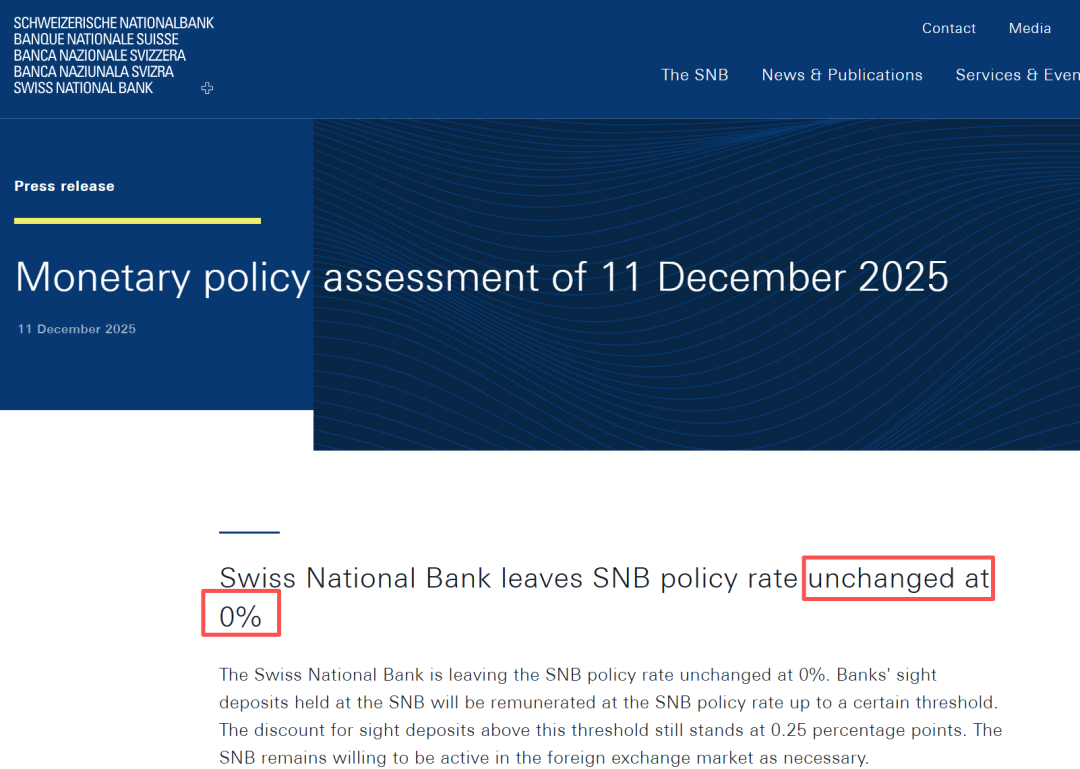
Group 1 - The Swiss National Bank (SNB) has maintained its policy interest rate at 0%, aligning with market expectations [4][8] - Following the announcement, the Swiss Franc strengthened slightly, with the USD/CHF exchange rate decreasing by 0.15% [4] - The SNB is prepared to intervene in the foreign exchange market if necessary [4] Group 2 - Recent inflation in Switzerland has been slightly below expectations, with the inflation rate dropping from 0.2% in August to 0% in November, primarily due to slower price increases in sectors like hospitality, rent, and clothing [6] - The Swiss economy contracted in the third quarter, mainly due to the pharmaceutical sector, while other manufacturing and service sectors showed slight growth [6] - The SNB has revised its GDP growth forecast for 2025 to slightly below 1.5% and for 2026 to approximately 1% [6] Group 3 - The SNB's decision to maintain a 0% interest rate reflects a cautious approach to avoid destabilizing the financial system, despite previous expectations of potential negative interest rates [8] - Recent inflation data being lower than the SNB's prior predictions has led to increased market speculation about the possibility of negative interest rates [8][9] - The recent trade agreement between the US and Switzerland, which reduced tariffs on Swiss goods from 39% to 15%, has alleviated some concerns regarding negative interest rate expectations [8]
刚刚宣布,0利率!
中国基金报· 2025-12-11 10:15
Group 1 - The Swiss National Bank (SNB) has maintained its policy interest rate at 0%, aligning with market expectations [2][4] - Following the announcement, the Swiss Franc strengthened slightly, with the USD/CHF exchange rate dropping by 0.15% to a low not seen since mid-November [4] - Recent inflation in Switzerland has been slightly below expectations, with the inflation rate decreasing from 0.2% in August to 0% in November, primarily due to slower price increases in the hotel, rental, and clothing sectors [6] Group 2 - The Swiss economy contracted in the third quarter, mainly due to the pharmaceutical sector, while other manufacturing and service industries showed slight growth [6] - The SNB projects GDP growth to be slightly below 1.5% in 2025 and around 1% in 2026, with the unemployment rate expected to continue rising slightly [6] - Based on the 0% interest rate assumption, the SNB has revised its inflation forecasts downwards, with the 2026 inflation expectation lowered from 0.5% to 0.3% and the 2027 expectation from 0.7% to 0.6% [7] Group 3 - Economists believe that the current decision-makers at the SNB are unlikely to take actions that could destabilize the financial system, such as moving interest rates back into negative territory [9] - The SNB's recent rate cut to 0% in June was the sixth reduction since the start of the easing cycle in March 2024, raising concerns about the potential return of negative interest rates [9] - Analysts suggest that if inflation forecasts are adjusted down to around 0.2% or close to zero, it may signal serious concerns from policymakers regarding economic conditions [12]

避险买盘推升瑞郎 负利率预期引关注
Jin Tou Wang· 2025-12-04 02:45
Group 1 - The core focus of the article is on the Swiss franc's performance against the US dollar, driven by risk aversion and policy expectations, with the exchange rate hovering around 0.8000, close to its low since the 2015 Swiss franc crisis [1] - The Swiss National Bank (SNB) faces a policy dilemma, having kept the benchmark interest rate at 0% after six consecutive cuts, while indicating that rates could go below zero if necessary, amidst a 13% appreciation of the franc against the dollar this year [1][2] - Economic fundamentals are under pressure, with Switzerland's GDP contracting by 0.5% in Q3 2023, marking the first negative growth since Q2 2023, primarily due to weakness in the chemical and pharmaceutical sectors [2] Group 2 - Trade tensions remain a concern, despite a reduction in export tariffs from 39% to 15% under the US-Swiss agreement, as the US accounts for over 10% of Swiss exports, creating uncertainty that dampens business confidence [2] - Inflation in Switzerland is at 0.3%, nearing the lower limit of the 0-2% target range, raising concerns about deflation risks and the impact of currency appreciation [2] - Market expectations for negative interest rates have intensified, with an 80% probability of a rate cut to zero by June, although opinions vary among institutions regarding the likelihood of further easing or potential rate hikes [2] Group 3 - The Federal Reserve's policy direction is amplifying exchange rate volatility, with an 87% probability of a 25 basis point rate cut in December, which should typically ease pressure on the franc, but geopolitical tensions and stock market fluctuations are enhancing the franc's safe-haven appeal [3] - Technical indicators show that the USD/CHF pair has been trading below 0.80 for four consecutive days, with a significant drop to 0.7992, while the largest Swiss franc ETF has seen a 5% increase in holdings, indicating rising demand for safe-haven assets [3] - Short-term focus is on two key events: the US PCE data on December 5, which could influence Fed rate cut expectations, and the Fed's decision on December 10, which may exacerbate pressure on the dollar [3]