铁矿石价格波动

Search documents
铁矿石周度报告-20260329
Guo Tai Jun An Qi Huo· 2026-03-29 09:29
1. Report Industry Investment Rating No relevant information is provided in the report. 2. Core View of the Report - Due to the expectation of a缓和 in negotiations, the driving force for the iron ore price to rise is weakening, leading to a decline in the ore price. The supply of iron ore is increasing year - on - year, while the demand is recovering slowly, and the port inventory is slightly decreasing from a high level [3][5]. 3. Summary According to Relevant Catalogs 3.1 Iron Ore Weekly View - **Supply**: Global shipments reached 3144.30 million tons, a 3.1% week - on - week increase and a 1.9% year - on - year increase. Australian shipments were 1909.40 million tons, up 5.3% week - on - week and 2.4% year - on - year. Brazilian shipments were 548.90 million tons, down 4.0% week - on - week and 13.8% year - on - year. The arrival volume at 45 ports was 2271.60 million tons, a 2.6% week - on - week increase and a 9.5% year - on - year decrease [4]. - **Demand**: The molten iron output was 231.09 million tons, a 1.3% week - on - week increase and a 2.6% year - on - year decrease. Steel mills' profits are at a low level, and the resumption of molten iron production is slow. Steel mills purchase on demand without excessive restocking [4][5]. - **Inventory**: The inventory at 45 ports was 17000.31 million tons, a 0.6% week - on - week decrease and a 17.1% year - on - year increase. BHP's iron ore inventory is about 0.2 billion tons, and the available inventory at 45 ports is about 1.5 billion tons, with a relatively low structural inventory [4][5]. 3.2 Iron Ore Price Spreads - Last Friday, the spot price of PB powder was 783 (-12) yuan/ton, and the price of the 05 contract was 812 (-4) yuan/ton. The basis of the 05 contract was 9 (-5) yuan/ton, and the 05 - 09 spread was 24 (-10.5) yuan/ton [10]. 3.3 Iron Ore Supply - **Global and Major Mines**: Mainstream and non - mainstream shipments are increasing year - on - year. The four major mines are maintaining normal shipping levels. The domestic mines have resumed production after the festival, and the output has increased [5][17][34]. - **Specific Data**: The global iron ore shipments, Australian shipments, and some mine shipments to China show different trends in week - on - week and year - on - year comparisons. For example, FMG's shipments to China increased by 16.9% week - on - week and 31.0% year - on - year, while Vale's global shipments decreased by 7.9% week - on - week and 20.5% year - on - year [4]. 3.4 Iron Ore Demand - **Overall Demand**: The demand expectation is dull. After the end of production restrictions, the output has increased, but steel mills' profits are low, and the resumption of molten iron production is slow. Steel mills mainly purchase on demand without excessive restocking [35][39]. - **Other Aspects**: Steel mills are accelerating the pulling of goods, and the port clearance is stronger than the molten iron production. The medium - grade ore is in short supply, and attention should be paid to the delivery game. The cost - effectiveness of scrap steel is lower than that of molten iron [40][44][46]. 3.5 Iron Ore Inventory - In the context of weak demand expectations, it is expected that steel mills will purchase on demand. The inventory at 45 ports is slightly decreasing from a high level, and the Australian ore inventory has increased significantly [48][50]. 3.6 Iron Ore Cost The rise in oil prices has led to an increase in freight rates, which is reflected in the upward trend of BCI, BDI, and sea freight rates from Western Australia to Qingdao and Tubarao to Qingdao [52].
铁矿石:谈判博弈,矿价波动加剧
Guo Tai Jun An Qi Huo· 2026-03-27 02:16
1. Report Industry Investment Rating - No specific industry investment rating is provided in the report 2. Core Viewpoints of the Report - The price fluctuations of iron ore are not driven by supply - demand factors but by the structural contradictions between cost and inventory, including rising energy costs and freight, low available port inventory, and restricted deliverable goods [1] - The 2026 government work report aims to stabilize expectations, adjust the structure, prevent risks, and promote reforms, with a more realistic GDP growth target and an increased scale of policy - based financial instruments [2] - The daily average pig iron output of 247 steel enterprises is 231.09 million tons, a month - on - month increase of 2.94 million tons [2] 3. Summary by Relevant Catalogs 3.1 Fundamental Tracking - **Futures Data**: The closing price of iron ore futures increased by 10.5 yuan/ton, with a growth rate of 1.30%. The price of contract I2605 is 817.0 yuan/ton, the yesterday's position is 408,026 hands, with a change of - 6,288 hands [1] - **Spot Price**: The prices of imported ores such as Carajás fines (65%), PB fines (61.5%), Jinbuba fines (61%), and Super Special fines (56.5%) all increased, while the prices of domestic ores such as Hanxing (66%) and Laiwu (65%) remained unchanged [1] - **Basis and Spread**: The basis of I2605 against Super Special fines and Jinbuba fines decreased. Spreads such as I2605 - I2609, I2609 - I2701, and the price difference between different ore types showed certain changes [1] 3.2 Macro and Industry News - The price fluctuations of iron ore are due to cost and inventory structural contradictions, not supply - demand factors [1] - The 2026 government work report focuses on stabilizing expectations, adjusting the structure, preventing risks, and promoting reforms, with a more realistic GDP growth target and an increased scale of policy - based financial instruments [2] - The daily average pig iron output of 247 steel enterprises increased by 2.94 million tons month - on - month [2] 3.3 Trend Intensity - The trend intensity of iron ore is 0, indicating a neutral trend [3]
铁矿石:技术面高位,波动加剧
Guo Tai Jun An Qi Huo· 2026-03-24 02:16
Report Industry Investment Rating - Not provided in the report Core Viewpoints - The strength of iron ore prices is not driven by supply - demand factors but by structural contradictions in cost and inventory, including rising energy costs and shipping freight, low available port inventories, and restricted deliverable items with a higher price of the lowest deliverable item [1] - The 2026 government work report aims to stabilize expectations, focusing on adjusting the economic structure, preventing risks, and promoting reforms. The GDP growth target is adjusted from "around 5%" to "4.5% - 5.0%", and the scale of policy - based financial instruments is increased [2] - The daily average hot metal output of 247 steel enterprises is 228.18 tons, a month - on - month increase of 6.95 tons [2] Summary by Relevant Catalogs Fundamental Tracking - **Futures Data**: The closing price of I2605 is 819.0 yuan/ton, up 3.5 yuan/ton (0.43%); the position is 441,933 hands, a decrease of 8,257 hands [1] - **Spot Price**: The prices of various iron ore types (such as Carajás fines, PB fines, etc.) have different changes, with some rising and some remaining stable [1] - **Basis and Spread**: The basis and spread of different iron ore varieties have changed, such as the basis of I2605 against Super Special and Jinbuba has decreased by 1.3 yuan/ton, and the spread between different contracts has also changed [1] Macro and Industry News - The strength of iron ore prices is due to cost and inventory contradictions rather than supply - demand factors [1] - The 2026 government work report has adjusted the GDP growth target and increased the scale of policy - based financial instruments [2] - The daily average hot metal output of 247 steel enterprises has increased [2] Trend Intensity - The trend intensity of iron ore is 1, indicating a moderately positive trend [3]
晨报铁矿石:铁矿石:需求环比回升,矿价高位震荡-20260320
Hua Bao Qi Huo· 2026-03-20 05:13
1. Report Industry Investment Rating - Not provided in the given content 2. Core View of the Report - Macro drivers remain weak, short - term iron ore supply - demand relationship improves marginally, geopolitical factors increase iron ore costs, but supply - demand changes and cost increases can't support rapid and significant price increases. Short - term iron ore prices are not determined by fundamentals, with over - heated market speculation. Later, beware of market sentiment decline and regulatory risks, especially trade negotiation progress. In the long run, trade restrictions won't change the loose supply - demand pattern, and the release of spot liquidity will put significant pressure on prices. [5] 3. Summary by Relevant Catalogs Supply - External ore supply has decreased both month - on - month and year - on - year. Brazil's output hasn't fully recovered due to precipitation, and there are concerns about the impact of US - Iran geopolitical factors on Iran's global iron ore supply, along with transfer pressure from other countries. Domestic ore supply is expected to enter a seasonal recovery cycle. Overall, short - term supply - side pressure has decreased month - on - month. [3] Demand - Domestic demand is in a recovery cycle. After the lifting of environmental restrictions in Hebei, concentrated resumption of production has led to a significant increase in hot metal. Recently, the significant weakening of the basis has driven speculative demand. However, the probability of terminal demand growing beyond expectations is low. Later, attention should be paid to the de - stocking slope of steel inventories and the intensity of resumption of work. It is expected that domestic iron ore demand has some support but the possibility of exceeding expectations is low, and the upward drive on the demand side is neutral. [4] Inventory - The resumption of production at steel mills has driven restocking demand, and the inventory level at steel mills has increased month - on - month. Port inventories have decreased month - on - month, and short - term port inventory pressure has weakened. With the recovery of domestic demand and trade restrictions, the structural contradiction of domestic inventories still exists, and there is an expectation of inventory de - stocking. The upward drive on the inventory side is moderately strong. [4] Price - The expected price range is 104 - 109 US dollars/ton (61% index), corresponding to Dalian iron ore futures at 790 - 825 yuan/ton. [5] Strategy - Adopt range - bound operation and sell call options. [5]
2026年3月16日宝城期货铁矿石早报-20260316
Bao Cheng Qi Huo· 2026-03-16 01:48
Group 1: Report Industry Investment Rating - There is no information about the report industry investment rating in the provided content. Group 2: Core Viewpoints of the Report - The short - term view of Iron Ore 2605 is slightly bullish, the medium - term view is oscillatory, and the intraday view is slightly bearish. It is recommended to pay attention to the support at the MA5 line. The core logic is that the current situation is weakly stable, and the ore price fluctuates at a high level [2]. - The BHP variety trading restriction has intensified the ore price fluctuations. The iron ore supply - demand pattern continues to operate weakly and stably. Steel mill production is restricted, and the terminal consumption of ore continues to decline. After the meeting, steel mills will gradually resume production, improving ore demand, but the profit situation of steel mills is not good, and the incremental space is questionable. Domestic port arrivals have increased significantly, while miner shipments have declined from a high level. According to the shipping schedule, subsequent arrivals will be stable, and domestic ore supply continues to recover, with ore supply increasing steadily. Currently, the increase in transportation costs and the liquidity contradiction caused by variety trading restrictions support the ore price to rise oscillatively. However, under the situation of stable supply and weak demand, the fundamentals of the ore market operate weakly and stably, with weak upward driving force. It is expected that the ore price will turn to high - level oscillation, and attention should be paid to the performance of steel prices [3]. Group 3: Summary According to the Catalog Variety Viewpoint Reference - For Iron Ore 2605, the short - term is slightly bullish, the medium - term is oscillatory, and the intraday is slightly bearish. The reference view is to pay attention to the support at the MA5 line, and the core logic is the weakly stable current situation and high - level oscillation of ore prices [2]. Market Driving Logic - The BHP variety trading restriction leads to intensified ore price fluctuations. The iron ore supply - demand pattern is weakly stable. Steel mill production is limited, and ore consumption is decreasing. After the meeting, steel mills will resume production, but the profit of steel mills is poor. Port arrivals have increased, miner shipments have decreased, and domestic ore supply is recovering. Transportation cost increase and trading restrictions support the ore price, but the upward driving force is weak, and the ore price is expected to oscillate at a high level [3].
铁矿石早报-20260106
Yong An Qi Huo· 2026-01-06 01:14
Report Summary 1) Industry Investment Rating - No information provided about the industry investment rating. 2) Core Viewpoint - No clear core viewpoint is presented in the given content; it mainly provides price data of various iron ore varieties and futures contracts. 3) Summary by Relevant Catalog Spot Market - **Australian mainstream ores**: Newman powder is priced at 798, down 7 from the previous day and up 4 for the week, with a discounted futures price of 854.2; PB powder is at 806, down 2 and up 9; Mac powder is at 808, down 2 and up 13; Jinbuba powder is at 759, down 2 and up 9; Mixed powder is at 742, up 2 and up 2; Super special powder is at 684, up 4 and up 9; Carajás powder is at 895, up 10 and up 20 [1]. - **Brazilian mainstream ores**: Brazilian mixed ore is at 852, down 6 and up 19; Brazilian coarse IOC6 is at 770, down 2 and up 9; Brazilian coarse SSFG is at 775, down 2 and up 9 [1]. - **Other ores**: Ukrainian concentrate powder is at 884, up 6 and up 11; 61% Indian powder is at 748, down 2 and up 9; Karara concentrate powder is at 885, up 3 and up 7; Roy Hill powder is at 793, down 2 and up 9; KUMBA powder is at 865, down 2 and up 9; 57% Indian powder is at 619, up 4 and up 9; Atlas powder is at 737, up 2 and up 2; Tangshan iron concentrate powder is at 976, down 6 and down 6 [1]. Futures Market - **DCE contracts**: i2601 is at 814.5, up 9.5 from the previous day and up 13 for the week, with a monthly spread of -39.5; i2605 is at 797.0, up 7.5 and up 14, with a spread of 17.5; i2609 is at 775.0, up 6.5 and up 14, with a spread of 22.0 [1]. - **SGX contracts**: FE01 is at 105.55, up 0.20 and up 0.88, with a spread of -3.24; FE05 is at 104.26, up 0.24 and up 1.24, with a spread of 1.29; FE09 is at 102.31, up 0.26 and up 1.29, with a spread of 1.95 [1]. Other Data - **Import profit**: Newman powder's import profit is 14.42; Mac powder's is 49.11; Jinbuba powder's is 44.36; Mixed powder's is 5.63; Super special powder's is 1.34; Carajás powder's is -14.77; Brazilian mixed ore's is 14.89; Roy Hill powder's is 56.49 [1]. - **Premium data**: Information about U - ball/pellet premium and PB block/lump ore premium is presented in the form of charts, but specific numerical data is incomplete [1].
【看新股】马矿股份冲刺上交所主板:拟募资10亿扩能铁矿采选 客户集中度较高
Zhong Guo Jin Rong Xin Xi Wang· 2025-12-10 23:39
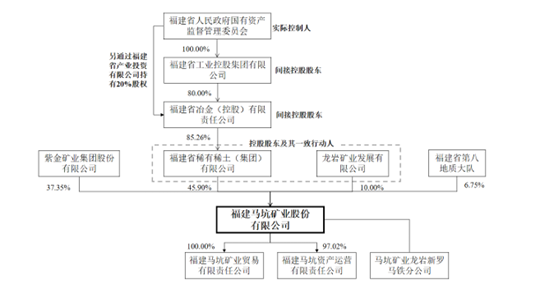
Core Viewpoint - Fujian Makeng Mining Co., Ltd. plans to go public on the Shanghai Stock Exchange, aiming to raise 1 billion yuan for the expansion of its iron ore mining project, with a focus on increasing production capacity and improving operational efficiency [1][4]. Group 1: Company Overview - Makeng Mining was established in 1995 and specializes in iron ore resource development and utilization [2]. - As of the signing date of the prospectus, Fujian Rare Earth holds 45.90% of the shares, making it the largest shareholder, while the Fujian Provincial State-owned Assets Supervision and Administration Commission indirectly controls 55.9% of the voting rights [2][4]. Group 2: Financial Performance - The company reported stable financial performance with revenues of 2.057 billion yuan, 1.962 billion yuan, 2.050 billion yuan, and 1.045 billion yuan for the years 2022, 2023, 2024, and the first half of 2025, respectively [5]. - The net profit attributable to the parent company for the same periods was 659 million yuan, 654 million yuan, 664 million yuan, and 362 million yuan, indicating consistent profitability [5]. Group 3: Business Operations - The main products include iron concentrate, molybdenum concentrate, and limestone, with iron concentrate accounting for over 90% of the main business revenue from 2022 to the first half of 2025 [7][8]. - The company relies heavily on the Makeng Iron Mine, with no other mining operations, which poses a risk if any adverse events affect this single source [8]. Group 4: Market Dynamics - The company's revenue is primarily generated from sales to steel enterprises in Fujian Province, with a high customer concentration, where the top five customers accounted for 96.89%, 97.68%, 92.50%, and 82.21% of annual revenue from 2022 to the first half of 2025 [11]. - Fluctuations in iron ore prices significantly impact the company's financial performance, with potential declines in prices due to macroeconomic factors and competition from major global mining companies [12].

铁矿石月报:铁水支撑仍存,关注限产预期-20250808
Wu Kuang Qi Huo· 2025-08-08 14:45
Report Industry Investment Rating No relevant content provided. Core Viewpoints - In July, the "anti-involution" sentiment drove the overall sentiment of commodities. The supply and demand of iron ore were relatively good, and the price rose under the influence of sentiment. After the sentiment subsided, the price fluctuated. In August, the supply is expected to recover to some extent as July was the traditional off-season for overseas mines' shipments, and the near-term arrivals may increase. The daily average hot metal output is expected to remain at a relatively high level, but the weakening demand of the downstream terminal needs attention. The port inventory is expected to rise slightly. Overall, the focus of the black sector remains on coking coal, and the iron ore fundamentals do not show obvious contradictions, with the price expected to fluctuate. Attention should also be paid to the possible impact of the production restriction expectations in the Beijing-Tianjin-Hebei region before the "September 3rd Parade" [13][14]. Summary by Directory 1. Monthly Assessment and Strategy Recommendation - **Supply**: The weekly average of global iron ore shipments in July was 30.73 million tons, a month-on-month decrease of 3.5885 million tons. The weekly average of Australia's shipments to China was 14.1845 million tons, a decrease of 3.3958 million tons from the previous month. The weekly average of Brazil's shipments was 8.1408 million tons, a decrease of 0.2047 million tons. The weekly average of arrivals at 45 ports was 24.3943 million tons, a month-on-month decrease of 0.4045 million tons [13]. - **Demand**: The domestic daily average hot metal output in July was 2.4126 million tons, a decrease of 0.0054 million tons from the previous month [13]. - **Inventory**: At the end of July, the inventory of imported iron ore at 45 ports was 136.8623 million tons, a decrease of 2.44 million tons from the end of the previous month. The weekly average of the daily ore removal volume at 45 ports was 3.1917 million tons, an increase of 0.0549 million tons from the previous month. The inventory of imported iron ore at steel mills was 88.8522 million tons, an increase of 0.3775 million tons from the end of the previous month [13]. 2. Futures and Spot Market - **Price Spreads**: At the end of July, the PB - Super Special powder spread was 126 yuan/ton, a month-on-month increase of 18 yuan/ton. The Carajás - PB powder spread was 104 yuan/ton, a month-on-month increase of 7 yuan/ton. The Carajás - Jinbuba powder spread was 146 yuan/ton, a month-on-month decrease of 14 yuan/ton. The ((Carajás + Super Special powder)/2 - PB powder) spread was -11 yuan/ton, a month-on-month decrease of 5.5 yuan/ton [19][22]. - **Feeding Ratio and Scrap Steel**: At the end of July, the pellet feeding ratio was 15.22%, an increase of 0.83 percentage points from the end of the previous month. The lump ore feeding ratio was 12.23%, an increase of 0.35 percentage points. The sinter feeding ratio was 72.55%, a decrease of 1.18 percentage points. The price of scrap steel in Tangshan was 2265 yuan/ton, an increase of 40 yuan/ton from the end of the previous month, and in Zhangjiagang was 2150 yuan/ton, an increase of 50 yuan/ton [25]. - **Profit**: At the end of July, the steel mill profitability rate was 63.64%, an increase of 4.33 percentage points from the end of the previous month [28]. 3. Inventory - **Port Inventory**: At the end of July, the inventory of imported iron ore at 45 ports was 136.8623 million tons, a decrease of 2.44 million tons from the end of the previous month. The pellet inventory was 3.9029 million tons, a decrease of 0.9653 million tons. The iron concentrate inventory was 10.815 million tons, a decrease of 1.0125 million tons. The lump ore inventory was 16.825 million tons, an increase of 1.7881 million tons. The Australian ore inventory was 61.9325 million tons, an increase of 0.9517 million tons. The Brazilian ore inventory was 47.786 million tons, a decrease of 1.442 million tons [35][38][41]. - **Steel Mill Inventory**: At the end of July, the inventory of imported iron ore at 247 steel mills was 88.8522 million tons, an increase of 0.3775 million tons from the end of the previous month [43]. 4. Supply Side - **Overseas Shipments**: In July, the weekly average of Australia's shipments to China was 14.1845 million tons, a decrease of 3.3958 million tons from the previous month. The weekly average of Brazil's shipments was 8.1408 million tons, a decrease of 0.2047 million tons. The weekly average of Rio Tinto's shipments was 5.788 million tons, a month-on-month decrease of 0.771 million tons. The weekly average of BHP's shipments was 5.4773 million tons, a month-on-month decrease of 0.9315 million tons. The weekly average of Vale's shipments was 6.1115 million tons, a month-on-month increase of 0.0575 million tons. The weekly average of FMG's shipments was 3.5103 million tons, a month-on-month decrease of 0.9163 million tons [49][52][55]. - **Arrivals and Imports**: The weekly average of arrivals at 45 ports in July was 24.3943 million tons, a month-on-month decrease of 0.4045 million tons. In June, China's non-Australian and non-Brazilian iron ore imports were 15.4151 million tons, a month-on-month decrease of 2.6103 million tons [58]. - **Domestic Mines**: At the end of July, the capacity utilization rate of domestic mines was 61.51%, a decrease of 1.45 percentage points from the end of the previous month. The daily average output of iron concentrate from domestic mines was 480300 tons, a decrease of 11300 tons from the end of the previous month [61]. 5. Demand Side - **Hot Metal Production**: The domestic hot metal output in July was 74.79 million tons, with a daily average of 2.4126 million tons, a decrease of 0.0054 million tons from the previous month. At the end of July, the blast furnace capacity utilization rate was 90.81%, a decrease of 0.02 percentage points from the end of the previous month [66]. - **Ore Removal and Consumption**: In July, the weekly average of the daily ore removal volume at 45 ports was 3.1917 million tons, an increase of 0.0549 million tons from the previous month. The weekly average of the daily consumption of imported iron ore at 247 steel mills was 3.0041 million tons, a decrease of 0.0038 million tons from the previous month [69]. 6. Basis - As of July 31, the basis of the iron ore IOC6 main contract was 50.07 yuan/ton, and the basis rate was 6.04% [74].
铁矿石:铁水港存疏港下降 铁矿跟随钢材价格波动
Jin Tou Wang· 2025-08-01 02:04
Market Overview - The mainstream spot prices for iron ore remain stable, with PB powder at 772.0 CNY/ton and lump ore at 874.0 CNY/ton [1] Futures Market - As of July 31, the main iron ore futures contract 2509 closed at 789.0 CNY/ton, down 2.38%, while the distant month 2601 contract closed at 766.0 CNY/ton, down 2.65% [2] Basis - The optimal delivery product is lump ore, with costs for lump ore, PB powder, mixed powder, and JMB powder at 793.4 CNY/ton, 818.4 CNY/ton, 823.4 CNY/ton, and 831.6 CNY/ton respectively. The basis for the 09 contract is 14.4 CNY/ton for lump ore, 39.4 CNY/ton for PB powder, 44.4 CNY/ton for mixed powder, and 52.6 CNY/ton for JMB powder [3] Demand - Daily iron output is 2.4071 million tons, down by 15,200 tons month-on-month; the blast furnace operating rate is 83.46%, unchanged; the capacity utilization rate is 90.24%, down by 0.57%; and the profit margin for steel mills is 65.37%, up by 1.73% [4] Supply - Global shipments increased by 918,000 tons week-on-week to 32.09 million tons, while the port arrival volume decreased by 130,700 tons to 22.405 million tons. The national monthly import volume is 105.948 million tons, up by 782,000 tons [5] Inventory - Port inventory saw a slight decrease, with average daily dispatch volume down month-on-month. The inventory at 45 ports is 136.579 million tons, down by 1.3248 million tons; average daily dispatch volume is 3.0271 million tons, down by 124,400 tons; and steel mills' imported ore inventory is 90.1209 million tons, up by 1.2687 million tons [6] Market Sentiment - The iron ore 09 contract experienced a volatile downward trend. Despite an increase in global shipments, the volumes from Australia and Brazil slightly declined, and port arrivals decreased. Steel mills maintain high profit margins, with iron output slightly declining but remaining around 2.4 million tons per day. The demand from the end market shows strong performance despite seasonal weakness. Inventory levels at ports are decreasing, while steel mills' inventories are rising. Looking ahead, iron output is expected to remain high in August, averaging around 2.35 million tons per day, supported by improving steel mill profits. New supply-side policies are anticipated, and there are expectations of production restrictions in Hebei ahead of the military parade [7]
铁矿石价格持续低迷 力拓(RIO.US)上半年利润跌至五年低点
智通财经网· 2025-07-30 07:05
Core Viewpoint - Rio Tinto, the world's largest iron ore producer, reported its lowest half-year underlying profit in five years due to weak iron ore prices driven by oversupply concerns and sluggish demand, offsetting gains from its copper business [1] Financial Performance - For the six months ending June 30, Rio Tinto's underlying profit was $4.81 billion, below market expectations of $5.05 billion, marking the worst half-year performance since 2020 [1] - The interim dividend for the first half of the year was announced at $1.48 per share, down from $1.77 per share the previous year [1] Market Conditions - Iron ore prices declined in the first half of the year due to reduced steel production in China and increased iron ore supply from Australia, Brazil, and South Africa, negatively impacting Rio Tinto's earnings from steelmaking raw materials [1] - A Morgan Stanley report indicated that iron ore prices could rebound to $100 per ton by the end of the year, as the market anticipates China will curb steel industry overcapacity and replenish inventories by the end of 2025 [1] Strategic Focus - The company is shifting its focus towards its copper business in response to the challenging iron ore market conditions [1]