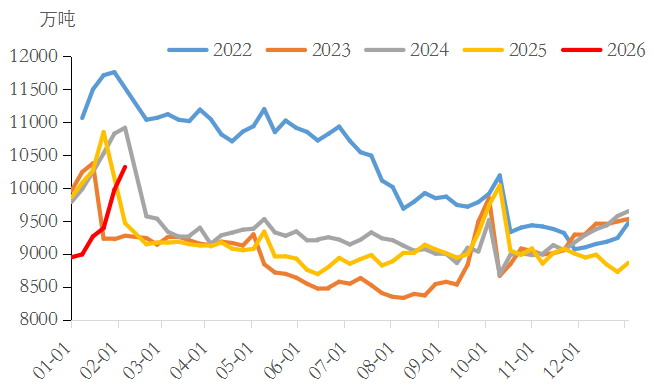
铁矿石价格走势

Search documents
铁矿石:铁水复产偏慢,矿价承压
Guo Tai Jun An Qi Huo· 2026-04-01 02:38
Report Summary 1. Report Industry Investment Rating - Not provided in the report 2. Core View of the Report - Due to the slow recovery of hot metal production, iron ore prices are under pressure. The previous structural contradictions that drove the iron ore price to a relatively high level are expected to ease, leading to a decline in the ore price [1][2] 3. Summary by Relevant Catalogs 3.1 Fundamentals Tracking - **Futures Data**: The closing price of I2605 was 808.0 yuan/ton, down 5.0 yuan/ton (-0.62%). The持仓 was 353,624 hands, a decrease of 17,797 hands [1] - **Spot Prices**: Imported ore prices, including Carajás fines (65%), PB fines (61.5%), Jinbuba (61%), and Super Special (56.5%), all decreased. Domestic ore prices of Hanxing (66%) and Laiwu (65%) remained unchanged [1] - **Basis and Spreads**: The basis of I2605 against Super Special increased by 1.7 yuan/ton, while the basis against Jinbuba decreased by 2.5 yuan/ton. The spreads between different contracts and different ore types also changed [1] 3.2 Macro and Industry News - The previous structural contradictions such as rising freight rates, limited spot liquidity, and the upward shift of the price of the lowest deliverable product drove the iron ore price to a relatively high level. Recently, there are expectations of easing in negotiations, and the driving force is expected to weaken, leading to a decline in the ore price [1] - The 2026 government work report focuses on stabilizing expectations, adjusting the structure, preventing risks, and promoting reforms. The GDP growth target is adjusted from "around 5%" to "4.5%-5.0%", and the scale of policy financial instruments is increased [2] - The daily average hot metal output of 247 steel enterprises was 231.09 tons, a month-on-month increase of 2.94 tons [2] 3.3 Trend Intensity - The trend intensity of iron ore is -1, indicating a bearish outlook [3]
宏源期货:宏源期货-2026-03-30涨跌
Hong Yuan Qi Huo· 2026-04-01 01:01
Group 1: Report Industry Investment Rating - Not provided Group 2: Core Viewpoints of the Report - The short - term price of near - end iron ore is supported by factors such as the decrease in Australian shipments due to hurricanes, the increase in Brazilian shipments, the improvement of molten iron production after the Two Sessions, and the enhanced expectation of rising shipping costs caused by geopolitical conflicts. However, the medium - and long - term trend depends on the intensity of steel mill复产, the recovery rhythm of molten iron production, and the actual realization of terminal demand. The de - stocking pressure under the high - inventory background will restrict the upward movement of prices. The short - term trend is expected to be volatile, and cautious operation is recommended [2] Group 3: Summary by Relevant Catalogs 1. Basis Rate and Spot Price - The basis rate of I2701 on March 31, 2026, was 769.0, down 2.5 from March 30; the basis rate of I2605 was 808.0, down 5.0; the basis rate of I2609 was 786.5, down 2.0. The spot prices of various iron ore varieties also showed different degrees of decline, such as the price of Jinbuba powder dropped from 737 to 730, a decrease of 7.0 [1] 2. Index and Import Profit - Mysteel 65% index decreased by 21, Mysteel 62% index decreased by 30, Mysteel 58% index decreased by 21. Import profits of different varieties also changed, for example, the import profit of Newman powder increased by 0.11 [1] 3. MS Inventory - The total iron ore inventory on March 27, 2026, was 17000, down 98 from March 20. Australian ore inventory decreased by 8, Brazilian ore inventory decreased by 44, and trader inventory decreased by 53 [1] 4. Strategy - **Night - session review**: The futures price of iron ore i2605 closed at 815 yuan/ton, i2609 at 792.5 yuan/ton, and the 5 - 9 spread was 22.5 yuan. The price of Qingdao Port PB powder was 777 (-7) yuan/ton, and the optimal delivery product, Newman powder, was 789 yuan after discounting the warehouse receipt (factory warehouse) [1] - **Important information**: From March 23 to March 29, the total iron ore inventory of seven major ports in Australia and Brazil decreased by 120.7 tons to 1273.7 tons. In March, China's manufacturing, non - manufacturing, and comprehensive PMI output indexes all returned to the expansion range. On March 31, the transaction volume of iron ore at major ports increased by 98.5% month - on - month, while the transaction volume of construction steel by 237 mainstream traders decreased by 17.27% month - on - month. As of now, there are about 300 coking production enterprises in China, with a total coke production capacity of about 5.70 billion tons. In mid - March, the output of key coal enterprises increased by 4.8% month - on - month and 3.9% year - on - year [1] - **Trading strategy**: Volatile [2]
铁矿石早报 2026/3/30-20260330
Hong Yuan Qi Huo· 2026-03-30 09:21
1. Report Industry Investment Rating - No relevant information provided 2. Core View of the Report - After the Two Sessions, demand improved and this period's hot metal production increased slightly. The Iran conflict is expected to raise shipping costs, providing short - term support for iron ore prices. However, the medium - and long - term trend depends on the intensity of steel mill复产, the recovery rhythm of hot metal production, and the actual fulfillment of terminal demand. The de - stocking pressure under the high - inventory background will restrict the later price increase. Short - term negotiation progress should be monitored as prices fluctuate greatly and cautious operation is advised [3] 3. Summary According to Related Catalogs 3.1 Iron Ore Morning Report Data - **Futures Price Changes**: On March 27, 2026, for contract 12701, the price was 769.5, up 2.0 from the previous day; for 12605, it was 812.0, down 5.0; for 12609, it was 788.0, up 0.5 [1] - **Spread Changes**: The spread between 101 - 105 was - 42.5 on March 27, 2026, up 7.0; 105 - 109 was 24.0, down 5.5; 109 - 101 was 18.5, down 1.5 [1] - **Basis Changes**: 01 basis was 20 on March 27, 2026, up 5; 05 basis was - 23, up 19; 09 basis was 1, up 10 [1] - **Spot Price Changes**: The price of Jinbuba powder was 736 on March 27, 2026, down 8.0; PB powder was 783, down 8.0; Ximan powder was 747, unchanged; etc. [1] - **Import Profit Changes**: The import profit of Kabin powder was - 21 on March 27, 2026, down 41; Ximan powder was - 37, down 25; Jinbuba powder was - 13, down 35; etc. [1] - **Inventory and Shipment Data**: Total inventory on March 27, 2026, was 17,000, down 98 from March 20; Australian ore inventory was 8315, down 8; Brazilian ore inventory was 5030, down 44. Australian shipments to the world were 2458 on March 20, up 74 from March 13; Brazilian shipments were 549, down 23 [1] 3.2 Night - Session Review - **Futures and Spot Prices**: Futures iron ore i2605 closed at 813 yuan/ton, i2609 at 790 yuan/ton, and the 5 - 9 spread was 23 yuan. The price of PB powder at Qingdao Port was 783 (-8) yuan/ton, and the standard - product equivalent (warehouse) was 815 yuan. The optimal delivery product, Newman powder, had a warehouse receipt equivalent (warehouse) of 789 yuan [2] 3.3 Important Information - **Military Attack Impact**: On March 27, the US and Israel attacked Iranian steel mills. It is expected to create a rigid supply gap of 500 - 550 tons/year in the short term, with the most prominent gaps in plates, billets, and long - products [2] - **Market Transaction Volume**: On March 27, the national main - port iron ore trading volume was 66.50 tons, a 3.6% decrease from the previous day; 237 mainstream trading companies' construction steel trading volume was 9.44 tons, a 5.9% increase [2] - **Steel - Mill Production Indicators**: Last week, the blast - furnace operating rate of 247 steel mills was 81.03%, a 1.25 - percentage - point increase; the profit rate of steel mills was 43.29%, a 0.87 - percentage - point increase; the daily average hot - metal output was 231.09 tons, a 2.94 - ton increase. The average capacity utilization rate of 94 independent electric - arc - furnace steel mills was 58.87%, a 2.3 - percentage - point increase from the previous week and a 3.87 - percentage - point increase year - on - year. The average operating rate was 68.82%, a 1.93 - percentage - point increase from the previous week and a 4.51 - percentage - point decrease year - on - year [2] - **Real - Estate Transaction Data**: On March 28, the single - day online - signing trading volume of second - hand houses (including commercial properties) in Shanghai reached 1585 units, setting a new high in the past 5 years [3] 3.4 Long - Short Logic and Trading Strategy - **Long - Short Logic**: Friday's spot - market trading volume decreased, and spot prices fell by 3 - 8 yuan. In the short term, demand improvement, increased hot - metal output, and expected higher shipping costs support the iron - ore price. In the long term, the price trend depends on steel - mill复产, hot - metal output recovery, and terminal - demand fulfillment. High - inventory de - stocking pressure restricts price increases [3] - **Trading Strategy**: No specific trading strategy provided in the report
铁矿石周报:多因素扰动,矿价高位震荡-20260328
Wu Kuang Qi Huo· 2026-03-28 14:36
1. Report Industry Investment Rating No relevant content provided. 2. Core View of the Report - The latest overseas ore shipments continued to recover. Australian shipments increased to a relatively high level, while Brazilian shipments declined slightly. Non - mainstream country shipments remained stable. Near - end arrivals increased month - on - month. - The daily average hot metal production recovered, with blast furnaces that were shut down for maintenance due to production restrictions basically resuming normal production. There is still room for an increase in hot metal production in the future. Steel mill profitability continued to recover slightly. - Port inventories continued to decline from a high level, and steel mill imported ore inventories decreased at a low level. - Due to the ongoing conflict in the Middle East, the cost center of ocean freight has shifted upward, strengthening the bottom support for iron ore. Negotiation issues have caused repeated emotional disturbances to prices. Short - term ore prices are expected to fluctuate at a high level. [11][14] 3. Summary by Directory 3.1. Weekly Assessment and Strategy Recommendation - Supply: The latest global iron ore shipments totaled 3,144.3 million tons, a month - on - month increase of 95.5 million tons. Australian and Brazilian iron ore shipments totaled 2,559.4 million tons, a month - on - month increase of 95.0 million tons. Australian shipments were 1,995.7 million tons, a month - on - month increase of 120.4 million tons, with shipments to China at 1,634.8 million tons, a month - on - month increase of 47.6 million tons. Brazilian shipments were 563.8 million tons, a month - on - month decrease of 25.4 million tons. The arrival volume at 47 ports in China was 2,383.1 million tons, a month - on - month increase of 66.1 million tons; the arrival volume at 45 ports in China was 2,271.6 million tons, a month - on - month increase of 56.6 million tons. - Demand: The daily average hot metal production was 231.09 million tons, a month - on - month increase of 2.94 million tons; the steel mill profitability rate was 43.29%, a month - on - month increase of 0.87 percentage points; the blast furnace operating rate was 81.03%, a month - on - month increase of 1.25 percentage points. - Inventory: The total inventory of imported iron ore at 47 ports nationwide was 17,666.83 million tons, a month - on - month decrease of 147.35 million tons; the daily average port clearance volume was 330.31 million tons, a month - on - month decrease of 5.61 million tons. [11] 3.2. Spot and Futures Market - Price Spreads: The PB - Super Special powder price spread was 118 yuan/ton, a month - on - month change of - 5.0 yuan/ton. The Carajás fines - PB powder price spread was 159 yuan/ton, a month - on - month change of + 2.0 yuan/ton. The Carajás fines - Jinbuba powder price spread was 217 yuan/ton, a month - on - month change of + 2.0 yuan/ton. The ((Carajás fines + Super Special powder)/2 - PB powder) price spread was 20.5 yuan/ton, a month - on - month change of + 3.5 yuan/ton. - Feed Ratio and Scrap Steel: The pellet feed ratio was 13.81%, a change of - 0.44 percentage points from the previous period. The lump ore feed ratio was 12.73%, a change of - 0.18 percentage points from the previous period. The sinter feed ratio was 73.45%, a change of + 0.61 percentage points from the previous period. The price of Tangshan scrap steel was 2,195 yuan/ton, a month - on - month change of - 10 yuan/ton. The price of Zhangjiagang scrap steel was 2,180 yuan/ton, a month - on - month change of - 10 yuan/ton. - Profit: The steel mill profitability rate was 43.29%, a month - on - month change of + 0.87 percentage points; the PB powder import profit was - 17.26 yuan/wet ton. [16] 3.3. Inventory - The total inventory of imported iron ore at 45 ports was 17,000.31 million tons, a month - on - month change of - 98.09 million tons. The pellet inventory was 379.66 million tons, a month - on - month change of + 3.02 million tons. - The iron concentrate inventory at ports was 1,647.88 million tons, a month - on - month change of - 41.65 million tons. The lump ore inventory at ports was 1,965.4 million tons, a month - on - month change of - 16.72 million tons. - The Australian ore port inventory was 8,315.38 million tons, a month - on - month change of - 8.42 million tons. The Brazilian ore port inventory was 5,029.89 million tons, a month - on - month change of - 43.98 million tons. - The imported iron ore inventory of 247 steel mills was 8,978.56 million tons, a month - on - month change of - 55.50 million tons. [32] 3.4. Supply Side - The latest 19 - port Australian shipments to China were 1,548.6 million tons, a week - on - week change of + 20.5 million tons. Brazilian shipments were 548.9 million tons, a week - on - week change of - 22.7 million tons. - Rio Tinto's shipments to China were 464.4 million tons, a week - on - week change of - 15.1 million tons. BHP's shipments to China were 392.6 million tons, a week - on - week change of - 53.2 million tons. - Vale's shipments were 377.9 million tons, a week - on - week change of - 32.5 million tons. FMG's shipments to China were 443 million tons, a week - on - week change of + 64.1 million tons. - The latest 45 - port arrivals were 2,271.6 million tons, a week - on - week increase of 56.6 million tons. In February, China's non - Australian and non - Brazilian iron ore imports were 2,018.50 million tons, a month - on - month decrease of 236.55 million tons. - The latest domestic mine capacity utilization rate was 60.42%, a month - on - month change of - 0.39 percentage points. The daily average iron concentrate output of domestic mines was 47.21 million tons, a month - on - month change of - 0.31 million tons. [48] 3.5. Demand Side - The domestic daily average hot metal production was 231.09 million tons, a month - on - month change of + 2.94 million tons. The blast furnace capacity utilization rate was 86.63%, a month - on - month change of + 1.1 percentage points. - The 45 - port daily average iron ore port clearance volume was 284.59 million tons, a month - on - month change of - 7.8 million tons. The daily consumption of imported iron ore by steel mills was 281.15 million tons, a month - on - month change of + 9.2 million tons. [68] 3.6. Basis As of March 27, the calculated iron ore BRBF basis was 10.61 yuan/ton, and the basis rate was 1.29%. [76]
铁矿石:近端交易边际改善,价格坚挺
Guo Tai Jun An Qi Huo· 2026-03-25 02:44
Report Industry Investment Rating - Not provided Core View of the Report - The strength of iron ore prices is not driven by supply and demand but by the structural contradictions of cost and inventory, including rising energy costs and freight, low available port inventory, and restricted deliverable products [1] - The 2026 government work report focuses on stabilizing expectations, adjusting the structure, preventing risks, and promoting reforms, with a more realistic GDP growth target and an increased scale of policy - based financial instruments [2] - The daily average pig iron output of 247 steel enterprises increased by 6950 tons to 2281800 tons [2] Summary by Relevant Catalogs Fundamental Tracking - **Futures Data**: The closing price of I2605 was 824 yuan/ton, up 5 yuan/ton (0.61%), with a position of 445891 hands and an increase of 3958 hands [1] - **Spot Price**: The prices of imported ores such as Carajás fines (65%), PB (61.5%), Jimbara (61%), and Super Special (56.5%) all increased slightly, while the prices of domestic ores such as Hanxing (66%) and Laiwu (65%) remained unchanged [1] - **Basis and Spread**: The basis of I2605 against Super Special decreased by 2.8 yuan/ton, and against Jimbara decreased by 3.9 yuan/ton. The spread of I2605 - I2609 increased by 1 yuan/ton, while I2609 - I2701 remained unchanged. The spread of Carajás fines - PB increased by 2 yuan/ton, PB - Jimbara remained unchanged, and PB - Super Special decreased by 1 yuan/ton [1] Macro and Industry News - The strength of iron ore prices is due to cost and inventory contradictions, including rising energy costs and freight, low available port inventory, and restricted deliverable products [1] - The 2026 government work report aims to stabilize expectations, adjust the structure, prevent risks, and promote reforms, with a more realistic GDP growth target and an increased scale of policy - based financial instruments [2] - The daily average pig iron output of 247 steel enterprises increased by 6950 tons to 2281800 tons [2] Trend Intensity - The trend intensity of iron ore is 1, indicating a relatively strong trend [3]
铁矿石早报-20260320
Hong Yuan Qi Huo· 2026-03-20 02:04
Group 1: Report Industry Investment Rating - No information provided Group 2: Core View of the Report - The trading strategy for iron ore is to expect a volatile market [2] - The short - term support for iron ore prices comes from factors such as improved demand after the Two Sessions, a significant rebound in hot metal production, and the expected increase in shipping costs due to the Iran conflict. However, the medium - to - long - term trend depends on the intensity of steel mill复产, the recovery rhythm of hot metal production, and the actual realization of terminal demand. The de - stocking pressure under the high - inventory background will restrict the upward movement of prices later. The positive spread runs strongly, and short - term attention should be paid to the negotiation progress and cautious operation is required [2] Group 3: Summary According to the Catalog 1. Basis Rate - For I2701 on March 19, 2026, the price was 756.5, down 1.5 from March 18; I01 - I05 was - 51.0, up 2.0 from March 18 [1] - For I2605 on March 19, 2026, the price was 807.5, down 3.5 from March 18; I05 - I09 was 31.5, down 0.5 from March 18 [1] - For I2609 on March 19, 2026, the price was 776.0, down 3.0 from March 18; I09 - I01 was - 1.5, up 2 from March 18 [1] 2. Spot - The prices of various iron ore varieties on March 19, 2026, generally decreased compared with March 18. For example, the price of Jinbuba powder decreased by 3.0 to 743, and the price of PB powder decreased by 3.0 to 790 [1] - The optimal delivery product is Newman powder, with a price of 784 on March 19, 2026, up 16 from March 18 [1] 3. Index - Mysteel 65% index for the current month decreased by 0.80 to 106.30 on March 19, 2026, compared with March 18 [1] - Mysteel 62% index for 1 - month decreased by 1.49 to 107.31 on March 19, 2026, compared with March 18 [1] - Mysteel 58% index for 2 - month decreased by 1.24 to 106.21 on March 19, 2026, compared with March 18 [1] 4. MS Inventory - The total inventory on March 13, 2026, was 17188, up 70 from March 6 [1] - Australian ore inventory was 8329 on March 13, 2026, up 245 from March 6; Brazilian ore inventory was 5105, down 215 from March 6 [1] - The inventory of traders was 11450 on March 13, 2026, up 90 from March 6 [1] 5. Strategy - Night - session review: The futures price of iron ore i2605 closed at 814.5 yuan/ton, and i2609 closed at 781 yuan/ton. The 5 - 9 spread of iron ore was 33.5 yuan. The price of PB powder at Qingdao Port was 790 (- 3) yuan/ton, and the standard - product price (factory warehouse) was 822 yuan. The optimal delivery product, Newman powder, had a warehouse - receipt price (factory warehouse) of 773 yuan [1] - Important information: - This week, the supply of five major steel products was 839.82 million tons, a week - on - week increase of 18.85 million tons, an increase of 2.3%; the total inventory was 1946.23 million tons, a week - on - week decrease of 28.66 million tons, a decrease of 1.5%; the apparent consumption was 868.28 million tons, a month - on - month increase of 8.8% [1] - As of March 18, the resumption rate of 10692 construction sites across the country was 62%, a month - on - month increase of 19.5 percentage points, and a year - on - year decrease of 2.62 percentage points [1] - On March 19, the trading volume of iron ore at major ports across the country was 61.30 million tons, a month - on - month increase of 18.3%; the trading volume of construction steel of 237 mainstream traders was 8.99 million tons, a month - on - month increase of 1.2% [1] - On March 19, the average cost of 76 independent electric - arc furnace construction steel mills was 3403 yuan/ton, remaining stable day - on - day. The average profit was a loss of 89 yuan/ton, and the valley - electricity profit was 22 yuan/ton [1] - From January to February 2026, China's rebar production was 2691.0 million tons, a year - on - year decrease of 9.1% [1]
铁矿石早报2026/3/19-20260319
Hong Yuan Qi Huo· 2026-03-19 10:35
1. Report Industry Investment Rating - The report gives an investment rating of "Oscillation" for the iron ore market [1] 2. Core View of the Report - The recent rise in iron ore prices is mainly driven by the strengthened supply control expectations, which restricts the liquidity of some spot varieties. In the short - term, the price volatility increases. The post - holiday market focuses on post - holiday resumption of work and demand realization. After the Two Sessions, the demand is expected to improve marginally, and the iron water output is expected to rise significantly. The Iran conflict will increase the shipping cost expectations, providing short - term support for ore prices. However, in the medium - to - long - term, the price trend depends on the intensity of steel mill复产, the recovery rhythm of iron water output, and the actual realization of terminal demand. The de - stocking pressure under the high - inventory background will restrict the upward movement of prices. The positive spread runs strongly, and short - term negotiation progress needs to be monitored [1] 3. Summary by Relevant Catalogs 3.1 Futures and Spot Market Data - **Futures**: The iron ore futures i2605 closed at 805 yuan/ton, and i2609 closed at 775.5 yuan/ton. The spread between i2605 and i2609 is 29.5 yuan [1] - **Spot**: The price of PB powder at Qingdao Port is 793 (-4) yuan/ton, and the price after converting to the standard product (factory warehouse) is 825 yuan. The optimal deliverable product, Newman powder, is 776 yuan after converting to the warehouse receipt (factory warehouse) [1] 3.2 Basis and Spread Data - **01 Basis**: For I2701, the basis is 758.0 on March 18, 2026, down 7.0 from March 17, 2026. The basis spread I01 - I05 is 18, and the basis rate is 2.34% [1] - **05 Basis**: For I2605, the basis is 811.0 on March 18, 2026, down 5.5 from March 17, 2026. The basis spread I05 - I09 is 32.0, and the basis rate is - 4.49% [1] - **09 Basis**: For I2609, the basis is 779.0 on March 18, 2026, down 6.5 from March 17, 2026. The basis spread I09 - I01 is 21.0, and the basis rate is - 0.37% [1] 3.3 Index and Import Profit Data - **Index**: Mysteel 65% index for the current month of Carajás fines increased by 0.68 to 107.10 on March 18, 2026; Mysteel 62% index for Newman powder one - month increased by 1.30 to 108.80; Mysteel 58% index for Jimbara powder two - month increased by 1.27 to 107.45 [1] - **Import Profit**: The import profit of Carajás fines decreased by 31 to - 22 on March 18, 2026; the import profit of Newman powder decreased by 20 to - 57; the import profit of Jimbara powder decreased by 24 to - 4 [1] 3.4 Inventory and Shipping Data - **Inventory**: The total iron ore inventory on March 13, 2026 is 17188, an increase of 70 compared to March 6, 2026. The Australian ore inventory is 8329, an increase of 245; the Brazilian ore inventory is 5105, a decrease of 215 [1] - **Shipping**: The Australian shipments to the world on March 13, 2026 is 2385, an increase of 115 compared to March 6, 2026; the Brazilian shipments is 572, a decrease of 3 [1] 3.5 Important News - In February 2026, China exported 463 million tons of steel sheets, a year - on - year decrease of 12.6%. From January to February, the cumulative export was 933 million tons, a year - on - year decrease of 14.5% [1] - On March 18, the transaction volume of iron ore at major ports in China was 51.80 million tons, a month - on - month decrease of 10.7%; the transaction volume of construction steel of 237 mainstream traders was 8.88 million tons, a month - on - month decrease of 4.5% [1] - On March 18, the average cost of 76 independent electric arc furnace construction steel mills was 3403 yuan/ton, a daily increase of 7 yuan/ton, and the average profit was a loss of 86 yuan/ton [1] - From March 1 to 15, the retail volume of the national passenger car market was 56.1 million vehicles, a year - on - year decrease of 21% and a month - on - month increase of 2%. Since the beginning of this year, the cumulative retail volume was 314 million vehicles, a year - on - year decrease of 19% [1] - In early March, the output of key monitored coal enterprises was 6444 million tons, with a daily average output of 644 million tons. The daily average output increased by 38 million tons compared to the late February, a growth of 6.3%, and increased by 9 million tons year - on - year, a growth of 1.4% [1]
新加坡铁矿石交易员反馈;短期目标价上调至约 105 美元 吨,必和必拓仍为核心标的-Global Metals & Mining_ Iron ore trader feedback from Singapore; upside to ~US$105_t seen near term, CMRG_BHP remain in focus
2026-03-10 10:17
Summary of Key Points from the Conference Call Industry Overview - The focus is on the **Iron Ore** trading industry, particularly involving **China Minerals Resource Group (CMRG)** and **BHP** as key players in the market [1][5][6]. Core Insights - **Near-term Price Outlook**: Traders are optimistic about iron ore prices post-Chinese New Year, with expectations for the 61% Fe benchmark price to rise to approximately **US$104-107/dmt** in the next 4-6 weeks due to seasonal demand in China and supply constraints from Australia and Brazil [5][6]. - **Inventory Levels**: Chinese port inventories have increased by about **10%** over the past year to around **162 million tons (Mt)**, attributed to improved shipments from Brazil and Australia. Major miners are reportedly increasing their portside blending activities [5][6][25]. - **Market Dynamics**: The central buying organization in China is gaining market share, reportedly controlling over **50%** of iron ore imports. This organization is pushing for increased trading on the COREX platform, which is a domestic exchange for iron ore trading in RMB [6][7]. Supply Chain Insights - **Seaborne Supply**: Shipments from Brazil have increased year-on-year, while shipments from Simandou are lower than expected, with increases anticipated post the wet season in Guinea. The Middle East exports around **15 million tons per annum (Mtpa)** of iron ore to China [7][8]. - **Freight Rates**: Cape size shipping rates have risen by approximately **20%** recently, now at **US$28/t** from Brazil to China, driven by a spike in oil prices [7][8]. Company-Specific Developments - **BHP and CMRG Negotiations**: Ongoing discussions between BHP and CMRG focus on contractual issues regarding Jimblebar product, particularly agent fees and exclusive marketing rights. BHP is reportedly stockpiling Jimblebar fines at the mine site [6][7]. - **Product Discounts**: Discounts for BHP's key products, including Newman and Mining Area C, have narrowed slightly, indicating a potential impact on realized prices for the current June half [6][7]. Additional Considerations - **Market Sentiment**: Traders express concerns that prices may decline in May due to a slowdown in Chinese construction activity and a rebound in shipments from Australia and Brazil [5][6]. - **Long-term Price Forecast**: The price range for iron ore is expected to stabilize between **US$95-105/dmt** over the next few years, with Indian steel mills expected to step in at **US$90-105/t** [5][6]. This summary encapsulates the key points discussed in the conference call, providing insights into the iron ore market dynamics, company-specific developments, and broader industry trends.
价格偏弱,关注重要会议政策指引
Wu Kuang Qi Huo· 2026-02-28 14:00
1. Report Industry Investment Rating - No information provided in the content 2. Core View of the Report - After the end of the weather impact, overseas supply has recovered, and high inventory restricts the price increase. There are still structural issues to be resolved. The demand side shows a decent recovery in molten iron production. It is expected that the price will fluctuate weakly. Attention should be paid to the policy guidance from the important meetings in March. Also, note the impact of the overseas conflict situation on the market [11][14]. 3. Summary by Relevant Catalogs 3.1. Weekly Assessment and Strategy Recommendation - Supply (2026/02/16 - 2026/02/22): Global iron ore shipments totaled 33.209 million tons, a week - on - week increase of 6.31 million tons. Shipments from Australia and Brazil totaled 27.133 million tons, a week - on - week increase of 5.984 million tons. Australia's shipments were 20.108 million tons, a week - on - week increase of 5.402 million tons, with 17.091 million tons sent to China, a week - on - week increase of 3.949 million tons. Brazil's shipments were 7.025 million tons, a week - on - week increase of 0.582 million tons. China's 47 - port arrivals totaled 23.211 million tons, a week - on - week decrease of 1.746 million tons; 45 - port arrivals totaled 21.524 million tons, a week - on - week decrease of 2.656 million tons [11]. - Demand: The daily average molten iron output was 2.3328 million tons, a week - on - week increase of 0.0279 million tons. The steel mill profitability rate was 39.83%, a week - on - week increase of 1.30 percentage points. The blast furnace operating rate was 80.22%, a week - on - week increase of 0.09 percentage points [11]. - Inventory: The imported iron ore inventory at 47 domestic ports was 178.913 million tons, a week - on - week increase of 1.5918 million tons. The daily average port clearance volume was 3.1353 million tons, a week - on - week decrease of 0.5364 million tons [11]. 3.2. Futures and Spot Market - Price Difference: The PB - Super Special powder price difference was 114 yuan/ton, a pre - holiday change of + 2.0 yuan/ton. The Carajás - PB powder price difference was 128 yuan/ton, a pre - holiday change of + 29.0 yuan/ton. The Carajás - Jinbuba powder price difference was 182 yuan/ton, a pre - holiday change of + 24.0 yuan/ton. The ((Carajás + Super Special powder)/2 - PB powder) price difference was 7.0 yuan/ton, a pre - holiday change of + 13.5 yuan/ton [19][22]. - Feed Ratio and Scrap Steel: The pellet feed ratio was 14.3%, a change of + 0.18 percentage points from the previous period. The lump ore feed ratio was 12.41%, a change of + 0.21 percentage points from the previous period. The sinter feed ratio was 73.3%, a change of - 0.39 percentage points from the previous period. The scrap steel price in Tangshan was 2165 yuan/ton, with a week - on - week change of 0 yuan/ton. The scrap steel price in Zhangjiagang was 2160 yuan/ton, with a week - on - week change of 0 yuan/ton [25]. - Profit: The steel mill profitability rate was 39.83%, a week - on - week change of + 1.3 percentage points. The PB powder import profit was 14.75 yuan/wet ton [28]. 3.3. Inventory - 45 - Port Imported Iron Ore Inventory: It was 170.9196 million tons, a week - on - week change of + 1.4564 million tons. The pellet inventory was 3.6473 million tons, a week - on - week change of - 0.1603 million tons. The iron concentrate powder inventory at ports was 15.6726 million tons, a week - on - week change of - 0.2529 million tons. The lump ore inventory at ports was 19.6457 million tons, a week - on - week change of + 0.1399 million tons [35][38]. - Australian and Brazilian Ore Port Inventory: The Australian ore port inventory was 80.8764 million tons, a week - on - week change of + 2.0616 million tons. The Brazilian ore port inventory was 53.291 million tons, a week - on - week change of - 0.9477 million tons [41]. - Steel Mill Imported Iron Ore Inventory: The imported iron ore inventory of 247 steel mills was 90.851 million tons, a week - on - week change of - 16.1883 million tons [46]. 3.4. Supply Side - Overseas Shipments: The latest 19 - port Australian shipments to China were 16.673 million tons, a week - on - week change of + 3.532 million tons. Brazilian shipments were 6.866 million tons, a week - on - week change of + 0.617 million tons. Rio Tinto's shipments to China were 5.568 million tons, a week - on - week increase of 1.685 million tons. BHP's shipments to China were 5.166 million tons, a week - on - week increase of 1.272 million tons. Vale's shipments were 5.161 million tons, a week - on - week increase of 1.34 million tons. FMG's shipments to China were 4.075 million tons, a week - on - week increase of 0.307 million tons [51][54][57]. - China's Arrivals and Non - Australian and Brazilian Imports: The 45 - port arrivals were 21.524 million tons, a week - on - week decrease of 2.656 million tons. In December, China's non - Australian and Brazilian iron ore imports were 21.9278 million tons, a month - on - month increase of 2.9236 million tons [60]. - Domestic Mine Production: The latest domestic mine capacity utilization rate was 55.34%, a month - on - month change of - 2.68 percentage points. The daily average output of iron concentrate powder from domestic mines was 432,400 tons, a month - on - month change of - 21,000 tons [66]. 3.5. Demand Side - Molten Iron Output and Blast Furnace Utilization: The domestic daily average molten iron output was 2.3328 million tons, a week - on - week change of + 0.0279 million tons. The blast furnace capacity utilization rate was 87.45%, a week - on - week change of + 1.04 percentage points [71]. - Port Clearance and Steel Mill Consumption: The 45 - port daily average iron ore clearance volume was 2.9848 million tons, a week - on - week change of - 0.5271 million tons. The daily consumption of imported iron ore by 247 steel mills was 2.8871 million tons, a week - on - week change of + 0.0317 million tons [74]. 3.6. Basis - As of February 27, the calculated BRBF basis of iron ore was 34.27 yuan/ton, and the basis ratio was 4.37% [79].
铁矿石 继续下跌空间有限
Qi Huo Ri Bao· 2026-02-12 09:20
Core Viewpoint - After the recent price adjustment, iron ore valuations are at a neutral to low level, and with the dual support of steel mills' phased resumption after the holiday and expectations of macro policy strengthening, further downside is limited. However, throughout the year, iron ore is expected to enter a phase of oversupply, with price levels likely to decline further [1][10]. Group 1: Price Trends and Market Dynamics - Since the end of January, iron ore prices have declined primarily due to two reasons: changes in market expectations regarding interest rate cuts and liquidity easing after the appointment of the new Federal Reserve chairman, and cautious raw material restocking by steel mills, with iron ore inventories at 247 steel mills down by 5.2968 million tons year-on-year [2]. - As of February 11, the main iron ore futures contract closed at 762.5 yuan/ton, indicating limited further downside in the current price position [1][10]. Group 2: Production and Inventory Insights - Despite the impact of the Baosteel incident, the average daily pig iron output among 247 steel mills has remained between 2.27 million and 2.29 million tons this year, suggesting a potential for phased production increases as steel mills aim to meet annual production targets [3]. - With low iron ore inventories at steel mills, there is a high likelihood of increased restocking efforts once production resumes after the holiday [4]. Group 3: Supply and Demand Outlook - The first quarter is traditionally a low supply season for iron ore, with historical data indicating a decrease in shipments by 9.5 to 10 million tons compared to the previous quarter. However, due to fewer extreme weather events this winter and a later Spring Festival, January's global iron ore shipments remained high [6]. - The global iron ore shipment volume was 25.353 million tons in the first week of February, down by 5.593 million tons week-on-week, indicating a potential supply-demand mismatch in the weeks following the holiday [7]. Group 4: Policy and Economic Context - Expectations for policy strengthening remain, with the Central Economic Work Conference prioritizing domestic demand expansion as a key economic task for 2026. The People's Bank of China has already implemented a 0.25 percentage point reduction in structural monetary policy rates among other measures, with further policy support anticipated around the National People's Congress [8]. - The resilience of exports and gradual recovery in manufacturing demand may provide a boost to iron ore demand [8]. Group 5: Valuation and Long-term Projections - Current iron ore spot prices are around 100 USD/ton, which is near a five-year low. The profit margin for long-process rebar has widened to 126 yuan/ton compared to iron ore import profits, indicating that both absolute and relative valuations are at a neutral to low level [9]. - In the medium to long term, iron ore is expected to enter a phase of oversupply, with supply increases primarily from emerging mines and major producers. It is projected that iron ore supply will increase by 40 to 45 million tons by 2026, with a significant contribution from the Simandou project [9].