
二次育肥

Search documents
生猪:宏观情绪扰动,等待产业逻辑兑现
Guo Tai Jun An Qi Huo· 2025-07-20 10:00
Report Summary 1. Report Industry Investment Rating No relevant information provided. 2. Core Views of the Report - This week (7.14 - 7.20), the spot market for live pigs showed weak performance. The price of 20KG piglets in Henan remained at 37.7 yuan/kg, the live pig price in Henan dropped from 14.83 yuan/kg last week to 14.43 yuan/kg, and the price of 50KG binary sows nationwide rose from 1623 yuan/head to 1628 yuan/head. The supply side saw a slight increase from large - scale farms and some smallholders selling their pigs as the market conditions were right. The demand side remained low, and the high temperature restricted the increase in demand. The average slaughter weight nationwide increased by 0.02% week - on - week to 124.94KG. In the futures market, the live pig futures price was also weak. The LH2509 contract had a high of 14360 yuan/ton, a low of 13905 yuan/ton, and a closing price of 14135 yuan/ton (down from 14345 yuan/ton last week). The basis of the LH2509 contract decreased from 485 yuan/ton last week to 295 yuan/ton [2]. - Next week (7.21 - 7.27), the spot price of live pigs is expected to oscillate weakly. During the off - season, large - scale farms' adjustment of slaughter volume has a greater impact on prices, but this influence will decline in the peak season. It is expected that contradictions will be released in August. From the supply perspective, there was continuous restocking from February to May and bottom - fishing by secondary fattening in June, resulting in a low vacancy rate of pigsties and a relatively high inventory accumulation. The slaughter progress of large - scale farms was slow in July, and there is still pressure in the future. From the demand perspective, the actual demand in July was significantly weaker than in June, and the high - temperature months of July and August will suppress demand. Although the secondary fattening sales policy has tightened and there is passive freezing of pork into storage, the government's purchase and storage policy may provide support. There were still a small number of secondary fattening entries in July, and the idle space in pigsties is decreasing. Attention should be paid to the release of pressure in the peak season [3]. - For the futures market, the LH2509 contract closed at 14135 yuan/ton on July 18. The spot price weakened continuously this week, and the slaughter digestion capacity decreased, causing a large decline in the September contract. However, there is an expectation of government purchase and storage, which may drive the spot price up at the end and beginning of the month, leading to a rebound in the futures market. The near - term policy and reality interact, and the September contract is in the position - reducing stage, with increased volatility. As the peak season for piglet purchases ends, and both the spot performance and feed data confirm future supply increases, the 2026 contracts will enter the stage of locking in profits by the industry. The short - term support level for the LH2509 contract is 13000 yuan/ton, and the pressure level is 14500 yuan/ton [4]. 3. Summary by Related Catalogs 3.1 Market Review (7.14 - 7.20) - **Spot Market**: In Henan, the price of 20KG piglets remained unchanged at 37.7 yuan/kg, the live pig price dropped from 14.83 yuan/kg to 14.43 yuan/kg, and the price of 50KG binary sows nationwide rose from 1623 yuan/head to 1628 yuan/head. The supply side had a slight increase from large - scale farms and some smallholders selling their pigs, while the demand side was restricted by high temperatures. The average slaughter weight nationwide increased by 0.02% week - on - week to 124.94KG [2]. - **Futures Market**: The LH2509 contract had a high of 14360 yuan/ton, a low of 13905 yuan/ton, and a closing price of 14135 yuan/ton (down from 14345 yuan/ton last week). The basis of the LH2509 contract decreased from 485 yuan/ton last week to 295 yuan/ton [2]. 3.2 Market Outlook (7.21 - 7.27) - **Spot Market**: The spot price of live pigs is expected to oscillate weakly. The influence of large - scale farms on prices will decline in the peak season. Supply pressure remains due to previous restocking, and demand will be suppressed by high temperatures. The government's purchase and storage policy may provide support, and there were still some secondary fattening entries in July [3]. - **Futures Market**: The LH2509 contract closed at 14135 yuan/ton on July 18. The September contract may rebound due to the expectation of government purchase and storage, but it is in the position - reducing stage with increased volatility. The 2026 contracts will enter the stage of locking in profits by the industry. The short - term support level for the LH2509 contract is 13000 yuan/ton, and the pressure level is 14500 yuan/ton [4]. 3.3 Other Data - **Basis and Spread**: This week, the basis was 295 yuan/ton, and the LH2509 - LH2511 spread was 500 yuan/ton [9]. - **Supply Data**: The average weight this week was 124.91KG (unchanged from last week). In May, the pork production was 549.6 tons, a 4.3% month - on - month increase, and the pork import was 9.37 million tons, a 16.17% month - on - month increase [12].
生猪日报:出栏压力逐步增加,价格有所回落-20250716
Yin He Qi Huo· 2025-07-16 13:24
1. Report Industry Investment Rating - No relevant information provided 2. Core View of the Report - The overall price of live pigs has declined. After the previous price increase, the market's enthusiasm for slaughter has increased, but the overall space for a sharp decline is limited. The supply pressure is still expected to exist in the future, and it is relatively difficult for the spot price to continue to strengthen [4][6]. - The live pig futures have shown an obvious decline, and the market's enthusiasm for further bullish sentiment has decreased. The futures market is expected to be affected by the weakening of the spot price. The short - term market lacks obvious driving factors, and the inter - monthly spread is expected to be mainly volatile [6]. 3. Summary According to Relevant Catalogs 3.1 Spot Market - **Price Changes**: The average spot price of live pigs today is 13.67 yuan/kg, down 0.1 yuan/kg from yesterday. The prices in various regions have generally declined, with the largest decline of 0.2 yuan/kg in Jiangxi [4]. - **Supply and Demand Situation**: After the previous price increase, the market's enthusiasm for slaughter has increased, but the overall space for a sharp decline is limited. The previous slaughter completion was relatively good, and the recent slaughter pressure has decreased. Secondary fattening is mainly in a wait - and - see state, and the subsequent supply pressure is still expected to exist due to the relatively high inventory [4]. - **Profit Situation**: The self - breeding and self - raising profit is 133.87 yuan/head, an increase of 14.15 yuan/head compared with yesterday; the profit of purchasing piglets is 31.60 yuan/head, an increase of 57.86 yuan/head compared with yesterday [4]. 3.2 Futures Market - **Price Changes**: All LH contracts have declined. For example, LH01 is now 13700 yuan/ton, down 65 yuan/ton from yesterday; LH09 is 14010 yuan/ton, down 240 yuan/ton from yesterday [4]. - **Spread Changes**: The spread of LH7 - 9 is - 120, an increase of 130 compared with yesterday; the spread of LH9 - 1 is 310, a decrease of 175 compared with yesterday [4]. - **Market Expectation**: The futures market is expected to be affected by the weakening of the spot price. The short - term market lacks obvious driving factors, and the inter - monthly spread is expected to be mainly volatile [6]. 3.3 Trading Strategy - **Single - side Trading**: Mainly operate in a high - level shock [7]. - **Arbitrage**: Conduct a positive spread arbitrage for LH91 [7]. - **Options**: Wait and see [7]
银河期货生猪日报-20250715
Yin He Qi Huo· 2025-07-15 14:13
Group 1: Report Overview - Report Title: "Pig Daily Report" [2] - Report Date: July 15, 2025 [2] - Researcher: Chen Jiezheng [3] Group 2: Investment Rating - Not provided in the report Group 3: Core Views - The overall pig price showed a decline today. After the previous continuous price increase, the market supply began to recover, but the price decline space is limited. The follow - up supply pressure still exists, and it is difficult for the spot price to continue to strengthen [4]. - The pig futures showed a volatile decline today. After the previous sharp increase, the market's bullish sentiment decreased, and the futures price is expected to be affected by the weakening spot price. The spread between contract months is expected to be volatile [5]. Group 4: Market Data Summary Spot Price - The average spot price of pigs was 13.77 yuan/kg today, down 0.03 yuan/kg from yesterday. Most regions showed a decline [4]. Futures Price - Futures contracts like LH01 rose by 40, while LH03 and LH05 declined by 25 and 5 respectively. LH07 remained unchanged, LH09 declined by 35, LH11 rose by 15 [4]. Other Prices - The price of piglets was 440 yuan, up 1 yuan from last week; the price of sows was 1628 yuan, up 7 yuan from last week [4]. - The self - breeding and self - raising profit was 133.87 yuan/head, up 14.15 yuan; the profit from purchasing piglets was 31.60 yuan/head, up 57.86 yuan [4]. Market Indicators - The slaughter volume was 133,615 heads today, an increase of 1108 heads from yesterday [4]. - The spread between different - sized pigs showed some changes, with the spread between standard pigs and medium - sized pigs increasing by 0.02 yuan/kg [4]. Contract Spreads - LH7 - 9 spread was - 250, up 35; LH9 - 1 spread was 485, down 75; LH9 - 11 spread was 630, down 50; LH11 - 1 spread was - 145, down 25 [4]. Group 5: Trading Strategies - Unilateral trading: High - level volatile operation [6]. - Arbitrage: LH91 long - spread arbitrage [6]. - Options: Wait and see [6]
建信期货生猪日报-20250715
Jian Xin Qi Huo· 2025-07-15 02:31
Report Information - Report Date: July 15, 2025 [2] - Report Type: Pig Daily Report [1] Investment Rating - No investment rating information provided Core Viewpoints - The supply and demand of pigs are both decreasing in the short - term. The reduced supply has boosted the rebound of futures and spot prices, but currently, the group's sales volume has recovered, leading to a slight price correction. In the medium and long - term, pig supply will continue to increase, and with the consumption off - season, pig prices may face pressure. Although the futures contracts are slightly at a discount to the spot, the spot market's supply reduction to maintain prices has driven the price rebound, and domestic anti - involution initiatives and strengthened environmental protection efforts support market sentiment [9] Summary by Directory 1. Market Review and Operation Suggestions - **Futures Market**: On the 14th, the main 2509 contract of live pigs opened lower, then bottomed out and rebounded, closing down. The highest price was 14,305 yuan/ton, the lowest was 14,185 yuan/ton, and the closing price was 14,285 yuan/ton, a 0.45% decrease from the previous day. The total open interest of the index decreased by 1,499 lots to 162,291 lots [8] - **Spot Market**: On the 14th, the average price of ternary pigs nationwide was 14.61 yuan/kg, a decrease of 0.08 yuan/kg from the previous day [8] - **Demand Side**: The price difference between fat and standard pigs slightly expanded, and the utilization rate of pigsties increased, indicating higher enthusiasm for secondary fattening. Due to hot weather, terminal demand was weak, slaughterhouse orders were average, and the slaughter rate and volume remained low. On July 14, the slaughter volume of sample slaughterhouses was 132,500 heads, a decrease of 2,000 heads from the previous day and an increase of 1,700 heads from a week ago [9] - **Supply Side**: According to Yongyi data, the planned pig sales volume of sample enterprises in July was 23.88 million heads, a 1.19% decrease from June. In the early part of the month, enterprises reduced supply and the average weight of pigs increased. There are still secondary - fattened pigs to be sold in the future [9] 2. Industry News - As of the week ending July 11, the average profit per self - bred and self - raised pig was 165 yuan/head, a weekly decrease of 6 yuan/head; the average profit per pig fattened from purchased piglets was - 44 yuan/head, a weekly decrease of 58 yuan/head [10][12] 3. Data Overview - The average market selling price of 15kg piglets in the week of July 10 was 539 yuan/head, a 10 - yuan increase from the previous week [20] - In late June, the utilization rate of fattening pigsties was 53.9%, a 9 - percentage - point increase from the previous ten - day period [20] - In the week of July 10, the price difference between 150 - kg fat pigs and standard pigs was 0.10 yuan/jin, the same as the previous week [20] - As of the week ending July 11, the average weight of nationwide pig sales was 129.03 kg, an increase of 0.39 kg from the previous week, a 0.30% increase [20]
南北出栏情况分化,猪价维持震荡
Hua Tai Qi Huo· 2025-07-09 05:14
Group 1: Report Industry Investment Ratings - Investment rating for the pig industry: Neutral [3] - Investment rating for the egg industry: Cautiously bearish [6] Group 2: Core Views of the Report - The pig industry is in a low - volatility cycle, with stable sow inventories and difficult rapid decline in production capacity. Whether secondary fattening can drive up prices in Q3 this year needs continuous attention [2] - The egg industry is in a seasonal consumption off - season, with a loose supply pattern and weak demand. Egg prices are expected to be sluggish in the short term, and farmers' losses will continue [4][5] Group 3: Summary by Related Catalogs Pig Market Market News and Important Data - Futures: The closing price of the live hog 2509 contract yesterday was 14,275 yuan/ton, up 30 yuan/ton (+0.21%) from the previous trading day [1] - Spot: In Henan, the price of external ternary live hogs was 15.05 yuan/kg, up 0.05 yuan/kg; in Jiangsu, it was 15.30 yuan/kg, up 0.03 yuan/kg; in Sichuan, it was 14.37 yuan/kg, unchanged [1] - Wholesale market: On July 8, the average price of pork in the national agricultural product wholesale market was 20.51 yuan/kg, down 0.7% from the previous day [1] Market Analysis - Due to the decline in feed raw material prices and cost - reduction measures by group factories, self - breeding and self - raising still have profits. The sow inventory is stable, and the production capacity is unlikely to decline rapidly [2] - In Q3 of the past two years, there were price peaks. This year, group factories are reducing supply to control prices, but the impact of secondary fattening on price increases is uncertain due to relevant policies [2] Strategy - The strategy for the pig market is neutral [3] Egg Market Market News and Important Data - Futures: The closing price of the egg 2508 contract yesterday was 3445 yuan/500 kg, down 4 yuan (-0.12%) from the previous trading day [3] - Spot: In Liaoning, the egg price was 2.36 yuan/jin, down 0.06 yuan; in Shandong, it was 2.50 yuan/jin, down 0.10 yuan; in Hebei, it was 2.44 yuan/jin, unchanged [3] - Inventory: On July 8, the national production - link inventory was 1.27 days, unchanged, and the circulation - link inventory was 1.60 days, down 0.01 days [3] Market Analysis - Eggs are in the seasonal consumption off - season, and there is no obvious consumption boost before the Mid - Autumn Festival. Despite possible decline in laying rate due to high temperature, the supply will remain loose [4] - The plum - rain season increases the probability of egg mildew, and traders are cautious in purchasing, resulting in weak demand [5] Strategy - The strategy for the egg market is cautiously bearish [6]
建信期货生猪日报-20250708
Jian Xin Qi Huo· 2025-07-08 01:27
General Information - Report Title: Pig Daily Report [1] - Report Date: July 8, 2025 [2] Industry Investment Rating - Not provided Core Viewpoints - The demand for pigs is in the off - season. The previous continuous pressure on pigs and reduced sales by enterprises continue to support the rebound of futures and spot prices. However, as the group's sales volume gradually recovers, the price is回调. In the medium - to - long - term, supply is expected to increase. Around the middle and late July, group - owned breeding enterprises may increase the volume of sales to meet the monthly sales target, and pig prices may be under pressure due to the off - season of consumption [9] Section Summaries 1. Market Review and Operation Suggestions - **Futures Market**: On the 7th, the main 2509 contract of live pigs opened lower, then rose and then fell in a volatile manner, closing with a negative line. The highest was 14,310 yuan/ton, the lowest was 14,205 yuan/ton, and the closing price was 14,245 yuan/ton, a decrease of 0.66% from the previous day. The total open interest of the index decreased by 2,324 lots to 161,386 lots [8] - **Spot Market**: On the 7th, the average price of三元 outside the country was 14.87 yuan/kg, a decrease of 0.07 yuan/kg from the previous day [8] - **Market Analysis**: On the demand side, the price difference between fat and standard pigs remains low, the utilization rate of pigsty is relatively high, the enthusiasm for secondary fattening to replenish stocks is low, and only a small amount enters the market. With the rise in temperature, terminal demand weakens, slaughter enterprise orders are average, and the slaughter rate and volume of slaughter enterprises remain low. On the supply side, the planned sales volume of sample enterprises in July decreased by 1.19% month - on - month compared with June, and the sales volume may be slightly reduced. The sales volume of groups is gradually recovering, and the average weight of pigs for sale is slightly decreasing, but there are still secondary - fattened pigs to be sold in the future [9] 2. Industry News - As of the week ending July 3, the profit per head from self - breeding and self - fattening was 171.09 yuan, an increase of 54.48 yuan per head compared with the previous week. The profit per head from purchasing piglets for fattening was 14.15 yuan, an increase of 16.71 yuan per head compared with the previous week [10][12] 3. Data Overview - The average sales price of 15 - kg piglets in the market in the week ending July 3 was 530 yuan/head, remaining the same as the previous week [21] - In the week ending July 3, the slaughter volume of the slaughter sample was 1.5608 million heads, a decrease of 125,900 heads compared with the previous week, a month - on - month decrease of 7.46%. The average daily slaughter volume of the daily slaughter sample was 139,029 heads, a decrease of 5,040 heads compared with the previous week, with an average daily decrease of 3.50%. The slaughter volume on Thursday of this week was 134,338 heads, a decrease of 7,789 heads compared with Thursday of the previous week, a decrease of 5.48% [21] - As of the week ending July 3, the average weight of pigs for sale nationwide was 128.64 kg, an increase of 0.50 kg compared with the previous week, a month - on - month increase of 0.39%, and an increase of 2.93 kg compared with the same period last year, a year - on - year increase of 2.33% [21]
生猪:现货情绪变化较快
Guo Tai Jun An Qi Huo· 2025-07-06 10:36
Report Summary 1. Report Industry Investment Rating - No relevant content provided. 2. Core Viewpoints - This week (6.30 - 7.6), the spot price of live pigs showed a strong trend. The price of 20KG piglets in Henan was 36.9 yuan/kg, and the price of live pigs in Henan was 15.18 yuan/kg. The national price of 50KG binary sows was 1623 yuan/head. The supply was tight at the beginning of the month, and the demand decreased during the week. The average slaughter weight decreased by 0.1% month - on - month. The futures price of live pigs also showed a strong trend. The LH2509 contract had a high of 14420 yuan/ton, a low of 13820 yuan/ton, and a closing price of 14305 yuan/ton. The basis was 875 yuan/ton [3]. - Next week (7.7 - 7.13), the spot price of live pigs is expected to fluctuate weakly. The adjustment of group slaughter has a great impact on the price during the off - season. Although the policy of purchasing and storing may support the price, the demand is weak, and the idle space in the social circle is getting smaller. The LH2509 contract price is mainly driven by sentiment. The short - term support level is 13000 yuan/ton, and the pressure level is 14500 yuan/ton [4][5]. 3. Summary by Directory 3.1 Market Review - **Spot Market**: The price of live pigs was strong. The price of 20KG piglets in Henan decreased from 37.3 yuan/kg last week to 36.9 yuan/kg, and the price of live pigs in Henan increased from 14.93 yuan/kg last week to 15.18 yuan/kg. The national price of 50KG binary sows remained unchanged at 1623 yuan/head. The supply was tight due to light pressure on group slaughter at the beginning of the month and farmers' reluctance to sell, while the demand decreased with the increase in temperature. The average slaughter weight was 125.13KG, a 0.1% decrease from last week [3]. - **Futures Market**: The LH2509 contract price was strong. The high was 14420 yuan/ton, the low was 13820 yuan/ton, and the closing price was 14305 yuan/ton, compared with 14005 yuan/ton last week. The basis was 875 yuan/ton, down from 925 yuan/ton last week [3]. 3.2 Market Outlook - **Spot Market**: The price is expected to fluctuate weakly. The adjustment of group slaughter has a great impact during the off - season. Although there is a policy bottom expectation from purchasing and storing, the demand is weak, and the idle space in the social circle is shrinking. There may be second - fattening entry in early and mid - July, but attention should be paid to pressure release [4]. - **Futures Market**: The LH2509 contract price first traded on the basis logic and then on the anti - involution logic. It is currently mainly sentiment - driven. The short - term support level is 13000 yuan/ton, and the pressure level is 14500 yuan/ton. Attention should be paid to the spot profit - taking and anti - spread trading opportunities [5]. 3.3 Other Data - **Basis and Spread**: The basis this week was 875 yuan/ton, and the LH2509 - LH2511 spread was 585 yuan/ton [10]. - **Supply**: The average slaughter weight this week was 125.13KG (last week was 125.26KG). In May, the pork production was 549.6 tons, a 4.3% month - on - month increase, and the pork import was 9.37 million tons, a 16.17% month - on - month increase [13]. - **Demand**: No specific demand - related data summary was provided other than the description of the current weak demand situation in the market outlook section.
建信期货生猪日报-20250704
Jian Xin Qi Huo· 2025-07-04 03:07
行业 生猪日报 日期 2025 年 07 月 04 日 021-60635740 期货从业资格号:F3055047 021-60635732 yulanlan@ccb.ccbfutures.com 期货从业资格号:F0301101 #summary# 021-60635727 期货从业资格号:F0230741 研究员:洪辰亮 021-60635572 hongchenliang@ccb.ccbfutures.co m 期货从业资格号:F3076808 021-60635570 liuyouran@ccb.ccbfutures.com 期货从业资格号:F03094925 农业产品研究团队 研究员:林贞磊 linzhenlei@ccb.ccbfutures.com 研究员:余兰兰 研究员:王海峰 wanghaifeng@ccb.ccbfutures.com 研究员:刘悠然 请阅读正文后的声明 每日报告 一、行情回顾与操作建议 数据来源:涌益,建信期货研究中心 生猪行情: 期货方面,3 日生猪主力 2509 合约平开后探底回升震荡走高,尾盘收阳,最 高 14420 元/吨,最低 142500 元/吨,收盘报 143 ...
上半年生猪养殖端仍存压栏时段 供应压力或再度后置
Qi Huo Ri Bao· 2025-07-02 01:19
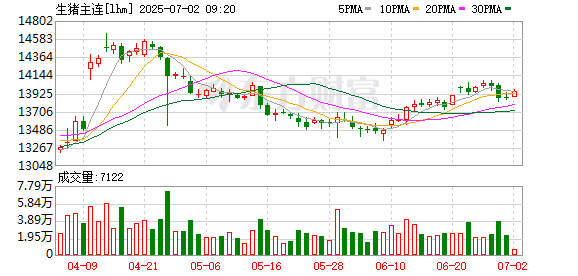
Group 1 - Recent fluctuations in live pig futures prices are influenced by the rhythm of livestock sales and market sentiment, with a recent sharp decline following a rebound from low points [2] - The current strong performance of live pig spot prices is attributed to farmers holding back sales and the entry of secondary fattening, while rising temperatures slow weight gain [2][3] - In June, the average trading price of live pigs in China was 14.28 yuan/kg, reflecting a month-on-month decline of 2.16% and a year-on-year decline of 21.81% [2] Group 2 - The overall trend of live pig prices from January to June was characterized by a decline, fluctuation, and subsequent drop, primarily due to abundant supply in the first half of 2025 [3] - Analysts expect a supply lag in the second half of the year, which may impact short-term supply and subsequently depress prices [3] - The current market anticipates price increases ahead of the Mid-Autumn Festival and National Day, providing some support for spot prices [3][4] Group 3 - The increase in pig prices in late June was linked to group enterprises reducing weights and some farmers resuming secondary fattening, despite a generally abundant supply [4] - The demand for pork is expected to decrease as the market enters a consumption lull, limiting the upward momentum for prices [4][5] - In July, there may be a reduction in supply due to some breeding enterprises having room for weight reduction, although most do not plan to reduce weights [5]

生猪:期现背离运行,等待现货印证
Guo Tai Jun An Qi Huo· 2025-06-29 09:34
Report Industry Investment Rating - Not provided Core View of the Report - This week, the spot market for live pigs showed strong performance, with the price of 20KG piglets in Henan at 37.3 yuan/kg, the price of live pigs in Henan at 14.93 yuan/kg, and the price of 50KG binary sows nationwide at 1623 yuan/head. The supply was tight due to significant reduction by large - scale farms and reluctance to sell by smallholders, while the demand increased slightly but was further suppressed by rising temperatures. The average slaughter weight decreased by 0.23% week - on - week. The futures market for live pigs showed strong fluctuations, with the LH2509 contract closing at 14005 yuan/ton. The basis of the LH2509 contract was 925 yuan/ton [2]. - Next week, the spot price of live pigs will fluctuate and adjust. During the off - season, the adjustment of slaughter volume by large - scale farms has a significant impact on prices. Although large - scale farms are reducing the weight of pigs according to the plan, smallholders are reluctant to sell, and the secondary fattening group is actively replenishing stocks. With the expectation of government purchasing, the spot price may turn strong again. The market is affected by factors such as supply, demand, and policy, and the core of the inventory cycle rotation in the second half of the year lies in the rhythm of social pigpens. The LH2509 contract price is expected to continue to rise in the short term, with a support level of 13000 yuan/ton and a pressure level of 14500 yuan/ton, and it is necessary to wait for the confirmation of the spot market [3][4]. Summary According to Relevant Catalogs This Week's Market Review (6.23 - 6.29) - **Spot Market**: The price of live pigs was strong. The price of 20KG piglets in Henan dropped from 37.8 yuan/kg last week to 37.3 yuan/kg, the price of live pigs in Henan rose from 14.43 yuan/kg last week to 14.93 yuan/kg, and the price of 50KG binary sows nationwide rose from 1621 yuan/head last week to 1623 yuan/head. Supply was tight due to large - scale farms reducing supply and smallholders' reluctance to sell, while demand increased slightly but was suppressed by rising temperatures. The average slaughter weight was 125.26KG, a 0.23% decrease from last week [2]. - **Futures Market**: The futures price of live pigs showed strong fluctuations. The highest price of the LH2509 contract was 14080 yuan/ton, the lowest was 13905 yuan/ton, and the closing price was 14005 yuan/ton (compared with 13895 yuan/ton last week). The basis of the LH2509 contract was 925 yuan/ton (compared with 535 yuan/ton last week) [2]. Next Week's Market Outlook (6.30 - 7.6) - **Spot Market**: The spot price of live pigs will fluctuate and adjust. Large - scale farms are reducing the weight of pigs according to the plan, but smallholders are reluctant to sell, and the secondary fattening group is actively replenishing stocks. With the expectation of government purchasing, the spot price may turn strong again. Supply may increase in the third quarter, and demand is in the off - season, with limited downstream support. The policy of government purchasing provides support, and the expectation of a policy bottom has been formed, making the de - stocking path more complex [3]. - **Futures Market**: The LH2509 contract price closed at 14005 yuan/ton on June 27. The market expectation is strong in the short term, and there is still a bullish sentiment. The expected centralized de - stocking time has not arrived, and it is necessary to wait for the confirmation of the spot market. The support level is 13000 yuan/ton, and the pressure level is 14500 yuan/ton [4]. Market Data - **Basis and Spread**: The basis this week was 925 yuan/ton, and the spread between LH2509 and LH2511 was 560 yuan/ton [8]. - **Supply**: The average weight this week was 125.26KG (compared with 125.55KG last week). In May, the pork production was 549.6 tons, a 4.3% increase month - on - month, and the pork import was 9.37 million tons, a 16.17% increase month - on - month [11]. - **Demand**: Not specifically summarized in the text.