
产品多元化

Search documents
吃货又立功!又一老字号要上市,靠一颗野果能否圆梦?
中国基金报· 2025-07-05 11:57
Core Viewpoint - Qi Yun Shan Food is heavily reliant on its single product, South Sour Jujube Cake, which poses risks for its IPO ambitions as it struggles with diversification and online transformation [1][2][4][6]. Financial Performance - In 2024, South Sour Jujube Cake generated 294 million RMB, accounting for 86.7% of total revenue, while other products contributed only 13 million RMB, representing a mere 3.8% [1][2][3]. - Revenue growth for Qi Yun Shan Food was 37.25% in 2024, significantly higher than 13.82% in 2023, driven by an expanded distribution network [14]. Product and Market Strategy - The company has strategically reduced production capacity for other products, focusing resources on South Sour Jujube Cake and South Sour Jujube Granules, with the latter's production capacity dropping from 1,100 tons to 677 tons [4][5]. - Despite claims of pursuing product diversification, R&D investment has decreased from 4.7% in 2022 to 3.5% in 2024 [6]. Sales Channels - In 2024, offline sales accounted for 89.3% of total revenue, with 199 out of 230 distributors being offline [8][10]. - Online sales have been declining, with online direct sales only reaching 35.5 million RMB in 2024, down from 12.7% in 2022 and 14% in 2023 [10][11]. Customer Concentration - The top five customers contributed 38.7% of total revenue in 2024, with the largest customer alone accounting for 22.9% [15][16]. - The reliance on a few key customers raises concerns about revenue stability and potential risks associated with customer concentration [15][16]. Supply Chain Challenges - Qi Yun Shan Food faces supply chain risks due to its dependence on local farmers for raw materials, which are not secured by formal contracts, leading to potential shortages and price volatility [18].


腌菜产品卖出新花样
Jing Ji Ri Bao· 2025-07-03 22:02
Group 1 - Fuling District is known as the "Hometown of Chinese Pickled Vegetables," with Fuling pickled vegetables being recognized as one of the "three major pickled vegetables in the world" alongside European sour cucumbers and German sweet-sour cabbage [2] - The total output value of the Fuling pickled vegetable industry is expected to exceed 15.5 billion yuan in 2024 [2] - Fuling District has established a national modern agricultural industrial park and a national agricultural science and technology park, creating the world's largest genetic resource gene bank for green cabbage with 1,336 varieties [2] Group 2 - Fuling pickled vegetables have expanded their market presence, exporting to over 80 countries and regions, with an export volume of 22,400 tons and an export value of 210 million yuan in 2024, representing growth rates of 22.2% and 25.7% respectively [3] - The Fuling pickled vegetable industry has developed a complete industrial chain from seed selection to planting, processing, and sales of by-products, with over 100 varieties across four major series [3] - Future efforts will focus on product diversification, building an online marketing system, and enhancing brand culture to further increase market scale and industry competitiveness [3]

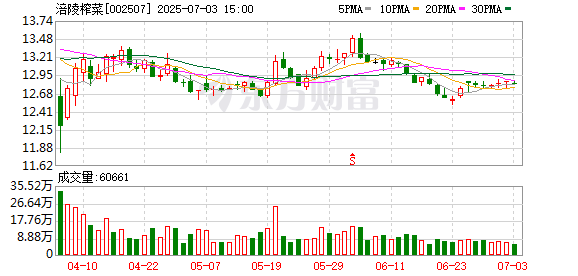
收入依赖大单品,线上线下渠道失衡,齐云山食品闯关港股
Bei Jing Shang Bao· 2025-06-30 13:33
Core Viewpoint - Qi Yunshan Food has submitted an application for listing on the Hong Kong Stock Exchange, with a strong reliance on its flagship product, South Jujube Cake, which accounts for over 80% of its revenue [1][3][4]. Group 1: Financial Performance - Qi Yunshan Food reported revenues of 217 million yuan, 247 million yuan, and 339 million yuan for the years 2022, 2023, and 2024, respectively, with net profits of 25.63 million yuan, 23.70 million yuan, and 53.20 million yuan during the same period [3][4]. - The flagship product, South Jujube Cake, generated revenues of 193 million yuan, 209 million yuan, and 294 million yuan from 2022 to 2024, representing 88.7%, 84.7%, and 86.7% of total revenue for those years [3][4]. Group 2: Product and Market Strategy - Qi Yunshan Food has launched five types of South Jujube products, including South Jujube Cake, South Jujube Granules, and South Jujube Soft Candy, among others [3]. - The company plans to diversify its product offerings and has introduced seven flavors of South Jujube Cake and various fruit and vegetable cakes to address market demand [4][5]. Group 3: Sales Channels - The company primarily relies on offline sales channels, with 199 out of 230 distributors being offline, generating 1.89 billion yuan, 2.11 billion yuan, and 3.03 billion yuan in revenue from 2022 to 2024, accounting for approximately 86.9%, 85.6%, and 89.3% of total revenue [6][7]. - Online direct sales generated revenues of 25.84 million yuan, 31.66 million yuan, and 32.93 million yuan during the same period, representing about 11.9%, 12.8%, and 9.7% of total revenue [7]. Group 4: Market Position - As of 2024, Qi Yunshan Food holds a 32.4% market share in the South Jujube food market in China, ranking first in the industry, while its overall market share in the fruit snack market is only 0.6%, placing it ninth [9].

IF椰子水母公司通过上市聆讯,原料、产品单一、代工等问题待解
Di Yi Cai Jing· 2025-06-17 03:40
Group 1 - The coconut water market in China is facing risks from rising costs and intensified competition, with IFBH Pte. Ltd. recently surprising the market by passing the Hong Kong Stock Exchange listing hearing in just two months [1] - IFBH's revenue is projected to reach approximately $160 million in 2024, representing an 80.3% year-on-year growth, with 92.4% of its revenue coming from the mainland China market [1] - Despite claiming to be the leading coconut water brand in China with a market share of about 34% in 2024, IFBH operates on a fully outsourced production model, raising concerns about its control over manufacturing and processing [1][2] Group 2 - IFBH's coconut water supply is solely sourced from Thailand through General Beverage, a company owned by its controlling shareholder, which poses risks related to supply chain independence [2] - The company plans to reduce its reliance on General Beverage for raw materials, aiming to decrease its supply share to below 70% by the end of 2025 and further to 50% by 2027 [2] - The beverage market in China is highly competitive, with many brands entering the coconut water segment, leading to increased raw material costs and price wars [3][4] Group 3 - In 2024, IFBH's revenue from coconut water and related products is expected to be $150 million, accounting for 97.5% of total revenue, indicating a heavy reliance on this single product category [3] - To diversify its product offerings, IFBH plans to launch 12 new beverage products in 2024, but these have shown lackluster performance, contributing only 2.2% to total revenue by year-end [3] - The popularity of coconut water has surged due to increased health awareness post-pandemic, but the market is shifting towards new trends like sugar-free tea and traditional health drinks [3]
海天味业H股IPO启动:多元化、全球化能否开辟新增长空间
Nan Fang Du Shi Bao· 2025-06-11 11:52
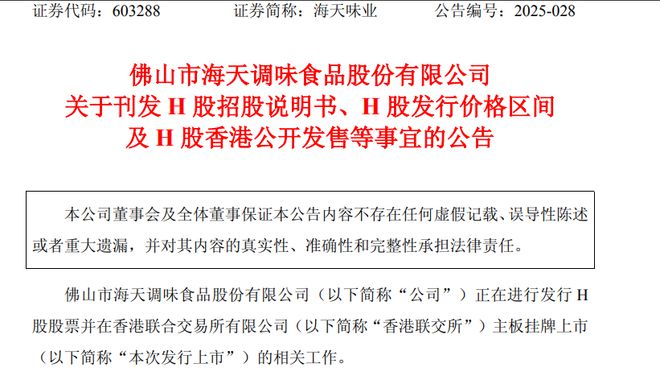
Core Viewpoint - Haitian Flavor Industry has officially launched its global public offering, planning to issue 263,237,500 shares with a price range set between HKD 35.00 and HKD 36.30, expected to be listed on the Hong Kong Stock Exchange on June 19, 2025 [1][3]. Offering Details - The company plans to publicly offer 15,794,300 shares in Hong Kong, accounting for approximately 6.00% of the total offering, while 247,443,200 shares will be offered internationally, making up about 94.00% of the total [3]. - The company may issue an additional 39,485,600 shares if the overallotment option is not exercised, or up to 41,854,700 shares if the option is fully exercised, leading to a maximum total of 320,886,400 shares available for global offering [3]. Cornerstone Investors - Haitian Flavor Industry has secured cornerstone investment agreements with several entities, including HHLRA, GIC, and UBS AM, committing to purchase shares worth approximately USD 595 million at the indicative price of HKD 35.65 per share, totaling around 131 million shares [4]. Financial Performance - The company reported a revenue of CNY 256.1 billion in 2022, a year-on-year increase of 2.42%, but faced a decline in net profit by 7.09% to CNY 61.98 billion [8]. - In 2023, the company experienced its first revenue decline in nearly a decade, with revenue dropping to approximately CNY 245.6 billion, a decrease of 4.10%, and net profit falling to about CNY 56.26 billion, down 9.21% [8]. - However, in 2024, the company rebounded with a revenue of CNY 269.01 billion, a year-on-year growth of 9.63%, and net profit reaching CNY 63.44 billion, up 12.75% [8]. Product Performance - The core product categories, including soy sauce, seasoning sauces, and oyster sauce, all saw revenue growth of nearly 10% year-on-year, with respective gross margin increases of 2.07%, 1.95%, and 4.69% [9]. - The "other" product category has also shown significant growth, with year-on-year increases of 32.61%, 19.35%, and 16.75% from 2022 to 2024, indicating the company's efforts to diversify its product offerings [10]. Strategic Significance - The IPO is seen as a strategic move to enhance the company's global presence and brand image, with plans to focus on markets with strong consumer bases and high demand for seasoning products [10]. - The company aims to utilize the proceeds from the global offering for product development, technological upgrades, capacity expansion, and enhancing its global supply chain capabilities [5].
美股新股解读|低盈利能力凸显“中间商”底色,通盈集团(TYZ.US)多维规划欲提升内在价值
智通财经网· 2025-06-08 01:23
Core Viewpoint - Tongying Group, a commodity trading firm with only 23 employees, is accelerating its IPO process after filing its updated prospectus with the SEC, aiming to raise up to $10 million despite a significant revenue decline in 2024 [1][2]. Group 1: Financial Performance - In 2024, Tongying Group reported revenues of $595 million, a 24.2% decrease from $784 million in 2023, while net profit increased to $810,000, a 14.57% year-over-year growth, resulting in a net profit margin of only 0.14% [1][5]. - The revenue breakdown for 2024 shows a drastic decline in ethylene glycol sales, which fell by 90.9%, contributing only 4.6% to total revenue, down from 38.6% in 2023 [3][4]. - Despite the overall revenue decline, the company saw an 11.7% increase in PTA sales and a remarkable 973.2% growth in corn sales, which now account for 10% of total revenue [5]. Group 2: Business Model and Market Position - Tongying Group operates as a middleman in the commodity trading sector, primarily generating revenue from trading chemical products, non-ferrous metals, and agricultural products, without providing transportation or storage services [2][3]. - The company has a concentrated product portfolio, with PTA and ethylene glycol accounting for 94% of its revenue in 2023, which poses risks due to price volatility in the cyclical chemical industry [2][3]. Group 3: Strategic Challenges - The company faces significant challenges in diversifying its product offerings, as its revenue concentration in PTA has increased to 84.3% in 2024, raising potential risks [6]. - To enhance market competitiveness, Tongying Group plans to establish a dedicated trading team for chemical futures and develop an automated warehouse by 2027, which requires substantial funding [7]. - As of December 31, 2024, the company reported current assets of $1.356 million and current liabilities of $1.846 million, resulting in a current ratio of only 0.73, indicating tight liquidity [7].

称霸高铁的“国民下饭菜”,为何年轻人咽不下去了?
创业邦· 2025-06-05 03:12
Core Viewpoint - The article discusses the declining performance of Fuling Mustard, the leading pickled vegetable brand in China, highlighting a significant drop in sales and market presence due to changing consumer preferences and increased competition from other food products like dipping sauces [3][9][30]. Financial Performance - Fuling Mustard reported a decline in both revenue and net profit for the second consecutive year, with five out of seven major sales regions experiencing varying degrees of decline [3][5]. - The company's market value has decreased by 300 billion yuan from a peak of over 350 billion yuan five years ago [5][11]. Market Dynamics - The consumption of Fuling Mustard has significantly changed, with the product now being less visible in key consumption scenarios such as supermarkets and high-speed trains, where consumers are opting for more diverse meal options [10][20]. - The brand's pricing strategy has led to a reduction in the number of distributors, with a notable decline of nearly 60% in the South China sales region [17][20]. Consumer Preferences - Younger consumers are increasingly sensitive to health concerns related to high-sodium products, leading them to seek alternatives like dipping sauces, which are perceived as more sophisticated and versatile [25][30]. - The rise of various brands in the dipping sauce market, including those from influencers and traditional brands, has created a competitive landscape that Fuling Mustard struggles to navigate [28][30]. Product Strategy - Fuling Mustard has heavily relied on its flagship product, which now accounts for over 80% of its revenue, limiting its growth potential [22][23]. - The company has attempted diversification by exploring other products like pickled radish and seaweed, but these efforts have not yielded significant results [23][30]. Marketing Efforts - In response to declining sales, Fuling Mustard has increased its marketing budget by over 30% in 2024, allocating 100 million yuan for promotional activities [32][34]. - Despite past successful marketing campaigns, current strategies have not resonated with younger consumers, leading to ineffective promotional efforts [34][36]. Industry Challenges - The challenges faced by Fuling Mustard reflect broader issues within the traditional food industry, emphasizing the need for value reconstruction rather than merely targeting premium markets [38].

Canalys:2025年第一季度全球TWS耳机市场强劲反弹 同比增长18%
智通财经网· 2025-05-22 03:46
Group 1 - The global true wireless stereo (TWS) market is experiencing a strong rebound, with shipments expected to grow by 18% year-on-year in Q1 2025, reaching 78 million units, marking the highest growth rate since 2021. This growth is attributed to manufacturers' dual expansion strategies in both regions and price tiers [1][3]. - Apple continues to lead the global TWS market with a 23% market share, benefiting from its strong ecosystem and ongoing integration of health features. Samsung ranks third with a 7% market share, showing growth in its Galaxy and JBL series [1][3]. - Emerging markets such as Southeast Asia, Eastern Europe, Latin America, and Africa are driving market growth through high-cost performance products and localized operations, with companies like Huawei gradually replacing white-label brands [3]. Group 2 - The open wireless stereo (OWS) segment is growing rapidly, outpacing the overall market growth, and is becoming a blend of technology and fashion. Mainstream manufacturers are investing in innovative designs and materials to enhance consumer appeal [3]. - The TWS market is entering a new phase characterized by product diversification, brand upgrades, and personalized experiences. Companies must innovate beyond price competition to meet emerging consumer demands for real-time translation, health tracking, and AI interaction [3]. - Leading brands are required to invest heavily in innovation and develop scenario-oriented products and services to enhance user engagement and brand influence across various domains such as office, health, and entertainment [3].

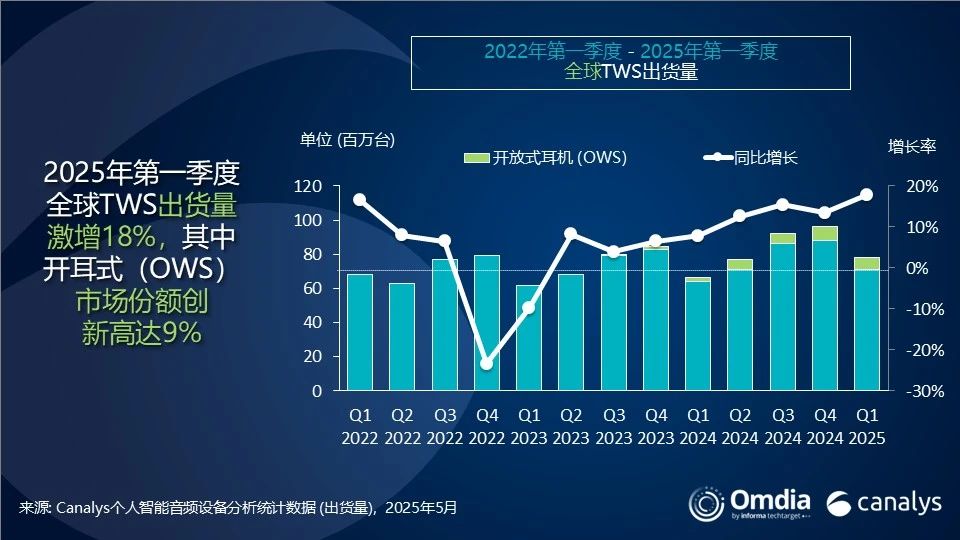
2025年第一季度,全球TWS耳机市场强劲反弹,同比增长18%
Canalys· 2025-05-22 02:37
Core Insights - The global true wireless stereo (TWS) market experienced a strong rebound in Q1 2025, with shipments increasing by 18% year-on-year to reach 78 million units, marking the highest growth rate since 2021 [1][4] - Apple maintained its leadership in the TWS market with a 23% market share, while Xiaomi surged to second place with a 63% year-on-year increase in shipments, reaching over 9 million units and capturing an 11.5% market share [1][4] - The market is characterized by a dual expansion strategy by manufacturers, focusing on both geographic and price tier growth, particularly in emerging markets [2][3] Market Dynamics - Leading ecosystem manufacturers are driving market growth through global expansion strategies, especially in emerging markets like Southeast Asia, Eastern Europe, Latin America, and Africa [2] - Xiaomi and Huawei are gradually replacing white-label brands by leveraging stronger brand influence, improved after-sales service, and channel strategies [2] - The U.S. market saw a recovery with double-digit growth, primarily driven by companies stocking up in response to tariff uncertainties, with Apple holding over 50% market share in North America [2] Product Trends - Open wireless headphones (OWS) are growing rapidly, outpacing overall market growth and shifting from functional audio devices to value-driven, lifestyle-oriented products [2][3] - Mainstream manufacturers are investing in ear-hook and ear-clip designs, utilizing bold materials and colors to enhance product appeal [2] - The TWS market is entering a new phase characterized by product diversification, brand upgrades, and personalized experiences, with innovation and scenario-based product development being crucial for long-term success [3] Shipment Data - Q1 2025 global TWS shipments and year-on-year growth rates: - Apple: 18.2 million units, 23.3% market share, 12% growth - Xiaomi: 9.0 million units, 11.5% market share, 63% growth - Samsung: 5.6 million units, 7.1% market share, 8% growth - Huawei: 4.7 million units, 6.0% market share, 40% growth - boAt: 3.9 million units, 4.9% market share, 31% growth - Total: 78.3 million units, 18% growth [4]


恒林股份: 恒林股份2024年度暨2025年第一季度业绩说明会PPT
Zheng Quan Zhi Xing· 2025-05-20 10:20
Core Viewpoint - The company, Henglin Home Furnishing Co., Ltd., has demonstrated significant growth in revenue and profitability, driven by online sales and international market expansion, while also focusing on innovation and sustainability in its operations [1][2][4]. Company Overview - Henglin Home Furnishing was established in Anji, Zhejiang, and has grown to have over 10,000 employees and 13 production bases across five countries, with a market capitalization exceeding 100 billion [1]. - The company has received numerous awards for its products, including the "German Red Dot Award" and "iF Design Award," and holds 1,630 authorized patents [1][2]. Business Performance - In 2024, the company achieved a revenue of 11.029 billion, marking a year-on-year increase of 34.59%, with a net profit attributable to shareholders of 281 million [2][4]. - The gross profit margin increased by 33.03% year-on-year, while the net profit margin decreased slightly to 2.55% [2][4]. - The company’s online sales grew significantly, contributing to a 196.5% increase in e-commerce revenue [4]. Product and Market Strategy - The company focuses on a diverse range of products, including office furniture, soft furniture, and new materials, with a strong emphasis on smart, eco-friendly, and customized solutions [1][2]. - The global market for soft furniture is projected to reach $80 billion, with Asia-Pacific and North America accounting for nearly 70% of the market [1]. Financial Metrics - The company reported a cash flow from operating activities that remained stable, with a slight increase in debt ratio due to leasing liabilities impacting the asset-liability ratio [2][4]. - The total assets turnover ratio improved to 1.08, reflecting better asset utilization [4]. Strategic Outlook - The company aims to enhance its core competitiveness through a dual-track strategy of "manufacturing overseas and brand expansion," focusing on innovation and differentiation [4][5]. - The "Quality Improvement and Efficiency Enhancement" action plan is designed to optimize operations and increase shareholder returns [5]. Awards and Recognition - Henglin Home Furnishing has been recognized as a national-level green factory and has received multiple accolades for its corporate governance and cultural initiatives [2][5].
