
去中心化

Search documents
2026Web3前沿趋势,与DOK共同探讨产业发展的实践路径
Sou Hu Cai Jing· 2025-10-21 16:42
Core Insights - The "2026 Web3 Frontier Trends Summit" held in Guangzhou marks the official start of the Web3 traffic era, focusing on the theme of "Digital Civilization × Ecological Prosperity" [1] - The DOK protocol is positioned as a decentralized operation engine, facilitating the transformation of user data and identity into value within the Web3 ecosystem [2][3] Industry Trends - User demands in the Web3 space have evolved beyond traditional social interactions, emphasizing the need for secure digital identities and transparent data analysis [2] - The DOK protocol is seen as a significant milestone in the acceleration of Web3 social and data intelligence ecosystems, potentially driving future value growth [2] Technological Innovations - DOK introduces a new traffic aggregation method that unifies user traffic across various applications and communities, creating a closed-loop application scenario where "social and data equal value" [3] - The protocol incorporates an AI-driven sentiment tracking module to provide real-time market trend analysis and community intelligence for decision-making support [2] Ecosystem Collaboration - The summit attracted diverse ecosystem partners, including decentralized social platforms and blockchain data platforms, showcasing DOK's influence and openness in the industry [5] - DOK aims to build a global Web3 traffic ecosystem through a "four-dimensional collaboration matrix" involving technology, capital, community, and media [5] Future Goals - DOK has outlined a roadmap for the next three years, targeting service for hundreds of millions of users, supporting trillions in assets, and creating significant traffic entry points for Web3 integration into mainstream internet [5][7] - The company emphasizes the importance of long-term consensus and value sharing in the development of a decentralized ecosystem, moving from a speculative phase to a structured governance model [7]


2025杭州未来生活嘉年华享受未来的乐趣
Hang Zhou Ri Bao· 2025-10-21 03:53
Group 1 - The 2025 Hangzhou Future Life Carnival took place from October 17 to 19, showcasing new products, technologies, and ideas from around the world, emphasizing a deep dialogue between Hangzhou and the future [1] - Kevin Kelly, a renowned futurist and author, delivered a keynote speech on "The Possibilities of the Next 10,000 Days," discussing the impact of AI and advanced technologies on future lifestyles, including AI-generated films and the potential for China to produce top AI chips within five years [1] - The event featured innovative aerial delivery technology from Xunyi Technology, enabling drone delivery of food, and showcased personal flying vehicles from Ku Fei (Zhejiang) Aircraft Technology Co., Ltd., highlighting advancements in transportation [2] Group 2 - Various robots were presented, including the Robbyant-R1 from Ant Lingbo Technology and the AI TR4, demonstrating capabilities in both domestic and industrial applications, indicating a shift towards more intelligent and versatile robotic solutions [2] - The "Ageless Future" segment introduced technologies aimed at enhancing the quality of life for the elderly, such as care robots and smart mobility aids, showcasing the human-centric approach of future technologies [2] - The AI Experience Park featured a range of AI applications, from AI pets to smart fitness solutions, allowing attendees to engage with the practical applications of AI in everyday life [3]
比特币启示录:中本聪技术颠覆传统,全球资本狂潮与监管博弈引发金融新格局
Sou Hu Cai Jing· 2025-10-20 21:09
Core Insights - Bitcoin is perceived as a tool for capital games, lacking intrinsic value and guarantees, driven by speculation and the actions of a few individuals [1] - The skepticism surrounding Bitcoin is rooted in its association with money laundering and the idea that it legitimizes illicit wealth [4][5] - The historical context of Bitcoin's emergence reveals a clash between new and old financial rules, with significant events shaping public perception and regulatory responses [12][24] Group 1: Bitcoin's Nature and Value - Bitcoin was created in 2008 by an anonymous entity known as "Satoshi Nakamoto," utilizing decentralized ledgers and proof-of-work mechanisms, with a capped supply of 21 million coins [6] - The lack of central bank backing and the absence of traditional monetary structures contribute to the debate over Bitcoin's value, with supporters emphasizing scarcity and network effects [18][19] - The argument that Bitcoin lacks value often stems from traditional financial perspectives that require backing by real assets or state credit [18] Group 2: Regulatory and Market Dynamics - The U.S. government has shown a keen interest in Bitcoin, viewing it as a dual tool for both capital acquisition and money laundering [4][5] - Historical incidents, such as the shutdown of the Silk Road and the Mt. Gox exchange collapse, have fueled skepticism and led to increased regulatory scrutiny [12] - The evolution of regulatory frameworks reflects a growing recognition of Bitcoin's role in both legitimate and illicit financial activities, with ongoing efforts to balance innovation and risk [21][22] Group 3: Market Behavior and Investor Sentiment - The volatility of Bitcoin prices is influenced by speculative behavior, with significant price movements often linked to broader market narratives and investor psychology [17][19] - Different market participants, including early adopters, speculators, miners, and regulators, contribute to a complex ecosystem where motivations and actions intersect [20] - The narrative surrounding Bitcoin as a "digital gold" has emerged, positioning it as a store of value rather than a traditional currency, complicating its role in everyday transactions [19] Group 4: Historical Context and Future Implications - The historical trajectory of Bitcoin highlights the ongoing tension between compliance and criminality, with regulatory bodies adapting to the evolving landscape of virtual assets [21] - The contrasting approaches of different countries towards Bitcoin regulation reveal varying attitudes towards risk and innovation, shaping the future of digital currencies [22] - The personal experiences of individuals interacting with Bitcoin reflect broader societal trends and the impact of regulatory changes on investment behavior [23][24]

比特币离崩盘不远了,原因就是美国查扣柬埔寨太子集团持有的127271枚比特币,价值超过150亿美元
Sou Hu Cai Jing· 2025-10-20 15:39
有人还在说,比特币是价值储藏工具,是数字黄金。可问题是,黄金不会被查封。2021年全球加密货币总市值最高时超过2.9万亿美元,现在剩不到1.1万亿 (数据来自CoinMarketCap)。比特币从最高点69000美元跌到现在27000多美元。你告诉我这是"抗通胀"的资产?过去两年美联储加息十几次,比特币的价 格曲线几乎和纳斯达克同步跌,所谓的独立性,根本不存在。 更可怕的是心理层面的崩塌。你仔细想,那些炒币的人为什么敢梭哈?因为他们信那句"我的币在链上,没人能动"。现在美国这一刀下去,信仰没了。下一 次谁还敢大额持币?一旦市场恐慌蔓延,比特币的价格支撑会直接塌。币圈没有央行,没有托底机制,一旦主力跑路,小散根本接不住。 这事还有个细节特别讽刺。太子集团的比特币大部分是通过场外交易(OTC)流入的,也就是说,不走交易所、不留痕。结果美国还是能把钱包链路查到。 这说明一个事,所谓的"匿名"其实是伪命题。区块链上的每一笔转账都是公开的,只要你动钱,就能被追踪。隐私?安全?全靠自我安慰。 我先说结论,比特币这事,离崩盘真不远了。理由?它最引以为傲的"去中心化"和"无法监管",现在全暴露了。你不是说没人能查到你的币、没 ...

比特币神话破了!150亿电诈赃款被没收,白白便宜了特朗普
Sou Hu Cai Jing· 2025-10-20 08:35
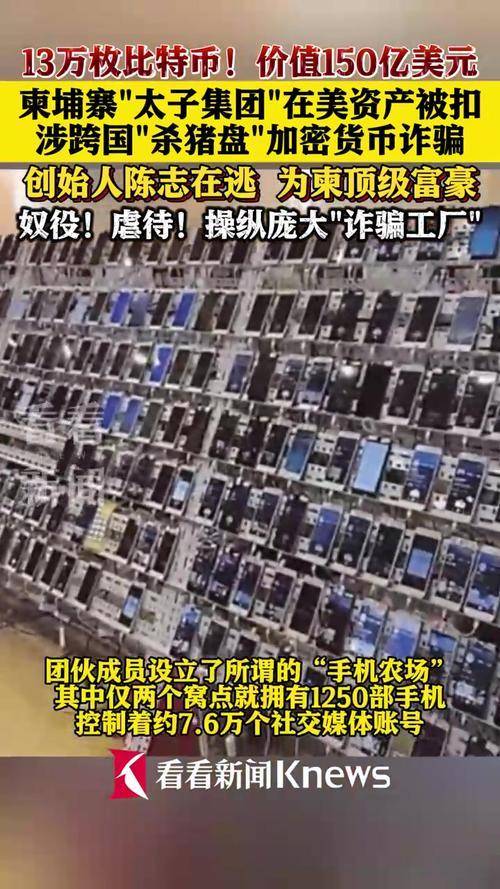
Core Insights - The U.S. Department of Justice seized a staggering $15 billion worth of Bitcoin from a Cambodian fraud group, highlighting the scale of financial crime and its implications for global security [2][26]. Group 1: Fraud Group Overview - The fraud group, known as the "Prince Group," was led by Chen Zhi, a 38-year-old from Fujian, who initially made money through unauthorized game servers before relocating to Cambodia to evade Chinese law enforcement [5][7]. - Chen Zhi established connections with the Cambodian government, becoming an advisor to former Prime Minister Hun Sen, which provided a protective layer for his operations [7][19]. - The group expanded its operations to target American citizens, resulting in over $10 billion in fraud losses in 2024 alone [9][12]. Group 2: Operational Tactics - The group utilized advanced technology, including SpaceX's Starlink, to facilitate their operations, demonstrating the intersection of technology and crime [12][14]. - They registered multiple companies in Taiwan, exploiting lax regulatory environments to launder money while maintaining a facade of legitimate business activities [16][21]. - The group’s operations were sophisticated, with a focus on English-speaking employees to specifically target American victims [12][19]. Group 3: Regulatory and Financial Implications - The U.S. government's seizure of assets was partly motivated by a need for funds amid a government shutdown, illustrating the financial pressures influencing law enforcement actions [25]. - The incident has raised questions about the security of cryptocurrencies, as the U.S. Department of Justice was able to trace and seize Bitcoin, contradicting claims of decentralization and anonymity [29][31]. - Following the seizure, Bitcoin's value dropped significantly, prompting central banks worldwide to increase gold purchases as a safer asset [31][35]. Group 4: Ongoing Challenges - Despite the seizure, the underlying issues of fraud and cybercrime remain prevalent, with ongoing operations in regions like Cambodia and Myanmar [35][37]. - The regulatory environment in Taiwan has been criticized for its ineffectiveness in combating money laundering and fraud, raising concerns about the adequacy of global financial regulations [21][37].
新世纪期货交易提示-20251020
Xin Shi Ji Qi Huo· 2025-10-20 05:02
Report Industry Investment Ratings - Iron ore: Volatile [2] - Coking coal and coke: Rebound [2] - Rolled steel (rebar and wire rod): Volatile [2] - Glass: Adjustment [2] - Soda ash: Adjustment [2] - CSI 300 Index Futures/Options: Volatile [4] - SSE 50 Index Futures/Options: Volatile [2] - CSI 500 Index Futures/Options: Decline [4] - CSI 1000 Index Futures/Options: Decline [4] - 2 - year Treasury bonds: Volatile [4] - 5 - year Treasury bonds: Volatile [4] - 10 - year Treasury bonds: Upward [4] - Gold: High - level operation [4] - Silver: High - level operation [4] - Logs: Range - bound [6] - Pulp: Consolidation [6] - Offset paper: Volatile [6] - Soybean oil: Wide - range volatility [6] - Palm oil: Wide - range volatility [6] - Rapeseed oil: Wide - range volatility [6] - Soybean meal: Volatile with a bearish bias [6] - Rapeseed meal: Volatile with a bearish bias [6] - Soybean No. 2: Volatile with a bearish bias [6][7] - Soybean No. 1: Volatile [6] - Live pigs: Volatile with a slightly bullish bias [7] - Rubber: Volatile [7] - PX: Wait - and - see [7] - PTA: Volatile [7][9] - MEG: Wait - and - see [9] - PR: Wait - and - see [9] - PF: Volatile with a bearish bias [9] Core Views - The iron ore market has an oversupply situation, but short - term price support exists due to potential macro - sentiment improvement. The market should closely monitor four main lines for potential price re - pricing [2]. - The coking coal and coke market is affected by macro - policy expectations and supply concerns. The core contradiction lies in the low profit of steel mills [2]. - The steel market has supply - demand contradictions and is expected to continue volatile adjustment. The fourth - plenary session of the 20th CPC Central Committee is expected to have limited short - term impact [2]. - The glass market has no significant improvement in the short - term supply - demand pattern, and it is expected to be under pressure. Attention should be paid to peak - season demand repair and capacity policies [2]. - The stock index market has seen a significant decline, and it is recommended to reduce risk appetite and lower long - positions in stock index futures [4]. - The Treasury bond market shows a slight upward trend, and it is suggested to hold long - positions in Treasury bonds lightly [4]. - The gold market is expected to operate at a high level, with its pricing mechanism shifting and influenced by factors such as central bank gold purchases, geopolitical risks, and interest - rate policies [4]. - The log market is expected to be range - bound, with stable spot prices and cost - side support [6]. - The pulp market is expected to be at the bottom, with cost support weakening and demand improvement yet to be verified [6]. - The offset paper market is expected to be volatile, with stable supply and potential demand improvement [6]. - The oil and fat market is expected to continue wide - range volatility, affected by factors such as inventory, production, and demand [6]. - The meal market is expected to be volatile with a bearish bias, due to increased supply and weakening post - festival demand [6]. - The live pig market is expected to be volatile in the short - term, with sufficient supply and fluctuating demand [7]. - The rubber market is expected to be in wide - range volatility, affected by weather, production, and demand factors [7]. - The PX, PTA, MEG, PR, and PF markets are affected by factors such as oil prices, supply - demand, and cost, with different trends and wait - and - see or volatile - bearish outlooks [7][9] Summary by Categories Black Industry - **Iron ore**: Supply is expected to remain high, and the oversupply pattern is hard to reverse. Trade friction may cause price drops, but short - term support exists due to macro - factors. Four main lines should be monitored [2]. - **Coking coal and coke**: Macro - policy expectations are high, and supply concerns have emerged after a coal mine accident. The core problem is the low profit of steel mills [2]. - **Rolled steel (rebar and wire rod)**: Supply pressure is relatively large, and demand recovery in October needs attention. The market is expected to continue volatile adjustment [2]. - **Glass**: The short - term supply - demand pattern is not improved, with inventory accumulation. It is expected to be under pressure, and attention should be paid to policies [2]. - **Soda ash**: Similar to glass, it is expected to be adjusted, and the marginal improvement in the peak season should be noted [2]. Financial Market - **Stock index futures/options**: The market has declined significantly. It is recommended to reduce risk and lower long - positions [4]. - **Treasury bonds**: The market shows a slight upward trend, and long - positions can be held lightly [4]. - **Gold and silver**: They are expected to operate at high levels, influenced by central bank purchases, geopolitical risks, and interest - rate policies [4]. Light Industry and Agricultural Products - **Logs**: Spot prices are stable, with cost support. It is expected to be range - bound [6]. - **Pulp**: Cost support weakens, and demand improvement is yet to be verified. It is expected to be at the bottom [6]. - **Offset paper**: Supply is stable, and demand may improve. It is expected to be volatile [6]. - **Oils and fats**: They are expected to continue wide - range volatility, affected by inventory, production, and demand [6]. - **Meals**: They are expected to be volatile with a bearish bias, due to increased supply and weakening post - festival demand [6]. - **Live pigs**: Supply is sufficient, and demand may decline. It is expected to be volatile in the short - term [7]. Soft Commodities and Chemicals - **Rubber**: Production is affected by weather, and demand is weak in the short - term. It is expected to be in wide - range volatility [7]. - **PX, PTA, MEG, PR, PF**: They are affected by oil prices, supply - demand, and cost, with different trends and wait - and - see or volatile - bearish outlooks [7][9]
美联储褐皮书揭经济疲软,USDT钱包最新XBIT Wallet深入透析经济密码
Sou Hu Cai Jing· 2025-10-20 00:43
Core Insights - The latest Federal Reserve Beige Book indicates that U.S. economic activity has plateaued, with a slight decline in consumer spending and persistently low labor demand [1][3] - In contrast, XBIT decentralized exchange is thriving, leveraging its technological advantages to attract global users amid increased volatility in traditional financial markets [1][3] Economic Context - The Beige Book highlights structural adjustments in the labor market, with layoffs and natural attrition reducing employee numbers, which interacts subtly with employment demand in the digital asset sector [3][8] - Despite the economic stagnation, blockchain developer job postings have increased by 8%, particularly in smart contract auditing and cross-chain protocol development [3] XBIT Wallet Innovations - XBIT Wallet's revolutionary private key management system utilizes a 12-word mnemonic phrase generated through the BIP39 protocol, ensuring users have complete control over their assets [1][3] - The wallet's design mitigates risks commonly associated with centralized exchanges, as 78% of security incidents in centralized exchanges stem from internal abuse of permissions [3] Security Features - XBIT Wallet employs a layered architecture with hot wallets for daily transactions and cold storage for larger amounts, successfully thwarting a recent hacking attempt that targeted $230 million in assets [5] - The introduction of a "three-dimensional verification" system enhances wallet security by 40%, requiring users to set up biometric and dynamic password verification alongside the mnemonic phrase [5] Market Opportunities - The consensus within the Federal Reserve is shifting towards potential interest rate cuts, with a 75% probability of a 25 basis point cut in the upcoming November meeting [5] - XBIT's liquidity pool design, utilizing an Automated Market Maker (AMM) mechanism, allows for continuous trading, particularly beneficial during traditional market closures [5] Corporate Adoption - There is a surge in demand for enterprise-level wallet solutions, with a multinational supply chain company reducing cross-border settlement costs by 30% and shortening settlement cycles from T+3 to T+0 through XBIT Wallet [7] - Among users holding over 10,000 USDT, 83% opt for XBIT Wallet for asset custody, reflecting trust in decentralized technology's immutable and censorship-resistant characteristics [8] Conclusion - As traditional financial systems undergo profound changes, innovations like XBIT Wallet are providing stability and new opportunities in an uncertain economic landscape, particularly as inflation and labor market challenges persist [8]

逄锦华:300万亿美元乌龙暴露稳定币“不稳定”
Sou Hu Cai Jing· 2025-10-19 23:16
Core Insights - The issuance of 300 trillion PYUSD stablecoins by Paxos, a subsidiary of PayPal, highlights significant structural risks and vulnerabilities within the stablecoin ecosystem, challenging the notion of decentralization and stability [1][2] - The incident underscores the fragility of stablecoins, which are heavily reliant on the creditworthiness of their issuers rather than on algorithmic stability [1][2] - The event raises concerns about the potential for a new form of international financial dominance through stablecoins, particularly by U.S. tech companies, which could lead to global credit crises if mismanaged [3] Summary by Sections Stablecoin Stability and Risks - The so-called "stable" coins are revealed to be highly unstable, with their value fundamentally tied to the issuer's balance sheet and national credit [1] - The incident reflects a broader issue of trust in digital reserve assets, as the operational error created an unprecedented amount of digital currency, undermining the seriousness of currency issuance [2] Market Reactions and Implications - The cryptocurrency market has shown significant volatility, with a 30% decrease in total market capitalization since early October, indicating sensitivity to regulatory uncertainties and macroeconomic conditions [2] - Stablecoins serve as a bridge between traditional finance and the crypto world, amplifying underlying risks through exchanges and DeFi protocols [2] Geopolitical and Strategic Considerations - The dominance of U.S. companies in the stablecoin market poses risks of financial sanctions and control over global virtual assets, potentially leading to targeted actions against specific nations [3] - China is advancing its digital currency initiatives, emphasizing monetary sovereignty and technological independence, while Hong Kong is working on regulatory frameworks for virtual asset trading [4]
1068亿比特币易主真相:30万受害者的血泪钱变成美国财政部数字黄金
Sou Hu Cai Jing· 2025-10-18 19:25
Core Insights - The article highlights the significant financial losses experienced by Chinese families due to a cryptocurrency scam involving 127,271 bitcoins valued at $15 billion, which were seized by the U.S. Department of Justice [1][3][9] - The operation, led by Chen Zhi's "Prince Group" in Cambodia, utilized multiple fraudulent schemes to extract wealth from victims, showcasing the dark side of cryptocurrency as both a tool for fraud and a means for money laundering [3][5] Group 1: Scam Operation - The scam involved 10 physical locations in Cambodia, referred to as "fraud parks," where victims were coerced and manipulated through various fraudulent tactics [3][5] - The operation generated over $30 million daily from global victims, utilizing a network of 1250 phones and 76,000 social media accounts [3] Group 2: Cryptocurrency's Role - Bitcoin served a dual purpose in the scam, acting as both a fraud mechanism and a laundering channel, with victim funds being fragmented into small bitcoin amounts and mixed into decentralized finance (DeFi) pools [5] - The U.S. Department of Justice's seizure of the bitcoins illustrates the irony of decentralization, as control over assets can still be exerted through centralized storage solutions [5] Group 3: International Legal Cooperation - The collaboration between U.S. and U.K. law enforcement agencies highlights an effective model for tackling cross-border crime, with the U.S. seizing bitcoins and the U.K. freezing assets linked to the scam [7] - The lack of legal recourse for Chinese victims emphasizes the challenges faced by domestic authorities in addressing international fraud, particularly when evidence and assets are located abroad [7][11] Group 4: Financial Implications - The U.S. government has become one of the largest single holders of bitcoin, with a total of 320,000 bitcoins, representing a potential value of $40 billion [9] - The strategic inclusion of seized bitcoins into national reserves could transform law enforcement actions into revenue-generating opportunities for the government [9] Group 5: Public Perception and Regulatory Challenges - The aftermath of the case has sparked mixed reactions on social media, with some blaming victims for their greed while others criticize regulatory failures [11] - The case underscores the inadequacy of current border controls in addressing the complexities of digital-era transnational crime [11]
特讯!比特币神话轰然崩塌
Sou Hu Cai Jing· 2025-10-18 08:02
当美国司法部宣布没收柬埔寨太子集团持有的12万多枚比特币时,币圈一片哗然。这一事件不仅涉及巨额资产,更戳破了比特币长期以来的两大神话:去中 心化不可追踪,加密安全牢不可破。 神话破灭:从"不可追踪"到一键没收 比特币最引以为傲的,就是其去中心化特性。支持者宣称,比特币交易不受任何政府监管,无法追踪。但太子集团案件彻底颠覆了这一认知——美国政府不 仅精准定位了该集团分散在全球的比特币地址,更直接将其转入政府账户。 面对这一尴尬事实,币圈流传起新的解释:太子集团私自修改了加密算法,导致被破解。这个说法实在经不起推敲。试问,一个依靠比特币隐匿资产的电诈 集团,为何要放弃公认的安全系统?如果他们对比特币加密技术心存疑虑,又为何将巨额资产置于其中? "中本聪"之谜:巧合还是精心设计? 比特币诞生十余年,其创始人"中本聪"始终神龙见首不见尾。全球顶尖调查记者、密码学专家多方追踪,却始终找不到这个"天才"的真实身份。 有研究者提出惊人发现:"中本聪"这个名字,很可能源自美国中情局(CIA)英文名称的直译——Central(中)、Intelligence(本)、Agency(聪)。这个 解释或许看似巧合,但结合比特币的发展轨 ...
