
宏观审慎管理

Search documents
每日债市速递 | 中国10月金融数据重磅出炉
Wind万得· 2025-11-13 22:35
Group 1: Open Market Operations - The central bank conducted a 7-day reverse repurchase operation on November 13, with a fixed rate and a total amount of 190 billion yuan, at an interest rate of 1.40% [1] - On the same day, 92.8 billion yuan of reverse repos matured, resulting in a net injection of 97.2 billion yuan [1] Group 2: Liquidity Conditions - Following several days of net injections by the central bank, the interbank market's liquidity improved, with overnight repurchase rates for deposit-taking institutions dropping by approximately 10 basis points to around 1.32% [3] - The overnight quotes in the anonymous click (X-repo) system returned to 1.3%, while non-bank institutions' pledging of credit bonds for overnight funding also decreased to 1.40%-1.45% [3] - Traders noted that the rapid decline in funding prices indicates the central bank's flexible injections are stabilizing liquidity, with limited impact expected from the upcoming tax period in November [3] Group 3: Financial Indicators - As of the end of October, M2 balance was 335.13 trillion yuan, growing by 8.2% year-on-year, while M1 balance was 112 trillion yuan, increasing by 6.2% [14] - The M0 balance reached 13.55 trillion yuan, reflecting a year-on-year growth of 10.6% [14] - The net cash injection in the first ten months was 728.4 billion yuan, with the total social financing scale increasing by 3.83 trillion yuan compared to the same period last year [14] Group 4: Regulatory Developments - The Financial Regulatory Bureau plans to release a revised "Commercial Bank Merger Loan Management Measures" to support mergers and restructuring for various enterprises, including technology innovation companies [15] - The Hong Kong Securities and Futures Commission announced new optimization measures for the cross-border wealth management pilot program to enhance communication between licensed institutions and their clients [15] Group 5: Global Economic Context - The latest overnight financing rate in the U.S. was reported at 3.95% [5] - The U.S. government shutdown has officially ended following President Trump's signing of a bill [18] - Japan's Finance Minister indicated that domestic investors primarily hold Japanese government bonds, making debt default unlikely, while also hinting at potential tax cuts as a future fiscal policy option [18]


货币市场日报:11月12日
Xin Hua Cai Jing· 2025-11-12 12:34
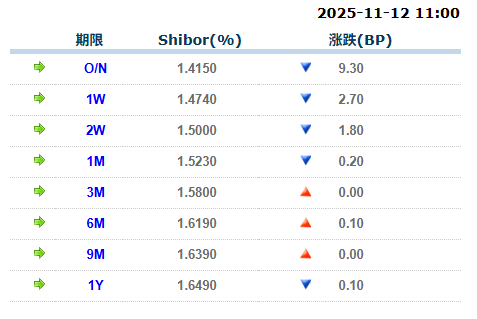
Group 1 - The People's Bank of China conducted a 1,955 billion yuan 7-day reverse repurchase operation at an interest rate of 1.40%, maintaining the previous rate, resulting in a net injection of 1,300 billion yuan after 655 billion yuan of reverse repos matured on the same day [1] - The Shanghai Interbank Offered Rate (Shibor) for short-term instruments saw a slight decline, with the overnight Shibor dropping by 9.30 basis points to 1.4150%, and the 7-day Shibor decreasing by 2.70 basis points to 1.4740% [1][2] - In the interbank pledged repo market, short-term funding rates fell across the board, with the weighted average rates for DR001 and R001 decreasing by 9.0 basis points and 7.0 basis points, respectively, while transaction volumes for these instruments increased [4] Group 2 - As of November 12, 113 interbank certificates of deposit were issued, with a total issuance amount of 1,999.8 million yuan, indicating active trading in the secondary market [10] - The People's Bank of China emphasized the importance of improving the central bank system as a strategic measure for promoting high-quality financial development during the 14th Five-Year Plan period [12] - New insurance premium income for Xinhua Insurance reached 1,819.73 million yuan in the first ten months of 2025, reflecting a year-on-year growth of 17% [12]
三季度货币政策执行报告,强化货币政策的执行和传导
Xiangcai Securities· 2025-11-12 09:20
Group 1: Monetary Policy Insights - The central bank emphasizes maintaining relatively loose social financing conditions and improving the execution and transmission of monetary policy[2] - The report highlights the need for counter-cyclical and cross-cyclical adjustments to strengthen economic recovery[3] - The central bank aims to optimize monetary policy intermediate variables and gradually reduce focus on quantitative targets, suggesting that loan growth may be slightly lower than nominal economic growth[4] Group 2: External Economic Factors - The report expresses caution regarding external uncertainties, noting challenges in international economic and trade order, and concerns about the diminishing effects of "export grabbing" and "import grabbing"[3] - High tariffs are expected to increase trade costs and create policy uncertainties that may suppress long-term investment and supply chain decisions, indicating a structural shift in global trade growth trends[3][12] Group 3: Interest Rate Management - The central bank stresses the importance of maintaining reasonable interest rate relationships across various dimensions, transitioning from setting a single price to managing a system[7][18] - The report identifies five key interest rate relationships that are crucial for effective monetary policy transmission, including the relationship between central bank policy rates and market rates[18][20] Group 4: Investment Recommendations - The central bank's commitment to a moderately loose monetary policy is expected to support interest-sensitive assets and sectors backed by clear policy support, such as technology innovation and green industries[21] - The likelihood of significant policy easing measures, such as rate cuts, is low for the remainder of the year, with more substantial easing expected to be deferred until early 2026[21][22] Group 5: Risk Considerations - Potential risks include slower-than-expected economic recovery, unexpected policy changes, and disturbances in the global economy[23]
央行最新报告显示:下阶段持续稳增长、稳就业、稳预期
Zhong Guo Jing Ji Wang· 2025-11-12 06:24
Core Insights - The People's Bank of China (PBOC) has maintained a moderately accommodative monetary policy throughout the year, with significant growth in financial metrics such as social financing and M2 money supply, which increased by 8.7% and 8.4% year-on-year respectively [1] - The report highlights a decline in social financing costs, with new corporate loans and personal housing loan rates dropping by approximately 40 and 25 basis points year-on-year [1] - The credit structure is improving, with notable growth in technology loans (11.8%), green loans (22.9%), inclusive loans (11.2%), elderly care industry loans (58.2%), and digital economy loans (12.9%), all surpassing the overall loan growth rate [1] - Despite external uncertainties and challenges in the global economy, China's economic fundamentals remain strong, with a call for strategic determination and confidence in achieving modernization goals [1] Monetary Policy and Financial Reform - The PBOC plans to deepen financial reforms and enhance high-level opening-up, aiming to build a robust financial system and a comprehensive macro-prudential management framework [2] - The focus will be on balancing short-term and long-term goals, stabilizing growth while managing risks, and ensuring the health of the banking system while supporting the real economy [2] - The PBOC will continue to implement a moderately accommodative monetary policy, utilizing various tools to maintain relatively loose social financing conditions [3] Future Directions - The PBOC aims to improve the monetary policy framework and enhance the execution and transmission of monetary policy [3] - There will be an emphasis on maintaining liquidity and aligning social financing and money supply growth with economic growth and price level expectations [3] - The central bank will also focus on promoting reasonable price recovery and refining the interest rate adjustment framework to lower financing costs [3] - The PBOC will explore expanding its macro-prudential and financial stability functions to maintain market stability and prevent systemic financial risks [3]
中国货币政策系列二十二:中枢已现,货币周期进入顶部区间
Hua Tai Qi Huo· 2025-11-12 05:04
Report Industry Investment Rating No relevant content provided. Core Viewpoints of the Report - The regulatory trend is easing, and the market is waiting for incremental policies. The external economic pressure remains but is weakening, and the internal high - quality development has achieved positive results, yet the foundation for the domestic economic recovery needs further consolidation. The effect of counter - cyclical adjustment of monetary policy is gradually emerging, and the financial aggregate is growing reasonably. The intensity of the "high - quality financial development" statement is reduced, and in the future, counter - cyclical and cross - cyclical adjustments will be carried out to improve the efficiency of macro - economic governance [2]. - The current monetary cycle is entering the top - range. The central bank is less likely to actively tighten liquidity, and attention should be paid to the rhythm of transmission to the real economy. Structural policies still focus on four major areas: "technological innovation, boosting consumption, small and micro enterprises, and stabilizing foreign trade". The RMB exchange rate volatility is expected to increase, and the central bank's intervention in the foreign exchange market is reduced, increasing the flexibility of monetary policy implementation. There may be a possibility of further monetary policy easing in the future [3]. - In 2026, the monetary policy is still waiting for incremental measures. After the monetary cycle enters the top - range, attention should be paid to the impact of the increasing market pressure in the second half of 2026 on the change of liquidity injection structure, and the monetary policy will become more accommodative [4]. Summary According to the Directory "The Monetary Policy Execution Report" Abstract Comparison Analysis First Paragraph: General Tone - Economic and macro - policy level: The pressure on the current economy is further weakened. The description of high - quality development has changed from "making new progress" to "achieving positive results"; the economic situation has changed from "performing well" to "generally stable", and the "resilience" of the economy is emphasized before "vitality" [11][13][15]. - Monetary policy level: The description has been adjusted. "Strengthening counter - cyclical adjustment" is deleted, and "maintaining sufficient liquidity" is added, indicating a weakening of "counter - cyclical" and a decrease in incremental easing as money is transmitted to the real economy. The goal of monetary policy has shifted from emphasizing "serving the high - quality development of the real economy" to "stabilizing the financial market operation". The use of "quantity, price, and structure" monetary policy tools is emphasized, increasing the possibility of the policy shifting from structural to aggregate adjustment [16]. Second Paragraph: Monetary Policy Execution - There are not many changes compared between the two quarters. The execution of monetary policy still covers five aspects: monetary credit, financing cost, credit structure, exchange rate stability, and risk prevention. - For aggregate monetary policies, the specific price (interest rate cut) and quantity (reserve requirement ratio cut) adjustments in the second - quarter report are weakened in the third - quarter report, indicating that the policy is waiting for the transmission effect of aggregate monetary policy tools [20][21][23]. - For structural monetary policies, the new and increased - quota policy operations in the second - quarter report are in the implementation state of "using well" and "giving full play to" existing policies in the third - quarter report, lacking incremental policies [23]. - The descriptions of exchange rate stability and risk prevention and resolution remain the same in the third and second quarters [24]. Third Paragraph: Effects of Monetary Policy - The third - quarter monetary policy report basically continues the second - quarter statement, but shows the gradual manifestation of the "moderately accommodative" policy effect. - Policy tone: The effect of counter - cyclical adjustment is "gradually emerging", and the financial aggregate has changed from "growing steadily" to "growing reasonably", indicating that the growth of the financial aggregate is more in line with the economic growth and price level targets [28][29][30]. - Effect performance: The financing cost remains low, but the year - on - year decline is narrowing. The RMB exchange rate has appreciated by 1.2% compared to the end of last year, showing better performance in both cost reduction and enhancing economic expectations [30]. Fourth Paragraph: Future Monetary Policy Tone - For the judgment of the future economic situation, the pressure on the external environment is weakened, the problems are more clearly defined, and the response measures are strengthened. There is still a demand for aggregate policies as the foundation for the domestic economic recovery needs further consolidation [35][36][38]. - In terms of the central bank's work in the next stage, the importance of building a financial powerhouse is advanced, and the demand for counter - cyclical monetary policy is increasing. The goal of "building a financial powerhouse" is advanced, and the statement of "high - quality financial development" is deleted. The focus of the policy implementation has shifted from "stabilizing employment" to "stabilizing growth" [39]. Fifth Paragraph: Future Monetary Policy Implementation - Aggregate monetary policy: The central bank's monetary policy has changed from "implementing in detail" in the second quarter to "implementing well" in the third quarter. The probability of the central bank actively tightening liquidity is reduced, and the policy framework will be continuously improved to strengthen policy implementation and transmission [47][48][49]. - Interest rate policy: The regulatory intensity of interest rate policy implementation and supervision may be weakened, and the constraints on the money supply side are relaxed, highlighting the support for the demand side [49]. - Structural policy: The third - quarter report emphasizes "implementing well" existing policies, and the focus areas remain the same: "technological innovation, boosting consumption, small and micro enterprises, and stabilizing foreign trade". The central bank also mentions policy support for the digital economy [50]. - Exchange rate policy: The description of the exchange rate has changed from "resilience" to "elasticity", and from "stabilizing expectations" to "guiding expectations". The "three resolutes" are deleted, increasing the flexibility of monetary policy implementation and the possibility of future policy easing [51][54]. - In terms of preventing financial risks, the third - quarter report continues the second - quarter statement [55]. "The Monetary Policy Execution Report" Column Analysis Column 1: Scientifically View Financial Aggregate Indicators - It is more appropriate to focus on aggregate indicators such as social financing scale and money supply rather than credit indicators. The slowdown in the growth rate of aggregate indicators is normal, and the goal of "matching the growth of social financing scale and money supply with economic growth and price level targets" remains unchanged. In the future, attention should be gradually shifted from quantity indicators to price indicators such as interest rates [62]. Column 2: The Relationship between Base Money and Money - By analyzing the relationship between the central bank's base money and broad money, it helps to clarify the concept of "excessive money issuance". The scale and growth rate of base money and broad money in China and the United States are compared, and it is pointed out that the US M2 caliber is narrower than that of China [63][64][65]. Column 3: Achievements and Prospects of Financial Support for the Digital Economy during the "14th Five - Year Plan" Period - The central bank's view on the digital economy in the financial field includes two aspects: the digital transformation of the financial industry and financial services for the digital economy. The policy framework system is gradually improving, the digital transformation is advancing steadily, digital technology is empowering high - quality financial services, data element value is being released, and financial data governance is more perfect [69]. Column 4: Maintaining a Reasonable Interest Rate Ratio - Attention should be paid to the relationship between the central bank's policy interest rate and market interest rate, the impact of deposit and loan interest rate changes on bank net interest margins, the interest rate spread between bank loans and bonds, the term spread of different - term time deposits, and the relationship between corporate financing interest rates and government bond yields [70].
央行:实施适度宽松的货币政策 保持流动性充裕
Zhong Guo Xin Wen Wang· 2025-11-12 00:26
Core Viewpoint - The People's Bank of China (PBOC) has released its monetary policy execution report for Q3 2025, highlighting the resilience and vitality of the national economy, with a GDP growth of 5.2% year-on-year in the first three quarters of the year. The PBOC is implementing a moderately accommodative monetary policy to support economic recovery and stabilize financial markets. Group 1: Monetary Policy Implementation - The PBOC is maintaining reasonable growth in monetary credit by utilizing various tools such as open market operations and medium-term lending facilities to ensure ample liquidity [1][2] - The central bank aims to reduce the overall financing costs in society by improving the market-based interest rate adjustment framework, leading to a decline in both deposit and loan rates [1][2] - The PBOC is optimizing the credit structure by utilizing 500 billion yuan for consumer services and elderly care loans, as well as increasing the loan quotas for technological innovation and transformation [1][2] Group 2: Financial Stability and Risk Management - The PBOC is focused on maintaining basic stability in the exchange rate, leveraging the market's role in exchange rate formation and ensuring the stability of the RMB against the USD [2][4] - The central bank is enhancing risk prevention and resolution measures, continuously improving the financial risk monitoring and early warning systems [2][3] - As of the end of September, the total social financing stock and broad money supply (M2) grew by 8.7% and 8.4% year-on-year, respectively, with the RMB loan balance reaching 270.4 trillion yuan [2][3] Group 3: Future Outlook and Strategic Goals - Despite external uncertainties and challenges, the PBOC emphasizes the strong foundation and potential of the Chinese economy, aiming to maintain strategic determination and confidence in achieving significant breakthroughs in modernization [3][4] - The PBOC plans to deepen financial reforms and high-level opening-up, enhance the central bank's system, and establish a robust monetary policy framework [3][4] - The central bank will balance short-term and long-term goals, ensuring consistent macro policy orientation to support economic growth, employment stability, and market expectations [3][4]
央行三季度货币政策执行报告提出:综合运用多种工具 保持社融相对宽松
Zhong Guo Zheng Quan Bao· 2025-11-11 23:27
Core Viewpoint - The People's Bank of China emphasizes the implementation of a moderately accommodative monetary policy to maintain relatively loose social financing conditions and improve the monetary policy framework [1][2]. Group 1: Monetary Policy Implementation - The report highlights the need to balance short-term and long-term goals, support for the real economy, and the health of the banking system while enhancing macroeconomic governance effectiveness [2]. - The central bank aims to achieve a 5% economic growth target for the year through coordinated macro policies, including fiscal, monetary, and industrial policies [2]. - The report stresses the importance of maintaining reasonable growth in financial aggregates and social financing scale in line with economic growth and price level expectations [2][3]. Group 2: Interest Rate and Exchange Rate Management - The report calls for deepening interest rate marketization reforms and improving the transmission channels of monetary policy [4]. - It emphasizes the need for a sound market-based interest rate formation and adjustment mechanism to enhance the effectiveness of monetary policy [4][5]. - The central bank is focused on maintaining reasonable interest rate relationships to facilitate effective monetary policy transmission and reduce arbitrage opportunities [4]. Group 3: Financial Innovation and Risk Management - The report outlines the importance of developing financial tools to support key national strategies and sectors, including technology finance, green finance, and inclusive finance [6]. - As of the end of September, the balance of structural monetary policy tools supporting these initiatives was 3.9 trillion yuan [6]. - The report also emphasizes the establishment of a comprehensive macro-prudential management system and mechanisms for systemic financial risk prevention and resolution [7].
实施好适度宽松的货币政策 保持社会融资条件相对宽松
Zheng Quan Ri Bao· 2025-11-11 23:26
Core Viewpoint - The People's Bank of China (PBOC) has implemented a moderately accommodative monetary policy in 2023, aiming to create a favorable monetary environment for economic recovery and financial market stability [1][2]. Group 1: Monetary Policy Implementation - The PBOC has utilized various monetary policy tools to maintain ample liquidity, with social financing scale and broad money supply (M2) growing by 8.7% and 8.4% year-on-year as of September [1]. - The balance of RMB loans reached 270.4 trillion yuan, with new corporate and personal housing loan rates decreasing by approximately 40 basis points and 25 basis points year-on-year, respectively [1]. - The RMB exchange rate has remained stable, appreciating by 1.2% against the US dollar compared to the end of the previous year [1]. Group 2: Economic Outlook and Challenges - The report highlights significant external uncertainties and challenges to the international economic and trade order, with the need for stronger foundations for domestic economic recovery [2]. - Despite these challenges, China's economic fundamentals remain strong, with a call for strategic determination and confidence in achieving major breakthroughs in modernization tasks [2]. Group 3: Future Monetary Policy Directions - The PBOC plans to maintain a balanced approach in its monetary policy, focusing on both short-term and long-term goals, while enhancing macroeconomic governance effectiveness [2][3]. - The central bank aims to improve the monetary policy framework, ensuring that social financing conditions remain relatively loose and aligned with economic growth and price level expectations [3]. - There is an emphasis on supporting key areas such as technological innovation, consumption, small and micro enterprises, and stabilizing foreign trade through targeted structural monetary policy tools [3].
央行最新报告显示:货币政策逆周期调节效果逐步显现
Jing Ji Ri Bao· 2025-11-11 22:03
Core Viewpoint - The People's Bank of China (PBOC) has reported that the moderately accommodative monetary policy has been effective this year, with counter-cyclical adjustments showing gradual results [1] Group 1: Monetary Policy and Financial Growth - The total financial volume has seen reasonable growth, with the social financing scale stock and broad money supply (M2) increasing by 8.7% and 8.4% year-on-year as of the end of September [1] - The balance of RMB loans reached 270.4 trillion yuan [1] - Social financing costs remain low, with new corporate loans and personal housing loan rates decreasing by approximately 40 basis points and 25 basis points year-on-year in September [1] Group 2: Credit Structure and Support for Key Areas - The credit structure is continuously optimizing, effectively supporting key areas, major strategies, and the transformation and upgrading of the economic structure [1] - As of the end of September, technology loans, green loans, inclusive loans, elderly care industry loans, and digital economy industry loans grew by 11.8%, 22.9%, 11.2%, 58.2%, and 12.9% year-on-year, all exceeding the overall loan growth rate [1] Group 3: Future Directions and Policy Goals - The PBOC plans to deepen financial reforms and enhance high-level opening-up, aiming to build a strong financial nation and improve the central bank system [1] - The focus will be on constructing a scientific and robust monetary policy system and a comprehensive macro-prudential management system, ensuring smooth monetary policy transmission [1] - The PBOC aims to balance short-term and long-term goals, stabilize growth while preventing risks, and support the real economy while maintaining the health of the banking system [1]
中国人民银行:实施好适度宽松的货币政策 保持社会融资条件相对宽松
Zheng Quan Ri Bao· 2025-11-11 16:12
Core Viewpoint - The People's Bank of China (PBOC) has implemented a moderately accommodative monetary policy in 2023, creating a favorable financial environment for economic recovery and market stability [1][2]. Group 1: Monetary Policy Implementation - The PBOC has utilized various monetary policy tools to maintain ample liquidity, with social financing and M2 growth rates at 8.7% and 8.4% year-on-year as of September [1]. - The balance of RMB loans reached 270.4 trillion yuan, with new corporate and personal housing loan rates decreasing by approximately 40 basis points and 25 basis points year-on-year, respectively [1]. - The RMB exchange rate has remained stable, appreciating by 1.2% against the USD compared to the end of the previous year [1]. Group 2: Economic Outlook and Challenges - The report highlights significant external uncertainties and challenges to the international economic order, with a need to strengthen the foundation for domestic economic recovery [2]. - Despite these challenges, China's economic fundamentals remain strong, with a call for strategic determination and confidence in achieving modernization goals [2]. Group 3: Future Monetary Policy Directions - The PBOC aims to maintain a balance between short-term and long-term goals, focusing on steady growth while managing risks and ensuring the health of the banking system [2][3]. - The central bank plans to enhance the monetary policy framework, ensuring that social financing conditions remain relatively loose and aligned with economic growth and price stability [3]. - There is an emphasis on supporting key areas such as technological innovation, consumption, small and micro enterprises, and stabilizing foreign trade through targeted monetary policy tools [3].