经济软着陆

Search documents
通胀仍高但信心增强 瑞典央行以降息押注经济软着陆
Xin Hua Cai Jing· 2025-10-14 14:16
邦奇指出,当前经济面临的风险发展已趋于平衡,这一平衡态势已充分体现在央行最新的政策利率预测 之中。她强调,政策制定不仅需评估既有数据,更需预判未来数个季度的经济路径。 除外部事件可能带来的扰动外,瑞典央行当前重点关注的核心问题之一是:在家庭购买力逐步提升的背 景下,居民消费行为将如何演变。这一变量被视为判断内需复苏强度的关键指标。 新华财经北京10月14日电瑞典央行副行长西西莉亚·邦奇(Cecilia Skingsley)就近期降息决策作出说 明,强调货币政策必须具备前瞻性,不能仅依赖当前经济数据作出判断。 尽管当前通胀水平仍高于目标区间,但瑞典央行对通胀持续回落的信心有所增强。基于这一判断,央行 决定通过降息为经济提供进一步支持,以应对潜在增长放缓风险。 瑞典央行正密切监测国内需求的恢复情况,并将以此作为未来政策调整节奏与空间的重要依据。 (文章来源:新华财经) ...
10月债市:枕戈待旦
Xinda Securities· 2025-10-10 06:05
1. Report Industry Investment Rating No information regarding the industry investment rating is provided in the report. 2. Core Viewpoints of the Report - The panic in the bond market in September has been largely released, and the official version of the redemption fee new rule is unlikely to be implemented in the short - term. The current fundamental environment remains weak, and the certainty of loose liquidity is relatively high. Without special unexpected events, the market's room for further adjustment is limited. However, for interest rates to break through the current trading range, the market needs to reach a new consensus on the weakening fundamentals forcing monetary easing. Given the possible further slowdown of economic data in Q4 and the potential restart of central bank bond purchases in October, this consensus may form in October [2][6]. - Since 2022, due to insufficient endogenous power, the economy has shown a pattern of short - term improvement after the implementation of stimulus policies and weakening again during the observation period. This pattern may continue until the real estate market clears. Future fiscal and monetary policies may need to work together to stabilize demand, and the low - interest - rate environment may persist for a long time [2][37]. - The central bank maintained a relatively loose attitude in September. In October, the exogenous disturbances to the capital market mainly come from the tax period and the large - scale maturity of policy tools. As long as the central bank's attitude remains unchanged, the impact of tool maturity is limited. There is still a possibility of RRR cuts and interest rate cuts in Q4, and liquidity loosening may be the greatest certainty for the current bond market [2][3][49]. 3. Summary According to the Table of Contents 3.1 Domestic Holiday Travel Rebounds but Has Limited Impact on Consumption; Overseas Market Sees Coexistence of Risk - Aversion Sentiment and Soft - Landing Expectations - In September, economic data continued to decline. The manufacturing PMI in September rebounded slightly but remained below the boom - bust line, with demand recovery still weak [7]. - During the holiday, domestic travel numbers increased, but the growth rate of travel spending was relatively slow, and the overall impact on consumption was uncertain. New home sales during the National Day holiday were weak, while second - hand home sales improved slightly compared to previous years. Port freight and container freight volume growth rates were generally stable [12]. - Overseas, the U.S. government shutdown during the National Day holiday increased risk - aversion sentiment, leading to a rise in gold prices. However, the U.S. stock market was not significantly affected, and the U.S. bond yields declined slightly. The co - rise of stocks, bonds, foreign exchange, and commodities in the U.S. market reflects the combination of short - term risk - aversion sentiment and medium - term economic soft - landing expectations. The future direction of asset prices depends on the Fed's balance between the economy and inflation, which is difficult to determine in the short term [25][27]. 3.2 The Pattern of Fundamental Weakening During the Policy Observation Period May Persist; Future Fiscal and Monetary Policies Need to Collaborate to Stabilize Demand - Since 2022, the economic cycle pattern has changed. Although real estate sales have declined significantly, the debt accumulated by residents, developers, and urban investment platforms during the real estate up - cycle still exists. If housing prices do not turn upward, the adjustment of the asset - liability structure of relevant entities may still put pressure on short - term demand [28]. - From 2024Q4 to 2025Q1, the economy expanded due to fiscal policy and large - scale credit expansion. However, since Q2, economic momentum has gradually declined, and the anti - involution policy has also brought new pressure. To break this pattern before the real estate market clears, continuous fiscal stimulus to boost consumption may be required [34]. - Although policies have increasingly emphasized consumption, the current measures are relatively limited compared to previous large - scale investments. With the marginal weakening of the "trade - in" policy, consumption may face greater downward pressure in Q4. Future policies may maintain a "support without over - stimulation" tone, and the pattern of short - term improvement after policy implementation and subsequent weakening may continue [37]. 3.3 Liquidity Loosening May Be the Greatest Certainty for the Bond Market - In September, investors were more sensitive to the capital market and the central bank's operations. Although the central bank did not continuously increase net investment when capital prices rose, the average values of DR001 and DR007 in September were still slightly lower than 1.4% and 1.5%, indicating that the central bank maintained a relatively loose attitude, which may be related to exogenous disturbances and tool - positioning adjustments [38]. - This year, the central bank's policy tool investment has been at a historically high level, mainly to offset exogenous factors such as government deposits, central bank bond maturity, and resident cash withdrawals. Since Q3, the central bank has shifted to using longer - term tools, and may have relaxed control over short - term capital market fluctuations [40][41]. - In October, the exogenous disturbances to the capital market mainly come from the tax period and the large - scale maturity of policy tools. However, the reduction in government bond supply in October may ease the tax - period disturbances. There is still a possibility of RRR cuts and interest rate cuts in Q4, and the central bank may need to observe the situation. The central values of DR001 and DR007 in October are expected to be slightly lower than 1.4% and 1.5%, with a higher downward risk [49]. 3.4 The Bond Market in October: Be Prepared - The adjustment of the bond market in September was mainly due to the panic of trading desks caused by concerns about institutional liabilities. The spreads of policy - financial bonds, credit bonds, and perpetual bonds widened significantly. However, the adjustment was not due to liquidity pressure but rather the panic of trading desks. The scale of institutions such as wealth management remained stable [51]. - During the selling process of trading desks, the net buying of allocation - oriented institutions such as insurance companies, large banks, and wealth management companies increased, stabilizing interest rates. The weak sentiment of non - bank institutions and the decline in their leverage willingness have released potential risks to some extent [54]. - Since a large amount of trading capital has a cost around 1.75% - 1.8%, the market may experience fluctuations during the recovery process. For interest rates to break through the current trading range, a new consensus on the weakening fundamentals forcing monetary easing is needed. It is recommended to maintain a certain level of leverage in October, use 2 - 3 - year medium - and high - grade credit bonds as the core portfolio, retain some 10 - year treasury bond positions, and increase positions after clear signals. Short - term trading can also target the recovery of over - adjusted perpetual bonds, while the operation of ultra - long - term bonds needs to observe the trend of the equity market [57].
贵金属大幅上涨 分析人士:短期需警惕调整风险
Qi Huo Ri Bao· 2025-10-10 00:21
Group 1 - The core viewpoint of the articles highlights a significant increase in gold and silver prices following the National Day and Mid-Autumn Festival holidays, driven by international market trends and domestic factors [1][2] - COMEX gold futures prices surpassed $4000 per ounce on October 7, attributed to rising market risk appetite due to the ongoing U.S. government shutdown, which is now the fourth longest in history [1] - Analysts note that the U.S. government shutdown could impact the release of key economic data, including non-farm payrolls and CPI, potentially affecting market sentiment and economic forecasts [1][2] Group 2 - Silver prices are influenced by multiple factors, including increased demand for safe-haven assets, expectations of preventive interest rate cuts, and the entry of arbitrage funds into the market [2] - The People's Bank of China reported an increase in gold reserves to approximately 7406 million ounces (about 2303.523 tons) as of September, marking the 11th consecutive month of gold accumulation [2] - Tether, the largest stablecoin issuer, plans to accumulate its own gold-backed tokens, indicating a deeper integration of cryptocurrency into traditional safe-haven assets, which may enhance the purchasing power of gold buyers [2] Group 3 - Short-term caution is advised for gold bullish operations, as indicators show signs of overextension, with high open interest but low trading volume, suggesting weakened buying momentum [3] - Despite recent improvements in U.S. economic data and a potential rebound in the dollar, the long-term upward trend for gold prices remains intact, although fluctuations may occur once the government shutdown ends [3] - For silver, medium to long-term price levels are expected to rise, benefiting from the anticipated interest rate cuts, with historical trends indicating significant support for silver prices as the rate-cutting cycle approaches its end [3]
突然“跳水”!一则利空突袭!美联储主席最新发声
Qi Huo Ri Bao· 2025-10-09 23:40
Group 1: Precious Metals Market - Silver prices surged, breaking the $50 per ounce mark for the first time, with a year-to-date increase of 73% [1] - Gold prices fell over 2%, dropping below $3960 per ounce, a decline of nearly $100 from recent highs [1] - As of the latest update, gold was priced at $3976.38 per ounce and silver at $49.04 per ounce [1] Group 2: Oil Market - WTI crude oil futures fell by 1.66%, closing at $61.51 per barrel, while Brent crude oil futures dropped by 1.55% to $65.22 per barrel [6] - A ceasefire agreement between Israel and Hamas was approved, which may impact oil market dynamics due to geopolitical stability [6] Group 3: U.S. Economic Policy - Federal Reserve Chairman Powell emphasized the importance of community banks but did not comment on current economic conditions or monetary policy [7] - New York Fed President John Williams expressed support for further interest rate cuts within the year to mitigate risks of a labor market slowdown [7] Group 4: Market Sentiment and Risks - Analysts noted that the recent surge in gold and silver prices was influenced by the U.S. government shutdown, which has become one of the longest in history [8] - The political turmoil in France and the election of a new Japanese leader have also contributed to increased market risk aversion [8] - The expectation of further interest rate cuts by the Federal Reserve is seen as a positive factor for silver prices, with analysts predicting a potential upward shift in the price center for silver [9][10]


大事不断!美国政府关门危机持续、高市早苗将当选日本首相、中国资产全线走强...A股节后将如何演绎?
雪球· 2025-10-05 06:55
Group 1: U.S. Government Shutdown - The U.S. government shutdown crisis is ongoing, with the House Republican leadership deciding not to return to Washington, indicating a prolonged shutdown that will impact key economic data releases [4] - Economic decisions are becoming more challenging due to the lack of accurate data, leading businesses and policymakers to make educated guesses about economic trends [4] - Despite short-term uncertainties, some analysts believe that markets have historically shown resilience to government shutdowns, with past experiences indicating potential reversals in market declines once attention shifts to other factors [5] Group 2: Japan's New Prime Minister - High-profile politician, Sanae Takaichi, has been elected as the new president of Japan's ruling Liberal Democratic Party, expected to become Japan's first female Prime Minister [7] - Takaichi advocates for fiscal expansion and a right-leaning political stance, calling for the maintenance of loose monetary policy and opposing interest rate hikes by the Bank of Japan [8] - Analysts predict significant impacts on the yen and Japanese government bond markets due to Takaichi's victory, with expectations of a weaker yen and a steepening yield curve [9][10] Group 3: A-Share Market Outlook - Historical analysis indicates a calendar effect in the A-share market, with the strongest performance observed in the first five trading days after the National Day holiday, showing a median return of 2.27% and an 80% win rate [12] - The current bullish trend in China's earnings fundamentals is believed to be developing, supported by external demand and improving domestic price stability [12] - Economic forecasts suggest a "N"-shaped oscillation in the fourth quarter, with technology remaining a key focus, while resource and consumer sectors may attract funding due to favorable policies [13]

国内风险可控,外部环境友好
Capital Securities· 2025-09-30 11:32
Group 1: Domestic Economic Outlook - The central bank confirms the economic recovery momentum and manageable risks, emphasizing the implementation of existing policies[9] - The focus of policy has shifted from "deployment" to "execution and effectiveness," aiming to fully utilize existing policy tools[10] - The economic recovery trend has formed, and current efforts should further consolidate and expand this recovery[11] Group 2: External Economic Environment - The correlation between the A-share market and overseas tech stocks has significantly increased, with potential valuation upside in core tech sectors like semiconductors and AI[14] - The "soft landing" scenario is the current main trading theme in the U.S. capital market, supported by AI industry trends and expected 50 basis points rate cuts by the Federal Reserve in 2025[14] - Despite various risks, the probability of a "soft landing" for the U.S. economy is currently viewed as the highest scenario by market participants[17] Group 3: Risks and Market Dynamics - Risks such as re-inflation, economic recession, and potential U.S. government shutdown are acknowledged[22] - The market's trading logic has shifted from "worrying about stagflation" to "trading on rate cuts," resulting in a simultaneous rise in both stocks and bonds[17] - Upcoming economic data releases, particularly the September non-farm payroll and CPI data, are critical for assessing the "soft landing" narrative[18]
施罗德投资:当前固收投资应等待更好的 入场时机
Sou Hu Wang· 2025-09-30 05:08
Group 1 - The assessment of "neutral interest rate" is a critical part of a central bank's monetary policy framework, influenced by factors such as productivity growth and demographic changes [1] - Schroders believes that the perception of how close central banks are to the "neutral interest rate" is more important than the actual level, as it affects their response to new data [1] - The European Central Bank (ECB) considers its current policy rate close to neutral, having halved its rate since mid-2024, while the market anticipates the Federal Reserve will reach neutral rates in the coming quarters [1] Group 2 - Schroders assesses a 60% probability for a "soft landing" of the US economy, with a 30% chance of a "hard landing" and 10% for "no landing" [2] - The current US Treasury yields have significantly decreased, reflecting market predictions of a 50% chance of a "hard landing" for the US economy [2] - The US labor market is currently stagnant, with companies adopting a cautious approach to hiring and layoffs, indicating high uncertainty [2] Group 3 - Schroders maintains that the necessity for further rate cuts by the ECB is limited, a view supported by recent statements from ECB President Lagarde [3] - The yield curve may steepen due to deteriorating supply-demand dynamics for long-term bonds, with slight upward movement in Eurozone bond yields expected [3] - Schroders is cautiously optimistic about certain investment opportunities, particularly in agency mortgage-backed securities (MBS), covered bonds, and emerging market bonds, while remaining patient regarding corporate credit [3]
白银创2010年以来新高 后市还有哪些投资机会?
Qi Huo Ri Bao· 2025-09-29 03:04
Core Viewpoint - The international silver price has surged, reaching a new high since 2010, driven by macroeconomic factors, strong industrial demand, and increased investment interest in silver assets [1][2][3]. Group 1: Price Movement - On September 26, the London spot silver price broke through $46 per ounce, peaking at $46.62, marking a 30% increase over the past six months and a 59% rise year-to-date, outperforming most commodities [1]. - The price of silver has been significantly influenced by the Federal Reserve's anticipated interest rate cuts, which enhance the appeal of dollar-denominated silver [2][4]. Group 2: Supply and Demand Dynamics - Industrial demand for silver remains robust, particularly in sectors like photovoltaics, electric grid upgrades, and automotive electronics, despite ongoing efforts to reduce silver usage in photovoltaic cells [3]. - The silver market is experiencing a persistent supply gap, with strong industrial demand supporting price increases [2][3]. Group 3: Investment Trends - Silver ETFs have seen substantial inflows, with over 95 million ounces net inflow in the first half of the year, surpassing the total for the previous year, indicating a revival in investment demand [3]. - The Indian market has shown increased investment buying and inventory replenishment, contributing to the upward pressure on silver prices [3]. Group 4: Future Outlook - Short-term silver prices are expected to remain influenced by macroeconomic conditions and gold price movements, with potential for further increases if the Fed maintains a dovish stance [4][5]. - The silver market is projected to remain in a supply-demand deficit, although the gap may decrease from 2024's high levels [4].
银铂飙升!重要数据公布,美国降息有变?美联储,大消息!
Qi Huo Ri Bao· 2025-09-27 08:24
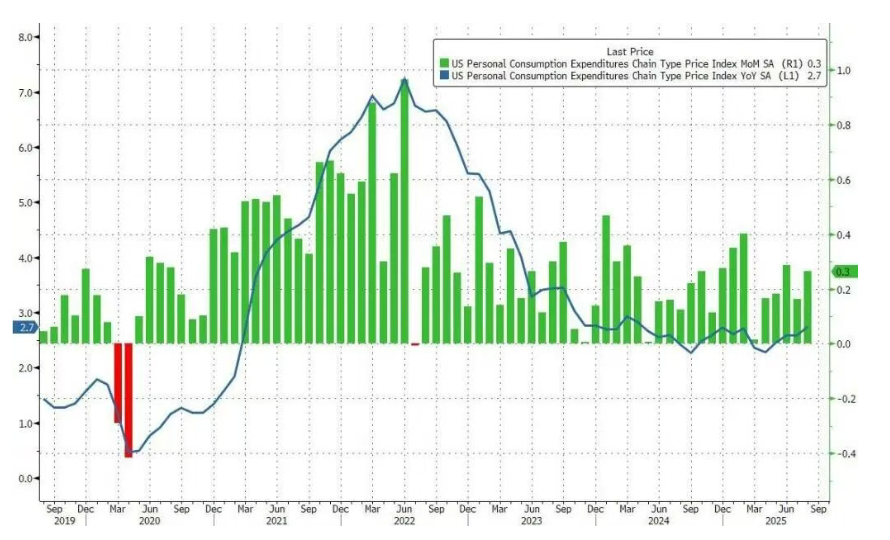
Group 1: Precious Metals Prices - International platinum prices surged, with London gold rising 0.29% to $3759.895 per ounce, London silver increasing 2.46% to $45.994 per ounce, marking a new high since May 2011, international palladium up 1.7% to $1305.3 per ounce, and international platinum up 3.61% to $1611.52 per ounce [1] Group 2: U.S. Economic Indicators - The U.S. core PCE price index for August showed a year-on-year increase of 2.9%, consistent with previous values, while the overall PCE price index rose 0.3% month-on-month, with a year-on-year increase of 2.7% compared to 2.6% previously [2][4] - Personal income in August grew by $95.7 billion, a month-on-month increase of 0.4%, while personal consumption expenditure rose by $129.2 billion, a month-on-month increase of 0.6%, both exceeding prior expectations by 0.1 percentage points [4] Group 3: Consumer Confidence - The consumer confidence index in the U.S. fell to 55.1 in September, a decrease of about 5% from August, with the current economic conditions index dropping from 61.7 to 60.4, and the consumer expectations index falling from 55.9 to 51.7 [5] - Nearly 70% of U.S. consumers expect inflation to exceed income growth in the coming year, while about 65% anticipate an increase in unemployment rates [5] Group 4: Federal Reserve's Monetary Policy - Federal Reserve Vice Chair Michelle Bowman emphasized the need for decisive and preemptive interest rate cuts to address worsening labor market issues [7][8] - Recent data indicates a significant increase in labor market vulnerability, prompting calls for immediate action to prevent further deterioration [8] - The uncertainty surrounding the Federal Reserve's interest rate cuts has increased, with strong economic data complicating the outlook for potential rate reductions [10] Group 5: Gold Price Forecasts - Several institutions have raised their gold price forecasts, with JPMorgan predicting spot gold prices could exceed $4000 per ounce by Q1 2026, and Goldman Sachs maintaining a target of $3700 per ounce by the end of 2025 [11] - The potential impact of U.S. government shutdown risks and ongoing global central bank gold purchases are expected to support gold's long-term investment appeal [11]
蓝莓外汇观察:金融环境趋宽,分析师解读市场新动向
Sou Hu Cai Jing· 2025-09-25 08:51
Group 1 - The recent interest rate decision by the Federal Reserve is viewed as a positive signal for risk assets, indicating a current loose financial environment [1][3] - The rate adjustment is interpreted as a "preventive measure," with the Fed signaling future policy paths through its latest economic forecasts [3] - Fed Chairman Jerome Powell highlighted increased downside risks to employment, suggesting a shift towards prioritizing job security and economic stability over immediate inflation concerns [3] Group 2 - The Fed's increased tolerance for short-term inflation aims to create more space for achieving a "soft landing" for the economy [3] - Current data does not support concerns that rate cuts indicate economic weakness, as the U.S. economic fundamentals remain robust with a low probability of recession in the near term [3][5] - Key supporting factors include stable corporate earnings growth, strong retail performance, accelerated business loan growth, and a significant investment trend driven by artificial intelligence [3] Group 3 - Government measures such as deregulation, infrastructure investment, and tax cuts are enhancing the long-term supply capacity of the economy [4] - The combination of further monetary easing and fiscal policy is providing strong support for economic growth [4] - Investors are encouraged to maintain a moderate "risk appetite," focusing on cyclical sectors sensitive to economic growth recovery and small-cap stocks and tech growth stocks that are more sensitive to declining financing costs [4] Group 4 - Despite an optimistic outlook, several risk factors warrant monitoring, including signs of economic slowdown, changes in the labor market, potential inflation resurgence, and rapid increases in long-term interest rates [4] - Current high-frequency data indicates that these risk factors do not pose a significant threat, with the overall market remaining in a healthy state [5]