行为金融学

Search documents
【有本好书送给你】生于大萧条,一生经历数次金融危机,巴菲特靠“不作为”赢麻了
重阳投资· 2025-07-09 06:53
Core Viewpoint - The article emphasizes the importance of reading as a pathway to growth and wisdom, highlighting the influence of Warren Buffett and Charlie Munger in promoting this idea [2][3][7]. Summary by Sections Book Recommendation - The featured book is "Warren Buffett: From Investor to Entrepreneur," authored by Todd A. Finkle, which explores Buffett's investment wisdom and entrepreneurial spirit [9][11]. Behavioral Finance - Buffett suggests that successful investors must understand two key aspects: how to evaluate a company and how to comprehend human nature [13]. - Behavioral finance, rooted in the research of Daniel Kahneman and Amos Tversky, examines how psychological biases affect investor decisions, emphasizing the importance of recognizing these biases to avoid mistakes [14][15]. Crisis Management - The article discusses how Buffett navigated various financial crises, including: 1. **COVID-19 Pandemic**: The U.S. stock market fell 34% in a rapid decline, but Buffett advised maintaining confidence and not making drastic changes [17]. 2. **Great Recession (2007-2009)**: The Dow Jones index dropped over 50%, yet Buffett's strategy of patience proved effective as the market eventually recovered [18]. 3. **Dot-com Bubble (2000-2002)**: Despite criticism for underperforming, Buffett's cautious approach during the tech boom and subsequent crash demonstrated the value of independent thinking [19]. 4. **Great Depression**: The Dow Jones index took 25 years to recover to its pre-crash peak, illustrating the long-term impact of economic downturns [21]. Summary of Crisis Responses - The recovery times from crises have decreased over the decades, from 25 years during the Great Depression to just two months during the COVID-19 pandemic, indicating improved resilience in the market [22].


Z世代的“炒股心经”
经济观察报· 2025-07-08 11:54
Core Viewpoint - The "Z Generation" is no longer an outsider in the financial market, as they actively participate in stock trading, driven by the desire to earn their first pot of gold, while experiencing a range of emotions from joy to anxiety and disillusionment [1][5]. Group 1: Z Generation's Market Entry - In recent years, there has been a significant influx of new investors, particularly from the Z Generation, with 72% of young investors having only about a year of experience in stock trading [4][3]. - The proportion of investors under 30 has reached 30%, doubling compared to before September 2024 [4]. Group 2: Individual Experiences and Learning - Young investors like Xiao Zeng and Li Yan have faced substantial losses, with Xiao Zeng experiencing a monthly loss of 80,000 yuan and a drop in account yield from 58% to -59% [2][16]. - Li, who initially felt confident in his theoretical knowledge, faced harsh realities in the market, leading to a realization that practical experience is essential for true understanding [9][12]. Group 3: Evolving Investment Strategies - Li's investment logic evolved through three iterations, moving from traditional media to interpersonal recommendations, and finally to a cautious approach towards new media stock recommendations [10][11]. - The survey indicated that only 6% of respondents relied on social media for investment information, reflecting a shift in the Z Generation's approach to information sourcing [11]. Group 4: Emotional and Psychological Aspects - Xiao Zeng's experience illustrates the "overconfidence trap," where initial success led to reckless trading decisions, resulting in significant losses [16]. - The emotional pain of losses is noted to be 2.5 times greater than the pleasure from gains, highlighting the psychological challenges faced by young investors [16]. Group 5: Lessons Learned and Future Outlook - Li Yan learned to adapt his strategies by focusing on risk management and understanding market dynamics, achieving an annual return of around 10% [22]. - The survey revealed that 73.78% of Z Generation investors plan to increase their stock investments in the coming year, with over 72% believing that emotional regulation is the most important skill in investing [28].

研究 | 隋鹏飞:筹码效应与投资者行为:投资者行为偏差揭秘
Sou Hu Cai Jing· 2025-07-08 05:01
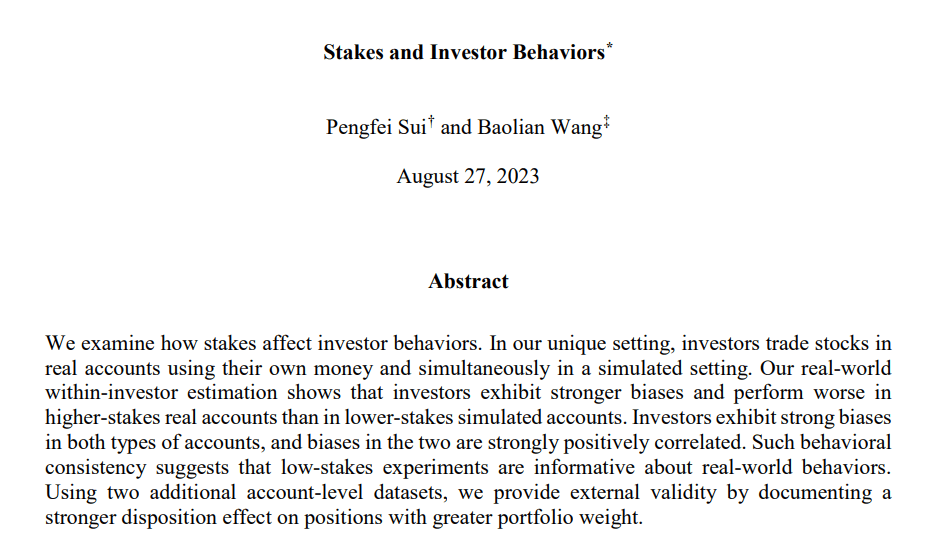
Core Insights - The research conducted by Professor Sui Pengfei from CUHK (Shenzhen) and Professor Wang Baolian from the University of Florida has been accepted by the Journal of Financial Economics, providing significant insights into the impact of stake effects on investor behavior [1][3] - The study challenges traditional views by demonstrating that investors exhibit more pronounced behavioral biases in high-stake real trading environments compared to low-stake simulated environments [1][11] Research Findings - The study utilized a unique natural experiment design, comparing the behaviors of investors managing both real and simulated accounts, revealing that higher stakes lead to increased behavioral biases such as disposition effect, lottery stock preference, and overconfidence [10][11] - Empirical results indicate that the performance of investors in real accounts is generally lower than in simulated accounts, contradicting the belief that higher stakes would enhance decision-making quality [1][11] Theoretical and Practical Implications - This research provides a new explanatory framework for the stake effect on investment behavior, raising important methodological questions about the applicability of laboratory findings to real-world high-stake financial scenarios [2][9] - The findings have significant implications for investor education, risk management in financial institutions, and regulatory policy formulation, emphasizing the need for a deeper understanding of investor psychology in high-stake environments [2][12] Behavioral Biases Identified - The study identifies four key behavioral biases that are exacerbated in high-stake environments: 1. Stronger disposition effect (selling winners too early and holding onto losers too long) [12] 2. More pronounced lottery stock preference [12] 3. Increased tendency for overconfidence [12] 4. More frequent overtrading behavior [12] Investor Characteristics - The research highlights that the impact of stake effects varies among different investor characteristics, with larger portfolio investors being less affected and those from economically developed regions showing stronger resilience to these biases [11][12]
会员金选丨教授公开课(全干货):洞察全球变局,把握投资与产业机遇
第一财经· 2025-07-08 02:16
Core Viewpoint - The article discusses the evolving U.S.-China tariff policies and their implications for global economic dynamics, emphasizing the need for strategic responses from companies and industries to mitigate risks and seize opportunities in the current geopolitical landscape [7][8]. Group 1: Event Overview - The public lecture will cover topics such as the multi-dimensional impacts of tariff negotiations, strategies for managing tariff risks through market and financial tools, and the implications of currency fluctuations and digital currency in countering tariff effects [3][10]. - The event is scheduled for July 12, 2025, at the Global Financial Center in Beijing, featuring a Q&A session to engage participants [3][9]. Group 2: Expert Insights - Professor Zhu Ning, a prominent figure in finance and economics, will provide insights into the complexities of U.S.-China trade relations, drawing from his extensive academic and professional background [4][5]. - Professor Li Nan will analyze the underlying logic of tariff negotiations, focusing on how U.S. inflation, debt, and electoral politics drive policy changes, and how China can enhance resilience through countermeasures and internal circulation [10][12]. Group 3: Investment Strategies - The lecture will explore investment strategy adjustments in response to market volatility, identifying long-term value anchors in the A-share market and how companies can optimize their global positioning amid changing policies [10][11]. - Key sectors such as semiconductors and renewable energy will be examined for their potential to navigate technology blockades and explore feasible trade routes [10].

【UNFX课堂】行为金融学角度的反转交易:群体超调β与均值回归γ的博弈模型
Sou Hu Cai Jing· 2025-07-07 11:18
Group 1 - The core logic of reversal trading is based on extreme emotions acting as value inflection points, where market sentiment reaches extremes leading to significant price deviations from intrinsic value, creating "cognitive arbitrage opportunities" [1] - Reversal trading differs from trend-following strategies by capturing the return to consensus, as seen in instances like the violent rebound of oil futures after they fell to negative values in 2020 [1] Group 2 - The extreme emotion identification system includes quantitative indicators for buy and sell signals based on valuation metrics, such as PB below the historical 10th percentile for buying and PE above the historical 90th percentile for selling [2] - Additional signals include liquidity metrics, where a 60%+ reduction in financing balance and VIX above 40 indicate buying opportunities during extreme pessimism, while a daily turnover rate above 10% signals selling during extreme optimism [2] Group 3 - Confirmation tools for extreme emotions involve assessing whether valuations deviate from fundamentals, and if liquidity crises exist, which would trigger buying signals [3] - In the case of the Hong Kong stock market in October 2022, the Hang Seng Index had a PB of 0.8, indicating a 10-year low, combined with record net buying from the Stock Connect, confirming a reversal buy point [4] Group 4 - The golden window for reversal trading indicates that the speed of recovery from pessimism is greater than the dissolution of optimism, as evidenced by historical events like the tech bubble burst in 2000 [4] - Three types of reversal strategies are identified: long positions after extreme pessimism, short positions after extreme optimism, and specific patterns like emotional mispricing and cyclical stock rebounds [4][5] Group 5 - The characteristics of targets for reversal trading include industry leaders with stable free cash flow and high ROE, which may be indiscriminately sold due to macro risks [5] - High-risk strategies involve leveraging positions in companies facing downgrades and significant price drops due to forced liquidations, necessitating day trading to capitalize on panic selling [5][6] Group 6 - Risk control mechanisms include avoiding value traps, ensuring companies have a net debt ratio below 50%, and being cautious of market trends and liquidity issues [6][7] - The essence of reversal trading lies in identifying collective market errors at extreme moments, emphasizing the importance of rationality and discipline in decision-making [8]
为什么投资者喜欢股息是正确的
雪球· 2025-07-02 08:22
Core Viewpoint - The article emphasizes the effectiveness of focusing on dividends for generating returns, challenging traditional financial theories that downplay their importance [1][2]. Group 1: Dividend Preference - Investors prefer dividend-paying stocks because they perceive them as providing higher returns with lower volatility compared to non-dividend stocks, as evidenced by a 9.2% annualized return for dividend-paying stocks versus 4.3% for non-dividend stocks over the past 50 years [2]. - The psychological aspect of dividends is significant; investors treat dividends similarly to wages, viewing them as income they can spend without touching their principal [1][2]. Group 2: Long-term Wealth Growth - From 1973 to 2024, dividend-paying companies are projected to increase wealth tenfold before taxes, significantly outperforming non-dividend companies [5]. - The best-performing stocks historically have not always paid dividends, indicating that high returns can also come from companies that reinvest profits rather than distribute them [6]. Group 3: Characteristics of Dividend-Paying Companies - Dividend-paying companies often exhibit characteristics of "value and quality," which are crucial for long-term investment success [6][7]. - Companies that pay dividends tend to be more cautious with cash not distributed to shareholders, which can lead to better financial management [7].

金工定期报告20250701:“重拾自信2.0”RCP因子绩效月报20250630-20250701
Soochow Securities· 2025-07-01 12:35
Quantitative Factors and Construction Methods 1. Factor Name: CP (Overconfidence Factor) - **Construction Idea**: Based on the behavioral finance concept of overconfidence, the factor uses the time difference between rapid price increases and decreases as a proxy variable to measure investor overconfidence [6] - **Construction Process**: - The factor is derived from the DHS model, which posits that investor overconfidence impacts stock prices - The time difference between rapid price increases (positive news) and rapid price decreases (negative news) is calculated to quantify overconfidence [6] - **Evaluation**: The CP factor innovatively captures overconfidence behavior but does not account for subsequent overcorrections in stock prices [6] 2. Factor Name: RCP (Reclaimed Confidence Factor) - **Construction Idea**: Extends the CP factor by considering potential overcorrections (excessive pessimism) during price pullbacks, followed by subsequent rebounds due to positive news [6] - **Construction Process**: - The CP factor is orthogonalized with intraday returns to remove noise - The residual term from this process is used to construct the RCP factor, which represents reclaimed confidence after overcorrection [6] - In the 2.0 version, standardized factor values replace ranking values to retain more factor information, improving the purity and effectiveness of the RCP factor [7] - **Evaluation**: The RCP factor demonstrates superior performance compared to traditional factor-based portfolio construction methods, particularly after the 2.0 enhancements [6][7] --- Factor Backtesting Results 1. CP Factor - No specific backtesting results provided for the CP factor in the report 2. RCP Factor (2.0 Version) - **Annualized Return**: 18.45% [7][10] - **Annualized Volatility**: 7.69% [7][10] - **Information Ratio (IR)**: 2.40 [7][10] - **Monthly Win Rate**: 78.10% [7][10] - **Maximum Drawdown**: 5.89% [7][10] 3. June 2025 Performance (RCP Factor) - **Long Portfolio Return**: 4.75% [11] - **Short Portfolio Return**: 5.64% [11] - **Long-Short Portfolio Return**: -0.89% [11]
牛市来了?三大隐忧暗藏杀机!
Sou Hu Cai Jing· 2025-06-26 03:08
Group 1 - The article emphasizes the importance of remaining calm amidst market exuberance, highlighting that underlying capital dynamics are crucial for investment success [1] - It discusses three major challenges facing the current bull market: geopolitical tensions, monetary policy uncertainties, and currency market fluctuations [2][4][5] Group 2 - The article points out the disparity in index performance, noting that the Shanghai and Shenzhen 300 index has outperformed micro-cap stocks by 13 times over three days, indicating a selective investment environment [7] - It describes the behavioral patterns of retail investors, illustrating a cycle of cautious profit-taking followed by aggressive chasing of highs, which leads to "fear of missing out" [8] - The rise of quantitative trading strategies is highlighted, with institutions leveraging AI and machine learning to gain an edge over retail investors who rely on traditional indicators [10] Group 3 - The article introduces the concept of "hot money chasing," where stocks that attract significant capital often experience independent price movements, emphasizing the need for quantitative tools to identify these signals [11] - It explains the deceptive nature of "shakeout" signals in the market, where institutions may use tactics to mislead retail investors while accumulating positions [13] - The narrative concludes with the assertion that understanding market dynamics through data analysis can help investors avoid emotional traps and make informed decisions [15]

A股何时崛起?市场总能爬过“忧虑之墙”!
证券时报· 2025-06-22 00:10
Core Viewpoint - The article emphasizes that while pessimism often dominates market sentiment, it is the optimists who ultimately succeed in investing, highlighting the importance of focusing on high-quality companies rather than succumbing to negative market outlooks [1][16]. Group 1: Pessimism vs. Optimism - Pessimism tends to attract more attention due to its novelty and immediate relevance, while optimism requires a historical perspective that is often overlooked [2][5]. - Historical data shows that the stock market has provided an annualized return of approximately 12%, despite its inherent volatility, which can lead to short-term pessimism overshadowing long-term gains [3][10]. - The tendency to focus on negative events in finance is exacerbated by the fact that financial crises impact a broader audience, making them more memorable than gradual progress [7][8]. Group 2: Investment Strategies - Investors are cautioned against allowing pessimistic views to dictate their investment decisions, as high-quality companies can navigate challenges effectively [4][16]. - Warren Buffett's experiences illustrate that significant market downturns often present the best buying opportunities, regardless of prevailing negative sentiments [14][16]. - The article suggests that the long-term returns from stocks are primarily driven by business performance rather than speculative gains, with a historical average return of 9.5% attributed to operational success [12]. Group 3: Market Performance - The A-share market has shown significant growth over the past 20 years, with total market capitalization increasing from 4.25 trillion to 26.65 trillion, reflecting a 5.27-fold increase and an annualized growth rate of 9.6% [15]. - Despite initial high valuations compared to mature markets, the long-term performance of quality companies in the A-share market underscores the potential for substantial returns [15].

A股何时崛起?以伊战争升级,市场总能爬过“忧虑之墙”!
券商中国· 2025-06-21 23:26
Core Viewpoint - The article emphasizes that while pessimism is prevalent in the current financial climate, it is optimism that ultimately leads to investment success. Investors should focus on high-quality companies rather than being swayed by negative market sentiment [1][10]. Group 1: Pessimism vs. Optimism - Pessimism tends to attract more attention than optimism, as it appears more novel and compelling in the face of recent events [2][3]. - Historical data shows that the stock market has provided an annualized return of approximately 12%, despite its volatility [8][9]. - Investors often overlook the long-term benefits of the stock market due to short-term negative sentiments [7][10]. Group 2: Investment Strategies - Investors should not let pessimistic views dictate their investment decisions; instead, they should focus on identifying high-quality companies capable of weathering economic challenges [10]. - The article cites that over the past 20 years, the total market capitalization of comparable companies in the A-share market increased from 4.25 trillion to 26.65 trillion, reflecting a growth rate of 5.27 times, with an annualized growth of 9.6% [10]. - It is crucial to avoid overemphasizing macroeconomic uncertainties and instead concentrate on the fundamentals of individual companies [10].