创新药

Search documents
6个中成药跻身国家医保目录新增名单,中药ETF(159647)盘中净申购650万份
Xin Lang Cai Jing· 2025-12-08 06:28
Group 1 - The core viewpoint of the news highlights the performance of the Traditional Chinese Medicine (TCM) sector, with the Zhongzheng TCM Index experiencing a slight decline of 0.28% as of December 8, 2025, while individual stocks showed mixed results, with Kangyuan Pharmaceutical leading with a gain of 1.71% [1] - The recent release of the new National Basic Medical Insurance, Maternity Insurance, and Work Injury Insurance Drug Catalog, along with the first Commercial Health Insurance Innovative Drug Catalog (2025), marks the 8th adjustment since the establishment of the National Medical Insurance Bureau, adding 114 new drugs, including 6 TCM products [1] - The Zhongzheng TCM Index includes companies involved in TCM production and sales, reflecting the overall performance of TCM-related listed companies [2] Group 2 - Huafu Securities recommends focusing on innovative drugs, particularly those with revenue and commercialization capabilities, as well as exploring potential big business development opportunities in the biotech and pharmaceutical sectors [2] - The medical device sector is expected to experience a policy turning point, with stock prices, valuations, and configurations at a low point, indicating a potential fundamental turnaround [2] - The TCM ETF closely tracks the Zhongzheng TCM Index, with the top ten weighted stocks accounting for 54.79% of the index, including notable companies such as Yunnan Baiyao and Tongrentang [2]
进入配置窗口期!高溢价频现,港股通创新药ETF(520880)磨底行情获资金坚定加仓
Mei Ri Jing Ji Xin Wen· 2025-12-08 06:01
Group 1 - The core viewpoint of the articles highlights that the innovation drug sector is experiencing a correction, with over 17% decline since early September, presenting a potential mid to long-term investment opportunity in core assets of innovation drugs [1] - The recent release of the first version of the "Medical Insurance + Commercial Insurance Dual Directory" by the National Healthcare Security Administration is expected to boost investment enthusiasm in innovation drugs [1] - Analysts from CITIC Securities predict that innovation drugs are likely to be a major upward trend in the cross-year market, supported by the industry's transition into a phase of "innovation realization + global layout" [1] Group 2 - The Hong Kong Stock Connect Innovation Drug ETF (520880) is highlighted as a key investment vehicle, with over 70% of its portfolio invested in leading innovation drug companies, indicating strong buying sentiment [1][2] - The Hang Seng Hong Kong Stock Connect Innovation Drug Select Index is noted for its three unique advantages: it is purely focused on innovation drugs, has a high concentration of leading companies, and offers better risk control by reducing the weight of less liquid stocks [2]
中融亚太:洞察行业投资机会
Sou Hu Cai Jing· 2025-12-08 05:49
Group 1: Investment Opportunities in New Energy - The new energy sector is experiencing structural opportunities, driven by global carbon neutrality goals, with strong growth resilience observed in the photovoltaic, energy storage, and electric vehicle industries [1] - The photovoltaic industry is shifting its focus from maximizing conversion efficiency to reducing levelized cost of electricity, with perovskite battery commercialization potentially reshaping the competitive landscape [1] - The energy storage sector is diversifying in technology routes, with flow batteries showing potential for long-duration storage applications and sodium-ion batteries gaining attention as a resource-constrained alternative [1] - The value focus in the electric vehicle supply chain is shifting from vehicle manufacturing to intelligent components and automotive-grade chips, marking the onset of the software-defined vehicle era [1] Group 2: Digital Economy and AI - The deepening development of the digital economy is creating new investment dimensions, with breakthroughs in artificial intelligence technology reshaping production methods and business models across various industries [3] - The rapid application of generative AI in vertical industries such as finance, healthcare, and manufacturing is creating urgent demands for intelligent transformation, favoring companies with industry know-how and technological implementation capabilities [3] - The industrial internet is becoming a key vehicle for the integration of the digital economy and the real economy, with platform development and data value extraction driving the transformation and upgrading of the manufacturing sector [3] - The cultivation of a data factor market is generating growth momentum for niche areas such as data security and privacy computing [3] Group 3: Consumer Market Trends - The structural upgrade and innovative transformation of the consumer market are giving rise to new investment opportunities, with a parallel development of high-end and cost-effective products under the trend of consumption stratification [3] - Emerging sectors such as health consumption, the silver economy, and national trend culture are showing robust vitality, with innovative business models that meet personalized and experiential demands continuously emerging [3] - Upgrades in flexible production and intelligent manufacturing are enhancing industry efficiency, while the globalization of cross-border e-commerce is creating new opportunities for Chinese brands to expand overseas [3] - The investment logic in the consumer sector is shifting from traffic-driven to value creation, with companies focusing on product strength and user experience expected to gain long-term development space [3] Group 4: Healthcare Industry Innovations - The healthcare industry is experiencing sustained growth driven by accelerated population aging and increased health awareness [4] - Differentiated R&D strategies in the innovative drug sector are yielding significant results, with therapies based on cutting-edge technologies like gene editing and cell therapy gradually moving towards clinical application [4] - The domestic substitution process in medical devices is accelerating, with a number of internationally competitive companies emerging in high-end imaging equipment and in vitro diagnostic reagents [4] - The modernization and internationalization of traditional Chinese medicine are encountering new opportunities, with the secondary development of classic formulas and the global dissemination of Chinese medicine culture opening new blue oceans for the industry [4] - Investment in the healthcare sector is evolving from single project investments to the construction of industrial ecosystems, with collaborative development of the innovation chain becoming key to enhancing investment value [4]


摩根大通解密BD潮:巨头“抄底”中国创新药,下一个爆款在哪?
2 1 Shi Ji Jing Ji Bao Dao· 2025-12-08 04:50
Core Insights - The global biopharmaceutical innovation landscape, traditionally dominated by multinational corporations (MNCs), is undergoing significant structural changes, with China's innovative drug industry emerging as a key player on the global stage [1] - China's transition from a "fast follower" to a "first mover" in innovative drugs is becoming an irreversible trend, as highlighted by The Economist, indicating that Chinese innovation drugs are at a "critical point" of globalization [1] - Data shows that China's share in global clinical trials and licensing transactions is rising significantly, with Chinese biotech companies' stock prices outperforming their U.S. counterparts over the past year [1][2] - The total market capitalization of Chinese listed biotech companies is still less than 15% of their U.S. peers, presenting a "historic investment opportunity" as perceived by international capital [1] Group 1 - The cost-effectiveness and speed advantages of Chinese innovative drug companies are notable, with drug discovery phases being 2-3 times faster and patient recruitment in clinical trials being 2-5 times quicker than international counterparts [4] - The total amount of licensing transactions for Chinese innovative drugs is expected to exceed $100 billion by 2025, with significant deals already occurring, such as the $12.5 billion upfront payment from Pfizer to 3SBio [4][2] - The surge in business development (BD) activities reflects a growing interest from MNCs in China's innovative drug capabilities, particularly in advanced fields like T-cell engagers and CAR-T therapies [2][5] Group 2 - The market is witnessing a "BD frenzy," with MNCs actively engaging in acquisitions, driven by the recognition of China's improving innovation, research, and clinical capabilities [5][6] - The anticipated growth in the pharmaceutical industry is expected to lead to a significant increase in the Hang Seng Index, with projections indicating a potential doubling by 2025 [8] - The overall revenue of Chinese innovative drug companies reached 48.83 billion yuan in the first three quarters of 2025, marking a 22% year-on-year increase, with the sector achieving its first quarterly profit since inception [8] Group 3 - The shift in capital market dynamics is evident, with investors now focusing more on the "hard power" of companies rather than just their narrative or story [10][9] - The trend of companies transitioning from A-share to Hong Kong markets is gaining momentum, with a growing number of firms seeking to list in Hong Kong, reflecting a tightening scrutiny of fundamentals by investors [11][14] - The current market environment is characterized by a rational return, where investors prioritize solid fundamentals over speculative narratives, indicating a more cautious approach to investment [12][13]
摩根大通解密BD潮:巨头“抄底”中国创新药 下一个爆款在哪?
2 1 Shi Ji Jing Ji Bao Dao· 2025-12-08 04:48
Core Insights - The global biopharmaceutical innovation landscape, traditionally dominated by multinational corporations (MNCs), is undergoing significant structural changes, with China's innovative drug industry emerging as a key player on the global stage [1][3] - China's transition from a "fast follower" to a "first mover" in innovative drugs is becoming an irreversible trend, as highlighted by international media [1] - Data shows that China's share in global clinical trials and licensing transactions is increasing, with Chinese biotech companies outperforming their U.S. counterparts in stock price growth over the past year [1][2] Group 1: Market Dynamics - The cost-effectiveness and speed of Chinese innovative drug companies are becoming critical factors for MNCs to source R&D pipelines from China, with costs being 30%-40% lower than in the U.S. [2] - The year 2025 is projected to be a breakout year for China's innovative drug licensing transactions, with total amounts surpassing $100 billion in the first three quarters [4][8] - Notable collaborations include a $12.5 billion upfront payment from Pfizer to 3SBio for overseas rights to a bispecific antibody, which significantly boosted market enthusiasm [2][4] Group 2: Investment Trends - MNCs are actively engaging in acquisitions during industry downturns, recognizing the continuous improvement in China's innovation, R&D, and clinical capabilities [5] - The capital market is witnessing a shift from "story-driven" investments to a focus on the "hard strengths" of companies, emphasizing clinical data and product quality [10][11] - The interaction between A-share and Hong Kong markets is tightening, with many quality companies seeking to list in Hong Kong, reflecting a more rigorous examination of fundamentals by investors [11][12] Group 3: Future Outlook - The biopharmaceutical sector is expected to thrive, with projections indicating that the Hang Seng Index could double by 2025 due to favorable policies and recovering valuations [8] - The market is experiencing a healthy adjustment, with the innovative drug sector reporting a 22% year-on-year revenue increase, marking its first quarterly profit since inception [8][9] - The trend of companies transitioning from "fast followers" to "first movers" is gaining momentum, with 5%-10% of innovations now being true first-in-class [11]
医药行业周报(2025/12/01-2025/12/05):本周申万医药生物指数下跌0.7%,关注医保商保双目录发布-20251208
Shenwan Hongyuan Securities· 2025-12-08 04:34
Investment Rating - The report maintains a "positive" outlook on the pharmaceutical industry, particularly focusing on innovative drug sectors [3]. Core Insights - The pharmaceutical sector's performance saw a decline of 0.7% this week, while the Shanghai Composite Index rose by 0.4%. The pharmaceutical index ranked 21st among 31 sub-industries [3][4]. - The new National Medical Insurance Drug List added 114 drugs, including 50 innovative drugs, with an overall success rate of 88%, significantly up from 76% in 2024. The first commercial health insurance innovative drug list includes 19 drugs, enhancing coverage for critical areas such as cancer and chronic diseases [3][12][14]. - The establishment of the Chinese Drug Price Registration System allows companies to self-declare innovative drug prices, facilitating global pricing strategies for innovative drugs [17][18]. Market Performance - The pharmaceutical index's valuation stands at 29.3 times earnings, ranking 10th among 31 primary industries [6]. - The performance of various sub-sectors includes: raw materials (-2.5%), chemical preparations (-0.9%), and medical devices (-0.9%), while medical circulation saw an increase of 6.5% [6][4]. Recent Key Events - The report highlights significant clinical trial results from companies like Junsheng Pharmaceutical, which demonstrated advantages in glycemic control and cardiovascular benefits with its new drug HTD1801 [25]. - The report notes the strategic partnership between Kelun Pharmaceutical and Crescent for developing ADC therapies, with potential milestone payments reaching up to $1.25 billion [27][28]. - The report also mentions the IPO application of Lingke Pharmaceutical, focusing on innovative small molecule drugs for autoimmune and inflammatory diseases, with a post-investment valuation of 3.42 billion yuan [30]


贝达药业高管:已上市创新药全部适应症均纳入国家医保目录
Nan Fang Du Shi Bao· 2025-12-08 03:56
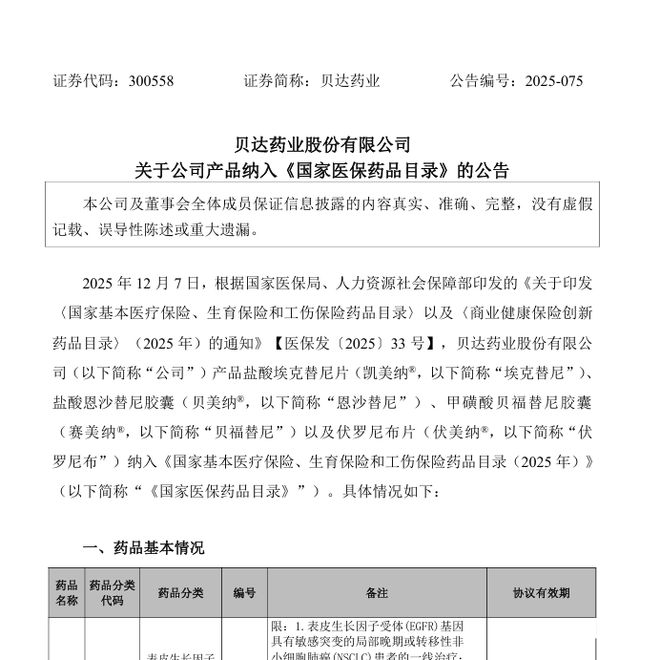
Core Viewpoint - Beida Pharmaceutical Co., Ltd. announced that four of its innovative drugs have been included in the National Medical Insurance Directory for 2025, reflecting the recognition of the company's innovation capabilities and the clinical value of its drugs by the national medical insurance department [1][5]. Group 1: Drug Information - The four drugs included are: 1. **Erlotinib Hydrochloride Tablets** - the first domestically developed EGFR-TKI for lung cancer treatment with independent intellectual property rights [1]. 2. **Ensartinib Capsules** - a new generation ALK inhibitor co-developed with Xcovery [1]. 3. **Befotnib** - a third-generation EGFR-TKI and a national class 1 innovative drug with independent intellectual property rights [2]. 4. **Vorolanib Tablets** - a new multi-target tyrosine kinase inhibitor that can inhibit tumor angiogenesis and is used for treating pathological angiogenesis diseases [2]. Group 2: Impact on Business - Inclusion in the National Medical Insurance Directory is expected to enhance the accessibility of these products and positively impact sales [5]. - The directory will be effective from January 1, 2026, and the immediate impact on the company's operating performance cannot be accurately estimated at this time [5].
国金证券:从2025医保谈判看行业风向 成功率提升创新导向持续强化
智通财经网· 2025-12-08 03:49
Core Viewpoint - The National Healthcare Security Administration (NHSA) has released the new basic medical insurance drug list for 2025, which will take effect on January 1, 2026, leading to a significant increase in the success rate of new drug negotiations, particularly for innovative drugs with high clinical value [1][2]. Group 1: New Drug Negotiation Success - The success rate for new drug negotiations in 2025 has significantly improved to 88%, up from 76% in 2024, with 114 new drugs added to the national medical insurance drug list, including 50 Class 1 innovative drugs [2][3]. - The total number of drugs in the national medical insurance drug list has increased to 3,253, enhancing coverage for critical areas such as cancer, chronic diseases, mental health, rare diseases, and pediatric medications [2]. Group 2: Unique Drug Inclusion - Among the 114 newly added drugs, 105 are unique varieties, representing 92.11% of the total, including 98 Western medicines and 7 traditional Chinese medicines [3]. - The inclusion of unique traditional Chinese medicines from companies like China Resources Sanjiu, Yiling Pharmaceutical, and others indicates a balanced representation in the new drug list [3]. Group 3: Market Potential and Growth - The inclusion of 116 drugs in the latest negotiation, particularly 11 new drugs from Heng Rui Medicine and others, is expected to lead to rapid market share growth and product volume increase due to their entry into the medical insurance directory [4][5]. - The negotiation also included new mechanism drugs, such as antibody-drug conjugates and small nucleic acid siRNA drugs, which are anticipated to drive market penetration and accessibility [5]. Group 4: Commercial Health Insurance Directory - The first commercial health insurance innovative drug directory saw intense competition, with 121 candidates but only 24 entering negotiations, resulting in 19 drugs being successfully included [6]. - The directory covers critical diseases such as Alzheimer's and multiple myeloma, with a balanced mix of imported and domestic drugs [6]. Group 5: Investment Recommendations - Companies with a significant number of innovative drugs included in the new medical insurance directory, such as Heng Rui Medicine, BeiGene, and others, are recommended for investment [9]. - Potential growth in traditional Chinese medicine products included in the new directory, such as those from China Resources Sanjiu and Yiling Pharmaceutical, is also highlighted [9].

医药行业周报:本周申万医药生物指数下跌0.7%,关注医保商保双目录发布-20251208
Shenwan Hongyuan Securities· 2025-12-08 02:54
Investment Rating - The report maintains a positive outlook on the innovative drug sector and recommends focusing on companies with strong performance in medical devices, CXO, and upstream sectors [3][4]. Core Insights - The report highlights a 0.7% decline in the Shenwan Pharmaceutical Bio Index, while the Shanghai Composite Index rose by 0.4% during the same period [3][4]. - The new National Medical Insurance Drug List added 114 drugs, including 50 innovative drugs, with an overall success rate of 88%, significantly up from 76% in 2024 [3][13]. - The launch of the Chinese Drug Price Registration System allows companies to self-declare innovative drug prices, enhancing the global pricing strategy for these drugs [19][21]. - Recent clinical trial successes and milestone payments indicate a robust pipeline for several companies, including a $250 million milestone payment received by BaiLi Tianheng [26][29]. Market Performance - The Shenwan Pharmaceutical Bio Index ranked 21st among 31 Shenwan first-level sub-industries, with a current overall valuation of 29.3 times earnings, placing it 10th among all first-level industries [3][4][6]. - Various sub-sectors showed mixed performance, with medical circulation and offline pharmacies seeing increases of 6.5% and 1.8%, respectively, while raw materials and chemical preparations declined by 2.5% and 0.9% [3][6]. Recent Key Events - The report notes the release of the first Commercial Health Insurance Innovative Drug Directory, which includes 19 drugs aimed at enhancing coverage for critical diseases and rare conditions [13][18]. - The FDA's drug review center director's resignation adds uncertainty to the regulatory environment, which may impact drug approvals and market dynamics [19][21]. - The report emphasizes the importance of monitoring flu vaccine stocks and related pharmaceutical companies as flu activity rises [22]. Company Dynamics - BaiLi Tianheng received a significant milestone payment, indicating strong progress in its global drug development efforts [26]. - Junsheng Pharmaceutical announced positive results from a head-to-head clinical trial, showcasing the advantages of its new drug HTD1801 over existing treatments [29]. - Heng Rui Pharmaceutical appointed a new senior vice president from Eli Lilly, enhancing its research and development capabilities [30]. - Kelong Botai entered a strategic partnership to develop and commercialize new cancer therapies, indicating a focus on innovative treatment options [31]. IPO Dynamics - Lingke Pharmaceutical has initiated its IPO process in Hong Kong, focusing on innovative small molecule drugs for autoimmune and inflammatory diseases [34]. - Hansi Aitai's IPO application has passed the hearing process, indicating strong market interest in its dual-function antibody therapies [36].


部分创新药概念股早盘走高 多款罕见病药物获纳入医保目录及商保创新药目录
Zhi Tong Cai Jing· 2025-12-08 01:57
Core Viewpoint - The article highlights a significant rise in the stock prices of several innovative pharmaceutical companies following the announcement of the 2025 National Medical Insurance drug list, which includes a substantial number of new innovative drugs [1] Group 1: Stock Performance - WuXi AppTec (02126) saw an increase of 8.77%, trading at HKD 3.35 [1] - Kintor Pharmaceutical (02171) rose by 3.8%, reaching HKD 18.87 [1] - Beihai Kangcheng (01228) increased by 3.38%, priced at HKD 2.45 [1] - Junshi Biosciences (01877) gained 2.29%, with a share price of HKD 24.1 [1] Group 2: Drug List Adjustments - The 2025 National Medical Insurance drug list is the 8th adjustment since the establishment of the National Healthcare Security Administration [1] - A total of 114 new drugs were added to the list, including 50 Class 1 innovative drugs [1] Group 3: Notable Drug Inclusions - Fosun Pharma's (600196) Luwomei Tablets and Beihai Kangcheng's injectable Vilazodone Beta were included in the commercial insurance innovative drug list [1] - The highly anticipated CAR-T cell therapies from various companies, including Fosun Kairui's Acalabrutinib Injection and WuXi AppTec's Regorafenib Injection, were also included in the first batch of commercial insurance innovative drug list [1]