AI大模型

Search documents
大模型与AI眼镜,扎克伯格都想要! 华尔街却质疑:Meta(META.US)狂热支出像极了当年的元宇宙
智通财经网· 2025-10-31 09:08
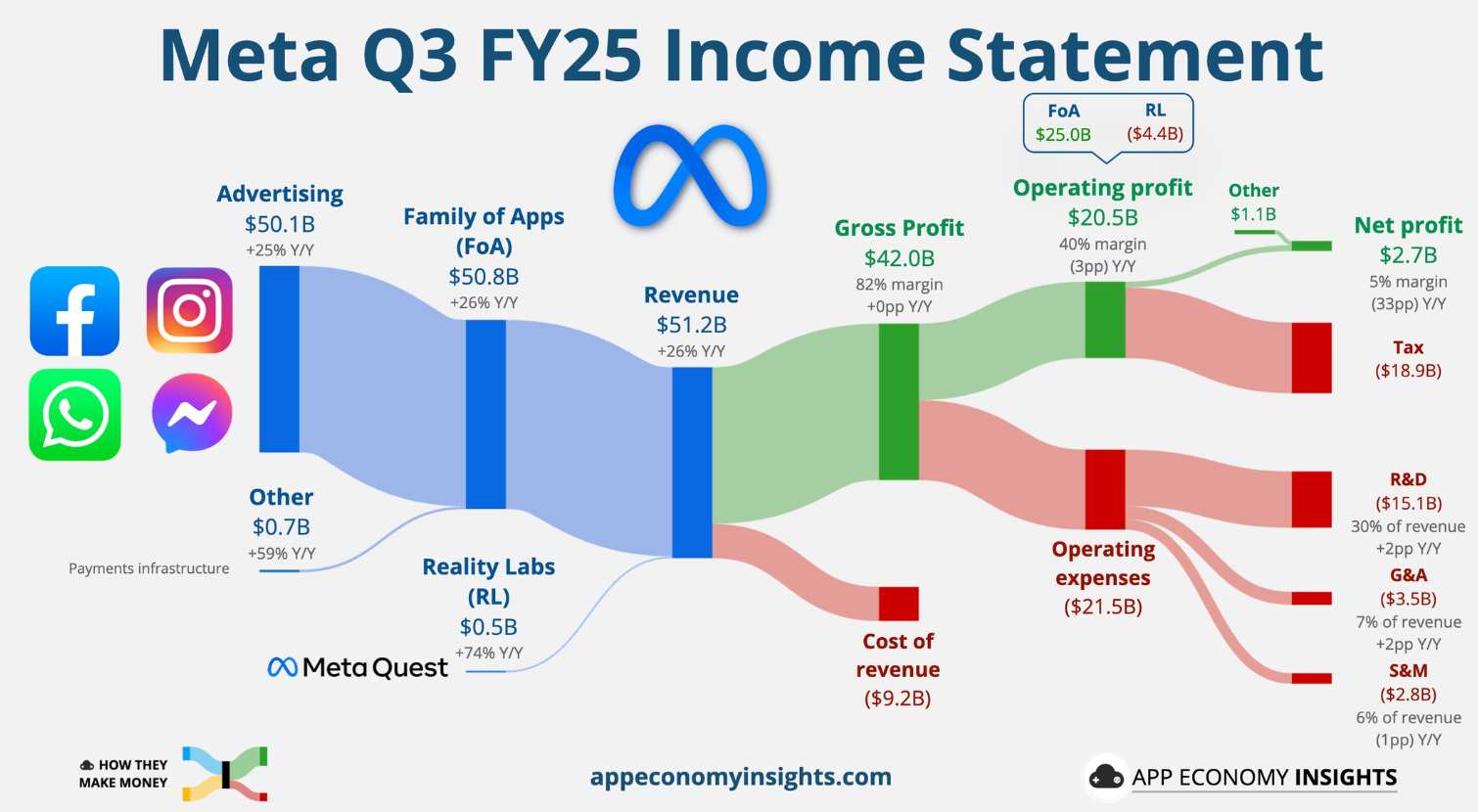
Core Insights - Meta Platforms' stock price dropped significantly by 11.3%, with a current market capitalization of approximately $1.68 trillion, following a $16 billion one-time expense due to the OBBBA tax law, leading to a drastic 83% decline in Q3 net profit from $15.69 billion to $2.71 billion [1][2] - Despite the challenges, Meta's digital advertising revenue continues to grow, driven by AI advancements, but concerns over rising capital expenditures have led analysts to lower their price targets for the stock [1][2][8] Financial Performance - Meta's Q3 net profit fell to $2.71 billion, a significant drop from $15.69 billion year-over-year, primarily due to a one-time tax expense of $16 billion [1][2] - The company expects its total expenditures for 2025 to be between $116 billion and $118 billion, up from a previous estimate of $114 billion to $118 billion, indicating a 20 billion increase in the lower end of the range [2] Capital Expenditure and AI Investments - Meta plans to significantly increase its capital expenditures in 2026, with guidance suggesting a range of $70 billion to $72 billion for 2025, focusing on AI infrastructure [2][4] - The company is investing heavily in AI capabilities, including the development of new AI data centers and advanced server farms to support AI model training and advertising workloads [4][5] Market Outlook and Analyst Ratings - Analysts have expressed mixed views on Meta's future, with some downgrading their ratings due to concerns over high capital expenditures reminiscent of past investments in the metaverse [8][9] - Bernstein maintains a "buy" rating but has lowered its price target to $870, while Citigroup also retains a "buy" rating with a reduced target of $850, reflecting concerns over future profitability due to increased spending [8][9][10] AI and Product Development - Meta is focusing on developing AI-powered products, including AI smart glasses, which are seen as a potential replacement for smartphones in the future [5][6][7] - The company aims to integrate advanced AI models with wearable technology, positioning itself to compete with major players like Apple in the consumer electronics space [6][7] Industry Trends - The generative AI market is projected to grow from approximately $40 billion in 2022 to $1.3 trillion by 2032, indicating a 32-fold increase over ten years, with a compound annual growth rate of 43% [5] - The shift towards AI-driven consumer electronics is expected to accelerate as smartphone demand stabilizes, leading to increased competition in the market [6]


渗透率不及预期,手机AI助手的困境与突围
2 1 Shi Ji Jing Ji Bao Dao· 2025-10-31 08:56
Core Insights - The penetration rate of AI assistants in smartphones is lower than expected, with users still waiting for a truly powerful and reliable AI assistant [1] - The upcoming flagship smartphone releases have made AI capabilities a central marketing focus for major manufacturers, indicating a competitive landscape [1] AI Assistant Evolution Trends - Deeper Understanding: AI can recognize more screen information, but this raises privacy concerns, prompting regulatory attention [1] - Enhanced Actionability: AI is beginning to engage in local life activities, such as restaurant recognition and price comparisons across platforms [1] - Increased Interoperability: There is more communication and collaboration between different AI assistants [1] Market Performance - In Q3, vivo led the domestic market with 11.8 million units shipped, capturing 17.3% market share, followed by Apple and Huawei [2] - Personalization has become a key theme among manufacturers, with AI expected to interact more with users' screen content [2] Memory Functionality - AI assistants from vivo and OPPO have introduced memory features to summarize screen content and generate notes, raising discussions about privacy [3] - OPPO's "AI One-Key Flash Memory" allows users to summarize content from apps like Xiaohongshu, but privacy concerns have led to limitations in functionality with certain apps [3] Regulatory Attention - Regulatory bodies are monitoring the use of screenshot recognition and automated operations by AI assistants, as seen in updates from Honor and OPPO [4] User Experience Challenges - Users find the fragmented AI functionalities across different systems inconvenient, with some expressing that they are less effective than dedicated AI applications [5] - The authenticity of AI-generated reviews and comments is under scrutiny, as distinguishing between genuine and fake information becomes increasingly difficult [6] Collaboration Paradigms - The emergence of "smart agents" and A2A protocols is facilitating communication between different AI assistants, although a mainstream collaboration solution is still lacking on mobile platforms [7] - Huawei's HarmonyOS 6 update emphasizes the coordination of multiple smart agents to assist users in various tasks [7]

加速前沿领域布局!美的前三季度营收3647亿元
Nan Fang Du Shi Bao· 2025-10-31 04:08
Core Insights - Midea Group reported a total revenue of 364.72 billion yuan for the first three quarters of 2025, representing a year-on-year growth of 13.8%, with a net profit of 37.88 billion yuan, up 19.5% [1] - In Q3 alone, Midea's revenue exceeded 100 billion yuan, reaching 112.4 billion yuan [1] - The company's ToB (business-to-business) segment, seen as a "second engine," showed strong growth, particularly in new energy and industrial technology, smart building technology, and robotics, with revenue increases of 21%, 25%, and 9% respectively [3][5] - Midea plans to invest at least 50 billion yuan in R&D over the next three years, focusing on AI large models and embodied intelligence [1] ToB Business Growth - The ToB business is expected to reach an annual revenue of 100 billion yuan, driven by diverse industries [3] - Midea's strategic focus on humanoid robotics includes the launch of five strategic intelligent products by KUKA, enhancing the company's capabilities in industrial automation [3] Smart Home and Traditional Business - Midea's smart home business revenue increased by 13% year-on-year, demonstrating resilience in a weak market [5][6] - The overseas OBM (own brand manufacturing) revenue has risen to over 45% of the ToC (business-to-consumer) segment, with significant market share gains in Japan [6] Global Expansion and Production Capacity - Midea's operations now span over 200 countries and regions, with 38 R&D centers and 63 major manufacturing bases globally, including 22 R&D centers and 41 bases overseas [6] - The company's Thai air conditioning factory has been recognized as a "lighthouse factory" by the World Economic Forum, marking a significant achievement in supply chain resilience [6]

“基金主理人”拒绝“黑卡”,试点六年,基金投顾的痛点和机遇在哪里?
Xin Lang Cai Jing· 2025-10-31 00:08
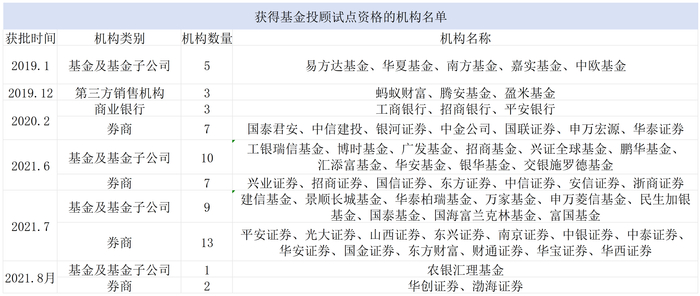
Core Viewpoint - The rise of "fund managers" among retail investors is challenging traditional fund advisory services, as these investors prefer to make their own investment decisions rather than relying on professional advice [1][2][3]. Group 1: Fund Manager Phenomenon - Retail investors, referred to as "fund managers," are increasingly taking control of their investments, often sharing their experiences and strategies online [1][2]. - A significant number of these investors have substantial assets, with some exceeding 1 million yuan in their fund accounts, allowing them access to professional advisory services [2][3]. - Many "fund managers" express skepticism towards fund advisors, questioning their ability to guarantee returns and preferring to manage their portfolios independently [3][4]. Group 2: Fund Advisory Services Development - As of August, the net asset value of public funds in China reached a record high of 36.25 trillion yuan, indicating a growing market for fund advisory services [2]. - The fund advisory business has been in a pilot phase since 2019, with the number of institutions involved increasing from 5 to 60 over six years, including various types of financial institutions [6][8]. - Despite the growth, challenges remain, such as underperformance of advisory portfolios during market downturns, leading to a poor experience for investors [10]. Group 3: Performance and Client Retention - Various financial institutions report differing scales of fund advisory business, with some like Huatai Securities showing a 16.36% growth in advisory assets year-over-year [8]. - Client retention rates vary, with some institutions reporting over 75% of clients reinvesting in advisory services, indicating a level of satisfaction among certain investor segments [7][9]. - The average duration of client engagement with advisory services is around 800 days, suggesting a commitment to long-term investment strategies [7][9]. Group 4: Challenges and Opportunities - The fund advisory sector faces challenges such as a lack of diverse investment products and a need for a shift from a "sell-side" mentality to a more client-focused approach [10][13]. - There is a call for fee reforms in the advisory sector to align costs with performance, potentially improving investor satisfaction and trust in advisory services [12][16]. - The integration of AI technologies in advisory services is being explored, with early results showing potential for enhancing efficiency and client engagement [15][16].
华泰证券(601688):经纪、自营业务同比大幅增长,带动前三季度扣非净利润同比翻倍
Soochow Securities· 2025-10-30 23:34
Investment Rating - The report maintains a "Buy" rating for Huatai Securities [1] Core Insights - The report highlights significant growth in brokerage and proprietary trading businesses, leading to a doubling of non-recurring net profit year-on-year for the first three quarters of 2025 [8] - The company's brokerage revenue increased by 66.1% year-on-year, accounting for 23.7% of total revenue, with a daily average trading volume of 18,723 billion yuan, up 108.6% year-on-year [8] - Investment banking revenue rose by 43.5% year-on-year, with equity underwriting volume increasing by 132.1% [8] - Asset management revenue declined by 63.8% due to reduced platform income following the sale of Assetmark, but the asset management scale grew by 23.9% year-on-year [8] - Proprietary trading net income significantly improved, with a year-on-year growth of 79% and 138% when excluding one-time gains from the previous year [8] - The report forecasts net profits for 2025-2027 to be 15.882 billion, 17.550 billion, and 18.660 billion yuan respectively, with corresponding year-on-year growth rates of 3.46%, 10.50%, and 6.32% [8] Financial Summary - Total revenue for 2025 is projected at 33.261 billion yuan, a decrease of 19.79% year-on-year [1] - The diluted EPS for 2025 is estimated at 1.76 yuan, with a P/E ratio of 12.93 [1] - The company's market capitalization is approximately 205.36 billion yuan, with a price-to-book ratio of 1.19 [5]

协鑫能科20251030
2025-10-30 15:21
Summary of GCL-Poly Energy Conference Call Company Overview - **Company**: GCL-Poly Energy - **Industry**: Renewable Energy and Energy Services Key Financial Metrics - **Revenue**: 7 billion CNY for the first three quarters, a year-on-year increase of 46.39% [2][3] - **Net Profit**: 7.62 billion CNY, up 25.78% year-on-year [3] - **Earnings Per Share**: 0.4819 CNY, a 25.76% increase [2][3] - **Total Assets**: 409.62 billion CNY, a growth of 1.24% [2][3] - **Net Assets**: 123.38 billion CNY, up 5.1% [2][3] - **Return on Equity**: 5.62%, an increase of 0.48% year-on-year [2][3] Business Development and Performance - **Distributed Energy and Storage Projects**: Significant expansion in distributed energy and storage projects, with a focus on energy services like electricity sales and virtual power plants [2][4] - **Virtual Power Plant Load**: Managed adjustable load reached 850,000 kW, representing a significant share of the national virtual power plant load [2][8] - **Commercial Solar Power**: New commercial solar installations of 850,000 kW, a 28% increase [9] - **Electricity Sales Volume**: 241 billion kWh in electricity sales transactions [9] - **Carbon Neutral Projects**: 12 carbon-neutral projects operational, providing comprehensive solutions for major clients [9] Market Position and Strategy - **Energy Center Operations**: Stable operation of regional energy centers with electricity generation of 6.82 billion kWh and gas consumption of 7.73 million tons [10] - **Installed Capacity**: Total installed capacity of 6.4 million kW, with wind and solar accounting for 60% [10] - **User Capacity Management**: Managed user capacity reached 20 GW, with 850,000 kW in adjustable load market testing [11] Technological Integration - **AI Utilization**: Leveraging over 30 years of energy experience and 13 years of user data to enhance predictive capabilities in energy supply and demand [11][26] - **Collaboration with Ant Group**: Partnership to integrate energy management experience with machine learning algorithms for optimizing energy asset aggregation [5][13] Regulatory and Market Challenges - **Policy Impact**: Existing projects are less affected by policy changes, while new projects face market competition [7] - **Market Opportunities**: Despite challenges, the company remains optimistic about future growth opportunities [6] Future Outlook - **Investment in Renewable Energy**: Continued investment in wind, solar, and storage to achieve carbon neutrality goals [22] - **Strategic Partnerships**: Plans to enhance collaboration with leading technology companies to improve market competitiveness [19] - **Response to Market Changes**: Strategies in place to manage risks associated with market fluctuations and regulatory changes [35] Conclusion GCL-Poly Energy is positioned for growth in the renewable energy sector, with strong financial performance and strategic initiatives aimed at expanding its market presence and technological capabilities. The company is optimistic about future opportunities despite facing regulatory challenges and market competition.

大模型爆发后,数字人行业开启淘汰赛
3 6 Ke· 2025-10-30 12:43
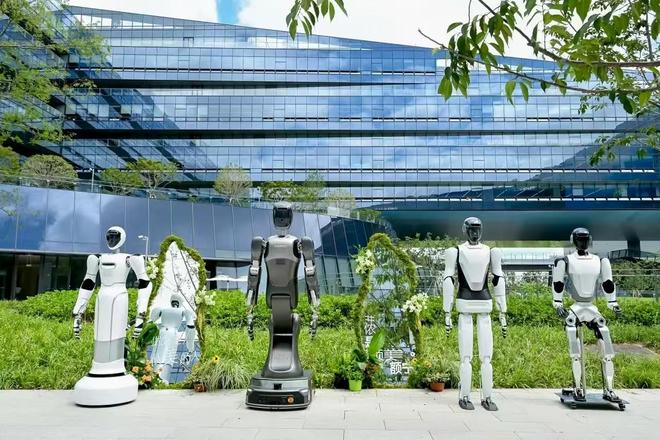
Core Insights - The emergence of large models has shifted the focus from digital humans to AI agents and assistants, leading to a decline in companies discussing digital humans [1] - The market for 2D digital humans is expected to grow rapidly, capturing 70.1% of the market share by 2024, while 3D digital humans hold only 29.9% due to technological limitations [1] - The digital human industry is experiencing a consolidation, with only a few companies remaining competitive, primarily due to their inability to integrate AI capabilities [2] Group 1 - The founder of MoFa Technology emphasizes that many companies failed because their digital human capabilities did not match the advancements in large models, which focus on language abilities [2] - There is a significant gap in the availability of high-quality 3D data, particularly for human motion and environmental interaction, which hampers the development of digital humans [2] - The industry is witnessing a trend towards platformization, with many companies focusing on applications in exhibition halls, cultural tourism, and education, supported by favorable policies [3] Group 2 - Advances in AI technology are reducing costs across the industry, making large-scale applications of 3D digital humans more feasible [4] - MoFa Technology has launched an open platform for 3D digital humans, allowing developers to integrate digital humans into applications within three minutes [4] - The development direction of MoFa Technology has been towards platformization, which is now becoming technically viable [5] Group 3 - Recent funding rounds in the digital human sector indicate ongoing investment and development, with companies like Yingmou Technology and Baidu advancing their 3D generation platforms [6] - Despite the initial hype around digital humans, their commercial viability remains uncertain, especially with emerging regulations and ethical considerations [6] - The emergence of more open platforms is expected to lower the barriers to creating digital humans, but their role in the AI era is still undetermined [6]

大众点评上线“明星打卡美食专区”
Guan Cha Zhe Wang· 2025-10-30 11:51
Core Insights - Dazhong Dianping has launched a new feature called "Celebrity Check-in Food Zone," allowing users to search for "celebrity favorite restaurants" and access a dedicated page for popular dining spots favored by celebrities [2] Group 1: Feature Launch - The new feature was inspired by the recent "taste buds chasing stars" trend, which saw increased attention on restaurants recommended by celebrities like Lu Han [2] - The restaurants included in the zone generally have ratings above 4.0, featuring high-rated local eateries and restaurants listed in various "must-eat" rankings [4] Group 2: Technology and Data Utilization - The selection of restaurants is based on an AI model that extracts insights from user reviews, notes, and related information to identify celebrity check-in clues [4] - The company plans to continuously update and enhance the feature based on user feedback and real needs, aiming to help users discover enjoyable dining and entertainment options [4]

大华股份(002236):Q3盈利能力同比提升,大模型发展推动产品持续升级
ZHONGTAI SECURITIES· 2025-10-30 11:33
Investment Rating - The report maintains a "Buy" rating for the company, expecting a relative performance increase of over 15% against the benchmark index in the next 6 to 12 months [2][9]. Core Insights - The company reported a year-on-year revenue increase of 2.06% for the first three quarters of 2025, reaching 22.913 billion yuan, with a significant net profit growth of 38.92% to 3.535 billion yuan [3][6]. - The third quarter of 2025 saw a revenue of 7.731 billion yuan, reflecting a 1.95% year-on-year increase, and a net profit of 1.060 billion yuan, up 44.12% year-on-year [6]. - The company is leveraging AI large model development to continuously upgrade its products, enhancing capabilities in various application scenarios [6]. Financial Performance Summary - **Revenue Forecast**: Projected revenues for 2023A, 2024A, 2025E, 2026E, and 2027E are 32.218 billion, 32.181 billion, 33.790 billion, 38.183 billion, and 42.956 billion yuan respectively, with growth rates of 5%, 0%, 5%, 13%, and 13% [2]. - **Net Profit Forecast**: Expected net profits for the same years are 7.362 billion, 2.906 billion, 3.937 billion, 4.155 billion, and 4.671 billion yuan, with growth rates of 217%, -61%, 35%, 6%, and 12% [2]. - **Earnings Per Share (EPS)**: The EPS is projected to be 2.24 yuan for 2023A, 0.88 yuan for 2024A, 1.20 yuan for 2025E, 1.26 yuan for 2026E, and 1.42 yuan for 2027E [2]. Profitability Metrics - The gross margin for the first three quarters of 2025 was 41.65%, an increase of 0.84 percentage points year-on-year [6]. - The net profit margin improved to 16.01%, up 4.43 percentage points year-on-year, attributed to better gross margins and reduced financial expenses [6]. - Operating cash flow for the first three quarters reached 1.564 billion yuan, significantly up by 1.689 billion yuan year-on-year, marking the best historical performance for the same period [6]. Market Position and Future Outlook - The company is focusing on digital transformation driven by AI large models, with plans to introduce more products that integrate large and small models across various application scenarios [6]. - The projected net profits for 2025-2027 are 3.94 billion, 4.16 billion, and 4.67 billion yuan, corresponding to PE valuations of 18, 17, and 15 times respectively [6].

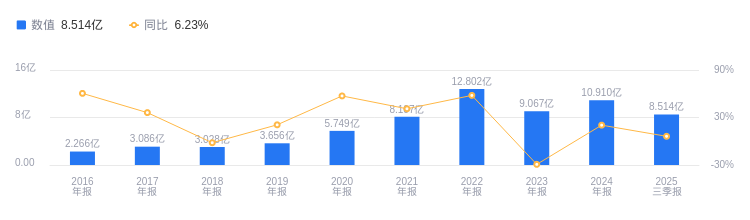
星云股份的前世今生:营收行业第11,净利润第15,积极拓展电池AI大模型领域
Xin Lang Cai Jing· 2025-10-30 11:20
Core Viewpoint - Xingyun Co., Ltd. is a leading enterprise in the lithium battery equipment sector, specializing in the research, production, and sales of lithium battery testing systems, with a comprehensive service capability across the entire industry chain [1] Group 1: Business Performance - In Q3 2025, Xingyun's revenue reached 851 million yuan, ranking 11th in the industry, significantly lower than the top competitor, Xianlead Intelligent, which reported 10.44 billion yuan [2] - The main business revenue composition includes lithium battery equipment at 422 million yuan (75.78%), other products at 80.73 million yuan (14.50%), testing services at 53.77 million yuan (9.66%), and rental income at 0.3931 million yuan (0.07%) [2] - The net profit for the same period was -35.08 million yuan, placing the company 15th in the industry, again trailing behind major competitors [2] Group 2: Financial Ratios - As of Q3 2025, Xingyun's debt-to-asset ratio was 49.63%, down from 62.69% year-on-year, and below the industry average of 57.48%, indicating strong solvency [3] - The gross profit margin stood at 32.61%, slightly lower than the previous year's 34.60%, but still above the industry average of 25.79%, reflecting a competitive edge in profitability [3] Group 3: Management and Shareholder Information - The chairman, Li Youcai, received a salary of 689,800 yuan in 2024, a decrease of 143,300 yuan from 2023 [4] - The number of A-share shareholders increased by 4.87% to 16,400 as of September 30, 2025, while the average number of shares held per shareholder decreased by 4.64% [5] Group 4: Industry Outlook and Strategic Initiatives - According to Zhonghang Securities, the core logic for Xingyun's performance includes a recovery in its main business, narrowing losses, and improved management of expenses and cash flow [6] - The lithium battery industry remains robust, benefiting from high growth in global electric vehicle and energy storage market sales [6] - The company is actively expanding into new areas, including solid-state batteries and AI applications for battery health monitoring, transitioning from a pure equipment manufacturer to an AI application enterprise [6]