基金投顾服务

Search documents
投资进化论丨低利率背景下,为什么需要重视多元资产配置?
Jin Rong Jie· 2026-01-08 11:59
Core Viewpoint - The traditional investment strategy of relying on bank deposits and government bonds is becoming less effective due to declining interest rates, prompting investors to adopt diversified asset allocation strategies to preserve and grow their wealth [1] Group 1: Importance of Diversified Asset Allocation - Diversified asset allocation helps combat the "invisible shrinkage" of wealth as traditional assets like bank deposits and government bonds yield lower returns that may not keep pace with inflation [2] - By diversifying investments across various asset classes such as stocks and commodities, investors can potentially increase overall portfolio returns and better counteract inflation [2] Group 2: Risk Diversification and Enhanced Investment Experience - Investing in a single asset class can lead to low returns or high volatility; for instance, fixed-income assets may offer limited appeal in a low-interest environment, while equities can be volatile [3] - Diversified asset allocation allows for the selection of assets with low or negative correlations, which can help mitigate risks and enhance the overall investment experience [3] Group 3: Stability of Long-Term Returns - According to the "Merrill Clock" theory, no single asset class consistently outperforms; different assets excel during various economic cycles [6] - A diversified portfolio can provide a buffer against market fluctuations, ensuring that at least one asset class performs well regardless of the economic phase [9] Group 4: Professional Assistance in Achieving Diversification - Constructing and maintaining a scientifically diversified asset portfolio is challenging for individual investors due to the need for personalized strategies and ongoing market analysis [10] - Professional management solutions, such as Fund of Funds (FOF) products and fund advisory services, are available to assist investors in achieving diversified asset allocation [10]


易方达基金:拟将零售直销、基金投顾业务逐步迁移至易方达财富
Bei Jing Shang Bao· 2026-01-07 11:44
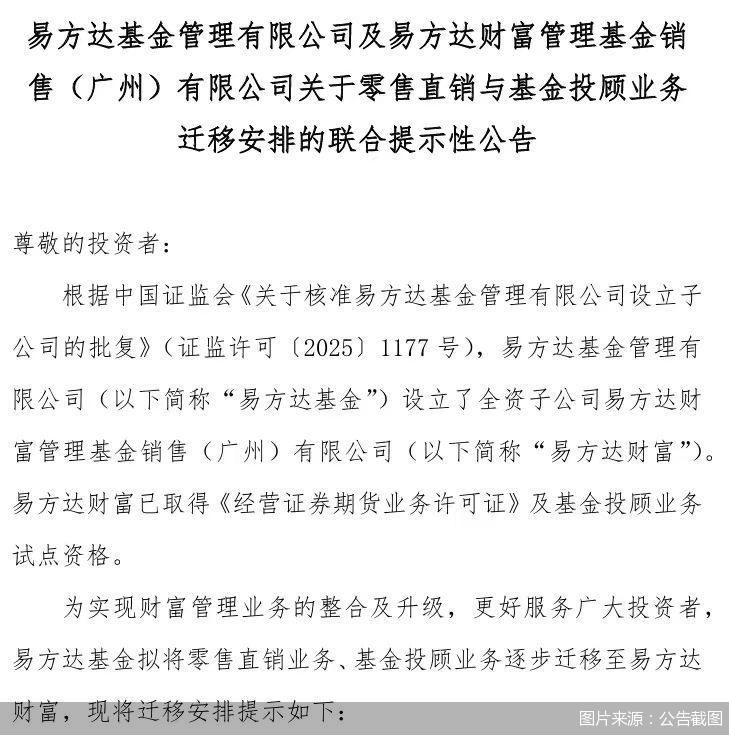
Core Viewpoint - E Fund Management has established a wholly-owned subsidiary, E Fund Wealth Management Fund Sales (Guangzhou) Co., Ltd., to enhance its wealth management services and integrate retail direct sales and fund advisory services [1][3] Group 1: Company Structure and Licensing - E Fund Wealth has obtained the Securities and Futures Business License and the qualification for the pilot fund advisory business [1][3] - The establishment of E Fund Wealth is part of a strategy to better serve investors through the integration and upgrade of wealth management services [1][3] Group 2: Business Migration Plan - E Fund plans to gradually migrate its retail direct sales and fund advisory services to E Fund Wealth, allowing personal investors to transfer their holdings to the new subsidiary [1] - Investors can choose to transfer their E Fund-related products to E Fund Wealth while maintaining the same redemption fees, transaction efficiency, and services [1] - A transition period will be set up during which both E Fund and E Fund Wealth will continue to provide announcements to investors [1] Group 3: Advisory Service Transition - Starting from January 23, the fund advisory service providers on 21 cooperative platforms, including Tian Tian Fund and China Merchants Bank, will change from E Fund to E Fund Wealth [2] - All rights and obligations under the advisory service agreements will automatically transfer to E Fund Wealth, which will continue to provide the same services, rules, and fee rates [2]
国联民生证券整合再提速!姜晓林出任财富子公司总裁
Xin Lang Cai Jing· 2025-12-22 03:36
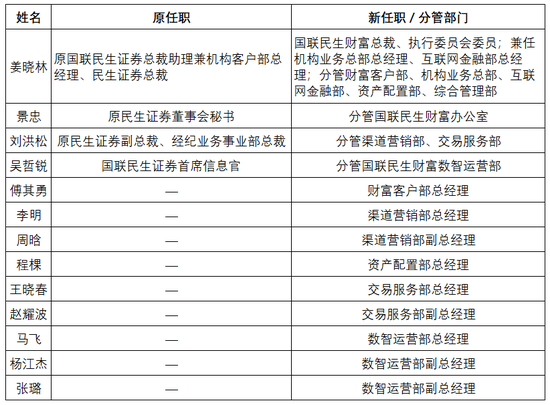
Group 1 - The core development of Guolian Minsheng Securities involves the integration of its wealth management business, transitioning to a new entity named "Guolian Minsheng Wealth" by June 2026 [1][8] - The company aims to consolidate client resources and business layouts from both Guolian Securities and Minsheng Securities in the wealth management sector [1][8] - Key personnel changes have been announced, with Jiang Xiaolin appointed as the president of Guolian Minsheng Wealth, overseeing multiple departments [1][2][8] Group 2 - Jiang Xiaolin has a significant background in the industry, having previously held various leadership roles at CITIC Securities, where he developed extensive experience in market expansion and institutional client services [3][11] - Under Jiang's leadership, Guolian Securities has enhanced its advisory services, achieving recognition in the industry with multiple awards for its fund advisory services [5][11] - The company reported a substantial increase in financial product sales, reaching 870.20 billion yuan, with a 50.01% growth in product holdings compared to the previous year [6][12] Group 3 - The wealth management industry is experiencing a trend of concentration among leading firms, while smaller firms are seeking to differentiate themselves amid challenges in profitability and competition [6][12] - The overall transformation of wealth management in the industry is still in its early stages, with many firms relying heavily on traditional commission-based models [6][12] - Guolian Minsheng Securities has positioned itself as the fastest-growing firm in terms of revenue in the brokerage and wealth management sectors, with a reported revenue growth of 215.76% in the first half of 2025 [6][12]

九成受访用户认可投顾服务政策助力行业转型升级
Shang Hai Zheng Quan Bao· 2025-12-21 18:20
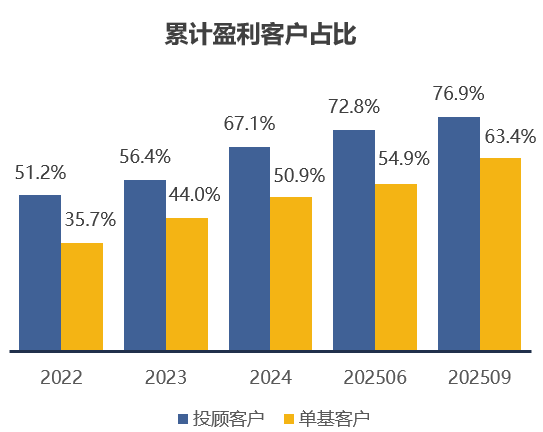
Group 1 - The core viewpoint of the article highlights the maturation of the fund advisory business in China, which has evolved from a pilot phase to a critical stage of development, with increasing attention on its role in connecting capital markets and ordinary investors [1] - The report indicates that over 90% of clients from 18 advisory institutions and 5 fund sales institutions have a holding scale of less than 100,000 yuan, breaking the barriers of professional wealth management services [1] - The profitability of advisory clients has improved significantly, with 76.9% of clients achieving investment profits, which is notably higher than self-investing clients, and less than 1% of clients experiencing losses exceeding 20% [1] Group 2 - Investment behavior among advisory clients has become more optimized, with a balanced and diversified holding configuration across various fund types, enhancing risk dispersion and volatility resistance [2] - The average holding period for advisory clients has increased to nearly 2 years, helping to avoid irrational operations due to short-term market fluctuations, aligning with long-term investment principles [2] - Client satisfaction with advisory services is high, with about 92% of clients expressing approval of service quality, and nearly 80% willing to continue using advisory services [2] Group 3 - As the transition from pilot to regularization of fund advisory approaches, there is ongoing optimization of business regulations, including the elimination of "double charging" practices and adjustments to advisory fee rates [3] - The establishment of advisory share classes is being discussed, which would allow for a separate class of fund shares specifically for advisory services, aimed at reducing overall holding costs for investors [3] - The industry anticipates that the maturation of the buy-side advisory ecosystem will continue as the fund advisory pilot transitions to regularization, with ongoing improvements in institutional frameworks and collaborative efforts [3]
每日钉一下(基金投顾,是如何发展起来的?)
银行螺丝钉· 2025-12-19 14:03
Group 1 - The article discusses the importance of diversifying investments across different asset classes, including both RMB and foreign currency assets, as well as stocks and bonds, highlighting the role of US dollar bond funds in this strategy [2] - A free course is offered to educate investors on the investment knowledge related to US dollar bond funds, including course notes and mind maps for efficient learning [2] Group 2 - The development of fund advisory services in China is traced back to its origins in overseas markets, where it has been established for decades, indicating a growing demand for such services in response to market evolution and client needs [5] - Initially, money market funds gained popularity due to their low risk and ease of access, leading to rapid growth in assets under management, which later slowed as interest rates declined, paving the way for the rise of actively managed funds [6] - The emergence of star fund managers in the 1980s and 1990s in the US stock market led to increased investor interest in funds over individual stock trading, but as the number of fund managers grew, the challenge of selecting the right manager became significant [7] - Fund advisory services began to address the need for diversified investment and asset allocation, providing a basket of funds to mitigate risks associated with individual fund managers and offering additional services like investment strategies and profit-taking advice [8] - The competition among fund advisors has driven down overall costs, leading to the growth of index funds, with top advisors managing trillions of dollars and charging low fees, thus reshaping the investment landscape [9]

《中国基金投顾业务洞察报告(2025)》发布:试点六周年成效显著,超七成客户实现稳健盈利
Morningstar晨星· 2025-12-18 01:05
Core Findings - The report highlights eight key findings that demonstrate the critical role of the buy-side advisory model in enhancing investor experience [3] - The advisory service has achieved dual optimization in both experience and behavior for clients [2] Investment Experience - Advisory clients have a significantly better investment experience, with a cumulative profit ratio of 76.9%, compared to 63.4% for self-directed fund investors, representing a 13.5 percentage point increase [4] - In terms of risk management, only 1% of advisory clients experienced losses exceeding 20%, and only 0.2% faced losses over 30%, which is 1/10 and 1/15 of the same metrics for self-directed clients, respectively [4] Asset Allocation - Advisory clients exhibit a scientifically balanced asset allocation, with the proportions of money market, bond, stock, and mixed funds stable between 16% and 26%, avoiding excessive concentration in any single asset [7] - Over 90% of advisory clients have holdings of less than 100,000 yuan, breaking down barriers to professional wealth management services [7] Investment Behavior - Advisory clients are increasingly adopting a rational investment approach, with a reinvestment rate rising to 38.2% by September 2025, up from 12.1% in 2022, indicating a growing trend towards additional investments [10] - The average holding period for clients has extended to nearly two years, effectively mitigating irrational actions triggered by short-term market fluctuations [10] Client Recognition - The recognition of advisory services among clients has significantly improved, with only 8% expressing dissatisfaction [13] - Trust levels are high, with 77.7% of advisory clients willing to continue using the service, and 56.2% willing to recommend it to others, indicating a positive word-of-mouth effect [13][20] Client Demographics - The report reveals a clear profile of advisory clients, showing a dual trend of youth and maturity: 40% of clients are under 35 years old, up from 32.3% in 2022, and 8.3% are aged 18-25, significantly higher than the 4.4% among self-directed clients [24] - The gender ratio is becoming more balanced, with female clients increasing from 44.5% in 2022 to 48% by September 2025 [24] - The proportion of clients with over five years of investment experience has surged from 6.6% in 2022 to 32% in 2025, attracting both new investors and long-term investors [24] Client Needs and Industry Challenges - Clients have clear demands, focusing on three main areas: a pressing need for professional services, with 73.7% seeking one-on-one advisory communication; retirement planning as a primary goal for over 40% of clients; and a strong concern for strategy stability, with 72.8% worried about the risk-return performance of advisory strategies [27][31] - The industry faces two core challenges: nearly 80% of clients prioritize historical performance and investment capability over the completeness of advisory services when selecting firms, and there is a notable gap in the experience of clients who have paused services, with a dissatisfaction rate of 14.2% and a return intention of 44.3% [31] Recommendations for Industry Development - The report proposes six recommendations for high-quality industry development, including enhancing advisory team expertise, focusing on retirement financial scenarios, improving strategy stability and transparency, deepening investor education, optimizing service experience, and strengthening core client retention [34] Industry Progress - The report emphasizes that six years of pilot practice have proven that the fund advisory business effectively improves investor profit experiences and guides rational investment behavior, transitioning the industry from "product sales" to "asset allocation services" [36]

《中国基金投顾业务洞察报告(2025)》发布 试点六周年成效显著 超七成客户实现稳健盈利
Xin Hua Cai Jing· 2025-12-16 06:53
Core Insights - The report highlights the significant transformation of the fund advisory business from "0 to 1" since the pilot program began in 2019, driven by regulatory changes and the growing demand for wealth management among residents [1][37] Group 1: Key Findings - The report identifies eight core findings that demonstrate the critical role of the buy-side advisory model in enhancing investor experience [2] - Advisory clients have a significantly better investment experience, with a cumulative profit ratio of 76.9%, compared to 63.4% for self-directed fund investors, indicating a 13.5 percentage point advantage [3] - In terms of risk management, advisory clients show a much lower percentage of significant losses, with less than 1% experiencing losses over 20% and only 0.2% over 30%, compared to 10% and 15% for self-directed clients, respectively [3] Group 2: Client Behavior and Recognition - Advisory clients exhibit more rational investment behavior, with a reinvestment rate of 38.2% as of September 2025, a significant increase of over 26 percentage points from 12.1% in 2022 [11] - Client satisfaction with advisory services is high, with only 8% expressing dissatisfaction; 77.7% are willing to continue using the service, and 56.2% would recommend it to others [16][22] Group 3: Client Demographics and Needs - The report reveals a dual trend of younger and more experienced clients in the advisory space, with clients under 35 increasing from 32.3% in 2022 to 40% in September 2025, and those with over five years of investment experience rising from 6.6% to 32% [26] - Clients express clear needs, with 73.7% seeking one-on-one professional communication, and over 40% prioritizing retirement planning as their main investment goal [27] Group 4: Industry Challenges and Recommendations - The industry faces challenges, including a lack of comprehensive investment philosophy among clients, with nearly 80% focusing on historical performance rather than service quality [29] - The report provides six recommendations for industry improvement, including enhancing professional capabilities, focusing on retirement financial planning, and improving strategy stability and transparency [36]
易方达基金:深入贯彻中央经济工作会议精神 助力金融强国和中国式现代化建设
Zhong Zheng Wang· 2025-12-14 09:10
Core Viewpoint - The central economic work conference highlighted the importance of the public fund industry in supporting high-quality development and enhancing wealth management services for residents, emphasizing the need for a more adaptive and competitive capital market [1] Group 1: Development of New Productive Forces - The public fund industry should deepen its understanding of new productive forces and enhance its research capabilities on new technologies and industries, guiding funds towards innovation sectors [2] - E Fund has established a comprehensive research system focused on technology industries, investing in sectors such as information technology, artificial intelligence, and renewable energy [2] Group 2: Strengthening Domestic Circulation - The public fund industry must prioritize investor interests, helping residents achieve property income through capital markets to boost consumption and domestic demand [3] - E Fund has been optimizing its product and service systems to cater to long-term capital, promoting long-term investment and value investment strategies [3] Group 3: Enhancing High-Quality Development - The public fund industry should integrate ESG principles into investment decisions and promote corporate governance improvements through shareholder rights [4] - E Fund has been actively expanding its international business and enhancing its global asset allocation capabilities, aiming to attract long-term foreign investment into China [4] Group 4: Future Outlook - Looking ahead to the 15th Five-Year Plan, E Fund aims to optimize its integrated research system and support technological innovation while meeting diverse wealth management needs [5]
公募基金:回归代客理财本源
Bei Jing Shang Bao· 2025-12-14 06:41
Core Viewpoint - The public fund industry in China plays a crucial role in the capital market, serving as a key hub for investment and financing, and is essential for inclusive finance, wealth management, and supporting the real economy. As of September 2025, the public fund scale reached 36.74 trillion yuan, marking a historical high [1] Group 1: Fee Reform and Investor Benefits - The public fund industry has actively reduced costs for investors through fee reforms, enhancing the development of inclusive finance. The China Securities Regulatory Commission (CSRC) released a three-phase fee reform plan, with the first two phases implemented in 2023 and 2024, and the third phase focusing on reducing sales fees [5][6] - The CSRC's recent draft regulation aims to lower subscription, purchase, and sales service fees, indicating the completion of the fee reform process, which is expected to promote high-quality development in the public fund industry [5][6] - The introduction of floating fee rate funds aligns the interests of fund managers and investors, with performance-based fee structures being implemented to enhance investor returns [7][8] Group 2: Investment Advisory Services - The emergence of buy-side investment advisory services addresses the lack of product understanding among individual investors, aligning with the core principles of inclusive finance. Since the pilot program began in 2019, 60 institutions have qualified for fund advisory services [9] - As of the third quarter of 2025, a significant portion of clients served by investment advisory services reported profitability, with 88% of clients achieving gains since the service's launch [9] - Investment advisory strategies have diversified to include active management, stable investment, and aggressive investment, reflecting the industry's commitment to providing comprehensive financial services [10]

京东肯特瑞相关负责人:通过数据洞察让基金投顾服务“千人千面”
Bei Jing Shang Bao· 2025-12-12 04:42
Core Insights - The forum focused on the theme of "Wealth Migration of Residents and the 'Money' Landscape of Bull Markets" [1] - JD Technology's Kentrui Fund Sales Co., Ltd. emphasized the importance of data insights in providing personalized fund advisory services [3] Group 1: Data-Driven Investment Advisory - Kentrui aims to achieve "precision matching" through data insights, enhancing understanding of both clients and assets [3] - The company utilizes a first-principles approach to assess clients' risk and liquidity budgets, moving beyond simple risk assessments [3] - For younger clients, Kentrui dynamically adjusts risk budgets based on their financial obligations, such as mortgage payments, to prevent impulsive investment decisions [3] Group 2: Understanding Assets and Market Dynamics - Kentrui's investment research team dissects market beta and product alpha into data tags for better product recommendations [4] - The company tracks product risk matrices to help clients avoid poor investment choices [4] - An investment portfolio optimizer is used to dynamically allocate assets based on user preferences for risk parity or mean-variance [4] Group 3: Educational Initiatives and User Engagement - Kentrui adopts a visual and case-based approach to investment education, moving away from traditional jargon [5] - The company conducts over 10 live sessions monthly, focusing on topics relevant to younger investors [5] - Kentrui's financial advisors provide comprehensive post-investment support throughout clients' financial journeys [5] Group 4: Future Directions - Kentrui plans to deepen its understanding of user needs and continue integrating JD's ecosystem data with its fund advisory services [5]