
AI泡沫

Search documents
投顾周刊:央行连续12个月增持黄金
Wind万得· 2025-11-08 22:33
Group 1 - The central bank has increased its gold reserves for 12 consecutive months, reaching 74.09 million ounces (approximately 2304.457 tons) as of the end of October, with a month-on-month increase of 30,000 ounces (approximately 0.93 tons) [2] - The insurance capital long-term investment pilot has expanded, with 9 private equity funds entering the operational phase, and a total of 222 billion yuan allocated across three batches of pilot programs [2] - China's new energy storage installed capacity has surpassed 100 million kilowatts, accounting for over 40% of the global total, highlighting the country's leading position in the energy storage sector [2] Group 2 - The Financial Regulatory Bureau is developing high-quality development guidelines for technology insurance, with a 30% year-on-year increase in premium income for technology insurance in the first three quarters of the year [3][4] - Five departments have jointly issued a document to promote the standardized application of "artificial intelligence + healthcare," focusing on 24 key applications across various sectors [4] Group 3 - Michael Burry has warned of an AI bubble, revealing short positions in Nvidia and Palantir, indicating that market sentiment may be overly exuberant [5] - The number of private equity funds in North America has exceeded the number of McDonald's locations, with predictions of an impending industry consolidation due to investor demands for higher returns and better governance [5] Group 4 - Global stock markets have shown mixed performance, with the Shanghai Composite Index rising by 1.08% and major U.S. indices experiencing declines [6] - Recent trends in bond yields indicate a mixed performance, with the 1-year Chinese government bond yield decreasing by 2.66 basis points to 1.40% [9][10] Group 5 - In the commodity market, precious metals have shown divergent trends, with COMEX gold rising by 0.28% and international oil prices continuing to adjust, with ICE Brent crude oil falling by 1.65% [12][13] - Recent data indicates that fixed-income products dominate the financing channels in banks, contributing over 70% of the total number of funds and over 90% of the financing scale [14][15]


美联储大消息,关键数据再缺席,纳指创七个月单周最大跌幅
Sou Hu Cai Jing· 2025-11-08 18:46
Group 1: Market Impact - The U.S. stock market experienced significant volatility, with the Nasdaq index dropping 3.04%, marking its worst performance since early April [1][3] - A dramatic V-shaped reversal occurred on November 7, where the market initially opened lower but ended with slight gains for the Dow and S&P 500, driven by news of a potential compromise to end the government shutdown [3] - Despite a minor rebound, technology stocks faced heavy selling, with Nvidia dropping nearly 5% during the day and Microsoft experiencing its longest losing streak since November 2011 [5] Group 2: Economic Consequences - The ongoing government shutdown, now lasting 39 days, is projected to reduce the U.S. GDP growth rate by 1 to 2 percentage points in Q4, leading to estimated economic losses of $7 billion to $14 billion depending on the duration of the shutdown [7] - The shutdown has disrupted the release of critical economic data, including the non-farm payroll report, creating a "data vacuum" that complicates market and policy decision-making [9][10] Group 3: Labor Market Conditions - Private sector reports indicate a struggling labor market, with over 153,000 layoffs announced in October, the highest for that month in over 20 years, primarily in the tech and warehousing sectors [13] - The ISM services employment index stands at 48.2% and manufacturing at 46%, indicating economic contraction, while job vacancy indicators have dropped to their lowest levels since February 2021 [13] Group 4: Government Negotiations - Negotiations between Senate Democrats and Republicans remain stalled, with Democrats seeking to extend healthcare subsidies while Republicans insist on reopening the government first [16]



深夜,全线大跌!超23万人爆仓
Sou Hu Cai Jing· 2025-11-08 08:37
Core Viewpoint - The cryptocurrency market experienced a significant downturn, with Bitcoin falling below the $100,000 mark again, indicating potential bearish trends in the market [1][3]. Market Performance - On November 4, Bitcoin dropped to a low of $98,888.8 per coin, while Ethereum fell below $3,300, currently priced at $3,239.6, reflecting a 4.73% decline over 24 hours [3]. - SOL's price decreased to $153, down 3.57%, and other cryptocurrencies like XRP, HYPE, and BNB also saw declines [5]. - The current prices and 24-hour changes for major cryptocurrencies are as follows: - BTC: $100,278, -2.61% - ETH: $3,259, -3.99% - SOL: $153, -3.57% - XRP: $2.182, -4.85% - HYPE: $38.96, -2.64% - BNB: $944.6, +1.4% [6]. Liquidation Data - Over the past 24 hours, more than 230,000 traders were liquidated, with a total liquidation amount of $675 million, including $460 million from long positions and $210 million from short positions [6]. - The liquidation breakdown over different time frames is as follows: - 1 hour: $76.89 million total, with $71.25 million long and $5.64 million short - 4 hours: $120 million total, with $100 million long and $19.22 million short - 12 hours: $230 million total, with $130 million long and $93.10 million short - 24 hours: $670 million total, with $460 million long and $210 million short [7]. Market Sentiment and Analysis - On November 6, the World Economic Forum Chairman warned of potential bubbles in the cryptocurrency market, AI, and debt, suggesting a bearish outlook for cryptocurrencies [8]. - Analysts indicated that if Bitcoin falls below the 50-week moving average, it would confirm a bear market, a pattern observed in previous years [8]. - Peter Schiff commented that the opportunity to sell Bitcoin above $100,000 may not last long, suggesting that Bitcoin is overpriced rather than being sold at a discount [8]. - Analysts believe that for the market to regain risk appetite, multiple favorable signals are needed, including stabilization or a decline in U.S. Treasury yields [8].
美政府“关门”进入第39天 美股上演“周五惊魂” “AI八巨头”单周蒸发8000亿美元;“次贷预言家”年内第二次做空英伟达;比特币一个月跌掉18% | 一周国际财经
Mei Ri Jing Ji Xin Wen· 2025-11-08 05:43
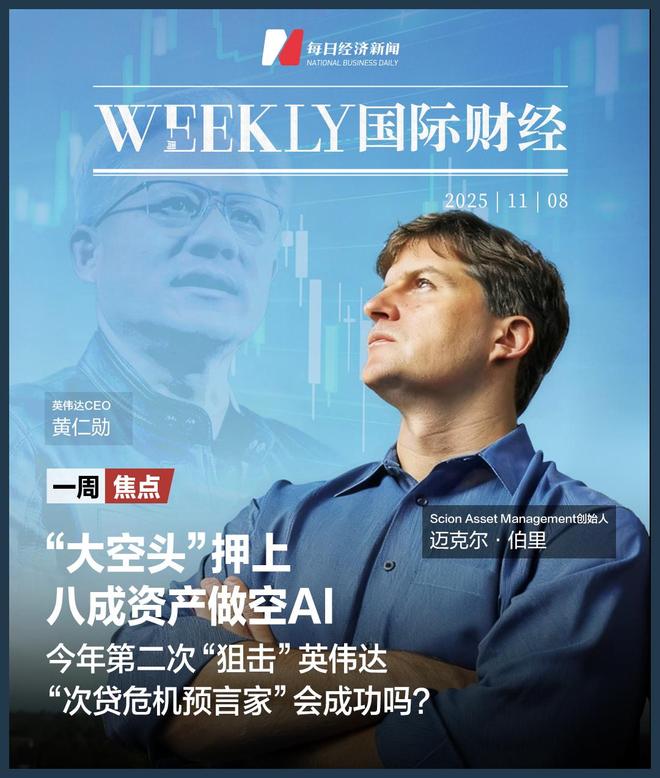
Group 1 - Michael Burry, known as the "Big Short," has again shorted Nvidia, with his fund Scion Asset Management revealing that approximately 80% of its assets are allocated to short positions on Nvidia and Palantir, amounting to over $1 billion in nominal value [1][3][5] - Following the disclosure of Burry's short positions, Nvidia's market value has dropped by approximately $455.1 billion (around 3.24 trillion RMB) over four trading days, with Nvidia's stock price falling by 9% [1][5][29] - Despite the significant drop in Nvidia's stock price, market interest in shorting Nvidia appears to be declining, with short positions decreasing from about 315 million shares to approximately 211 million shares between June 2024 and October 2025 [21][23] Group 2 - Burry's fund holds approximately $9.12 million in Palantir put options and about $1.87 million in Nvidia put options, indicating a strong bearish stance on these AI companies [5][6] - Palantir's CEO has publicly criticized Burry's actions, asserting that the company is genuinely profitable in the AI sector, and emphasized their commitment to delivering strong performance despite being targeted for shorting [18][19] - The broader market sentiment has been cautious, with major investment banks adopting a dual strategy of supporting AI investments while simultaneously preparing for potential downturns by shorting stocks [24][25] Group 3 - The U.S. government shutdown has entered its 39th day, causing significant volatility in the stock market, with major indices experiencing sharp declines before recovering slightly [26][35] - The Nasdaq index recorded its worst weekly performance since April, with a cumulative drop of 3.04%, and major AI-related companies collectively losing about $800 billion in market value [32][48] - Bitcoin's price has also seen significant fluctuations, dropping 18% over the past month, with a brief dip below $100,000 [47][49] Group 4 - The demand for electricity from AI companies is surging, with reports indicating that data centers are driving a significant increase in electricity demand in the UK, which has doubled compared to peak demand levels [44][45] - Major tech companies, including Microsoft, are facing challenges in securing sufficient power for their operations, highlighting the growing strain on energy resources due to the rapid expansion of AI infrastructure [44][45] - Analysts predict that by 2027, the electricity consumption of AI servers will be 50 times that of cloud servers five years ago, indicating a substantial increase in energy requirements for the AI sector [45]
“大空头”押上八成资产做空AI,今年第二次“狙击”英伟达 “次贷危机预言家”会成功吗?
Mei Ri Jing Ji Xin Wen· 2025-11-08 05:40
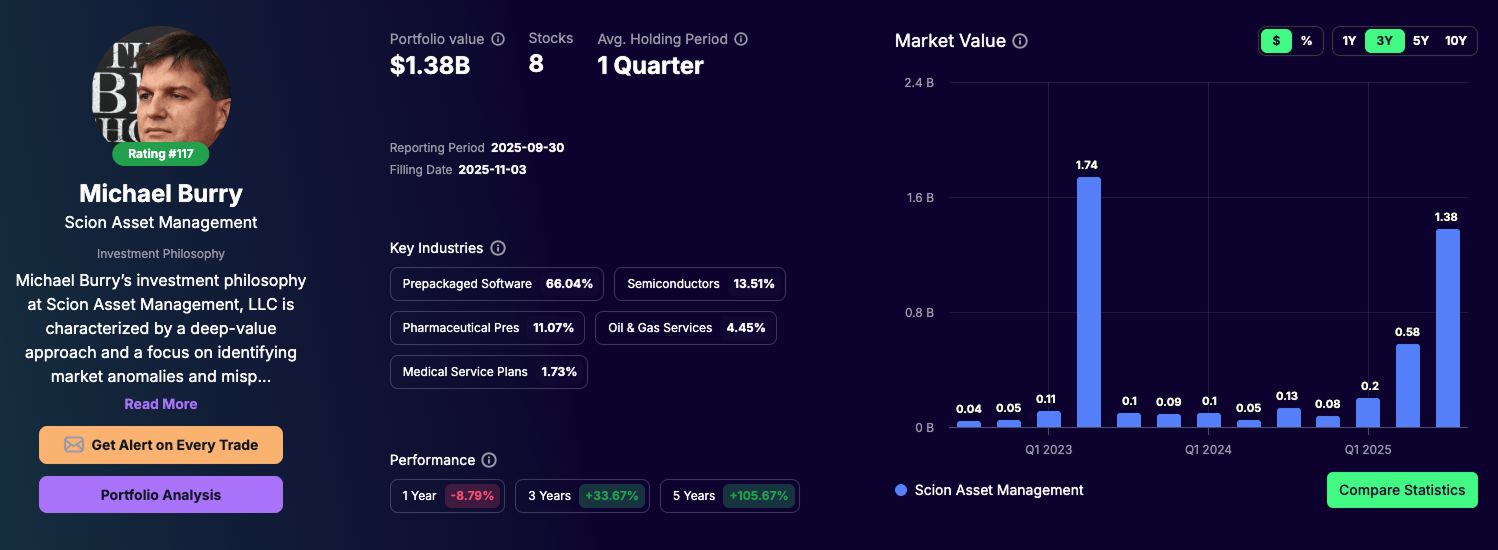
Group 1 - Michael Burry's hedge fund, Scion Asset Management, disclosed a third-quarter position holding over $1 billion in put options, representing 80% of its total assets, betting against AI stocks Nvidia and Palantir [1][5][6] - Nvidia's stock price fell by 3.96% the day after the report, while Palantir experienced a larger decline of 7.95%, with Nvidia's market cap dropping by $45.51 billion (approximately 324 billion RMB) over four trading days [5][6] - Scion Asset Management's total holdings amount to approximately $1.38 billion, with a significant portion concentrated in put options for Nvidia and Palantir [6][10] Group 2 - Burry's fund previously established a short position in Nvidia worth over $97 million in the first quarter, which was fully liquidated by the second quarter [8][10] - The put options give holders the right to sell stocks at a specific price in the future, serving as a typical short-selling tool [7] - Market interest in shorting Nvidia is declining, with short positions decreasing from approximately 315 million shares to about 211 million shares between June 2024 and October 2025 [22][24] Group 3 - Palantir's CEO criticized Burry's shorting actions, asserting that the companies he targets are genuinely profitable in the AI sector [19] - Palantir reported third-quarter revenue of $1.18 billion, a 63% year-over-year increase, and has exceeded analyst expectations for 21 consecutive quarters [19] - Concerns about Palantir's high valuation multiples and performance relative to its valuation have led to a "good news already priced in" sentiment in the market [19][25] Group 4 - Major investment banks are adopting a dual strategy of lending while simultaneously shorting stocks in the AI sector to hedge against potential risks [27][28] - Deutsche Bank has injected billions into the data center industry, primarily financing operators serving major tech companies, while also exploring various hedging strategies [27][28] - The financial sector is cautious about the rapid depreciation of infrastructure and the unverified profitability models in the AI industry, reflecting a complex sentiment towards AI investments [28]

美政府“关门”进入第39天,美股上演“周五惊魂”,“AI八巨头”单周蒸发8000亿美元;“次贷预言家”年内第二次做空英伟达;比特币一个月跌掉18% | ...
Mei Ri Jing Ji Xin Wen· 2025-11-08 05:39
Group 1 - Michael Burry, known as the "Big Short," has again shorted Nvidia, with his fund Scion Asset Management allocating approximately 80% of its assets to short positions on Nvidia and Palantir, amounting to over $1 billion in nominal value [6][10] - Following the announcement of Burry's short positions, Nvidia's market value dropped by approximately $455.1 billion (around 3.24 trillion RMB) over four trading days, with Nvidia's stock price falling by 9% [6][10][11] - Despite the significant drop in Nvidia's stock price, interest in shorting Nvidia appears to be declining, with short positions decreasing from about 315 million shares to approximately 211 million shares between June 2024 and October 2025 [8][24][26] Group 2 - Burry's fund holds about $912 million in Palantir put options and approximately $186.58 million in Nvidia put options, indicating a strong bearish stance on these AI stocks [10][11] - Palantir's CEO criticized Burry's actions, asserting that the company is genuinely profitable in the AI sector, and emphasized their commitment to delivering strong performance despite being targeted by short sellers [22] - Palantir reported a 63% year-over-year increase in revenue for the third quarter, totaling $1.18 billion, and has consistently exceeded analyst expectations for 21 consecutive quarters [22] Group 3 - The broader market has shown volatility, with major indices experiencing significant fluctuations, including a V-shaped recovery after initial declines, amidst concerns over high valuations in the tech sector [31][37] - The Nasdaq index recorded its worst weekly performance since April, with a cumulative drop of 3.04%, and major AI-related companies collectively losing about $800 billion in market value [37][54] - Investment banks are adopting a dual strategy of supporting AI investments while simultaneously preparing for potential downturns by shorting stocks in the sector [29][30]
全线大跌!超23万人爆仓
Sou Hu Cai Jing· 2025-11-08 05:11
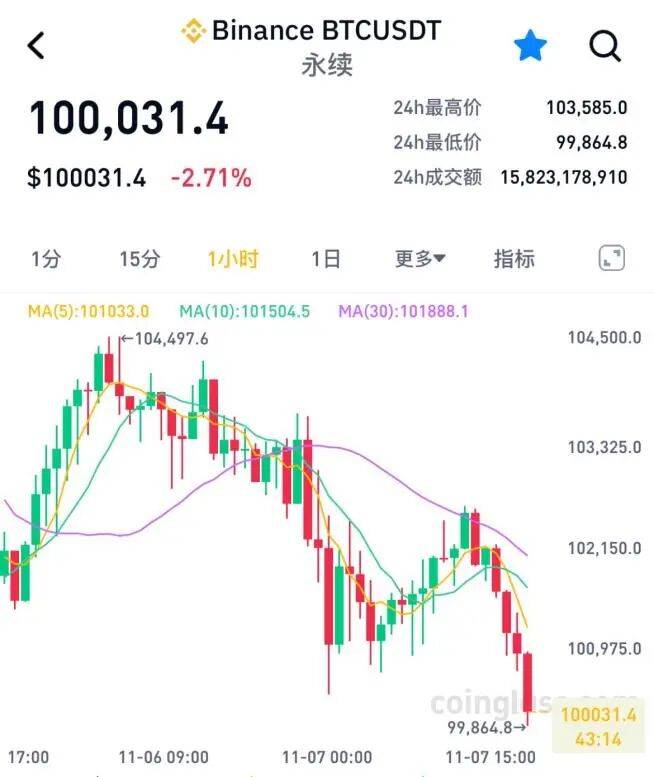
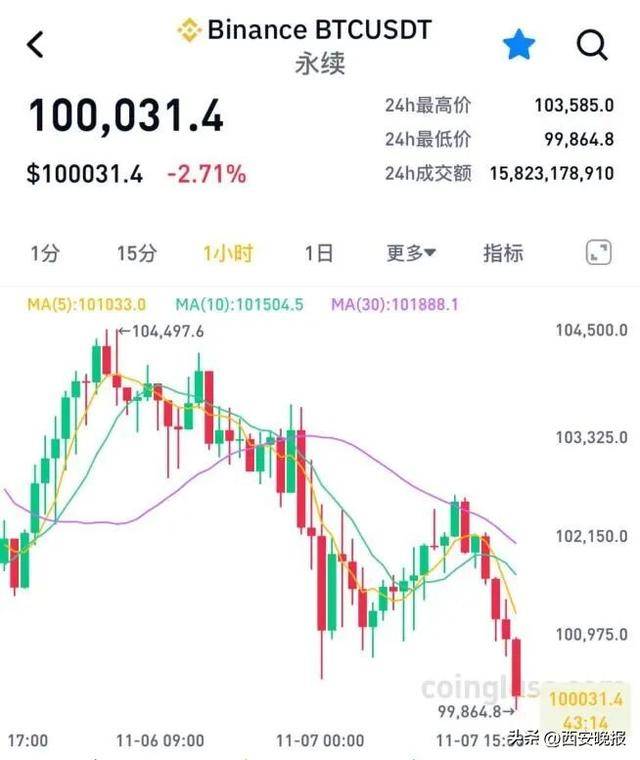
Core Viewpoint - The cryptocurrency market experienced a significant downturn, with Bitcoin falling below the $100,000 mark, indicating a potential shift towards a bear market [1][8]. Market Performance - As of November 7, Bitcoin was priced at $100,031.4, reflecting a 24-hour decline of 2.71% [1]. - On November 4, Bitcoin had briefly dipped below $100,000, reaching a low of $98,888.8 [3]. - Ethereum also saw a decline, dropping to $3,239.6 with a 24-hour decrease of 4.73% [3]. - Solana's price fell below $160, currently at $153, marking a 24-hour drop of 3.57% [5]. - Other cryptocurrencies such as XRP, HYPE, and BNB also experienced declines [5]. Liquidation Data - Over the past 24 hours, more than 230,000 traders were liquidated, with a total liquidation amount of $675 million, including $460 million from long positions and $210 million from short positions [6][7]. Economic Context - World Economic Forum Chairman Borge Brende warned of potential bubbles in cryptocurrencies, AI, and debt markets, suggesting a broader financial instability [8]. - The rise in risk-averse sentiment was attributed to issues in the U.S. credit market, leading to increased expectations for interest rate cuts by the Federal Reserve [8]. - Bitcoin's performance has disappointed the market, with analysts indicating that a drop below the 50-week moving average could confirm a bear market [8]. - Peter Schiff commented on Bitcoin's pricing, suggesting that it is overvalued and that selling now could allow for the purchase of undervalued physical assets [8]. - Analysts noted that a return to risk appetite in the market would require multiple favorable signals, including stabilization or a decline in U.S. Treasury yields [8].
深夜,美股大反转,英伟达V型反弹,中概股多数下挫!特斯拉市值一夜蒸发超3800亿元,加密币市场超25万人爆仓
Mei Ri Jing Ji Xin Wen· 2025-11-08 00:51
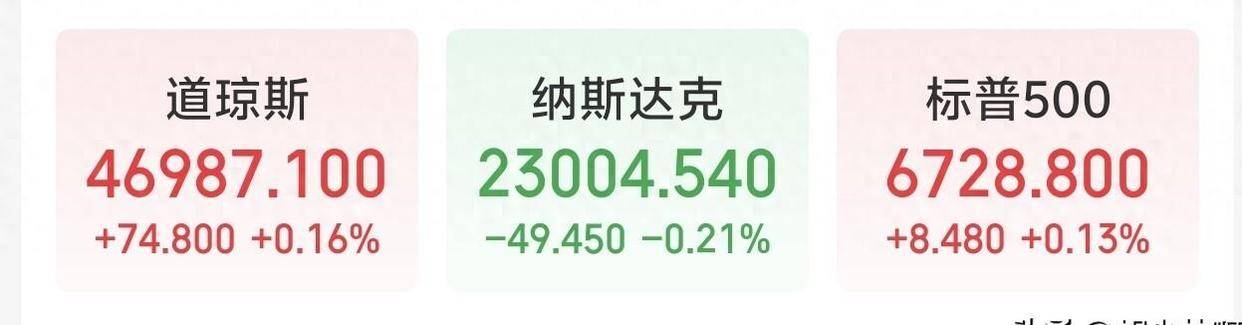
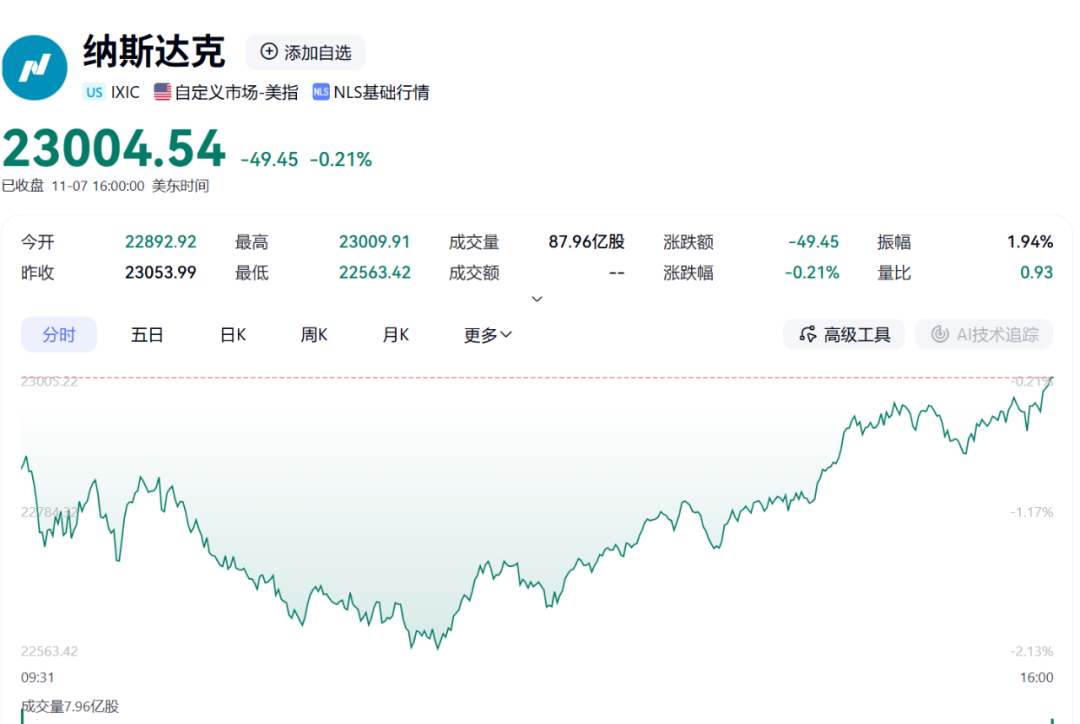
Core Viewpoint - The U.S. stock market experienced a "V-shaped reversal" as signs of a resolution to the government shutdown emerged, with the S&P 500 and Dow Jones Industrial Average turning positive towards the end of trading [1]. Market Performance - As of the market close, the Nasdaq Composite fell by 0.21%, with a weekly decline of 3.04%. The S&P 500 rose by 0.13%, with a weekly decline of 1.63%. The Dow Jones increased by 0.16%, with a weekly decline of 1.21% [2]. Individual Stock Movements - Nvidia, a leading AI trading stock, saw a nearly 5% drop during the day but managed to close slightly up. Microsoft missed the opportunity to turn positive, marking its longest losing streak since November 2011, with a total market value loss exceeding $330 billion [8]. - Tesla's stock dropped over 3%, resulting in a market value loss of $54.5 billion (approximately 388.2 billion RMB) [10]. - Major Chinese stocks listed in the U.S. mostly declined, with the Nasdaq Golden Dragon China Index falling by 0.95% and a weekly decline of 2.62%. Xpeng Motors dropped over 6%, while other companies like Tencent Music and NIO saw declines exceeding 4% [12]. Economic Indicators - The U.S. consumer confidence index fell to its lowest level since June 2022, dropping from 53.6 to 50.3, influenced by concerns over the government shutdown and high inflation [18]. - Concerns about rising unemployment have increased, with 71% of respondents expecting a rise in the unemployment rate over the next year, more than double the proportion from the previous year [19].
深夜美股集体下挫 小马智行、文远知行跌超9% 加密货币超24万人爆仓
2 1 Shi Ji Jing Ji Bao Dao· 2025-11-07 16:56
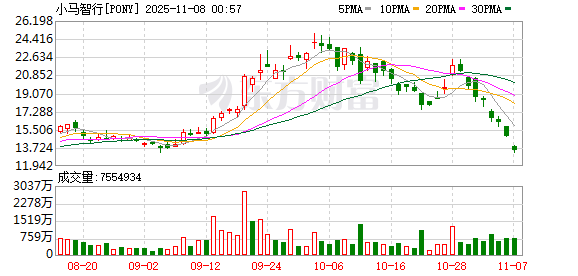
Market Overview - Major US stock indices experienced declines, with the Dow Jones down 0.36%, S&P 500 down 0.85%, and Nasdaq down 1.46% [3] - Large-cap tech stocks saw significant drops, including Nvidia, Tesla, Oracle, and AMD, each falling over 3% [1] - The Nasdaq China Golden Dragon Index also fell by 2.19%, with notable declines in popular Chinese concept stocks [4] Semiconductor Sector - The semiconductor sector faced a sharp decline, with the Philadelphia Semiconductor Index dropping 2.8% to a two-week low [2] - Specific stocks like Microchip Technology fell over 8%, while Marvell Technology and Advanced Micro Devices dropped over 4% and 2%, respectively [2] Precious Metals - Gold prices showed a slight increase, with spot gold at $3988.97 per ounce, up 0.3%, and COMEX gold at $4004.2 per ounce, up 0.33% [5] - Silver also saw gains, with London silver at $48.230, up 0.49% [5] Cryptocurrency Market - The cryptocurrency market faced heavy selling pressure, with Bitcoin dropping over 2% and Ethereum down nearly 4% [5] - Over 240,000 traders were liquidated in the past 24 hours, with a total liquidation amount of $772 million [5] Economic Indicators - The US government's "shutdown" is expected to have a more significant impact on the economy than previously anticipated, potentially slowing GDP growth in Q4 [6] - The Michigan Consumer Sentiment Index for November reported a low of 50.3, the lowest since June 2022 [6] - Concerns regarding an "AI bubble" have intensified, leading to increased worries about overvaluation in related stocks [6]
深夜美股集体下挫,小马智行、文远知行跌超9%,加密货币超24万人爆仓
2 1 Shi Ji Jing Ji Bao Dao· 2025-11-07 15:44
Market Overview - On November 7, U.S. stock indices opened lower, with the Dow Jones down 0.36%, S&P 500 down 0.85%, and Nasdaq down 1.46% [1] - Major technology stocks experienced significant declines, with Nvidia, Tesla, Oracle, and AMD dropping over 3%, while TSMC ADR fell over 2% [2] Sector Performance - The semiconductor sector faced a sharp decline, with the Philadelphia Semiconductor Index dropping 2.8%, reaching a two-week low [3] - Notable declines included Microchip Technology down over 8%, Marvell Technology down over 4%, and Advanced Micro Devices down over 2% [3] Chinese Stocks - The Nasdaq China Golden Dragon Index opened lower and saw its decline expand to 2.19%, with major Chinese stocks like Xiaopeng Motors down over 6% and Bilibili down over 3% [3] Precious Metals - Gold prices showed a slight increase, with spot gold at $3988.97 per ounce, up 0.3%, and COMEX gold at $4004.2 per ounce, up 0.33% [4] Cryptocurrency Market - The cryptocurrency market faced heavy selling, with Bitcoin dropping over 2% and Ethereum down nearly 4% [4] - Over the last 24 hours, more than 240,000 traders were liquidated, with a total liquidation amount of $772 million [4][5] Economic Indicators - The U.S. economic outlook is under pressure, with the White House economic advisor stating that the government shutdown's impact on the economy is greater than expected, potentially slowing GDP growth in Q4 [5] - The Michigan Consumer Sentiment Index for November reported a low of 50.3, the lowest since June 2022 [5] - Concerns regarding an "AI bubble" have intensified, raising worries about the overvaluation of related stocks [5]


