
智能驾驶

Search documents
公司互动丨这些公司披露在商业航天、光刻胶等方面最新情况
Di Yi Cai Jing· 2025-12-17 14:40
Lithography Resin - Company Aiyishikong has established collaborations with several leading lithography resin manufacturers [1] Commercial Aerospace - Company Tefa Information currently has no orders or products related to commercial aerospace [1] - Company Nengke Technology has been collaborating with Blue Arrow Aerospace since 2021, with cumulative orders amounting to tens of millions [1] - Company Shangda has obtained qualifications from Blue Arrow Aerospace and Jiuzhou Cloud Arrow, and is providing stable mass production supply [1] Intelligent Driving - Company Xingmin Zhitong's communication domain controller is currently equipped in L3 and L4 autonomous vehicles, including Robotaxi and unmanned logistics vehicles [1] - Company Siwei Tuxin has partnerships with Changan and BAIC Blue Valley in the areas of intelligent cockpits, automotive-grade chips, and intelligent driving [1] - Company Zhejiang Shibao's intelligent steering products are applicable to L3 and above autonomous driving [1] Other Developments - Company Guanfeng Lithium's energy storage cell production capacity is currently at full capacity [1] - Company Zhonglai has begun mass production and shipment of TOPCon high-efficiency batteries [1] - Company Lian De Equipment has formed sales orders in the semiconductor packaging and testing equipment sector, gradually ramping up production [1] - Company Guoke Technology's Leshan drone base is expected to commence production in the first quarter of next year [1] - Company Bertley anticipates that EMB will gradually achieve mass production in the first half of next year [1]





云从科技:未来公司将持续深化技术应用与产业合作,推动公司智能驾驶技术在更多场景的规模化落地
Zheng Quan Ri Bao Wang· 2025-12-17 12:41
证券日报网讯12月17日,云从科技在互动平台回答投资者提问时表示,公司作为人工智能平台型企业, 智慧出行是重点布局场景之一。针对自动驾驶场景,公司聚焦于"人车路协同平台"和"车路城一体化解 决方案",并将"车路云"协同系统作为核心产品推进。技术储备上,公司应用高位视频监控与高精感知 设备结合AI算法(如识别道路积水、违停、占道等),为无人驾驶提供实时监测和预警;同时,跨镜追踪 Re-ID技术能够补充复杂场景下的行人与车辆识别能力,显著提升无人驾驶对行人轨迹的预测和安全 性。目前,公司相关产品与解决方案已在部分场景成功落地。未来公司将持续深化技术应用与产业合 作,推动公司智能驾驶技术在更多场景的规模化落地。 ...

2026年汽车产业趋势怎么看?这些方面值得关注
Xin Hua She· 2025-12-17 09:49
新华社北京12月17日电 题:2026年汽车产业趋势怎么看?这些方面值得关注 "把牢产品安全标准和底线,应对产业发展中的竞争与'内卷'问题,需加强监督检查、引导行业自律、 健全长效机制、强化标准规范,同时,进一步做好新技术的安全评估与创新监管。"张永伟说。(完) 在国际化发展方面,张永伟认为,汽车产业出海将实现规模跃升、区域拓展与模式升级,"整车+智能 化+电池+零部件+服务"生态协同的出海模式正加速推进。此外,面对中国自主品牌占比逐步提升的市 场格局,跨国车企正通过"在中国为中国"的研发本土化与"在中国为世界"的全球推广战略,深度融入中 国市场。 产业融合与新赛道布局同样值得关注。汽车产业与机器人、低空经济加速融合,供应链重合度约70%、 AI底层技术支持共享,推动零部件企业向"一变多"转型,形成"汽车+N"融合生态;数字服务、软件升 级、能源管理、AI远程诊断等新服务形态快速发展,智能网联新能源汽车后市场全面扩容。 《电动汽车用动力蓄电池安全要求》(GB38031-2025)将于2026年7月1日起实施,"不起火、不爆 炸"列为强制性要求;《汽车行业价格行为合规指南(征求意见稿)》发布,拟为汽车生产、销售 ...
伯特利(603596.SH):公司EMB的产线已经调试完成,今年年底将小批量交付
Ge Long Hui· 2025-12-17 09:32
Core Viewpoint - The company Bertli (603596.SH) has completed the debugging of its EMB production line, with small batch deliveries expected by the end of this year and full-scale production anticipated in the first half of next year [1] Group 1: Product Advantages - The core advantages of EMB include faster response times compared to traditional braking systems, a fully redundant functional architecture, and higher safety, making it suitable for advanced intelligent driving systems [1] - EMB can be deeply integrated with chassis domain control, aligning with the trend of electronic and integrated automotive development [1] Group 2: Market Outlook - As the automotive industry progresses towards higher levels of intelligent driving, EMB products are expected to become the mainstream solution for braking safety redundancy and will be a key growth driver for the company in the future [1]

【快讯】每日快讯(2025年12月17日)
乘联分会· 2025-12-17 08:38
Domestic News - Chongqing has issued the "Chongqing Hydrogen Station Industry Development Plan (2025-2035)", focusing on the construction of hydrogen infrastructure along major highways to enhance the application scale of hydrogen fuel cell vehicles [6] - Guangzhou is actively promoting the construction of the first batch of vehicle-network interactive application pilot cities in the country to facilitate vehicle-network collaboration [7] - Zhengzhou's "14th Five-Year Plan" emphasizes accelerating the production and efficiency of new energy vehicles, aiming to enhance local supply chain capabilities [8] - XPeng Motors has obtained an L3 autonomous driving road testing license in Guangzhou, initiating regular L3 road tests [9] - China FAW plans to mass-produce solid-state batteries by the end of 2027, which will be first used in its Hongqi flagship models [10] - Xiaomi has open-sourced the MiMo-V2-Flash large model, which has a total parameter count of 309 billion, designed for AI applications [11] - Geely has signed a strategic cooperation agreement with iTaxi to promote the electrification of taxi fleets in Poland, with 50 Geely EX5 vehicles delivered for operation [12] - Great Wall Motors announced the official launch of the WEY G9 in Malaysia, featuring a hybrid system and a price of approximately 517,800 RMB [13] International News - The EU plans to abandon the 2035 ban on internal combustion engines, allowing some plug-in hybrid vehicles and range-extended electric vehicles to be sold [14] - Japan intends to impose a new tax on private electric vehicles based on weight starting in May 2028 [15] - Maruti Suzuki anticipates that electric vehicles will account for 45% of its total sales in India next year [16] - Tesla plans to start battery production in Germany by 2027, with an expected annual capacity of up to 8 GWh, sufficient for approximately 130,000 electric vehicles [17] Commercial Vehicles - Suzhou King Long has received the highest level of certification for functional safety standards, establishing a robust product development and management process [18] - Jiushi Intelligent and Dongfeng Motor have signed a comprehensive strategic cooperation agreement to develop innovative autonomous vehicle products across various categories [19] - Yunnan has lifted restrictions on 168,800 pickup trucks, allowing them to have the same urban road access as small passenger cars, promoting logistics and rural development [20] - Hubei Ezhou has issued new regulations to support the commercial operation of autonomous delivery vehicles, aiming to enhance the logistics sector [22]





继18亿并购案遭拷问后,欧菲光欲溢价收购亏损标的
Xin Lang Cai Jing· 2025-12-17 08:26
Group 1 - Company plans to acquire 8.46% stake in Anhui Ofei Intelligent Vehicle Networking Technology Co., Ltd. for 365 million yuan [1][2] - The acquisition includes purchasing 5.305% from Shenzhen Xinshi Fund for 241 million yuan and 3.157% from FAW Innovation Fund for 123 million yuan [2][3] - The transaction is considered a related party transaction due to ownership connections between the company and Anhui Ofei [2][3] Group 2 - Anhui Ofei is involved in smart driving, body electronics, and smart cockpit technology, with products including optical lenses and cameras [2][3] - The acquisition aims to strengthen the company's management of its subsidiaries and enhance its position in the smart vehicle sector [2][3] - The estimated valuation of Anhui Ofei is approximately 4.314 billion yuan, which is 3.15 times its net asset value of 1.04 billion yuan [3][4] Group 3 - Anhui Ofei has reported significant losses, with net profits of -241 million yuan and -148 million yuan for 2024 and the first three quarters of 2025, respectively [3][4] - The total accumulated losses for the last year and the latest period amount to 389 million yuan [3][4] - The company has been actively acquiring other businesses, including a planned acquisition of 28.2461% of Ofei Microelectronics for 1.791 billion yuan [5][6] Group 4 - Ofei Microelectronics is expected to contribute positively to the company's net profit, with projected net profits of 238 million yuan, 280 million yuan, and 117 million yuan for 2023, 2024, and the first half of 2025, respectively [5][6] - However, Ofei Microelectronics faces high customer concentration risks, with the top five customers accounting for over 79% of its revenue [6][7] - The company has been questioned by the stock exchange regarding the necessity of its fundraising and the overlap between suppliers and customers [7][8] Group 5 - The company has experienced a decline in profitability, with a net profit loss of 68.05 million yuan in the first three quarters of 2025, reversing from profit in previous periods [10][21] - Revenue for the same period was 15.816 billion yuan, reflecting a year-on-year growth of 9.29% [10][21] - The company's accounts receivable have increased significantly, reaching 7.727 billion yuan, which is 28.74% higher than the previous year [10][21] Group 6 - The gross margin for the company has decreased, with margins for its smartphone and smart vehicle segments at 9.67% and 7.73%, respectively, showing declines from previous periods [11][22] - Overall gross margin for the first half of 2025 was 10%, down 0.88 percentage points year-on-year [11][22] - The company has also faced increased asset impairment losses, amounting to 44.1852 million yuan, which is a 34.07% increase compared to the previous year [22]

汽车ETF(516110)涨超0.8%,市场关注产业新方向与政策托底效应
Mei Ri Jing Ji Xin Wen· 2025-12-17 08:23
Core Viewpoint - The introduction of the new automotive anti-involution policy is expected to correct price irregularities in the industry, enhancing profitability across the automotive supply chain [1] Group 1: Policy Impact - The National Market Supervision Administration released the "Guidelines for Compliance with Price Behavior in the Automotive Industry (Draft for Comments)" on December 12, 2025, which aims to regulate pricing behaviors from production to sales and institutional development [1] - The policy specifically prohibits practices such as setting factory prices below production costs and false sales pricing [1] - Major automotive companies like BYD, BAIC Group, and Xpeng Motors have actively responded to this policy, indicating industry-wide support [1] Group 2: Market Trends - As of November, the retail penetration rate of new energy passenger vehicles reached 59.4%, an increase of 6.99 percentage points year-on-year [1] - The penetration rate of L2.5 and above intelligent driving systems stands at 33%, reflecting a continuous strengthening of the trend towards vehicle intelligence [1] Group 3: Investment Insights - The automotive ETF (516110) tracks the 800 Automotive Index (H30015), which selects listed company securities involved in vehicle manufacturing, parts supply, and automotive services to reflect the overall performance of the automotive industry chain [1] - This index covers the entire automotive industry chain and exhibits high industry concentration and market representativeness [1]
智能汽车ETF(159889)涨超1.2%,行业加速与结构性机会受关注
Mei Ri Jing Ji Xin Wen· 2025-12-17 07:14
Group 1 - The smart driving industry is expected to accelerate its development by 2025, with leading OEMs like BYD increasing their investment in smart driving, leading to a continuous rise in penetration rates [1] - In 2026, despite ongoing price competition among OEMs and pressure from subsidy reductions, there are still structural opportunities in the industry: 1) The competition landscape for smart driving chips is favorable, with significant room for domestic production rate improvement, as local manufacturers like Horizon Robotics, Black Sesame Intelligence, and Huawei have achieved mass production capabilities [1] - The overseas market is becoming an important growth driver, with low penetration rates in regions like Europe, the US, and Japan, allowing local Tier 1 and lidar companies to accelerate their international expansion based on product competitiveness [1] Group 2 - The new autonomous driving sector is witnessing breakthroughs from 0 to 1, with policies accelerating the commercialization of Robotaxi, and companies like Pony.ai are going public [1] - The commonality of technical architecture allows for the reuse of core components such as smart driving chips and sensors in the robotics field, creating industrial synergy effects [1] - The Smart Car ETF (159889) tracks the CS Smart Car Index (930721), which selects listed companies providing terminal perception and platform applications for smart cars from the Shanghai and Shenzhen markets, reflecting the overall performance of securities related to the smart car industry [1]
午后异动!002703,再度封板
Shang Hai Zheng Quan Bao· 2025-12-17 05:55
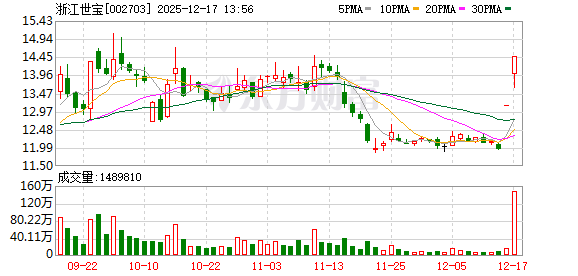
Group 1 - The core viewpoint of the news is that the smart driving concept continues to show strong momentum, with Zhejiang Shibao experiencing a rapid increase in stock price, reaching a closing price of 14.47 yuan per share and achieving two consecutive trading limits [2] - Zhejiang Shibao has established long-term cooperative relationships with various domestic traditional and new car manufacturers, providing products suitable for L3 and above autonomous driving, such as intelligent steering and electronic control columns [4] - The Ministry of Industry and Information Technology has announced the first batch of L3-level conditional autonomous driving vehicle approvals, marking a significant step towards the commercialization of L3 autonomous driving in China [6] Group 2 - The stock market showed positive performance, with the ChiNext Index increasing by 2.02%, the Shanghai Composite Index rising by 0.58%, and the Shenzhen Component Index up by 1.38% [7] - The approval of L3 autonomous driving vehicles is expected to promote the adoption and mass production of intelligent steering products by companies like Zhejiang Shibao [4][6]

长安、北汽L3级车型明年一季度试点上路,资本市场闻风动
Bei Ke Cai Jing· 2025-12-17 05:40
Core Viewpoint - The Ministry of Industry and Information Technology has announced the first batch of L3 conditional autonomous driving vehicle permits in China, with Changan Automobile and BAIC's Arcfox planning to pilot their models in designated areas of Beijing and Chongqing by the first quarter of 2026 [1][2]. Group 1: Company Plans - Changan Automobile's model, the Deep Blue SL03, and BAIC's Arcfox Alpha S (L3 version) will be operated by Chongqing Changan Car Networking Technology Co., Ltd. and Beijing Mobility Automotive Service Co., Ltd., respectively [2]. - Both companies aim to accumulate practical experience for a replicable and scalable autonomous driving operation system, with plans to initiate L3 operations in specific scenarios by the first quarter of 2026 [2]. Group 2: Market Impact - Following the announcement of the permit list, BAIC Blue Valley's stock hit the daily limit, while Changan Automobile's stock closed with a 4.42% increase; the intelligent driving sector saw a surge, with multiple stocks reaching their daily limits [2]. - However, by the afternoon of December 17, both Changan Automobile and BAIC Blue Valley experienced declines, although the intelligent driving index continued to rise [2].

