
避险资产

Search documents
小摩CEO:在投资组合中持有黄金是“半理性选择”,资产价格普遍偏高
智通财经网· 2025-10-15 00:38
上周,资产管理公司城堡集团(Citadel)首席执行官肯·格里芬(Ken Griffin)表示,投资者开始将黄金视为 比美元更安全的投资选择,并称这一情况"令人十分担忧"。 智通财经APP获悉,摩根大通公司首席执行官杰米·戴蒙表示,他认为持有黄金有一定道理,但对于经 历了历史性上涨后黄金是否被高估了,他不置可否。 戴蒙周二说道:"我并不热衷于购买黄金——持有黄金的成本是 4%。在这种环境下,黄金价格很容易 涨到 5000 美元、10000 美元。这是在我人生中少有的几次,在投资组合中持有一些黄金是半理性的。" 两年前,黄金价格还低于每盎司 2000 美元,但自本世纪以来,其涨幅已超过了股票市场。这反映出在 通胀担忧和地缘政治动荡的背景下,投资者对避险资产的需求。周二,黄金价格继续强劲上涨,上涨 0.8%至每盎司 4142.94 美元,今年的涨幅达到了 58%。 戴蒙说:"资产价格确实偏高。并且在我看来,这一点几乎影响到了所有领域。" ...

伦敦逼空引全球抢运银条,白银创历史新高后降价
阿尔法工场研究院· 2025-10-15 00:07
此后,近几周印度市场对白银的需求激增,进一步减少了伦敦市场可供交易的银条供应。 尽管 4 月份贵金属已被正式豁免征税,但在美国政府针对关键矿产(包括白银、铂金和钯金)开展 的所谓" 232 条款调查"得出结论之前,交易商仍保持警惕。这项调查重燃了市场对这些金属可能 被纳入新关税范围的担忧,进一步加剧了市场紧张局势。 高盛集团( Goldman Sachs Group Inc. )分析师在一份报告中写道:"白银市场流动性较低,规 模约为黄金市场的九分之一,这会放大价格波动。由于没有央行买入来稳定白银价格,即便投资资 金出现暂时性回撤,也可能引发幅度较大的回调——因为这同时会缓解此前推动近期大部分涨势的 伦敦市场白银紧张局面。" 白银价格在触及每盎司 53 美元以上的历史高点后出现回落。此前,伦敦市场发生历史性空头逼 空,叠加避险资产需求激增所带来的推动作用,曾令白银涨势如虹。 伦敦市场白银现货价格在触及每盎司 53.55 美元后下跌 2.2% 。这一价格比 1980 年 1 月芝加哥 期货交易所(现该交易所旗下相关合约已失效)监管的合约所创下的峰值高出约 1 美元——当时亿 万富翁亨特兄弟曾试图操纵白银市场。 ...


Gold's rally isn't over, says Sprott's ETF director Schoffstall
Youtube· 2025-10-14 21:50
Core Viewpoint - Gold prices have been steadily increasing, recently surpassing $4,000 per troy ounce, driven by economic turmoil and geopolitical instability, with a notable shift in investment strategies towards gold allocation [1][2][3]. Gold Market Dynamics - There has been a significant inflow of $38 billion into physical gold exchange-traded products this year, indicating a growing acceptance of gold as a mainstream investment [4]. - Prominent economists are suggesting a shift in portfolio allocation from a traditional 60/40 model to a 60/20/20 model, with 20% allocated to gold [5]. - Gold typically shows low to moderate correlations with major asset classes and an inverse correlation to the US dollar, making it an attractive hedge for investors [6]. Geopolitical and Economic Factors - Ongoing geopolitical risks, including tensions in the Middle East and potential trade restrictions from China, are contributing to the upward pressure on gold prices [7][8]. - Central banks have been actively buying gold, averaging about 1,000 tons per year over the last three years, which supports higher prices and allows for dollarization of assets [8][9]. Investment Strategies - Investors are generally underallocated to gold, with many holding less than the recommended 5% allocation in their portfolios [12]. - Gold mining equities have outperformed physical gold, with top-performing ETFs primarily consisting of gold and silver miners, returning 120-130% this year [13][14]. - The allocation strategy for gold and silver should consider the different risk profiles, with gold serving as a stable component and silver offering growth potential due to its industrial uses [22][23]. Silver Market Insights - Silver is increasingly recognized for its dual role as both a precious and industrial metal, with about 60% of its demand coming from industrial applications [22]. - There has been a notable inflow into silver miners, contrasting with outflows from gold miners, indicating a shift in investor preference [24]. - Silver's performance tends to be more volatile compared to gold, influenced by economic conditions and industrial demand [28].

黄金已经涨疯了,接下来你能做些什么?
Sou Hu Cai Jing· 2025-10-14 20:57
- 299 - 2 a All Reportation on The Children 刚过去的"黄金周",这次成了真正的"黄金"周。 黄金的警告:为何金价一路狂飙? 黄金从来不只是商品,它是全球经济和政治的晴雨表。 10月8日,国际金价一举突破4000美元/盎司大关,最高触及4081美元,创下历史新高。 看着这闪亮的数字,我想起美国经济学家彼得·伯恩斯坦的那句名言:"黄金被选为货币,并非因为其光泽,而是因为它诚实。" 当然,国内足金饰品价格也随之飙升,周大福、周大生等品牌的足金首饰价格已达1168元/克,较9月30日上涨45元/克。 无数抱着"等等看"心态的消费者傻眼了——去年还在犹豫每克500多的价格,转眼间就已高不可攀。 一位在深圳水贝采购金饰的顾客分享道,她曾因金价高反对儿子买20克金手串,没想到儿子购入短短20天竟升值900多元。 黄金的保值能力,再次让人惊叹。 而更多的人看到金价飙升,才发现手里的资产如此脆弱。 在当今这个充满不确定性的世界里,黄金似乎正在用它耀眼的光芒,向我们揭示某些不容忽视的真相。 这次金价暴涨,表面上是市场供需变化,背后却是多重因素共同作用的结果。理解这些,才能明白我们正处在 ...

金价暴涨引发市场,投资者疯狂抢购,财富机会瞬间来袭!
Sou Hu Cai Jing· 2025-10-14 16:58
Core Viewpoint - The recent surge in gold prices reflects growing investor distrust in the global financial and monetary systems, driven by economic instability and geopolitical tensions [3][11]. Market Reaction - On October 10, 2025, gold prices reached $4017.845 per ounce, marking a 1.05% increase, which triggered panic among investors [1] - Following the spike in gold prices, global financial markets experienced a sharp decline, with major U.S. and European stock indices falling, as investors shifted to safer assets like gold and government bonds [2] - The sentiment among investors is mixed, with many expressing regret for not purchasing gold earlier, while others are hesitant to buy at high prices [2][10]. Economic Indicators - The U.S. government shutdown is contributing to uncertainty in the economic outlook, with signs of a cooling labor market and concerns about prolonged impacts on employment and business confidence [2] - The University of Michigan's consumer sentiment index for October was reported at 55, the lowest since May, indicating consumer apprehension about financial conditions [2]. Central Bank Actions - In Q2 2025, global central banks purchased a net total of 166 tons of gold, with significant purchases from emerging market countries like Poland, Turkey, and Qatar [5] - As of October 2025, the total value of global official gold reserves reached $4.64 trillion, a 52.9% increase from the end of 2024, highlighting a strong demand for gold among central banks [5]. Consumer Behavior - Despite rising gold prices, consumer interest in gold jewelry remains strong, with significant sales during festive seasons, indicating a shift towards high-value, well-designed products [6][8]. - The overall consumption of gold has seen a structural change, with a focus on high-margin products despite a decline in total consumption volume [8]. Future Outlook - Predictions suggest that gold prices could exceed $5000 per ounce in 2026, with some analysts speculating that prices could reach $10,000 by 2030, reflecting a bullish sentiment in the market [4]. - The volatility in gold prices is seen as a reflection of broader economic uncertainties and investor psychology, with future movements likely influenced by geopolitical events and policy changes [12][14].

日本执政联盟破裂新首相或“难产” 日央行或推迟加息
2 1 Shi Ji Jing Ji Bao Dao· 2025-10-14 15:03
Market Overview - The Japanese stock market experienced significant declines, with the Nikkei 225 index falling by 2.58% and the Topix index dropping by 1.99% as of October 14 [1][2] - The decline was primarily driven by political instability following the announcement of the Komeito party's withdrawal from the ruling coalition with the Liberal Democratic Party, raising concerns about the potential inability of the new LDP president, Sanae Takaichi, to assume the role of Prime Minister [1][2] Currency and Bond Market - The Japanese yen showed volatility, initially declining but later rising due to increased demand for safe-haven assets, although it has depreciated by 2.79% against the US dollar for the month [1][3] - Japanese long-term government bond yields continued to rise, indicating investor disinterest in Japanese bonds, with the 20-year bond yield increasing by 0.15% and the 30-year bond yield rising by 0.81% [3][4] Political Impact on Financial Markets - The political uncertainty in Japan is expected to continue affecting the stock market, with potential for further declines if the political deadlock persists and external negative factors arise [3][6] - Analysts suggest that if political stability is restored and global risk appetite improves, the Japanese stock market may stabilize and rebound [3][6] Government Debt Concerns - Concerns regarding Japan's fiscal sustainability are heightened, with government debt exceeding 260% of GDP, leading to fears of increased bond issuance and potential fiscal deterioration [4][5] - The market anticipates that if the new government opts for fiscal stimulus measures, it could further increase the supply of government bonds, necessitating higher yields as compensation [4][5] Interest Rate Outlook - The likelihood of a rate hike by the Bank of Japan has diminished significantly, with current expectations for an increase in October at only 10%, down from 63% earlier in the month [6] - The political instability may lead the Bank of Japan to adopt a cautious approach regarding monetary policy, delaying any potential rate hikes until the political landscape stabilizes [6]
日本执政联盟破裂新首相或“难产”,日央行或推迟加息
2 1 Shi Ji Jing Ji Bao Dao· 2025-10-14 14:07
Market Overview - The Japanese stock market experienced significant declines, with the Nikkei 225 index falling by 2.58% and the Topix index down by 1.99% as of October 14 [2][3] - The decline is attributed to political instability following the announcement of the Komeito party's exit from the ruling coalition with the Liberal Democratic Party, raising concerns about the potential inability of the new LDP president, Sanae Takaichi, to assume the role of Prime Minister [2][3] Currency and Bond Market - The Japanese yen showed volatility, initially declining but later rising by 0.14% against the US dollar, reflecting increased demand for safe-haven assets amid global market uncertainties [4] - The yield on Japan's 20-year and 30-year government bonds increased by 0.15% and 0.81%, respectively, indicating a cooling interest in Japanese bonds despite the yen's safe-haven status [4] Economic Implications - Analysts suggest that the political turmoil in Japan is causing heightened investor caution, particularly affecting technology and banking stocks, which are sensitive to economic outlook and policy changes [3] - The potential for a new fiscal stimulus from a new government could lead to increased government debt issuance, raising concerns about fiscal sustainability and pushing bond yields higher [5][6] Interest Rate Outlook - The likelihood of a rate hike by the Bank of Japan has decreased significantly, with current market expectations placing the probability of a rate increase this month at only 10%, down from 63% earlier in October [6][7] - The uncertainty surrounding the new government's monetary policy direction, whether dovish or hawkish, adds to the complexity of the interest rate outlook in Japan [7]

一小时内跳水近100美元!金价“过山车”是风险还是“黄金坑”?
Sou Hu Cai Jing· 2025-10-14 11:18
Core Viewpoint - International gold prices experienced significant volatility on October 14, 2023, with a peak of $4,179.75 per ounce before dropping to a low of $4,089.81, and later rebounding to around $4,140 [2][4]. Price Trends - On October 14, COMEX gold futures reached a high of $4,190.9 per ounce, marking a historical peak, before falling to $4,105 and recovering to approximately $4,150 by 5 PM [4][5]. - The overall trend in international gold prices has been upward, with a notable surge after surpassing the $4,000 per ounce mark [5]. Factors Driving Gold Prices - The primary driver for the recent surge in gold prices is the strengthened market expectation of a Federal Reserve interest rate cut, which could weaken the dollar and lower real interest rates, enhancing the appeal of non-yielding assets like gold [5]. - Ongoing geopolitical conflicts and concerns regarding U.S. government debt have heightened market risk aversion, leading to increased investment in gold as a safe haven [5]. - Central banks, particularly in emerging markets, have been diversifying their foreign exchange reserves by purchasing significant amounts of gold, providing structural long-term support for gold prices [5]. Investment Dynamics - The buying power behind the recent gold price increases is attributed to three main sources: central bank purchases, accelerated inflows into gold ETFs, and capital reallocating from other assets, such as cryptocurrencies, into gold [5][6]. - In September, global physical gold ETF inflows reached 145.6 tons, the second-highest level since the onset of the Russia-Ukraine conflict and the COVID-19 pandemic [6]. Future Outlook - Despite short-term volatility, institutional investors maintain a generally optimistic view on gold's investment value. Goldman Sachs has raised its gold price forecast for the end of 2026 from $4,300 to $4,900 per ounce, reflecting a nearly 14% increase [7]. - Long-term factors such as high U.S. fiscal deficits and a weakening confidence in dollar assets support the view that gold will continue to be a crucial reserve asset, with short-term pullbacks seen as potential buying opportunities [7].

中美关税摩擦冲击汇市:美元重成避风港
智通财经网· 2025-10-14 10:59
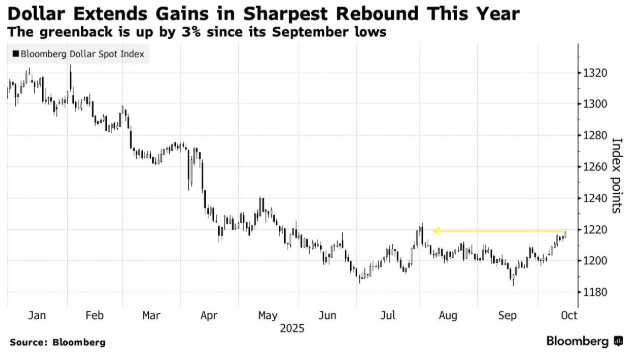
Core Viewpoint - The strengthening of the US dollar against major currencies is influenced by the new developments in US-China tariff tensions, leading investors to shift towards safe-haven assets [1][4]. Group 1: Currency Movements - The Bloomberg Dollar Spot Index increased by 0.3%, reaching its highest level since August 1, alongside a rise in government bonds, while the stock market declined [1]. - The Australian dollar led the declines among currencies, falling by 1% to a near two-month low, while the British pound also hit a two-month low following the release of UK employment data [1]. Group 2: Analyst Insights - ING analysts Chris Turner and Francesco Pesole noted that the "revitalized status" of the dollar as a safe-haven asset and "additional bullish momentum" could support the currency in the short term [4]. - The options market shows a resurgence in demand for bullish positions on the dollar, particularly against the British pound, Australian dollar, and Canadian dollar [4]. Group 3: Market Reactions - Traders are taking opposite positions on the Japanese yen, which led gains among G-10 currencies on Tuesday [4]. - Turner and Pesole indicated that if the market finds reasons to ease tensions regarding the Japanese political situation, the undervalued yen could be in a favorable position to benefit from further escalation [4]. - Market participants are also closely watching Federal Reserve Chairman Jerome Powell's important speech for clues on whether recent market pricing of the central bank's outlook has turned overly dovish [4].
工银瑞信基金|公募基金高质量发展之《财懂得》 :除了黄金,避险的资产还有哪些?
Xin Lang Ji Jin· 2025-10-14 09:46
专题:北京公募基金高质量发展系列活动 新时代、新基金、新价值 MACD金叉信号形成,这些股涨势不错! 责任编辑:石秀珍 SF183 ...