军工

Search documents
“没有俘虏日军计划”?孚日股份因公司名字8连涨停,公司回应
Mei Ri Shang Bao· 2025-11-17 10:11
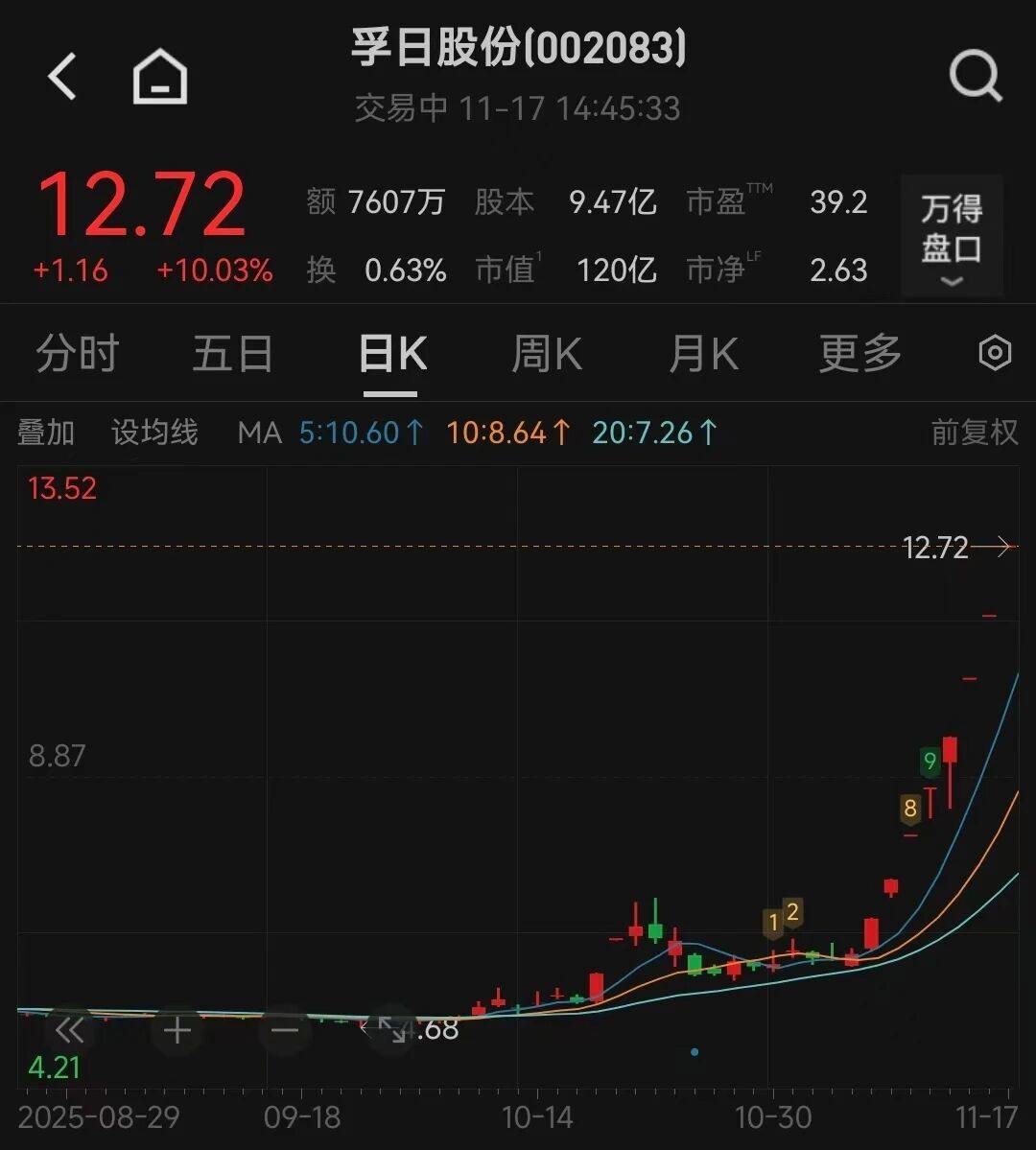
Core Viewpoint - Fuzhi Co., Ltd. has experienced a significant stock price surge, reaching a historical high of 12.72 yuan per share, with a market capitalization exceeding 12 billion yuan, attributed to the rising prices of its electrolyte additive VC and market speculation around its military applications [1][3][5] Group 1 - Fuzhi Co., Ltd. has achieved an 8-day consecutive limit-up in stock price, with the latest price reaching 12.72 yuan per share and a total market value surpassing 12 billion yuan [1] - The recent stock price increase has been linked to the rising price of VC, which has surged from 45,000 yuan per ton to over 100,000 yuan per ton, marking a 150% increase [3] - There is speculation in the market regarding the company's name and its association with military applications, although the company has stated that the stock price increase is unrelated to its name [2][3] Group 2 - Investors have shown interest in the company's export ratio to Japan and the progress of its military certification, indicating a growing curiosity about its military-related products [3] - A screenshot circulating in online communities claimed that the company has no plans related to military operations, which has drawn attention to the potential for speculative trading and associated risks [5] - The company has issued a notice regarding abnormal stock fluctuations, warning of potential irrational speculation and short-term trading risks [3][5]


全线爆发!两大板块,涨停潮!
Zheng Quan Shi Bao· 2025-11-17 09:23
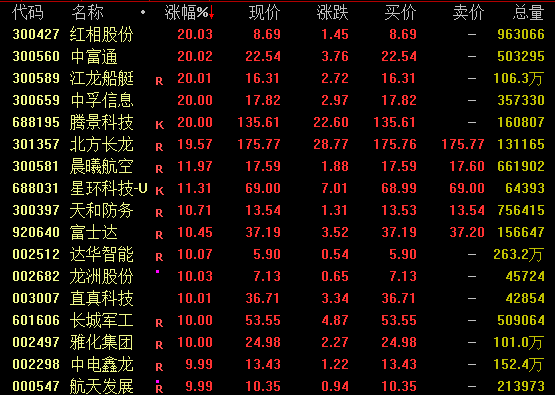
Core Insights - The military and lithium mining sectors have experienced significant surges in stock performance, indicating strong investor interest and potential growth opportunities in these areas [1][4][7]. Military Sector - The military sector saw a robust rally, with several stocks hitting the 20% daily limit, including Hongxiang Co., Ltd. (300427), Zhongfutong (300560), Jianglong Shipbuilding (300589), and Tengjing Technology [4][5]. - Analysts suggest that increasing geopolitical uncertainties are likely to enhance focus on the military sector, with expectations for a revaluation of core military assets due to the competitiveness of China's advanced weaponry in both domestic and international markets [6]. - The demand for military products is anticipated to grow, particularly in the fourth quarter, as domestic needs expand and military trade orders continue to materialize [6]. Lithium Mining Sector - The lithium mining sector demonstrated strong performance, with stocks like Tianhua New Energy (300390) and Shengxin Lithium Energy (002240) reaching their daily limit of 20% [7][8]. - Predictions indicate a 30% increase in lithium carbonate demand by 2026, potentially leading to price surges if demand growth exceeds expectations [9]. - The energy storage market is expected to drive rapid growth in lithium battery demand, with significant orders extending to 2026 for leading storage companies [9]. AI Application Sector - The AI application sector showed active trading, with stocks such as Xuan Ya International (300612) and BlueFocus Communication Group (300058) achieving notable gains [10][11]. - Alibaba's recent initiatives in AI, including the launch of the "Qwen" personal AI assistant, are expected to enhance its market position and drive growth in AI-related revenues [12].




全线爆发!两大板块,涨停潮!
证券时报· 2025-11-17 09:18
Core Viewpoint - The military and lithium mining sectors have experienced a significant surge, indicating strong market interest and potential investment opportunities in these areas [1][9]. Market Overview - On November 17, the Shanghai Composite Index experienced a slight decline of 0.46%, closing at 3972.03 points, while the Shenzhen Component Index and the ChiNext Index saw minor recoveries towards the end of the trading day [2][3]. - The total trading volume across the Shanghai and Shenzhen markets was approximately 19.3 billion yuan, a decrease of about 500 million yuan from the previous day [3]. Military Sector - The military sector saw a robust performance, with stocks such as Hongxiang Co., Zhongfutong, Jianglong Shipbuilding, and Tengjing Technology hitting the daily limit of 20% increase [6][8]. - Analysts suggest that the increasing geopolitical uncertainties are likely to enhance the focus on the military sector, with expectations of a significant recovery in demand for advanced military equipment in the coming years [8]. Lithium Mining Sector - The lithium mining sector demonstrated strong momentum, with Tianhua New Energy and other companies like Shengxin Lithium Energy and Rongjie Co. also reaching their daily limit of 20% increase [10][12]. - Predictions indicate a 30% increase in lithium carbonate demand by 2026, with potential price increases if demand growth exceeds expectations [12]. AI Application Sector - The AI application sector showed active trading, with stocks like Xuan Ya International and BlueFocus reaching a 20% increase [14][16]. - Alibaba's recent initiatives in AI, including the launch of the "Qwen" project, are expected to drive growth in AI applications, particularly in the consumer market [16].


哪些低估滞涨方向尚未轮动?
Huaan Securities· 2025-11-16 11:24
Core Insights - Economic and financial data show marginal weakening, with internal policy support expectations rising, but the probability of new incremental policies being introduced near year-end is low, leading to continued high-level fluctuations in the market [3][4] - The AI industry adjustment provides better layout opportunities, while sectors with earnings support such as energy storage/batteries, military industry, storage, and engineering machinery should also be emphasized [3][6] Market Perspective - October macroeconomic data continues to show marginal slowdown, with investment declining rapidly and consumption growth remaining low. The GDP growth rate for October is estimated at around 4.6%, which is a marginal decline from the second quarter [4][13] - The third-quarter monetary policy execution report indicates an increased probability of monetary policy easing to support the economy, with a shift in focus towards interest rates rather than quantity [5][22] Industry Allocation - The market has entered a high-level fluctuation phase since early October, with significant increases in industry rotation intensity. Consumption sectors have shown strong performance recently, while resource sectors led the previous week [6][29] - Low valuation and stagnant sectors such as non-banking, food and beverage, agriculture, public utilities, and home appliances are expected to see short-term rebound opportunities [6][30] Financial Data Analysis - Fixed asset investment in October showed a cumulative year-on-year decline of 1.7%, with manufacturing investment growth at 2.7%, and real estate investment down by 14.7% [16][19] - The real estate sector continues to show a downward trend, with property investment in October down 23% year-on-year, indicating significant cash flow pressure on real estate companies [19][20] Future Outlook - The AI industry remains a key focus for investment, with specific attention on computing power and application sectors. The third-quarter reports continue to validate the relative performance advantages of growth styles [38][40] - Sectors with strong earnings support, including energy storage, military, storage, and engineering machinery, are also highlighted as promising areas for investment [40]
关注军工ETF(512660)投资机会,技术突破与长期需求受关注
Mei Ri Jing Ji Xin Wen· 2025-11-14 07:08
Core Viewpoint - The 20th National Congress of the Communist Party emphasizes achieving the centenary goal of military development and advancing the modernization of national defense and the military, indicating a long-term positive trend for the military industry [1] Industry Summary - The military industry sector has underperformed the broader market in the short term, but the CS Aerospace and Defense Index has shown strong performance, highlighting structural opportunities in specific sub-sectors [1] - The military ETF (512660) tracks the CSI Military Industry Index (399967), which consists of securities from ten major military groups and other military-related listed companies, covering key military sectors such as aviation, aerospace, shipbuilding, weapons, military electronics, and satellites [1] - The index sample has a broad industry distribution and exhibits a small to mid-cap style, aiming to comprehensively reflect the overall market performance of military-related listed company securities [1]
港股收评:恒指涨0.85%,金融股、石油股权重活跃,农行等多股创新高!
Ge Long Hui· 2025-11-12 08:17
Market Performance - The Hong Kong stock market indices collectively rose, with the Hang Seng Index and the Hang Seng China Enterprises Index reaching intraday highs of 1.2%, and the Hang Seng Index briefly surpassing the 27,000-point mark, ultimately closing up by 0.85% and 0.82% respectively [1] - The Hang Seng Tech Index showed relatively weaker performance, with a slight increase of 0.16% [1] Sector Performance - Large technology stocks exhibited mixed performance, with Xiaomi up by 1.68%, JD.com by 1.3%, and Tencent by 1%, while Alibaba fell over 2% and Baidu dropped by 1.86% [1] - Major sectors such as banking, oil, and insurance stocks were notably active, with Industrial and Commercial Bank of China, Agricultural Bank of China, and China National Offshore Oil Corporation reaching historical highs [1] - China Life Insurance and New China Life Insurance showed strong performance [1] Consumer and Other Sectors - Home appliance sales for the Double Eleven shopping festival were impressive, with Hisense Home Appliances leading the gains, rising over 8% [1] - Biopharmaceutical stocks, gaming stocks, brain-computer interface concept stocks, coal stocks, and restaurant stocks all experienced increases [1] Weak Performers - The China Photovoltaic Industry Association stated that circulating rumors were false, leading to weak performance in photovoltaic stocks, with GCL-Poly Energy and New Energy Technology among the biggest decliners [1] - Rare earth concept stocks, gold stocks, automotive stocks, and military industry stocks generally declined [1]
CPO延续回调,如何看待AI算力的短期波动和长期机会?
Xin Lang Cai Jing· 2025-11-12 06:22
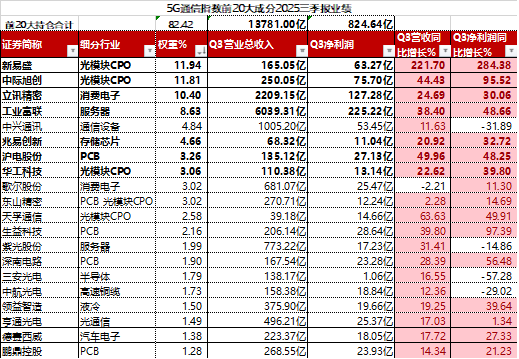
Core Viewpoint - The A-share market is experiencing a shift in investment sentiment as it approaches the 4000-point mark, with strong sectors like AI computing and consumer electronics undergoing corrections, while new themes such as Hainan Free Trade Zone and lithium battery technology gain traction [1] Group 1: Market Trends - The A-share market is seeing a rotation in investment styles, with previous strong sectors like AI computing and consumer electronics facing corrections, while new themes are emerging [1] - The AI computing sector has experienced significant gains, leading to potential technical adjustments as optimistic expectations from Q3 reports are realized [2] - Investors are advised to clarify their investment strategies, whether they are short-term traders or long-term investors, before making decisions [1][3] Group 2: Company Performance - The 5G communication index's top 20 constituent stocks reported a total revenue of 1.37 trillion yuan and a net profit of 82.464 billion yuan for Q3 2025, with 19 companies showing revenue growth and 16 showing net profit growth year-on-year [4] - Notable companies like Xinyi Technology and Zhongji Xuchuang reported net profit growth rates of 284.38% and 95.52% respectively for Q3 [4] - The 5G communication index is expected to see a net profit growth rate of 41.19% in 2025, maintaining over 40% growth in 2026 [5] Group 3: Market Style and Future Expectations - Historical analysis suggests that if the high prosperity of leading sectors continues, the market may maintain its focus on these sectors, while a shift to lower-performing sectors could trigger a reversal [6] - The AI hardware sector is projected to remain a key focus for the market, with expected net profit growth exceeding 30% in segments like communication equipment and semiconductors [6] - Despite concerns about an AI bubble, global investment in AI computing is increasing, with major cloud providers reporting significant capital expenditure growth [7][8] Group 4: Investment Products - The AI-focused ETF has attracted nearly 240 million yuan in the last 10 trading days, indicating strong market interest in core assets within the AI computing sector [11] - The 5G communication ETF has also seen over 500 million yuan in net inflows, reflecting investor confidence in the telecommunications sector [12] - The A500 ETF, which covers a broad range of industries, has raised nearly 1.8 billion yuan, showcasing a preference for diversified investment strategies in a volatile market [11]
周期半月谈 - 周期板块3季报综述和近期观点
2025-11-10 03:34
Summary of Key Points from Conference Call Records Industry Overview Tungsten Industry - The tungsten industry has shown outstanding performance, with tungsten concentrate prices increasing by 30% year-on-year in the first three quarters and a quarterly increase of 40% in Q3, reaching a historical high [1][5] - Integrated tungsten companies such as Xiamen Tungsten and China Tungsten High-tech, along with downstream tool companies like Dingtai High-tech and Oko Yi, have seen improvements in gross margins and profitability [1][4] - Integrated tungsten companies reported a gross margin of 19.2% in Q3, up 0.5 percentage points quarter-on-quarter, while downstream tool companies had a gross margin of 37.7%, an increase of 3.8 percentage points [1][4] Nonferrous Metals Industry - The overall performance of the nonferrous metals industry in Q3 2025 was below expectations, with gold prices rising by only about 3% and aluminum and copper showing marginal increases of 3% and 2% respectively [3] - Despite the underperformance, the tungsten sector stood out, with significant price increases and strong demand [3][5] Petrochemical and Chemical Industry - The petrochemical sector experienced a 1.2% year-on-year decline in revenue in Q3, but net profit attributable to shareholders grew by 29% [11] - Sub-sectors such as fluorochemicals and private refining saw significant profit increases, with fluorochemicals' net profit rising by 320% [11] - The chemical industry has been in a decline for over three years, but profitability is expected to bottom out in 2025 and gradually increase from 2026 [13] Future Outlook Nonferrous Metals - The supply elasticity of nonferrous metals is expected to weaken over the next 3 to 5 years due to constrained supply and increasing demand from sectors like electric power, AI, military, and high-end manufacturing [1][7] - The market outlook for nonferrous metals remains optimistic, with expectations of good performance from metals like gold, copper, aluminum, tungsten, and cobalt from current adjustments until spring 2026 [7] Petrochemical and Chemical - A decline in capital expenditure among petrochemical companies since the end of 2023 suggests a potential turning point in the capacity cycle [12] - The chemical industry is expected to see a rebound in profitability starting in 2026, driven by significant changes in supply dynamics and reduced capital expenditures [13] Construction Materials - The construction materials sector showed signs of recovery, with revenue and profit declines narrowing significantly in Q3 [19] - The cement sector remains weak domestically but has significant growth potential in overseas markets, particularly in Africa [19][20] Express Delivery Industry - The express delivery sector has made notable progress in reducing competition, with significant performance disparities among companies [23] - The upcoming peak seasons are expected to improve the performance of express delivery companies significantly [23] Cross-Border Logistics - The cross-border logistics sector faced challenges due to changes in tariff policies, leading to a decline in performance [24] - However, stable tariff policies and upcoming demand peaks in North America and Europe may provide rebound opportunities [24] Additional Insights - The chemical sector is experiencing a significant shift with a focus on reducing capital expenditures and improving profitability through technological upgrades and new project launches [15] - The phosphoric acid market is expected to benefit from strong demand driven by energy storage applications, with high profitability likely to persist due to long construction cycles for new capacity [16] - Companies with relatively low valuations in the chemical sector, such as Wanhua and Hualu, are recommended for potential growth even in a weak demand environment [15]
【公告全知道】钍基熔盐+可控核聚变+核电+芯片+军工+航空发动机!公司已研发钍基熔盐堆系列产品和技术储备
财联社· 2025-11-06 15:36
Group 1 - The company has developed a series of thorium-based molten salt reactor products and has a technology reserve, achieving small batch orders for nuclear fusion scientific devices [1] - The company possesses a series of products for the International Thermonuclear Experimental Reactor (ITER) test platform, integrating controlled nuclear fusion, nuclear power, computing power, energy storage, data centers, and wind power [1] - The company plans to supply over 800,000 tons of electrolyte products to Guoxuan High-Tech, focusing on solid-state batteries and sodium-ion batteries [1]

【公告全知道】可控核聚变+量子计算+核电+海峡两岸+数据中心!公司产品已应用于全超导托克马克核聚变实验装置
财联社· 2025-11-05 15:49
Group 1 - The article highlights the importance of major announcements in the stock market, including suspensions, investments, acquisitions, and performance reports, to help investors identify potential investment opportunities and risks [1] - The company involved in controlled nuclear fusion has products applied in superconducting tokamak nuclear fusion experimental devices [1] - Another company provides products and components for domestic and international fusion clients, including ITER, focusing on controlled nuclear fusion, humanoid robots, solid-state batteries, and rare earth permanent magnets [1] Group 2 - A company is investing 100 million to accelerate its humanoid robot business layout, indicating a strategic move towards robotics and energy storage [1] - The article emphasizes the significance of timely information on stock announcements to prevent unforeseen events and to allow investors to make informed decisions [1]