
居民消费价格指数(CPI)

Search documents
国家统计局:2025年11月份CPI同比上涨0.7%
智通财经网· 2025-12-10 01:44
Core Viewpoint - The National Bureau of Statistics reported that in November 2025, the national consumer price index (CPI) increased by 0.7% year-on-year, with urban areas rising by 0.7% and rural areas by 0.4% [1][3] Price Changes Overview - In November, the prices of food, tobacco, and alcohol rose by 0.3% year-on-year, contributing approximately 0.09 percentage points to the CPI increase [3] - Fresh vegetable prices surged by 14.5%, impacting the CPI by approximately 0.31 percentage points, while pork prices fell by 15.0%, reducing the CPI by about 0.21 percentage points [3][7] - The average CPI for January to November remained unchanged compared to the same period last year [1] Monthly Price Changes - In November, the CPI decreased by 0.1% month-on-month, with urban areas also declining by 0.1% and rural areas remaining stable [1][7] - Food prices increased by 0.5% month-on-month, while non-food prices decreased by 0.2% [1][7] - Among various categories, other goods and services, clothing, and healthcare saw month-on-month price increases of 1.2%, 0.7%, and 0.1%, respectively [5][7] Detailed Price Movements - The prices of fresh vegetables rose by 7.2% month-on-month, contributing 0.17 percentage points to the CPI [5] - Conversely, prices for aquatic products and eggs fell by 1.8%, each contributing a decrease of 0.03 and 0.01 percentage points to the CPI, respectively [5][7] - Transportation and communication prices decreased by 0.9% month-on-month, reflecting a decline of 2.3% year-on-year [7]

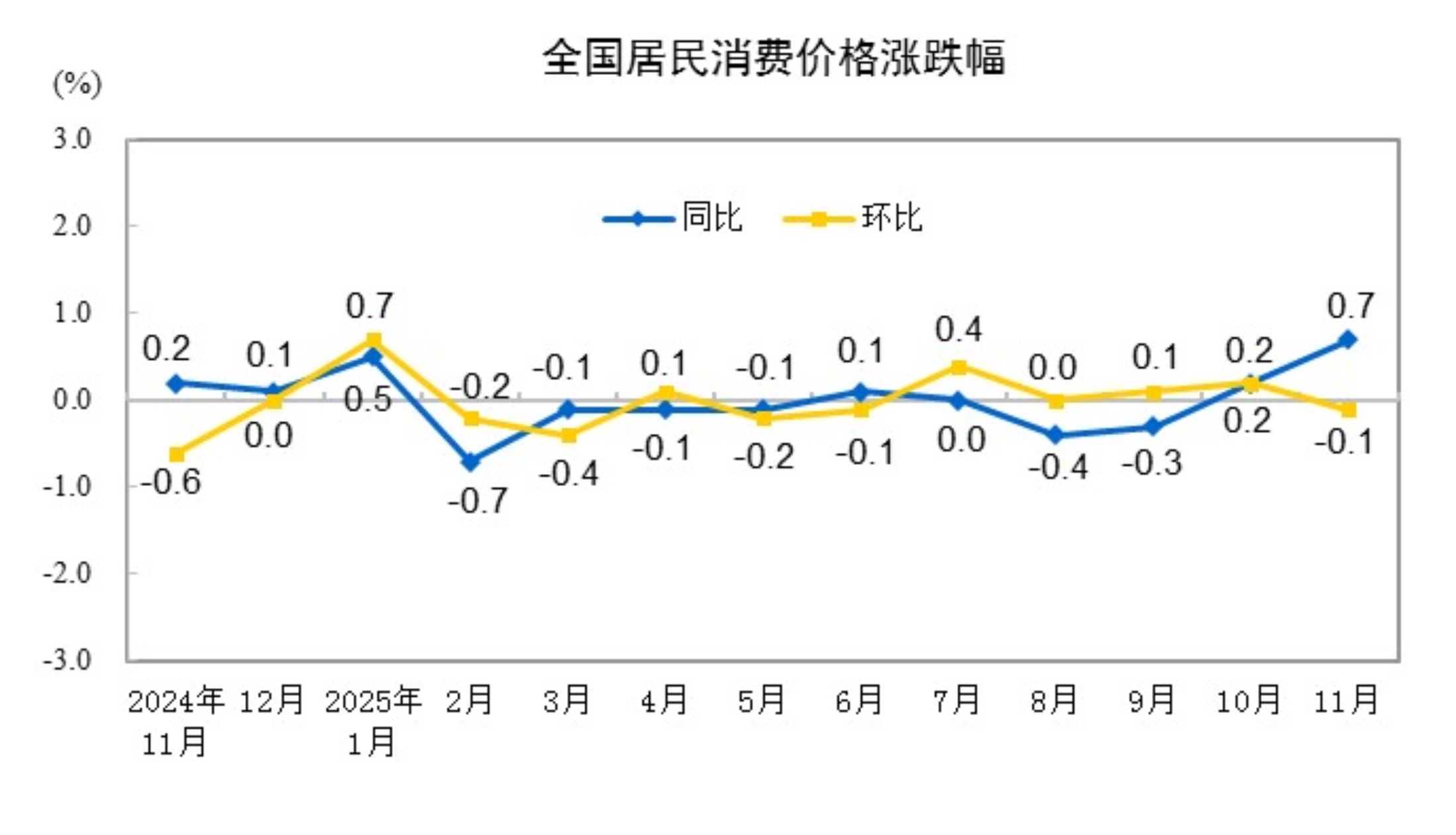
国家统计局:2025年11月份居民消费价格同比上涨0.7%
Yang Shi Wang· 2025-12-10 01:41
Core Insights - In November 2025, the national consumer price index (CPI) increased by 0.7% year-on-year, with urban areas rising by 0.7% and rural areas by 0.4% [1] - The average CPI from January to November remained unchanged compared to the same period last year [1] - Month-on-month, the CPI decreased by 0.1% in November, with urban areas also declining by 0.1% while rural areas remained stable [1] Price Changes Year-on-Year - In November, the prices of food, tobacco, and alcohol increased by 0.3%, contributing approximately 0.09 percentage points to the CPI [2] - Fresh vegetable prices surged by 14.5%, impacting the CPI by about 0.31 percentage points, while pork prices fell by 15.0%, reducing the CPI by approximately 0.21 percentage points [2] - Other categories showed mixed results, with significant increases in other goods and services (14.2%), clothing (1.9%), and healthcare (1.6%), while transportation and communication prices decreased by 2.3% [2] Price Changes Month-on-Month - In November, food, tobacco, and alcohol prices rose by 0.3%, contributing around 0.07 percentage points to the CPI [3] - Fresh vegetable prices increased by 7.2%, adding approximately 0.17 percentage points to the CPI, while pork prices decreased by 2.2%, impacting the CPI negatively by about 0.03 percentage points [3] - Other categories experienced a mix of increases and decreases, with other goods and services (1.2%) and clothing (0.7%) rising, while transportation and education prices fell by 0.9% and 0.8%, respectively [3]
国家统计局:11月居民消费价格同比上涨0.7%
Xin Lang Cai Jing· 2025-12-10 01:34
Core Viewpoint - In November 2025, the national consumer price index (CPI) increased by 0.7% year-on-year, with urban areas rising by 0.7% and rural areas by 0.4%. Food prices rose by 0.2%, while non-food prices increased by 0.8% [1][9]. Year-on-Year Price Changes - In November, the prices of food, tobacco, and alcohol increased by 0.3%, contributing approximately 0.09 percentage points to the CPI. Notably, fresh vegetable prices surged by 14.5%, adding about 0.31 percentage points to the CPI. Conversely, egg prices fell by 12.5%, reducing the CPI by approximately 0.08 percentage points [3][11]. - Among the seven major categories, five saw price increases, one remained stable, and one decreased. Other goods and services, daily necessities, and clothing prices rose by 14.2%, 2.1%, and 1.9%, respectively. Healthcare and education prices increased by 1.6% and 0.8%, while housing prices remained stable. Transportation and communication prices decreased by 2.3% [3][11]. Month-on-Month Price Changes - In November, the prices of food, tobacco, and alcohol rose by 0.3%, contributing approximately 0.07 percentage points to the CPI. Fresh vegetable prices increased by 7.2%, adding about 0.17 percentage points to the CPI. However, prices for water products and eggs decreased by 1.8% and 1.8%, respectively, impacting the CPI negatively [5][13]. - Among the seven major categories, three experienced price increases while four saw declines. Other goods and services, clothing, and healthcare prices rose by 1.2%, 0.7%, and 0.1%, respectively. In contrast, transportation and communication, as well as education and cultural entertainment prices, decreased by 0.9% and 0.8% [5][14].
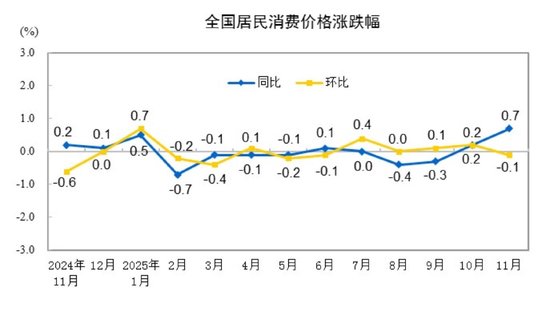
国家统计局:11月份居民消费价格同比上涨0.7%
Xin Jing Bao· 2025-12-10 01:33
Core Insights - In November 2025, the national consumer price index (CPI) increased by 0.7% year-on-year, with urban areas rising by 0.7% and rural areas by 0.4% [1] - The average CPI from January to November remained unchanged compared to the same period last year [1] - Month-on-month, the CPI decreased by 0.1% in November, with urban areas also declining by 0.1% while rural areas remained stable [1] Year-on-Year Price Changes - In November, food, tobacco, and alcohol prices rose by 0.3%, contributing approximately 0.09 percentage points to the CPI increase [2] - Fresh vegetable prices surged by 14.5%, impacting the CPI by approximately 0.31 percentage points; however, pork prices fell by 15.0%, leading to a CPI decrease of about 0.21 percentage points [2] - Other categories showed mixed results, with significant increases in other goods and services (14.2%), clothing (1.9%), and healthcare (1.6%), while transportation and communication prices dropped by 2.3% [2] Month-on-Month Price Changes - In November, food, tobacco, and alcohol prices increased by 0.3%, contributing around 0.07 percentage points to the CPI [3] - Fresh vegetable prices rose by 7.2%, affecting the CPI by approximately 0.17 percentage points, while pork prices decreased by 2.2%, leading to a CPI decrease of about 0.03 percentage points [3] - Other categories experienced three price increases and four decreases, with notable rises in other goods and services (1.2%) and clothing (0.7%), while transportation and education prices fell by 0.9% and 0.8% respectively [3]
11月份CPI同比增速 有望回升
Xin Lang Cai Jing· 2025-12-04 23:10
炒股就看金麒麟分析师研报,权威,专业,及时,全面,助您挖掘潜力主题机会! 本报记者 孟 珂 国家统计局12月10日将发布11月份居民消费价格指数(CPI)和工业生产者出厂价格指数(PPI)月度报 告,《证券日报》记者近日采访了多位业内专家,对数据进行前瞻。 在CPI方面,民生银行首席经济学家温彬在接受《证券日报》记者采访时表示,预计11月份CPI环比上 涨0.1%,同比上涨0.9%;兴业银行首席经济学家鲁政委也认为,11月份CPI同比或上涨0.9%,较10月份 上升0.7个百分点。 分析原因,温彬表示,从食品价格来看,11月份农产品批发价格200指数均值环比上涨4.4%。其中,由 于气温降低,蔬菜、水果供应量下降、运输难度与成本增加,价格分别环比上涨10.1%、1.3%;产能释 放叠加市场需求偏弱,猪肉、鸡蛋价格承压,环比分别下降0.6%、2.3%。能源价格方面,11月10日国 内成品油价格上调后,因全球原油供应过剩预期加剧、地缘风险溢价削减等因素影响国际油价波动下 行,又于24日下调,整体来看涨幅高于跌幅,从而带动能源价格上涨。 在鲁政委看来,消费品方面,11月份食品价格回升,CPI同比增速有望回升。11月 ...
11月份CPI同比增速有望回升
Zheng Quan Ri Bao· 2025-12-04 16:13
Group 1: CPI Insights - The Consumer Price Index (CPI) for November is expected to show a month-on-month increase of 0.1% and a year-on-year increase of 0.9% [1] - Food prices are a significant factor, with wholesale agricultural product prices rising by an average of 4.4% month-on-month in November, driven by lower supply and increased transportation costs [1] - The price of vegetables and fruits increased by 10.1% and 1.3% respectively due to seasonal factors, while pork and egg prices faced downward pressure, decreasing by 0.6% and 2.3% respectively [1][2] Group 2: Core CPI and Service Sector - The core CPI is expected to see a decline, influenced by a service sector business activity index of 49.5%, which is lower than the previous month [2] - The housing market is entering a traditional off-season, with average rental prices in 50 cities decreasing by 0.6% month-on-month and 3.6% year-on-year [2] Group 3: PPI Insights - The Producer Price Index (PPI) is anticipated to rise by 0.2% month-on-month but decrease by 2.0% year-on-year [2][3] - Industrial product prices are generally declining, with notable decreases in glass prices by 7.1% and in coking coal and coke prices by 2.7% and 2.0% respectively [2] - Some industrial commodities like aluminum and copper saw slight increases of 1.3% and 1.0% month-on-month [2]
天津:10月份居住类价格同比下降0.1%
Sou Hu Cai Jing· 2025-11-14 01:24
Core Viewpoint - In October, the Consumer Price Index (CPI) in Tianjin increased by 0.1% month-on-month and 0.4% year-on-year, with a cumulative increase of 0.1% from January to October [1] Group 1: Price Changes - In October, food prices rose by 0.1% and non-food prices also increased by 0.1% compared to September [1] - During the eight-day holiday period, hotel accommodation and travel agency fees increased by 5.9% and 2.1% respectively due to heightened travel demand [1] - Diesel and gasoline prices decreased by 0.9% influenced by international price transmission, while the prices of platinum, gold, and silver jewelry rose by 14.1%, 10.4%, and 3.8% respectively [1] Group 2: Year-on-Year Price Comparison - Compared to October of the previous year, prices for eight categories of goods and services showed four increases and four decreases [1] - Prices for other goods and services rose by 15.1%, while clothing, education, culture, entertainment, and daily necessities increased by 2.5%, 2.0%, and 0.9% respectively [1] - Conversely, transportation and communication, as well as food and tobacco prices decreased by 2.2% and 1.1%, while medical care and housing prices fell by 0.4% and 0.1% respectively [1]
10月郑州CPI同比持平
Zheng Zhou Ri Bao· 2025-11-13 00:34
Core Insights - The consumer price index (CPI) in Zhengzhou remained stable year-on-year in October 2025, with a slight month-on-month increase of 0.1% [1] Price Changes Overview - Year-on-year changes in October 2025 showed a 3.3% decrease in food prices, while non-food prices increased by 0.8%. Overall, consumer goods prices fell by 0.9%, industrial goods prices rose by 0.3%, and service prices increased by 1.5% [1] - Among the eight categories of goods and services, five experienced price increases and three saw declines. Specifically, food and tobacco prices decreased by 2.5%, clothing prices rose by 2.4%, housing prices fell by 0.1%, daily necessities and services increased by 0.2%, transportation and communication prices dropped by 3.1%, education, culture, and entertainment prices rose by 1.3%, healthcare prices increased by 3.7%, and other goods and services surged by 14.0% [1] Month-on-Month Changes - Compared to the previous month, the overall consumer price level in October 2025 increased by 0.1%. Food prices rose by 0.5%, while non-food prices remained stable. Consumer goods prices increased by 0.3%, industrial goods prices rose by 0.1%, and service prices decreased by 0.1% [1] - In the month-on-month breakdown, food and tobacco prices increased by 0.4%, clothing prices rose by 0.1%, housing prices decreased by 0.1%, daily necessities and services fell by 0.2%, transportation and communication prices dropped by 0.8%, education, culture, and entertainment prices increased by 0.1%, healthcare prices remained stable, and other goods and services rose by 3.7% [1]
10月深圳CPI上涨0.4%
Shen Zhen Shang Bao· 2025-11-12 07:02
Group 1 - The Consumer Price Index (CPI) in Shenzhen increased by 0.4% year-on-year in October 2025, with the core CPI rising by 0.9%, marking a 0.1 percentage point increase from the previous month [1] - Average CPI from January to October 2025 rose by 0.1% compared to the same period last year [1] - Food prices decreased by 1.5%, with rice, pork, and dairy prices falling by 10.0%, 6.3%, and 4.4% respectively, contributing to a 0.17 percentage point decline in CPI [1] Group 2 - Non-food prices increased by 0.7%, with medical services and utilities rising by 6.3% and 1.4%, respectively, contributing to a 0.29 percentage point increase in CPI [1] - Jewelry and platinum prices surged by 51.1% and 56.4%, respectively, adding approximately 0.21 percentage points to the CPI [1] - The CPI remained stable month-on-month, following a 0.2% decline in the previous month [1] Group 3 - The pork market is currently characterized by strong supply and weak demand, leading to a 2.1% decrease in pork prices [2] - The arrival of seasonal fruits has increased supply, resulting in a 2.8% drop in fresh fruit prices [2] - Non-food prices remained stable, with hotel accommodation and travel agency fees rising by 7.6% and 4.1% during the National Day holiday, contributing to a 0.06 percentage point increase in CPI [2]
10月份我省CPI同比上涨0.1
Liao Ning Ri Bao· 2025-11-12 00:59
Core Insights - In October, Liaoning's Consumer Price Index (CPI) increased by 0.1% year-on-year, which is 0.1 percentage points lower than the national average, ranking 16th nationwide [1] - The core CPI, excluding food and energy prices, rose by 1.1% year-on-year, with an increase of 0.3 percentage points compared to the previous month [1] - Month-on-month, the CPI increased by 0.3%, surpassing the national average increase of 0.1%, ranking 7th nationwide [1] Year-on-Year Analysis - In October, prices of eight major categories of goods and services showed a "four increases, three decreases, and one stable" trend. Specifically, prices for other goods and services rose by 13.1%, while food, tobacco, and alcohol prices decreased by 1.2% [1] - The categories that saw price increases included other goods and services (13.1%), daily necessities (1.7%), clothing (0.9%), and education, culture, and entertainment (0.6%) [1] - Conversely, healthcare prices decreased by 0.5%, transportation and communication prices fell by 1.4%, and housing prices remained stable [1] Month-on-Month Analysis - Month-on-month, the prices of eight major categories of goods and services exhibited a "three increases, five decreases" trend, with increases noted in other goods and services, food, tobacco, and alcohol, and transportation and communication [1] Average Price Trends (January to October) - From January to October, the average CPI decreased by 0.3% compared to the same period last year, ranking 22nd nationwide [1] - The average price trend for the eight major categories showed "five increases and three decreases," with healthcare, food, tobacco, and alcohol, and transportation and communication prices declining [1]