差异化竞争

Search documents
一线调研|当“苏超”遇见普惠金融:江南农商行的差异化竞争之路
2 1 Shi Ji Jing Ji Bao Dao· 2025-08-25 12:01
Group 1 - The article highlights the rise of the "Su Chao" league and its impact on local businesses and community engagement, particularly through the story of Jiangnan Rural Commercial Bank employee Wang Haining, who balances his job and passion for football [1][2] - Jiangnan Rural Commercial Bank has successfully supported local small and micro enterprises, with Wang Haining expanding his client base to 32 small micro clients and a credit balance of 26.17 million yuan [1][2] - The bank's strategy focuses on localized service and understanding the unique needs of small businesses, contrasting with larger banks that are increasing their market share in small micro enterprise loans [3][4] Group 2 - Data shows that the share of large commercial banks in providing inclusive loans to small micro enterprises has increased from 31.65% in 2020 to 42.77% by the end of 2024, while rural financial institutions' share has decreased from 33.92% to 26.87% in the same period [3] - Jiangnan Rural Commercial Bank's approach includes grassroots engagement and efficient service, emphasizing the importance of building trust with local small business owners [3][4] - The bank reported a loan balance of 196.55 billion yuan for private enterprises, with an increase of 6.56 billion yuan and a growth rate of 3.45% as of June 2025 [4] Group 3 - The bank has initiated a "thousand-household" outreach program where executives personally engage with small businesses to understand their needs and provide tailored financial solutions [4][5] - Jiangnan Rural Commercial Bank aims to create differentiated products that cater to local industries, such as supply chain finance products for manufacturing businesses [6][10] - The bank's leadership emphasizes the importance of speed, depth, and warmth in service delivery, aiming to be a responsive partner for local enterprises [10][11] Group 4 - The bank has developed its own AI platform, "Xiao Jiang Zhi Nao," to enhance service efficiency and customer experience, although it faces challenges related to data availability and talent shortages [11] - The bank's commitment to serving small micro enterprises and rural areas is seen as essential for local economic stability and growth, positioning itself as a vital player in the financial ecosystem [10][11]
当“苏超”遇见普惠金融:江南农商行的差异化竞争之路
2 1 Shi Ji Jing Ji Bao Dao· 2025-08-25 11:53
Group 1 - Jiangnan Rural Commercial Bank aims to focus on non-standardized products and operational products, leveraging its advantages in differentiation [1][8] - The bank's strategy includes deepening local engagement and understanding the specific needs of small and micro enterprises [5][6] - The bank has successfully increased its loans to private enterprises and agricultural loans, demonstrating effective support for local economic development [6][7] Group 2 - The bank's employees, like Wang Haining, actively engage in community activities, which helps in expanding their client base and building trust [3][4] - Jiangnan Rural Commercial Bank emphasizes the importance of personalized service and quick response times to meet the needs of local businesses [5][13] - The bank has implemented a "run a thousand households" initiative, where executives personally visit small enterprises to understand their needs better [6][7] Group 3 - The bank's digital transformation includes the development of the "Xiao Jiang Smart Brain" model application platform to enhance service efficiency and customer experience [13][14] - Challenges in implementing advanced digital solutions include data scarcity and a lack of qualified personnel with both financial and technical expertise [14] - The bank believes that understanding local economic and cultural contexts is crucial for effectively leveraging digital tools in financial services [14]


隆基绿能运营效率提升中期减亏26.6亿 授权专利超3500项竞争破内卷
Chang Jiang Shang Bao· 2025-08-25 03:51
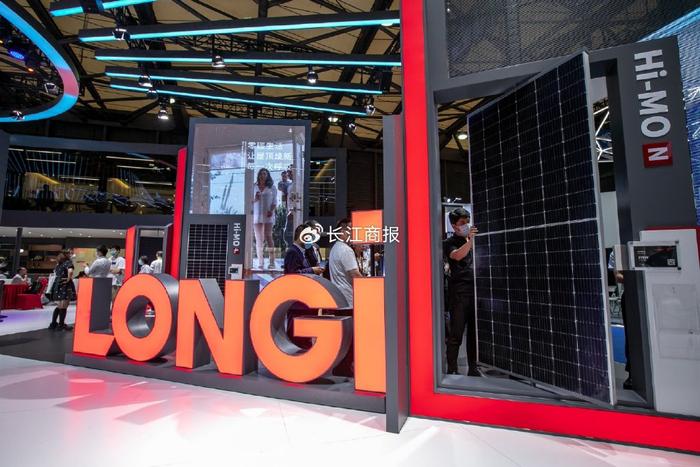
Core Viewpoint - The photovoltaic industry is facing significant challenges, but Longi Green Energy has demonstrated resilience by substantially reducing its losses in the first half of 2025 [2][3]. Financial Performance - In the first half of 2025, Longi Green Energy reported revenue of approximately 32.8 billion yuan, a year-on-year decline of 15% [2][3]. - The company recorded a net loss attributable to shareholders of 2.569 billion yuan, which is a reduction in losses by 2.661 billion yuan compared to the same period last year [2][3]. - The first half of 2025 saw a shipment of 52.08 GW of silicon wafers and 41.85 GW of battery modules [2][4]. Cost Management - The significant reduction in losses was primarily due to a decrease in sales and management expenses, as well as a substantial reduction in asset impairment losses [5][6]. - Sales expenses and management expenses for the first half of 2025 were 839 million yuan and 1.343 billion yuan, respectively, showing a decrease of 490 million yuan and 395 million yuan year-on-year [5][6]. Market Environment - The photovoltaic industry is transitioning from explosive growth to a more stable development phase, with competition shifting from homogeneous price competition to differentiated value competition [6][7]. - Longi Green Energy aims to become the most valuable solar technology company globally, focusing on technological innovation and a comprehensive range of solar solutions [6][8]. Product Development - Longi Green Energy has successfully implemented its BC strategy, focusing on HPBC 2.0 technology products and deep scenario solutions to enhance its competitive edge [7][8]. - The company has achieved a module conversion efficiency of 24.8% for its HPBC 2.0 products, with significant market penetration across over 70 countries and regions [8].

隆基绿能运营效率提升中期减亏26.6亿 授权专利超3500项差异化竞争破局内卷
Chang Jiang Shang Bao· 2025-08-25 00:41
Core Viewpoint - The photovoltaic industry is facing significant challenges, but Longi Green Energy has demonstrated resilience by substantially reducing its losses in the first half of 2025 [2][5]. Financial Performance - In the first half of 2025, Longi Green Energy reported revenue of approximately 32.8 billion yuan, a year-on-year decline of 15% [2][5]. - The net profit attributable to shareholders was a loss of 2.569 billion yuan, which is a reduction in losses by 2.661 billion yuan compared to the same period last year [2][5]. - The company achieved a silicon wafer shipment of 52.08 GW and a battery module shipment of 41.85 GW during the same period [2][5]. Cost Management - The significant reduction in losses is attributed to a decrease in sales and management expenses, as well as a substantial reduction in asset impairment losses [3][7]. - In the first half of 2025, sales expenses and management expenses were 839 million yuan and 1.343 billion yuan, respectively, showing a decrease of 490 million yuan and 395 million yuan year-on-year [7]. Market Environment - The global photovoltaic market is transitioning from explosive growth to a stable development phase, with competition shifting from homogeneous price competition to differentiated value competition [3][8]. - Longi Green Energy aims to enhance its competitive edge through product and business model innovation, cost control, and global expansion [8]. Product Development - Longi Green Energy is focusing on its BC product line, which has seen rapid growth in market penetration, with a shipment of approximately 4 GW in the first half of 2025 [9]. - The company has achieved a module conversion efficiency of 24.8% for its HPBC2.0 technology products, with expectations that by the end of 2025, over 60% of its high-efficiency production capacity will be from this technology [9]. Research and Development - As of June 30, 2025, Longi Green Energy has obtained over 3,500 authorized patents, including 480 patents for BC battery modules [4][9]. - The company's R&D expenditures for the first half of 2025 amounted to 751 million yuan, continuing its commitment to technological advancement [4][9].
横店东磁(002056) - 002056横店东磁投资者关系管理信息20250823
2025-08-23 05:28
Group 1: Financial Performance - The company achieved a revenue of 11.94 billion CNY in the first half of the year, with a net profit attributable to shareholders of 1.02 billion CNY, representing a year-on-year growth of approximately 59% [2] - The net cash flow from operating activities was 1.7 billion CNY, with a weighted average return on equity of 9.84% [2] Group 2: Business Segment Performance - The magnetic materials segment generated a revenue of 2.371 billion CNY, with a slight year-on-year increase and a shipment of 107,300 tons [3] - The photovoltaic segment reported a revenue of 8.054 billion CNY, showing a year-on-year growth of 36.58%, with shipments of 13.4 GW, an increase of over 65% [4] - The lithium battery segment achieved a revenue of 1.286 billion CNY, with shipments exceeding 300 million units, reflecting a year-on-year growth of 12.25% [4] Group 3: Market Dynamics and Pricing - The company noted that the price transmission in the market is still not fully market-oriented, with domestic acceptance of price increases remaining low [5][6] - The company is preparing for potential impacts from the U.S. anti-dumping and countervailing investigations against Indonesia, having already assessed risks and prepared responses [7][8] - The company has established strategic inventory to mitigate the impact of rising silicon prices, expecting continued support for component profitability in the second half of the year [9] Group 4: Product Development and Strategy - The company aims to achieve a TOPCon module power of 650W by the end of the year, with half of the capacity already capable of producing 640-645W [10] - The company has completed technical preparations for full ear technology and will evaluate mass production investment based on market demand and capital returns [12] - The magnetic materials segment has seen significant growth in AI server-related products, with monthly revenues increasing from millions to tens of millions [12] Group 5: Dividend Policy - The company has implemented cash dividends since its listing, with cumulative amounts reaching 3.76 billion CNY, and plans to continue a high proportion of cash dividends in the future [12]

艾森股份H1实现营收2.8亿元,同比增长50.64%
Ju Chao Zi Xun· 2025-08-22 08:58
Core Viewpoint - The company reported significant growth in revenue and net profit for the first half of 2025, driven by a focus on the semiconductor business and strategic international expansion [2][3]. Financial Performance - The company achieved operating revenue of 279.89 million yuan, a year-on-year increase of 50.64% [1]. - The net profit attributable to shareholders was 16.78 million yuan, reflecting a 22.14% increase compared to the previous year [1][3]. - The net profit after deducting non-recurring gains and losses was 14.44 million yuan, showing a substantial growth of 76.14% [1][3]. - The net cash flow from operating activities was 22.85 million yuan, a significant recovery from a negative cash flow of 34.07 million yuan in the previous year [1]. Business Strategy and Market Expansion - The company emphasizes a "differentiated competition and global layout" strategy, focusing on advanced packaging and wafer sectors [2]. - The company is enhancing its international strategy through localized operations and meticulous market cultivation, leading to growth in international business [2]. - The subsidiary INOFINE has successfully expanded into the Southeast Asian market, with ongoing integration and optimization efforts [2]. - The construction and operational preparation of the Southeast Asia manufacturing center are progressing well, establishing a secure global supply chain [2]. Product Development - The company is strategically increasing the proportion of high-value products like photoresists, enhancing its technological barriers and market competitiveness [2]. - Continuous optimization of product structure and expansion of customer base and project capabilities are key focuses for increasing market share [2].
机械ETF(516960)收涨超过1.4%,行业技术迭代引关注
Mei Ri Jing Ji Xin Wen· 2025-08-22 08:27
Group 1 - The core viewpoint indicates that the global top ten component suppliers are expected to ship 247.9 GW in the first half of 2025, representing a 10% year-on-year growth, with a domestic market share of 58% and an overseas market share of 42% [1] - TOPCon components have become the mainstream technology route, accounting for over 94% of the market [1] - The photovoltaic industry is currently in a low point reversal period, where companies need to balance scale and profitability while enhancing long-term competitiveness through differentiated competition [1] Group 2 - In the power battery sector, global installed capacity is projected to reach 504.4 GWh in the first half of 2025, marking a 37.3% year-on-year increase, with CATL and BYD together holding a market share of 55.7%, indicating a "stronger stronger" market trend [1] - Hive Energy's installed capacity has surged by 208% year-on-year, leading in growth rate [1] - In the electric equipment sector, the demand for electric meters in the State Grid's 53rd procurement batch in 2025 is expected to increase by 12% year-on-year, while the demand for collection terminals is projected to rise by 80.8%, reflecting ongoing investment in the power grid [1] Group 3 - The Mechanical ETF (516960) tracks a specific mechanical index (000812), which selects listed companies involved in industrial automation and engineering machinery from the Shanghai and Shenzhen markets to reflect the overall performance of the mechanical equipment industry [1] - The index constituents typically possess strong technological innovation capabilities and market competitiveness, focusing on leading companies with growth potential [1]
横店东磁(002056):磁材、锂电业务稳中有增,光伏差异化布局保障盈利能力行业领先
EBSCN· 2025-08-22 03:59
Investment Rating - The report maintains a "Buy" rating for the company, indicating a positive outlook for future performance [4]. Core Insights - The company achieved a revenue of 11.936 billion yuan in H1 2025, representing a year-on-year increase of 24.76%, and a net profit attributable to shareholders of 1.020 billion yuan, up 58.94% year-on-year [1]. - The magnetic materials business is steadily growing, with a slight decrease in shipment volume but an increase in revenue due to improved product mix [2]. - The company's photovoltaic products have seen significant growth, with shipments increasing over 65% year-on-year, supported by a differentiated product strategy [3]. - The lithium battery segment is also performing well, with a shipment of over 300 million units, reflecting a 12.25% year-on-year increase [4]. Summary by Sections Magnetic Materials - The company has maintained its leading position in the magnetic materials market, with a market share increase despite a slight decline in shipment volume by 8.05% to 107,300 tons in H1 2025. Revenue from magnetic materials grew by 4.51% to 1.939 billion yuan, with a gross margin increase of 1.22 percentage points to 27.71% [2]. Photovoltaic Products - The company emphasizes a differentiated competitive strategy, resulting in a 65% year-on-year increase in photovoltaic product shipments to 13.4 GW in H1 2025. Revenue from this segment rose by 36.58% to 8.054 billion yuan, with a gross margin increase of 5.29 percentage points to 16.70% [3]. Lithium Battery Products - The lithium battery segment has a leading capacity utilization rate, focusing on small power applications. In H1 2025, the company shipped over 300 million lithium batteries, achieving a revenue of 1.286 billion yuan, a 4.04% increase year-on-year, with a gross margin increase of 2.06 percentage points to 12.90% [4].
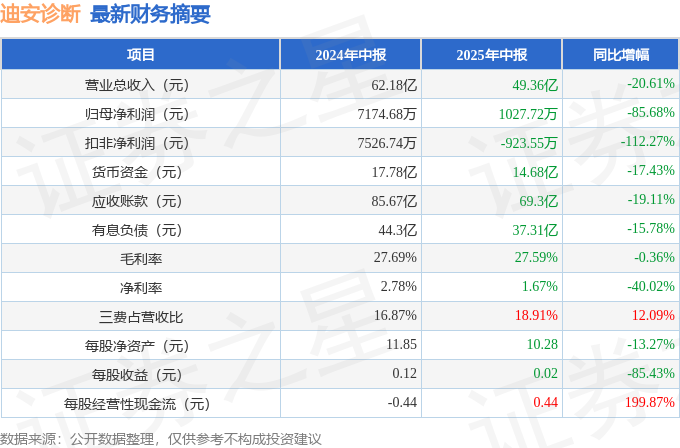
迪安诊断2025年中报简析:净利润同比下降85.68%,公司应收账款体量较大
Zheng Quan Zhi Xing· 2025-08-21 22:32
Financial Performance - The company's total revenue for the first half of 2025 was 4.936 billion yuan, a decrease of 20.61% year-on-year [1] - The net profit attributable to shareholders was 10.2772 million yuan, down 85.68% compared to the previous year [1] - The gross profit margin was 27.59%, a slight decrease of 0.36% year-on-year, while the net profit margin fell by 40.02% to 1.67% [1] - Total accounts receivable accounted for 56.82% of the latest annual revenue, indicating a significant receivables issue [1] - The company reported a significant increase in operating cash flow per share, which was 0.44 yuan, up 199.87% year-on-year [1] Cash Flow and Investment Activities - The net cash flow from operating activities increased by 199.56% due to improved cost control and reduced cash outflows [3] - The net cash flow from investing activities rose by 79.82% as long-term asset investments decreased compared to the previous period [3] - The net cash flow from financing activities decreased by 50.88% due to an increase in loan repayments [3] Business Model and Strategy - The company relies heavily on research and marketing to drive its performance, necessitating a thorough examination of these underlying drivers [7] - The company aims to differentiate itself in a highly competitive market through scale and cost advantages, unique technology products, innovative service models, and digital empowerment [10] Market Position and Fund Holdings - The largest fund holding the company's shares is the Changcheng Consumption Value Mixed A fund, with a current scale of 421 million yuan [9] - Analysts expect the company's performance in 2025 to reach 435 million yuan, with an average earnings per share of 0.7 yuan [8]

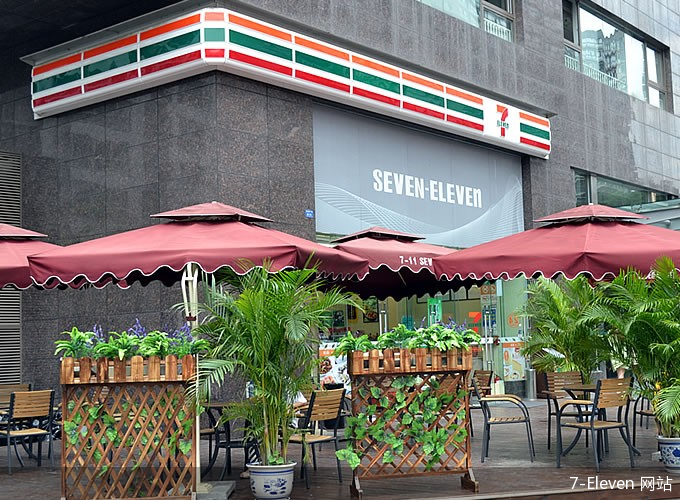
推新型门店、代收快递 便利店的自救与升级
Bei Jing Shang Bao· 2025-08-21 14:17
Core Insights - 7-Eleven is undergoing self-rescue efforts after the withdrawal of a takeover bid by Canadian convenience store giant ACT, which marked a loss of a quick transformation opportunity for 7&i Holdings [5] - The convenience store industry is actively exploring new store models to seek breakthroughs amid challenges of sluggish growth and profit pressure [1][5] New Store Formats - 7-Eleven has launched a new store format in Tongzhou District, featuring a 24-hour service window, redesigned employee uniforms, and new product offerings including self-service coffee machines and a relaxation area on the second floor [3] - Lawson has also accelerated service innovation with its first new store in Qingdao, offering 24-hour services such as package collection and self-service charging [3] - Both companies are focusing on unique products as a standard feature of their new store formats, with Lawson emphasizing the need to develop specific products based on consumer characteristics [4] Industry Challenges - 7-Eleven is experiencing a slowdown in franchise growth, with a reported 0.7% decline in revenue and an 11.0% drop in operating profit for the first quarter of fiscal year 2025, marking five consecutive quarters of negative growth [5] - In comparison, competitors like FamilyMart and Lawson have maintained an 8% growth rate in daily sales [5] - The number of 7-Eleven stores in China has been surpassed by Lawson, with 6,652 and 4,639 stores respectively [5] Competitive Landscape - Domestic convenience store brands such as Meiyijia, Yijie, and Kunlun Haokai are dominating the top three positions, prompting foreign brands like Lawson and 7-Eleven to innovate and localize their strategies [6] - New entrants like Three Squirrels and Kudi Coffee are also entering the convenience store market, indicating a trend of cross-industry competition [7] - The convenience store sector is increasingly focusing on young consumers, with a need for precise channel and customer matching [7] Market Trends - The China Chain Store & Franchise Association's report indicates that the number of convenience stores will continue to grow in 2024, with 24-hour and community-based stores becoming increasingly important [8] - Convenience stores are encouraged to enhance product cost-effectiveness and adopt a strategy of "market demand + differentiated value" to develop proprietary brand products [8]