
数据治理

Search documents
新交所证券市场欢迎AvePoint在主板上市
Jin Tou Wang· 2025-09-19 09:43
Group 1 - AvePoint has successfully completed its secondary listing on the Singapore Exchange (SGX) under the stock code "AVP," with its primary listing on NASDAQ (NASDAQ: AVPT) [1] - AvePoint is recognized as a leader in global data security, governance, and resilient data solutions, marking it as the first B2B SaaS company to list on SGX [1] - The company supports over 25,000 clients across various sizes, industries, and regions through its cloud-native data management platform [1] Group 2 - AvePoint's CEO, Dr. TJ Jiang, emphasized the significance of the listing as a milestone in the company's development and a testament to its global strategic vision [2] - The listing is seen as a demonstration of SGX's appeal as a strategic international capital market platform for high-growth technology companies [2] - AvePoint's opening price on the first day of trading was 20.20 Singapore dollars [2]

打造数字化改革“苏州范本”
Su Zhou Ri Bao· 2025-09-17 06:18
Core Insights - Suzhou Smart Technology Group's urban lifeline safety project has been recognized as a benchmark for digital government innovation in 2025, marking a significant step in the digital transformation of urban safety governance [1] - The company has developed a comprehensive development path characterized by "data-driven" governance, enhancing service efficiency and improving citizen experience through digital reforms [1] Digital Foundation - The core of digital reform lies in activating data value, transforming previously isolated data into a unified and efficient resource through a comprehensive data system [2] - The integrated public data foundation launched in June last year has consolidated over 1.5 trillion data entries, facilitating efficient data circulation and deep empowerment across various departments [2] - In the civil affairs sector, over 24 million data entries have been integrated, significantly enhancing the management of population information and financial supervision [2] Centralized Pathway - Centralized construction is key to improving government service efficiency, with tailored solutions for each department leading to effective and streamlined operations [3] - This approach has been successfully implemented across various sectors, including education, technology, and talent services, demonstrating significant improvements in service delivery [3] Urban Governance - The establishment of a city operation center has enhanced urban governance resilience through a three-tiered communication command system, enabling rapid cross-departmental coordination [4] - The "Suzhou Around" online service platform has attracted 25.6 million users, providing nearly 654 service applications and achieving over 12.8 billion service calls [4] - The "Suzhou Service Enterprise" platform offers comprehensive services for businesses, consolidating over 240 applications and more than 20,000 supportive policies [4] Replicable Model - The "Suzhou model" of centralized digital construction is creating a comprehensive and interconnected "smart cloud map," providing a replicable example for urban governance modernization [5] - The company is not only a builder but also a promoter of best practices, with successful products in urban governance, public services, and ecological management being shared nationwide [6] Future Outlook - The company plans to continue enhancing its core capabilities in data foundation, solutions, and public support, aiming for a comprehensive reconstruction of industrial infrastructure and government service processes [7] - By leveraging technological empowerment and ecological collaboration, the company seeks to export more replicable "Suzhou experiences" and establish new benchmarks for smart city construction [8]
以“数智”带“数治”——数智赋能助力基层减负的国能探索
Jing Ji Wang· 2025-09-16 10:37
Core Insights - The article highlights the implementation of intelligent digital tools by the State Power Investment Corporation to enhance efficiency and reduce the administrative burden on grassroots employees in the energy sector [1][2][3][4][5][6][7] Group 1: Digital Tools and Their Impact - The introduction of the "Intelligent Reporting Assistant" allows plant managers to complete data reporting in just one minute, significantly reducing the time spent on data processing from approximately 40 minutes to 12 minutes, achieving an over 80% reduction in reporting time [2][3] - The "Travel Expense Reimbursement Assistant" automates the reimbursement process, increasing financial review efficiency by 200%, allowing the review of 120 reimbursement requests daily, while reducing the average time spent on filling out forms to less than one minute [2][3] - The "Intelligent Receipt Collection Robot" processes expense reports quickly, completing initial audits and documentation in under one minute, thus minimizing the need for manual submission and reducing the risk of document loss [3][4] Group 2: Enhancing Governance and Efficiency - The digital transformation aims to alleviate the burdens on grassroots employees, allowing them to focus on core responsibilities rather than administrative tasks, thereby improving overall governance efficiency [1][2][3][4] - The implementation of AI-driven tools has led to a 30% increase in task response and data acquisition efficiency, a 60% improvement in issue resolution, and a 70% reduction in time spent on safety activity records [4][5] - The "Digital Employee for Power Trading" redefines the trading process, enabling real-time interaction and significantly reducing data processing time from 2 hours to just 5 minutes, enhancing efficiency by 24 times [5][6] Group 3: Strategic Vision and Future Directions - The State Power Investment Corporation emphasizes that digital empowerment is crucial for industry transformation, aiming to create a closed-loop mechanism for technology research, scenario validation, and application promotion [7] - The corporation's vision is to integrate digital solutions deeply into frontline operations, thereby accelerating the reduction of burdens on grassroots employees and driving sustainable growth and high-quality development [7]
张家港农商银行夯实数据根基赋能业务发展
Jiang Nan Shi Bao· 2025-09-15 23:22
张家齐、郭伟两位老师分别就金融"五篇大文章"的核心要义、政策体系、监管统计信息要点及信贷系统 实操进行了系统性讲解。培训内容紧密围绕一线工作实际,涵盖了数据标准解读、数据质量排查、数据 安全规范、数据价值挖掘等多个关键领域,并针对支行在日常业务中遇到的数据痛点、难点问题进行了 逐一解答和指导。 此次培训不仅为江阴支行数据治理提升工作指明了方向,也进一步增强了总行与支行之间的联动与协 同,为全行深化数据驱动战略、推动数字化转型落地进一步夯实了基础。何丽霞 数字银行部副总经理徐惠作总结发言。她指出,客户经理提供的各项数据是各项业务统计的核心生产要 素,高质量的数据是支行实现精细化管理和业务创新突破的基石,要牢固树立"数据意识",严格遵守数 据规范,共同筑牢支行的数据防线,让数据真正成为驱动支行发展的强大引擎。 为深入贯彻落实全行数字化转型战略,全面提升数据质量与管理水平,赋能一线业务高质量发展,9月9 日,张家港农商银行江阴支行特邀总行数字银行部资深老师,举办了一场以"数据治理提升与应用"为主 题的专题培训。江阴支行全体客户经理、综合管理员参加了本次培训。 ...

北京将率先试行世贸组织《电子商务协定》 商务部详解工作方案
Yang Shi Xin Wen· 2025-09-12 06:27
Group 1 - The core viewpoint of the news is the implementation of the "Working Plan" to support Beijing in being the first to trial the WTO's Electronic Commerce Agreement, which aims to enhance digital trade practices and establish a framework for international cooperation in this area [1] - The Electronic Commerce Agreement, confirmed by 71 members including China, the EU, and Australia, encompasses four main pillars: digital facilitation, digital openness, digital trust, and digital inclusion, addressing key rules for electronic transactions, certification, and tariff exemptions on electronic transmissions [1] - The "Working Plan" includes 41 specific measures aimed at fostering institutional innovation and creating replicable digital trade policies, which will serve as a foundation for nationwide implementation and showcase China's commitment to high-level openness [1] Group 2 - The plan aims to enhance trade digitalization by promoting the use of electronic documents such as bills of lading and invoices, and facilitating cross-border recognition of electronic certifications and signatures [2] - It seeks to establish a comprehensive data governance system in Beijing, including the creation of a data element market and enhancing personal information protection, while also improving the convenience of cross-border data flow [2] - The initiative includes optimizing the digital consumer environment by improving online consumer protection mechanisms and enhancing the transparency of telecommunications services, as well as promoting international cooperation in digital trade [3]
厦门市促进数据产业高质量发展 提速建设厦门数据港
Zhong Guo Chan Ye Jing Ji Xin Xi Wang· 2025-09-11 22:30
Group 1 - The Xiamen Municipal Government has issued a notification to promote high-quality development of the data industry, focusing on five key areas: infrastructure, industry layout, data circulation, application innovation, and development environment [1] - The notification includes 16 practical measures aimed at accelerating the construction of Xiamen Data Port and establishing a digital economy driven by data as a key element [1] - It emphasizes the construction of a data infrastructure support system and encourages enterprises to engage in various technological practices, including trusted data spaces and blockchain [1] Group 2 - The notification encourages the establishment of independent data business entities by leading industry companies and internet platform enterprises, fostering a diverse range of data operating entities [2] - It promotes the creation of a new paradigm for enterprise data circulation and enhances data governance capabilities by encouraging the establishment of Chief Data Officer roles and improving data resource management mechanisms [2] - The notification aims to stimulate data application innovation, expand data resource supply, and accelerate the development and utilization of public data [2]

华夏银行被罚8725万元 从贷款审批到数据治理系统性失灵
Jing Ji Guan Cha Bao· 2025-09-07 10:48
Core Viewpoint - The significant administrative penalty of 87.25 million yuan imposed on Huaxia Bank highlights serious deficiencies in the bank's internal controls and data governance, particularly in loan approval and regulatory data reporting [2][4][6] Group 1: Penalty Details - The penalty was issued by the National Financial Supervision Administration due to insufficient prudence in core business management, including loans, bills, and interbank operations [2][4] - Multiple responsible personnel were also penalized, indicating a strong regulatory focus on risk management and data governance issues within financial institutions [2][3] Group 2: Bank's Response - Huaxia Bank acknowledged the penalty and emphasized its commitment to analyzing the root causes, implementing corrective measures, and holding responsible personnel accountable [3][10] - The bank plans to strengthen internal control compliance management and promote healthy business development in response to the regulatory actions [3][10] Group 3: Internal Control Issues - The core reason for the penalty was identified as a lack of prudence in managing key business lines, which may involve credit approval, fund flow monitoring, and transaction structure design [4][6] - As of June 2025, Huaxia Bank's restructured loan balance was 9.014 billion yuan, indicating ongoing risk management challenges despite a slight decrease [4][6] Group 4: Data Governance Concerns - The penalty also stemmed from non-compliance in regulatory data reporting, which is crucial for macro-prudential management and identifying systemic risks [6][8] - The bank's core Tier 1 capital adequacy ratio was 9.56% as of June 2025, showing a decline from the beginning of the year, raising concerns about the accuracy of its capital status [7][10] Group 5: Broader Implications for the Banking Sector - The incident serves as a warning for the entire banking industry regarding the necessity of compliance and risk prevention in a complex financial environment [3][8] - Regulatory authorities are shifting focus from merely addressing specific violations to enhancing governance mechanisms and information systems within banks [8][9]

中国零售消费行业生成式AI及数据应用研究报告
艾瑞咨询· 2025-09-05 00:05
Core Viewpoint - The retail industry is transitioning from high-speed growth to stock competition, necessitating the integration of generative AI and data applications to reshape the "people, goods, and scenarios" model, enhancing consumer demand insights, operational efficiency, and global market expansion [1]. Group 1: Retail Consumption Transition - The retail sector is shifting from a growth phase driven by demand to a competitive landscape focused on existing market share, requiring digital transformation to optimize sales conversion and inventory turnover [2]. - Companies must leverage digital technologies to gain precise consumer insights and expand touchpoints, which are critical for reshaping the retail model [2]. Group 2: Demand-Side Transformation - Post-pandemic, consumers are more rational, leading companies to shift focus from traffic-driven strategies to membership-based economies, emphasizing user retention and value extraction [4]. - Businesses need to utilize digital tools to create detailed user profiles and efficiently target high-intent consumers [4]. Group 3: Supply-Side Transformation - The retail market is projected to reach approximately 49 trillion yuan in retail sales by 2024, with online sales channels continuing to grow [6]. - Companies must establish efficient data processing systems to support comprehensive digital integration and leverage AI for customer acquisition and operational efficiency [6]. Group 4: Beauty Industry Insights - Domestic beauty brands have rapidly increased their market share from 43.7% in 2022 to 55.7% in 2024, utilizing KOL evaluations and UGC content to establish a marketing loop that surpasses foreign brands [9]. - Chinese beauty brands are expanding into Southeast Asia, the Middle East, and Europe, enhancing their global presence through localized marketing strategies [9]. Group 5: Footwear and Apparel Industry Insights - The footwear and apparel market is experiencing intense competition, with companies needing to build strong product development capabilities and brand recognition [11]. - Leading firms are focusing on consumer insights to develop differentiated products and enhance brand loyalty through content marketing [11]. Group 6: Home Furnishing Industry Insights - The home furnishing market is transitioning to a replacement phase, with companies seeking growth through international expansion [14]. - Firms are building omnichannel operations to enhance customer experience and are increasingly focusing on establishing their own brands overseas [14]. Group 7: Generative AI and Data Governance - The success of generative AI applications relies on high-quality, compliant data, with data governance being essential for establishing this foundation [20]. - Companies with strong data governance and generative AI capabilities can offer end-to-end solutions to enhance AI application value [20]. Group 8: Generative AI in Retail - 71% of companies plan to strengthen data-driven decision-making, with generative AI primarily being applied in marketing and customer service scenarios [23]. - The integration of generative AI in product development and supply chain management is contingent on the support of enterprise knowledge bases [23]. Group 9: Cloud Services and AI Integration - Choosing cloud service providers with comprehensive data and AI capabilities can lower the barriers to generative AI application [26]. - Public cloud services offer extensive resources and platforms, enabling companies to focus on business logic rather than infrastructure management [26]. Group 10: AI Agent Adoption - 94% of retail companies have implemented AI agents, balancing customized development with platform deployment [31]. - The penetration of AI agents is higher in user-facing scenarios, while market analysis and consumer insights require more complex data and algorithms [31]. Group 11: Marketing and User Journey - Over 90% of companies have adopted generative AI in marketing to address high costs and fragmented user demands [48]. - Generative AI significantly reduces content production costs, with 91% of companies reporting lower expenses in this area [51]. Group 12: Internal Decision-Making and Governance - 93% of companies are building knowledge bases across multiple scenarios, with generative AI enhancing data governance and decision-making efficiency [56]. - The combination of generative AI and data applications is transforming decision-making from experience-driven to data-driven processes [56]. Group 13: International Market Expansion - 93% of retail companies are pursuing overseas business, focusing on markets with high purchasing power and established channels [66]. - Generative AI aids in overcoming language and cultural barriers, facilitating localized marketing and efficient customer service [69].


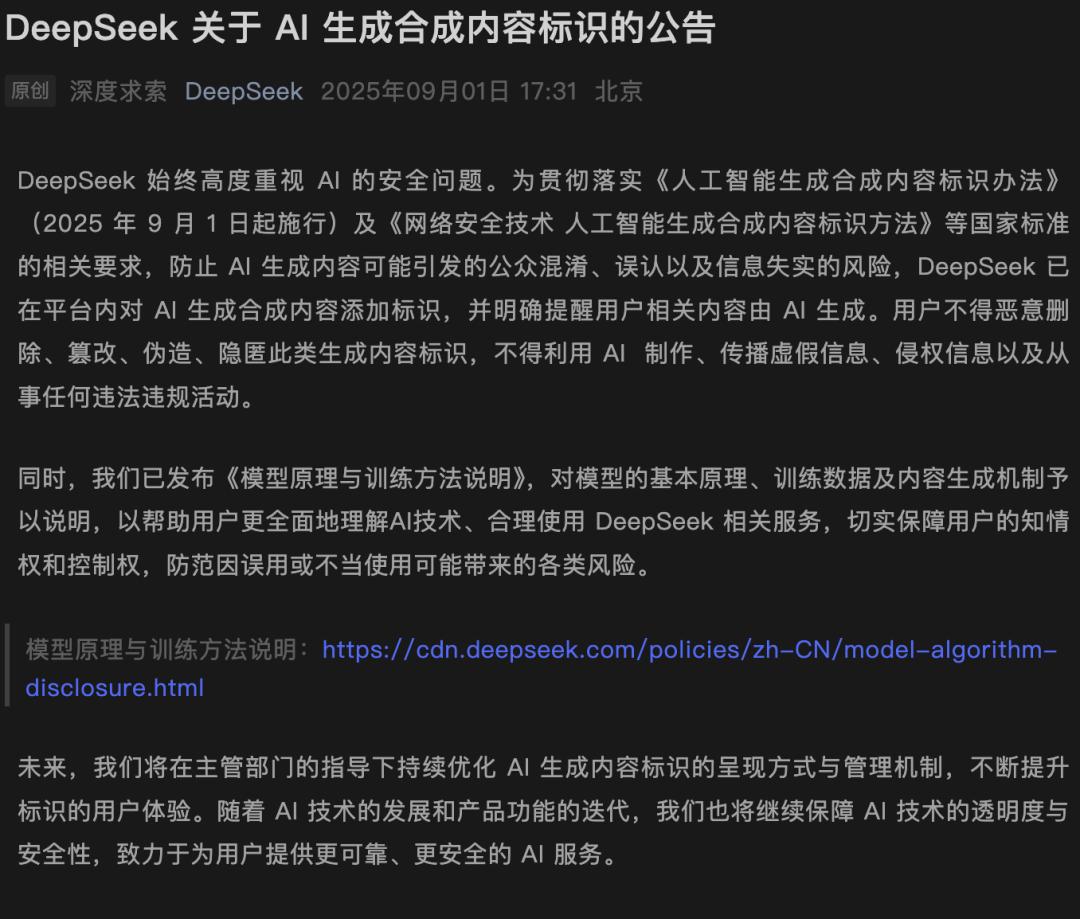
刚刚,DeepSeek最新发文,V3/R1训练细节全公开,信息量巨大
3 6 Ke· 2025-09-01 12:06
Core Viewpoint - DeepSeek has proactively responded to the new regulations by marking all AI-generated content with an "AI-generated" label and has disclosed details about its V3/R1 model training process following the implementation of the "Identification Measures for AI-Generated Synthetic Content" by the Cyberspace Administration of China [1][2]. Group 1: Compliance with New Regulations - DeepSeek has announced that all AI-generated content will be clearly labeled as "AI-generated" to comply with the new regulations [2]. - The company has emphasized that users are strictly prohibited from maliciously deleting, altering, or concealing these labels, and from using AI to spread or create false information [2]. Group 2: Technical Disclosure - DeepSeek has released a document titled "Model Principles and Training Methods," providing insights into its technical approach [4]. - The training process of DeepSeek's models is divided into pre-training and optimization training phases, which include various stages such as data collection and model fine-tuning [6][17]. Group 3: Model Training Details - The latest DeepSeek V3-0324 model has a total parameter count of 685 billion, with parameters optimized through gradient descent during training [15]. - During the pre-training phase, the model learns general language understanding and generation capabilities using publicly available internet data and licensed third-party data, while ensuring no personal information is intentionally used [21]. - The optimization training phase involves constructing and annotating question-answer pairs, with some data potentially based on user input, while ensuring data privacy through encryption and anonymization [22][23]. Group 4: Model Deployment and Functionality - Once training is complete, the model enters the inference phase, where it can generate text and perform various tasks based on user input [25]. - DeepSeek has emphasized that the model does not store original training data but generates responses based on a deep understanding of language structure and semantics [27]. - The company has made its models open-source, allowing users to freely download and deploy them under a permissive MIT license [28]. Group 5: Addressing Limitations and Risks - DeepSeek acknowledges the limitations of AI, including the phenomenon known as "hallucination," where AI may generate incorrect or misleading content [30][31]. - The company is implementing various technical measures to reduce the hallucination rate, including high-quality training data and alignment strategies, although complete elimination is not currently feasible [32]. - DeepSeek has established internal risk management protocols and user rights, allowing users to opt-out of data usage for model training and delete their historical data [37][38].

变“向基层要”为“从系统取”,报表减负值得期待
Nan Fang Du Shi Bao· 2025-09-01 05:45
Core Viewpoint - The National Data Bureau is addressing the issue of excessive reporting burdens on grassroots workers by promoting data sharing and system integration to streamline processes and reduce the need for repetitive data submissions [1][2][4] Group 1: Current Challenges - Grassroots workers face overwhelming reporting tasks, leading to inefficiencies and wasted resources, which detracts from their ability to engage with the community and solve real problems [1] - Issues such as multiple submissions and varying data requirements from different departments exacerbate the reporting burden [1][3] Group 2: Technological Solutions - The National Data Bureau emphasizes the use of digital tools to optimize government processes and break down data silos, with significant advancements in digital infrastructure already achieved [2] - As of August 2025, over 11,000 resources, products, and services are registered on the national public data resource platform, supporting over 540 billion data sharing instances [2] Group 3: Successful Case Studies - Initiatives like Chongqing's "One Table Pass" application have successfully reduced the number of reports, processing time, and personnel involved by over 60% [2] - The "Cloud Table Pass" platform in Yunnan allows for efficient data retrieval and generation, significantly alleviating the reporting burden on grassroots workers [2] Group 4: Future Directions - To effectively transition from "requesting data from grassroots" to "retrieving data from systems," the establishment of unified data standards and governance mechanisms is essential [3] - Enhancing data quality control and utilizing advanced technologies like big data and AI can improve data accuracy and support informed policy-making [3][4] - Continuous development of data sharing platforms is necessary to address key challenges such as standardization, security, and inter-departmental collaboration [4]