
财政赤字

Search documents
前11个月广义财政支出超收入近10万亿,原因有哪些
Di Yi Cai Jing· 2025-12-25 12:25
Group 1 - The core viewpoint of the articles highlights the optimization of fiscal expenditure structure in China, with a focus on investing in people and ensuring the well-being of the population [1][8] - In the first 11 months of this year, the broad fiscal revenue reached 24,079 billion yuan, showing a year-on-year decline of approximately 0.2%, while broad fiscal expenditure was 34,066 billion yuan, reflecting a year-on-year increase of about 4.5% [1][4] - The broad fiscal expenditure exceeded revenue by 99,872 billion yuan, which is a year-on-year increase of approximately 17.9%, indicating a more proactive fiscal policy aimed at stabilizing growth and expanding domestic demand [1][6] Group 2 - The broad fiscal revenue is close to the initial official expectations for the year, with a projected growth of about 0.2% for 2025, aligning with the current year-to-date performance [4] - The general public budget revenue increased by 0.8% year-on-year in the first 11 months, slightly better than the initial forecast of 0.1%, driven by stable economic performance and increased tax revenues from a vibrant capital market [4] - However, government fund revenue remains below initial expectations, primarily due to a sluggish real estate market and lower-than-expected land transfer income, which decreased by 10.7% year-on-year [5] Group 3 - The growth rate of broad fiscal expenditure is lower than the initial official forecast, with an actual increase of 4.5% compared to an expected 9.3% for 2025, largely due to underperformance in land transfer income [6] - To maintain fiscal expenditure levels, the central government has allowed local governments to issue an additional 500 billion yuan in bonds in the fourth quarter to support local financial capacity and major project construction [6] - The total investment from new policy financial tools has reached approximately 7 trillion yuan, focusing on digital economy, artificial intelligence, and urban infrastructure projects [6][8] Group 4 - The net financing of government bonds reached 1.315 trillion yuan in the first 11 months, an increase of 361 billion yuan year-on-year [7] - The central economic work conference has called for continued implementation of a more proactive fiscal policy next year, with expectations for the fiscal deficit rate to be set around 4% for 2026 [9] - The anticipated increase in government debt issuance, including long-term special bonds and local government bonds, is expected to exceed 12 trillion yuan in 2025, potentially reaching between 13 trillion and 16 trillion yuan [9]


【广发宏观吴棋滢】延续必要强度,优化发力路径:2026年财政政策展望
Xin Lang Cai Jing· 2025-12-25 01:33
Group 1 - The core viewpoint of the report is that the fiscal policy for 2025 will be "more proactive," leading to significant increases in both narrow and broad fiscal deficits, with narrow deficit expected to rise by 39% and broad deficit by 27% [1][13][14] - The issuance of government bonds will be accelerated, with net supply expected to increase by 128% year-on-year in the first half of 2025, while broad fiscal expenditure is projected to show a "U"-shaped trend in 2024 and a "front high and back low" trend in 2025 [1][14] - The structure of fiscal revenue is improving, with a target growth rate for non-tax revenue set at -14.2%, indicating a reduced reliance on non-tax income [2][15][16] Group 2 - The expansion of debt resolution measures and diversification of debt resolution methods are highlighted, including the issuance of special bonds and policies targeting corporate arrears and PPP projects [2][16][17] - The expected slowdown in infrastructure investment growth in the second half of 2025 is attributed to several factors, including the completion of prior funding projects and the diversion of funds to debt resolution [3][18][19] - For 2026, the central economic work conference emphasizes the continuation of a more proactive fiscal policy, with expectations for a slight increase in fiscal strength compared to 2025 [4][20][21] Group 3 - The anticipated fiscal revenue growth for 2026 is projected to rebound to 3%-5%, driven by price increases and tax policy adjustments [5][26][27] - The introduction of new policy financial tools is expected to significantly impact fixed asset investment, with an estimated investment scale of 1.5-2 trillion yuan in 2026 [6][28][29] - The report indicates a structural shift in consumption patterns, with a focus on new types of consumption and service consumption, as traditional durable goods consumption is expected to slow down [8][32][33] Group 4 - The report discusses the expansion of debt resolution to include non-hidden debts, with measures to clear local government arrears to enterprises [9][34][35] - The importance of improving the local tax system is highlighted, with potential reforms in consumption tax expected to accelerate [10][36][37] - The overall impact on the asset side suggests that continued fiscal strength and proactive measures will support nominal growth and micro-activity in 2026 [11][37]
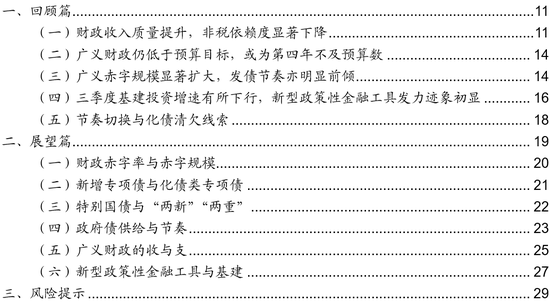
【广发宏观吴棋滢】延续必要强度,优化发力路径:2026年财政政策展望
郭磊宏观茶座· 2025-12-25 01:26
Group 1 - The core viewpoint of the article is that the fiscal policy for 2025 is set to be "more proactive," leading to significant increases in both narrow and broad fiscal deficits, with narrow deficit scale increasing by 39% and broad deficit scale by 27% [1][12][13] - The government debt net supply is expected to reach a recent high, with a notable increase in the issuance pace of bonds, particularly in the first half of 2025, where net supply is projected to increase by 128% year-on-year [1][14] - Fiscal expenditure trends are expected to show a "U" shape in 2024 and a "front high and back low" pattern in 2025, aligning with economic and equity asset trends [1][13] Group 2 - One highlight in the fiscal sector for 2025 is the improvement in the structure of fiscal revenue, with a target growth rate for non-tax revenue set at -14.2%, indicating a commitment to reduce reliance on non-tax income [1][16] - Tax revenue is expected to perform well in the second half of the year, driven by active industries and tax policy adjustments, contrasting with the decline in non-tax revenue [1][17] Group 3 - Another highlight in the fiscal sector for 2025 is the expansion of debt resolution methods and the diversification of debt resolution tools, including the issuance of special new bonds and the use of local fiscal funds to pay for existing PPP project costs [2][19] - The debt resolution measures are expected to benefit small and micro enterprises by improving cash flow [2][19] Group 4 - A constraint on the economy in 2025 is the anticipated slowdown in infrastructure investment growth in the second half of the year, attributed to various factors including the front-loading of fiscal funds and the diversion of debt funds to debt resolution [2][22][23] - The decline in infrastructure investment growth is expected to be predictable, with narrow infrastructure investment growth dropping from 10.4% in the first five months to 0.1% by November [2][22] Group 5 - Looking ahead to 2026, the central economic work conference has indicated that a "more proactive fiscal policy" will continue, with expectations for a slight increase in fiscal intensity compared to 2025 [3][25] - The narrow target deficit rate is expected to remain at a relatively high level of 4.0%, with a small chance of increasing to 4.2%, reflecting a cautious approach to fiscal policy [3][25][26] Group 6 - The broad deficit is expected to see structural adjustments, with new special bonds projected to increase from 4.6 trillion yuan to around 5 trillion yuan, focusing on optimizing the use of local government special bonds [3][28] - The total government debt net supply is anticipated to be approximately 14.9 trillion yuan in 2026, an increase of about 5.4 billion yuan compared to 2025, indicating a continued expansion of fiscal policy [3][30] Group 7 - Fiscal revenue growth is projected to rebound to around 3%-5% in 2026, driven by price increases and the effects of tax policy adjustments [3][33] - The expected growth in fiscal expenditure is anticipated to slow to 3.9%, down from 5.9% in 2025, reflecting limited debt expansion [3][34] Group 8 - The main driver for fixed asset investment will be the 500 billion yuan new policy financial tools, which are expected to leverage credit significantly and support investment growth in 2026 [3][36] - The focus on effective investment will also include adjustments to special bonds and support for private sector participation in key projects [3][39] Group 9 - In the consumption sector, there is an expected structural shift towards new types of consumption and service consumption, with a focus on releasing the potential of service consumption [3][41] - The anticipated growth in durable goods consumption is expected to slow, while service consumption areas such as tourism and elderly care are projected to see increased demand [3][41] Group 10 - The debt resolution area is expected to expand to include non-hidden debts, with measures to clear debts owed by local governments to enterprises [3][43] - The central economic work conference emphasized the need for multiple measures to mitigate risks associated with local government financing platforms [3][43] Group 11 - The improvement of the local tax system is highlighted as a key focus for 2026, with potential reforms in consumption tax expected to accelerate [3][45] - The reforms aim to create incentives for local tax revenue generation and shift the competitive focus from production to consumption [3][45]

机构:2026年中国降息降准有空间
2 1 Shi Ji Jing Ji Bao Dao· 2025-12-24 23:58
Global Economic Outlook - In 2025, the global macroeconomic environment shows unexpected resilience amid ongoing tariff uncertainties and continuous technological breakthroughs [1] - Precious metals have performed particularly well, with COMEX gold rising by 60.84% and Shanghai silver increasing by 112.87% year-to-date [1] - The MSCI global index has increased by 20.70% since the beginning of the year, with emerging markets in Asia outperforming those in Europe and the US [1] Market Performance - The Shenzhen Composite Index has risen by 28.02% and the CSI 300 by 17.20% in China, while the Korean Composite Index has surged by 71.12% [1] - The MSCI Vietnam Index has increased by 61.08%, and the Nikkei 225 in Japan has risen by 26.37% [1] - In contrast, major US indices like the Nasdaq and S&P 500 have seen increases of 21.33% and 16.95%, respectively [1] Investment Strategies - Major institutions are adopting a cautious approach towards US equities due to high valuations, with a shift towards regional diversification [4] - HSBC has reduced its overweight position in the US market, emphasizing the importance of Asian markets [4] - Fidelity International is focusing on emerging markets like China, South Korea, and South Africa for more attractive valuations [4] AI Investment Trends - Artificial intelligence (AI) is recognized as a core theme for the global market in 2026, with a shift in focus from hardware to broader ecosystem value creation [7] - AI capital expenditure is expected to exceed $350 billion in 2025 and grow to approximately $500 billion in 2026 [7] - The revenue potential of AI-enabled applications is projected to reach $3.1 trillion by 2030, with a compound annual growth rate of 30% [7] Chinese Economic Policy - Institutions predict that China's macroeconomic policy in 2026 will continue to focus on fiscal stimulus and supportive monetary policy [10] - The fiscal deficit is expected to rise, providing strong support for economic growth, while monetary policy will aim to support the real economy [10] - The GDP growth target for China in 2026 is anticipated to be between 4.5% and 5% [11] Asset Allocation - Given the high correlation between traditional assets, diversification is increasingly important, with gold and alternative assets becoming key tools for portfolio resilience [13] - Gold is expected to maintain its position as a significant diversification asset, supported by central bank demand and a weak dollar [13] - In fixed income, the trend of de-dollarization and Asian policy easing creates favorable conditions for local currency government bonds [14]

全球资产配置方法论黄金框架性报告之七:2026年黄金配置指南:供需新格局与战术择时策略
Shenwan Hongyuan Securities· 2025-12-24 14:18
证 券 研 究 报 告 2026年黄金配置指南:供需新格局与战术择时策略 主要观点 www.swsresearch.com 证券研究报告 2 ◼ 展望2026年黄金:战略层面,美国财政赤字居高不下+去美元化长期趋势持续(全球央行购金)背景下,金价长期仍有上涨空间。2026 年金价年内战术择时需重点关注美国周期性变化下的美债利率走 势与波动率等交易性指标,相比2025年,2026年美国利率周期边际变化和交易性力量的增加或提升黄金波动性,需要加强战术择时。 ◼ 2026年黄金战略配置逻辑关注供需格局变化和美元信用,中期仍有上行空间。供需格局来看,2022 年以来的金价上涨核心源于黄金供需缺口扩大,而缺口扩大的核心驱动力是需求大幅增加。2022年 以来央行购金是主要需求增量,而2025年ETF需求出现加速回升。1)央行与官方机构购金方面,欧美债务风险与地缘政治风险叠加,以中国为首的央行对黄金的配置性需求趋势将持续,支撑黄金长期 战略配置价值。截至 2025 年 8 月,中国黄金占储备资产比例仅 7%,显著低于 22.4% 的全球平均水平,仍有较大上行空间。而俄罗斯近年阶段性黄金抛售并未阻碍金价系统性牛市,历史数据显 ...
法国通过2026年临时预算案以避免政府停摆
Xin Lang Cai Jing· 2025-12-23 17:03
格隆汇12月24日|由于法国议员未能就完整财政计划达成一致,法国国民议会通过了一项针对2026年的 临时预算法案,以确保国家运行至明年1月。这项所谓的"特别预算法"(去年年底也曾使用)允许政府 在缺乏完整预算的情况下继续征税和借款。该法案实质是将2025年的财政计划延续至新年,预计将于本 周二晚些时候获参议院批准。法国政府上周警告称,目前已达成一致的财政法案条款,仅能将2026年的 赤字占经济产出比重降至5.3%,较今年的5.4%略有下降。在勒科尔尼最初的计划中,赤字目标设定为 4.7%,但其后已表示赤字率应控制在5%以下。 ...
克罗地亚四大银行首席经济学家预测2026年克GDP增长2.8%,通货膨胀率3.1%
Shang Wu Bu Wang Zhan· 2025-12-23 16:39
Economic Growth Forecast - Croatia's economy is expected to grow by approximately 3.0% in 2025 and slightly slow to 2.8% in 2026, aligning closely with the government's official forecast of 2.7% [1] - The growth is primarily driven by public spending and investment, with investment growth projected to reach 4.8% in 2026 [1] Inflation and Wage Growth - Inflation is forecasted to be 3.7% in 2025 and remain at a high level of 3.1% in 2026, correlating with an expected wage growth of nearly 6% [2] Fiscal Deficit Concerns - The fiscal deficit is anticipated to reach 3% of GDP in 2026, approaching the warning threshold set by the EU's Maastricht Treaty [2] - The report indicates that Croatia is on the "danger edge" of fiscal compliance [2] Export Growth Projections - Due to optimistic economic expectations from Germany, Croatia's main trading partner and tourism market, the total exports of goods and services are expected to accelerate by 2.5% in 2026 and grow by 3% in 2027 [2]
意大利参议院通过2026预算案 黄金所有权条款激怒欧洲央行
Zhi Tong Cai Jing· 2025-12-23 13:48
此外,银行业也对政府提高贷方税负的举措表达了深切担忧,直言此举或许会对信贷供给能力造成冲 击;与此同时,欧洲央行也发表看法,指出过多的一次性政策措施将会制造出不确定性因素。 尽管从目前情况来看,该预算仍有望在本月按计划推进,这与法国将相关计划推迟至2026年的做法形成 了鲜明对比。然而,在议会审议过程中,激烈的政治争吵却成为阻碍预算推进的绊脚石,这也凸显出意 大利总理梅洛尼在进入执政第四年时,所面临的挑战正与日俱增。 意大利参议院顺利通过了2026年预算案,该预算案在着力抑制财政赤字的同时,还附带了一项引发广泛 争议的黄金储备所有权修正条款。当地时间周二,罗马的议员们投票支持了以中产阶级减税为核心内容 的方案,这一投票结果为持续数周、围绕养老金及央行黄金问题展开的激烈争论画上了句号。不过,该 预算案若要正式生效,仍需在年底前获得众议院的通过。 最引人注目的是,一项明确规定意大利央行黄金归全体国民所有的修正案,引发了罗马与法兰克福之间 的多轮函件交锋。 该法案为意大利总理梅洛尼经济计划的关键支柱,计划在三年内实施约90亿欧元(折合106亿美元)的减 税举措。当前,意大利政府背负着占GDP比重超过130%的债务, ...
法国紧急推动临时预算法案 避免政府“停摆”危机
智通财经网· 2025-12-23 11:09
Group 1 - The French parliament is pushing for an emergency bill to ensure the government can operate normally before the approval of the 2026 budget, which is facing significant division [1] - The emergency bill aims to allow the government to extend the spending limit for 2025 into the new year and to continue taxing and issuing government bonds [1] - The French Finance Minister has warned that while the emergency bill can prevent a government shutdown similar to that in the U.S., it is merely a temporary solution, urging lawmakers to finalize the formal budget early next year [1] Group 2 - The current fiscal deficit in France has reached 5.4% of GDP, the highest among Eurozone countries, prompting the government to take measures to curb the deficit [1] - The minority government led by Leclerc has limited room to maneuver in a divided parliament, with three governments having fallen due to budget disputes since losing the majority in the 2024 elections [2] - A similar temporary budget extension was used last year, resulting in an economic loss of €12 billion (approximately $14 billion) until the formal budget was passed in February 2025 [2]
黄金挑战5000美元
Xin Lang Cai Jing· 2025-12-23 00:30
Core Viewpoint - Wall Street is generally optimistic about gold prices in the coming year, with target ranges between $4,800 and $5,000 [1] Group 1: Market Outlook - HSBC's recent commodity outlook report indicates that the upward momentum for gold is expected to continue until 2026, driven by strong central bank purchases, ongoing fiscal concerns in the U.S., and expectations of further monetary easing, with a target price of $5,000 [1] - The report emphasizes that the U.S. fiscal deficit is a significant factor driving gold demand, as investors increasingly view gold as a hedge against debt sustainability risks and potential dollar weakness [1] Group 2: Central Bank Demand - HSBC anticipates that central bank gold purchasing will remain high, particularly due to sustained buying from emerging market central banks, which constitutes a key support for gold prices [1] - However, HSBC warns that if the Federal Reserve's rate cuts are fewer than market expectations, the upward trajectory of gold may face resistance [1]