AGI(通用人工智能)

Search documents
兵临OpenAI,谷歌集结2500人「复仇」,Gemini 3夺回AI王座
3 6 Ke· 2025-12-03 08:04
Core Insights - Google has launched Gemini 3, positioning itself as a leader in the AI space, leveraging its technological, strategic, and resource advantages to reclaim dominance in the generative AI era [1][5][6] Group 1: Gemini 3 Launch and Collaboration - The release of Gemini 3 is described as a collective effort involving a record number of participants, second only to NASA's moon landing [9] - Google emphasizes a collaborative approach to building AGI, engaging users globally in the development process [6][8] - The launch is not merely an iteration of a model but a declaration of intent to co-create the next generation of intelligent systems with users [5][6] Group 2: Technical Advancements and Model Performance - Gemini 3 has shown significant improvements in various benchmark tests, with notable scores such as 37.5% in Humanity's Last Exam without tools and 91.9% in GPQA Diamond [21] - The model's capabilities are continuously evolving, with a focus on real-world applications and user feedback to drive improvements [20][16] - Koray Kavukcuoglu highlights the importance of redefining benchmarks to measure progress, indicating that the model has made substantial advancements despite concerns of stagnation [14][22] Group 3: Future Directions and Challenges - Google is committed to enhancing the model's capabilities in areas such as instruction following and internationalization, ensuring it meets the needs of a global user base [17][18] - The integration of various functionalities, including tool and function calls, is crucial for expanding the model's practical applications [18][19] - Despite the progress, there are still challenges in areas like agent behavior and tool usage, which require further development to align with real-world applications [23][22] Group 4: Strategic Vision and Company Philosophy - Google acknowledges its past challenges in the AI landscape and emphasizes the importance of learning from competitors to innovate effectively [30][32] - The company views its scale as a strength, enabling a unique collaborative environment that fosters innovation across various domains [24][32] - The overarching goal remains clear: to build truly intelligent systems, with ongoing commitment to improvement and adaptation in the AI field [32][33]



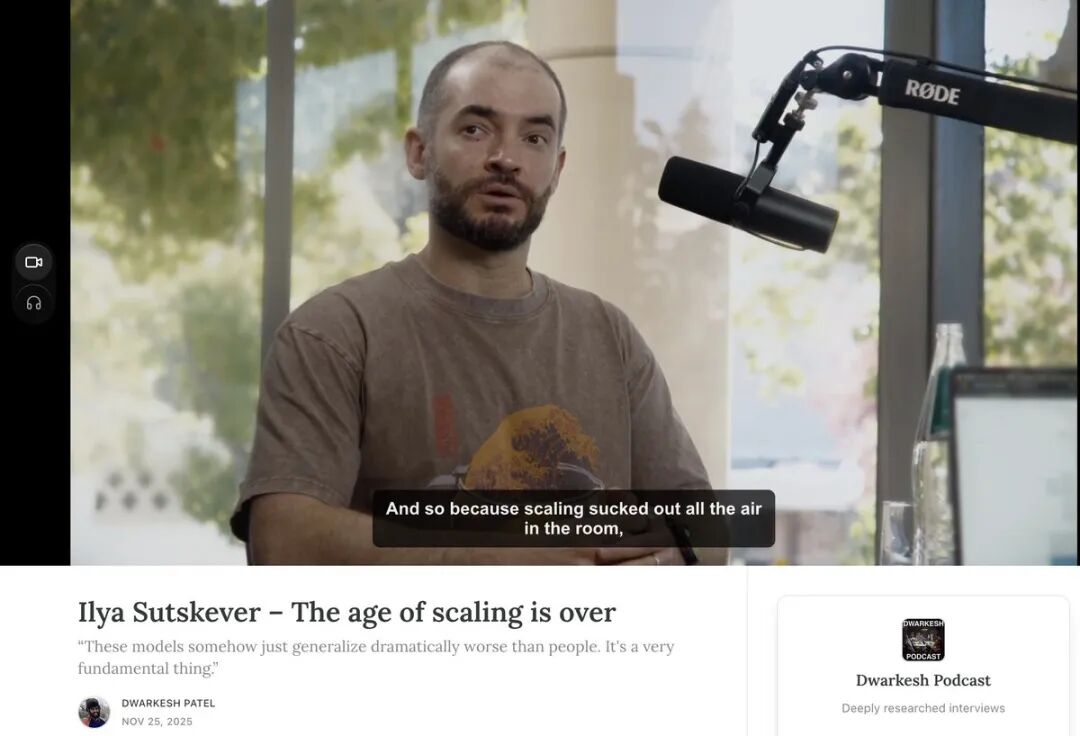
Ilya辟谣Scaling Law终结论
AI前线· 2025-11-30 05:33
Core Insights - The era of relying solely on scaling resources to achieve breakthroughs in AI capabilities may be over, as stated by Ilya Sutskever, former chief scientist of OpenAI [2] - Current AI technologies can still produce significant economic and social impacts, even without further breakthroughs [5] - The consensus among experts is that achieving Artificial General Intelligence (AGI) may require more breakthroughs, particularly in continuous learning and sample efficiency, likely within the next 20 years [5] Group 1 - Ilya Sutskever emphasized that the belief in "bigger is better" for AI development is diminishing, indicating a shift back to a research-driven era [16][42] - The current models exhibit a "jaggedness" in performance, excelling in benchmarks but struggling with real-world tasks, highlighting a gap in generalization capabilities [16][20] - The focus on scaling has led to a situation where the number of companies exceeds the number of novel ideas, suggesting a need for innovative thinking in AI research [60] Group 2 - The discussion on the importance of emotional intelligence in humans was compared to the value function in AI, suggesting that emotions play a crucial role in decision-making processes [31][39] - Sutskever pointed out that the evolution of human capabilities in areas like vision and motor skills provides a strong prior knowledge that current AI lacks [49] - The potential for rapid economic growth through the deployment of advanced AI systems was highlighted, with the caveat that regulatory mechanisms could influence this growth [82]

中国智驾打响残酷突围战
Hua Er Jie Jian Wen· 2025-11-27 12:17
Core Insights - The Chinese intelligent driving industry is undergoing a significant reshuffle, highlighted by the suspension of the once-prominent unicorn, Haomo Zhixing, while competitors like Yuanrong Qixing and Zhuoyu are gaining market share and investment support [1][2][5] Company Analysis - Haomo Zhixing, originally a spin-off from Great Wall Motors, received substantial early-stage funding but has struggled to maintain momentum, with its last financing round occurring in early 2024 without support from its former backer [2][3] - The company's choice of Qualcomm Snapdragon Ride chips over the industry-standard NVIDIA Orin has hindered its ability to adapt to new technological trends, leading to operational inefficiencies [3][4] - Great Wall Motors has shifted its focus to other suppliers, notably investing $100 million in Yuanrong Qixing, indicating a loss of confidence in Haomo Zhixing's capabilities [5][6] Industry Trends - The competitive landscape has evolved, with a focus on achieving a scale of one million vehicles to generate valuable data for algorithm development, moving beyond flashy demonstrations to practical data-driven solutions [7][10] - Companies like Yuanrong Qixing and Horizon Robotics are positioning themselves as strategic partners rather than mere component suppliers, emphasizing the importance of data access and integration [8][9] - The industry is witnessing a consolidation of market share among leading players, with predictions that only a few companies will dominate the market by 2025 [14][15] Future Outlook - The intelligent driving sector is transitioning from an optional feature to a core asset for automotive companies, with a clear divide emerging between those who can leverage large-scale data and those who cannot [14][15] - The ultimate goal for many companies is to develop systems that not only enhance vehicle performance but also contribute to broader applications in robotics and artificial intelligence [12][13]
离开OpenAI后,苏茨克维1.5小时长谈:AGI最快5年实现
3 6 Ke· 2025-11-27 05:43
Core Insights - The interview discusses the strategic vision of Safe Superintelligence (SSI) and the challenges in AI model training, particularly the gap between model performance in evaluations and real-world applications [1][3][5]. Group 1: AI Development and Economic Impact - SSI's CEO predicts that human-level AGI will be achieved within 5 to 20 years [5]. - Current AI investments, such as allocating 1% of GDP to AI, are seen as significant yet underappreciated by society [3][5]. - The economic impact of AI is expected to become more pronounced as AI technology permeates various sectors [3][5]. Group 2: Model Performance and Training Challenges - There is a "jagged" performance gap where models excel in evaluations but often make basic errors in practical applications [5][6]. - The reliance on large datasets and computational power for training has reached its limits, indicating a need for new approaches [5][6]. - The training environments may inadvertently optimize for evaluation metrics rather than real-world applicability, leading to poor generalization [6][21]. Group 3: Research and Development Focus - SSI is prioritizing research over immediate commercialization, aiming for a direct path to superintelligence [5][27]. - The company believes that fostering competition among AI models can help break the "homogeneity" of current models [5][27]. - The shift from a "scaling" era back to a "research" era is anticipated, emphasizing the need for innovative ideas rather than just scaling existing models [17][28]. Group 4: Value Function and Learning Mechanisms - The concept of a value function is likened to human emotions, suggesting it could guide AI learning more effectively [11][12]. - The importance of internal feedback mechanisms in human learning is highlighted, which could inform better AI training methodologies [25][39]. - SSI's approach may involve deploying AI systems that learn from real-world interactions, enhancing their adaptability and effectiveness [35][37]. Group 5: Future of AI and Societal Implications - The potential for rapid economic growth driven by advanced AI systems is acknowledged, with varying impacts based on regulatory environments [38][39]. - SSI's vision includes developing AI that cares for sentient beings, which may lead to more robust and empathetic AI systems [41][42]. - The company is aware of the challenges in aligning AI with human values and the importance of demonstrating AI's capabilities to the public [40][41].
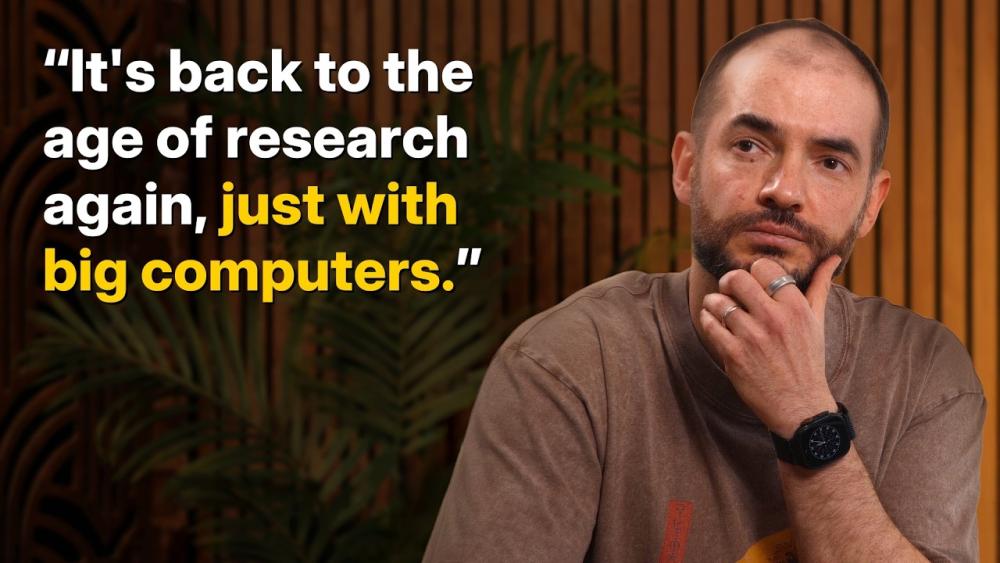
Ilya重磅发声:Scaling时代终结,自曝不再感受AGI
3 6 Ke· 2025-11-26 06:54
Core Insights - The era of Scaling has ended, and the industry is transitioning into a Research Era [1][3][14] - Current AI models, despite their improvements, lack the generalization capabilities necessary for achieving Artificial General Intelligence (AGI) [3][5][8] - The disconnect between AI model performance in benchmarks and real-world applications is a significant issue [5][6][8] Summary by Sections Transition from Scaling to Research Era - Ilya Sutskever emphasizes that the AI community is moving from a focus on scaling models to a renewed emphasis on research and innovation [1][3][14] - The previous Scaling Era, characterized by increasing data, parameters, and computational power, has reached its limits, necessitating a shift in approach [12][14][15] Limitations of Current AI Models - Despite advancements, current models exhibit poor generalization abilities compared to human intelligence, failing to develop true problem-solving intuition [3][5][8] - Reinforcement Learning (RL) training often leads to over-optimization for specific benchmarks, detracting from the model's overall performance [3][5][6] Importance of Human-Like Learning - Ilya argues that human learning is driven by an intrinsic "value function," which AI currently lacks, leading to less effective decision-making [10][11][12] - The need for AI to incorporate human-like judgment and intuition is highlighted as essential for future advancements [15][18] Future of AI and AGI - Predictions suggest that Superintelligent AI (ASI) could emerge within 5 to 20 years, but its development must be approached cautiously [19][51] - The concept of AGI is redefined, emphasizing the importance of continuous learning rather than a static state of intelligence [28][30][51] Role of Research and Innovation - The industry is expected to see a resurgence of smaller, innovative projects that can lead to significant breakthroughs, moving away from the trend of developing larger models [16][18] - Ilya suggests that the next major paradigm shift may come from seemingly modest experiments rather than grand scaling efforts [18][19] Collaboration and Safety in AI Development - As AI capabilities grow, collaboration among companies and regulatory bodies will become increasingly important to ensure safety and ethical considerations [43][44] - The need for a robustly aligned AI that cares for sentient life is emphasized as a preferable direction for future AI development [48][49]
阿里巴巴最新披露!
Zheng Quan Shi Bao· 2025-11-24 11:09
Core Insights - Alibaba's AI assistant Qwen APP has surpassed 10 million downloads within a week of its public testing, marking it as the fastest-growing AI application in history [1] - The management views the Qwen project as a critical component in the "AI era's future battle," aiming to leverage the open-source Qwen model and its international influence to secure a significant position in the consumer AI application market [1][2] - Alibaba plans to expand the Qwen APP globally through an overseas version, integrating various ecosystem services such as maps, food delivery, and ticket booking to create a unified AI service entry point [1] Strategic Overview - Alibaba is focusing on a "user-first, AI-driven" strategy, investing heavily in building a comprehensive ecosystem from foundational computing power to upper-level applications [2] - The CEO has emphasized that achieving AGI (Artificial General Intelligence) is a certainty, with the ultimate goal of developing ASI (Artificial Super Intelligence) to tackle major scientific challenges [2] - The integration of Qwen APP with other Alibaba applications like Taobao, Amap, and DingTalk is expected to enhance user engagement and create synergistic value [2] Market Positioning - Goldman Sachs has raised its capital expenditure forecast for leading Chinese cloud providers, predicting Alibaba's total capital expenditure to reach 460 billion RMB from 2026 to 2028, driven by the surge in AI inference demand [2] - The report highlights that Chinese multimodal models are gaining traction in the global market, leveraging strategies such as open-source, low-cost, and high-speed to establish competitive advantages [3] - The global application of Chinese AI models is increasing, with companies like Airbnb utilizing Alibaba's Qwen model for customer service, indicating growing recognition of Chinese open-source AI models in the international market [3]

新BAT逐鹿AI to C
Bei Jing Shang Bao· 2025-11-23 15:32
Core Insights - Ant Group recently launched its multimodal AI assistant "Lingguang," which achieved over 1 million downloads within four days, indicating strong market interest and potential disruption in the AI to C sector [1][2] - The competition in the AI to C market is shifting from individual product comparisons to a battle of resource integration capabilities among major players like ByteDance, Tencent, and Alibaba [1][7] Product Features - "Lingguang" allows users to generate runnable applications in 30 seconds using natural language, supporting various output formats such as 3D, audio, video, charts, animations, and maps [2][4] - The assistant includes three main features: "Lingguang Dialogue," "Lingguang Flash Applications," and "Lingguang Open Eye," which enhance user interaction and application creation [2][4] Market Dynamics - The launch of "Lingguang" and Alibaba's "Qianwen" app signifies a strategic move to cover all user levels in the AI to C market, with both products complementing each other rather than competing directly [3][4] - The AI to C landscape is characterized by a focus on productivity tools, moving beyond simple conversational capabilities to more complex task execution [6][10] Competitive Landscape - The current market sees ByteDance's "Doubao" leading with 172 million monthly active users, while Alibaba's "Lingguang" and "Qianwen" aim to carve out their niches [6][10] - Analysts suggest that the differentiation strategy of Alibaba's dual approach—general coverage combined with vertical depth—contrasts with the strategies of ByteDance and Tencent [6][7] Future Outlook - The industry is expected to evolve towards more personalized and intelligent services, with a focus on data security, user experience, and effective integration of AI capabilities into daily life [9][10] - The competition is not just about individual products but also about the ability to create a cohesive ecosystem that meets user needs effectively [10]
“千问恐慌”背后:全球AI价值正在重估
Huan Qiu Shi Bao· 2025-11-21 22:45
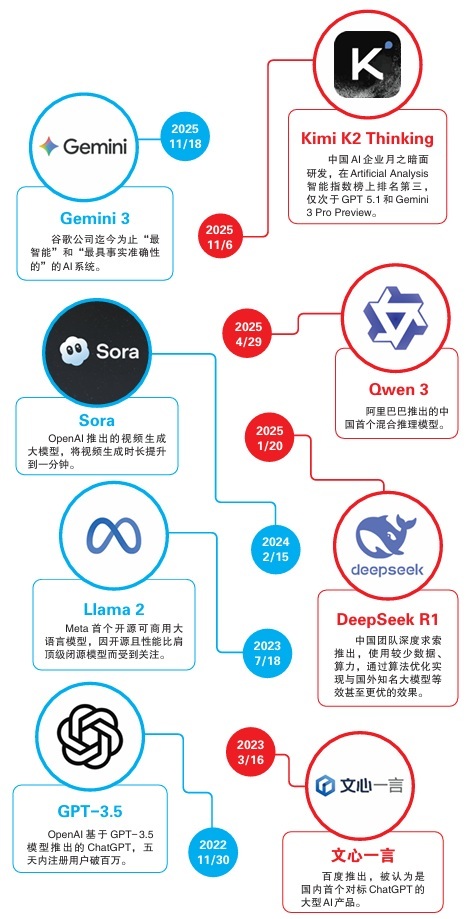
Core Insights - The article discusses the rising prominence of Chinese AI models, particularly highlighting the emergence of applications like Qwen from Alibaba, which are challenging established players in Silicon Valley [1][11][12]. Industry Overview - The Chinese AI market is transitioning from a "hundred models battle" to a differentiated competition phase, with applications covering various aspects of life and work [3]. - The launch of advanced models such as Baidu's Wenxin 5.0 and Alibaba's Qwen indicates a significant leap in capabilities, with Qwen already demonstrating the ability to generate comprehensive reports and presentations [3][6]. Competitive Landscape - Chinese AI models are not only catering to local users but are also gaining traction globally, with platforms like MiniMax's Hai Luo AI being utilized in over 200 countries [7]. - The performance gap between Chinese and American AI models has narrowed significantly, with reports indicating a mere 0.3% difference in capabilities [16]. Strategic Shifts - Chinese companies are moving away from the capital-intensive strategies of their American counterparts, focusing instead on algorithm optimization and cost-effective solutions [16][17]. - The trend of adopting Chinese AI models in Silicon Valley reflects a shift in preference towards open-source and cost-effective solutions, posing a challenge to traditional closed-source models from American firms [12][13]. Future Projections - Experts predict a surge in "national-level" AI applications around mid-2026 to mid-2027, as the technology matures and integrates more deeply into everyday life [10]. - The next phase of competition will focus on practical applications and user retention, with a need for AI to evolve from being merely entertaining to being genuinely useful [10][18]. Geopolitical Considerations - The geopolitical landscape is influencing the global AI market, with Chinese firms needing to navigate high regulatory barriers in Western markets while exploring opportunities in regions like ASEAN and the Middle East [19].
中国AI编程赛道,谁能跑到最后?
3 6 Ke· 2025-11-20 11:34
Core Insights - AI programming is recognized as one of the fastest-growing, most commercially viable, and widely adopted applications of AI technology, with significant capital backing [1] - Cursor, an AI programming tool founded in 2022, has seen its valuation soar to $9.9 billion within 20 months, with an annual recurring revenue (ARR) exceeding $500 million and over 360,000 paying users [1] - The global market for AI coding tools could potentially contribute $3 trillion to GDP annually, comparable to France's GDP in 2024 [1] Group 1: Market Dynamics - In the U.S., 91% of developers use AI programming tools, while only 30% do so in China, indicating a significant growth opportunity for domestic AI programming tools [4] - Major Chinese tech companies like Alibaba, ByteDance, Tencent, and Baidu have launched AI programming products, with revenues expected to reach millions in the Chinese market [5][6] - The competitive landscape is intensifying as companies adopt aggressive pricing strategies, with many offering free versions of their AI programming tools to attract users [11][12] Group 2: Product Development and Ecosystem - The development of independent AI Integrated Development Environments (IDEs) is becoming a trend among Chinese companies, allowing for a complete coding solution without reliance on traditional tools [12][13] - The focus on creating user-friendly IDEs is crucial for attracting developers, as seen with Cursor's strategy of leveraging familiar open-source ecosystems [21][22] - Companies are also integrating their AI programming tools with cloud services and developer communities to enhance user engagement and product adoption [23][24] Group 3: B2B and B2C Strategies - The B2B market for AI programming tools is characterized by high customization demands, making it challenging for companies to quickly capture this segment [28][30] - Despite the focus on B2B, many companies are prioritizing B2C strategies to build a user base, with ByteDance and Alibaba leading in this area [16][29] - The willingness of enterprises to pay for AI programming tools is currently low, primarily due to a lack of perceived value in improving software quality [31] Group 4: Future Outlook - The AI programming market in China is still considered a blue ocean, with potential for various tools catering to different user needs and development processes [33] - The rapid evolution of AI programming tools suggests that new paradigms and tools may emerge, potentially disrupting existing players [33] - The long-term success in the AI programming space will depend on building robust developer ecosystems and maintaining competitive advantages through continuous innovation [20][33]

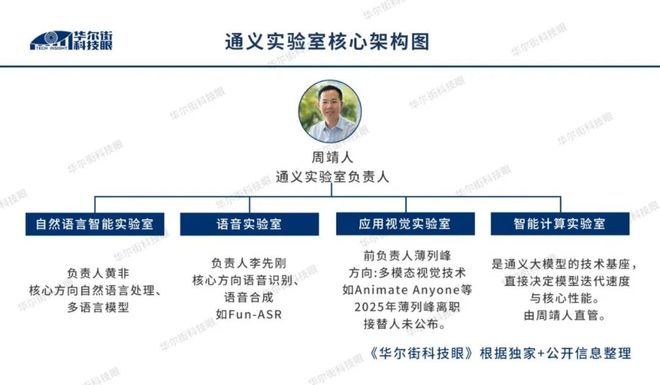
独家 | 通义核心人才相继“叛逃”,阿里双管齐下:砸天价年薪揽才+竞业锁喉
Tai Mei Ti A P P· 2025-11-19 08:37
Core Insights - Alibaba officially announced its entry into the AI to C market with the launch of the "Qianwen" project and the public beta of the Qianwen App, aiming to compete directly with ChatGPT [1][2] - The company plans to invest at least 380 billion yuan in cloud computing and AI infrastructure over the next three years, significantly increasing its investment in these areas compared to the past decade [2][4] - The Qianwen App focuses on developing a "world model" aimed at achieving artificial general intelligence (AGI), which is seen as a key competitive advantage for Alibaba in the AI sector [4][5] Investment Strategy - Alibaba's strategic shift towards the C-end market is driven by the growing demand for AI applications, with 729 million monthly active users in mobile AI applications as of September 2025 [2][4] - The investment plan includes comprehensive coverage of computing power deployment, model research, and AI cloud computing [2][4] Technological Development - The Qianwen flagship model, Qwen3-Max, ranks among the top three globally in performance, outperforming leading models like GPT-5 and Claude Opus4 in various tests [6] - The development of the "world model" aims to transform user interaction with AI, allowing it to understand, predict, and integrate into real-life scenarios [5][6] Talent Acquisition and Retention - Alibaba is aggressively recruiting top AI talent with significantly higher salaries than the market average, with some positions seeing salary increases of over 50% [25][27] - The company has implemented strict non-compete agreements to protect its technological advancements and prevent talent from moving to competitors [31][32] Competitive Landscape - The AI talent market is becoming increasingly competitive, with Alibaba being viewed as a training ground for high-end talent in the industry [25][33] - The departure of key personnel from Alibaba's AI teams has raised concerns about the pace of technological development within the company [8][19][23]