PPI

Search documents
王有捐:2025年CPI总体平稳 PPI低位回升
Guo Jia Tong Ji Ju· 2026-01-19 03:35
Group 1: Consumer Price Index (CPI) Trends - The overall consumer market in 2025 is stable and gradually improving, with CPI showing monthly fluctuations and a year-on-year increase of 0.8% in December, the highest since March 2023 [2] - Food prices decreased by 1.5% for the year, impacting CPI by approximately 0.27 percentage points, with significant declines in pork and egg prices [3] - Core CPI has been rising since March 2025, maintaining a year-on-year increase of over 1% for four consecutive months, reaching 1.2% in December [4] Group 2: Producer Price Index (PPI) Trends - The PPI for 2025 decreased by 2.6%, but the decline narrowed in the second half of the year, with a year-on-year decrease of only 1.9% in December [5] - The optimization of market competition and capacity management in key industries has led to a recovery in prices, particularly in coal and new energy sectors [6] - External factors, such as rising international metal prices, have contributed to price increases in related domestic industries, with non-ferrous metal mining prices up by 17.2% [7]
晓数点|速览!2025年国民经济成绩单出炉
Di Yi Cai Jing Zi Xun· 2026-01-19 03:09
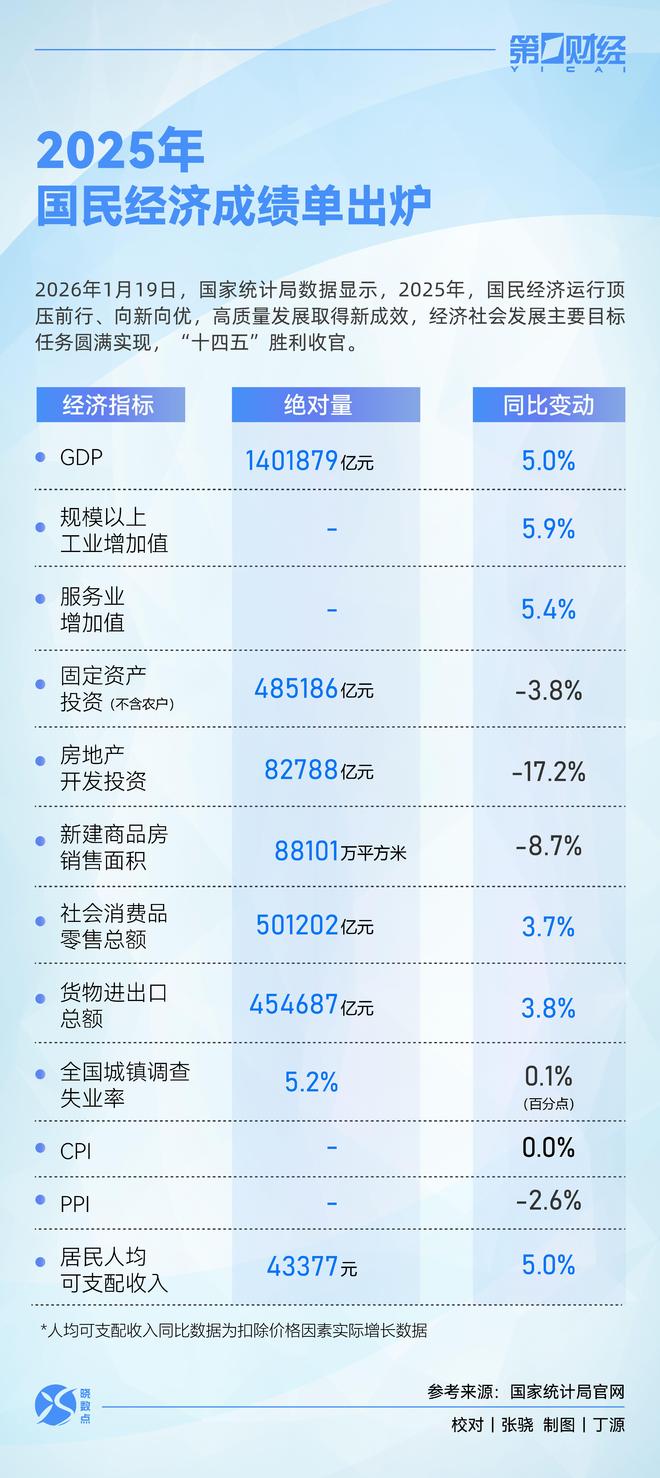
Core Viewpoint - The national economic performance report for 2025 indicates that high-quality development has achieved new results, with major economic and social development goals successfully met, marking a successful conclusion to the "14th Five-Year Plan" [1] Economic Indicators - GDP reached 14,018.79 billion yuan, growing by 5.0% year-on-year [2] - Investment (excluding rural households) totaled 485.186 billion yuan, declining by 3.8% [2] - Real estate development investment was 82.788 billion yuan, down by 17.2% [2] - New commercial housing construction area was 8,810.1 million square meters, decreasing by 8.7% [2] - Total retail sales of consumer goods amounted to 501.202 billion yuan, increasing by 3.7% [2] - Total import and export value reached 454.687 billion yuan, growing by 3.8% [2] Employment and Income - The national urban surveyed unemployment rate was 5.2%, an increase of 0.1 percentage points [3] - Per capita disposable income was 43,377 yuan, reflecting a real growth of 5.0% after adjusting for price factors [3]

李迅雷:PPI“失去十五年”之谜
Xin Lang Cai Jing· 2026-01-18 09:25
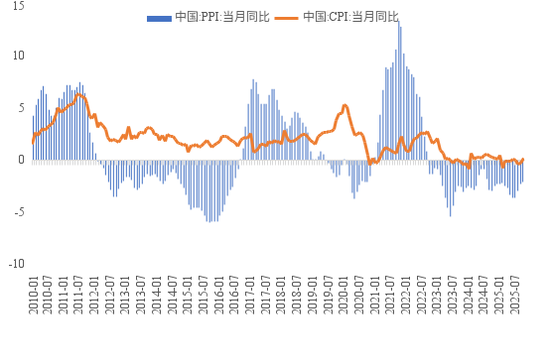
Core Viewpoint - The Producer Price Index (PPI) in China has shown a continuous decline, with a year-on-year decrease of 1.9% reported for December 2025, marking 39 consecutive months of decline since October 2021. This trend raises questions about the underlying reasons for the prolonged weakness in PPI despite significant GDP growth over the same period [1][52]. Group 1: PPI Trends and Historical Context - The PPI has been in negative territory for 111 months from 2012 to 2025, indicating that two-thirds of this period has been characterized by negative growth [1][52]. - From 2010 to 2025, China's GDP increased by 250%, yet the PPI index remained unchanged, suggesting a disconnect between economic growth and producer prices [1][53]. - The decline in PPI began after a significant investment stimulus in response to the 2008 financial crisis, which initially boosted PPI and CPI but later led to a prolonged period of negative PPI starting in March 2012 [2][53]. Group 2: Factors Influencing PPI - The PPI's long-term decline is primarily influenced by the prices of production materials, which have shown significant volatility but an overall cumulative increase of zero over the past 15 years [4][56]. - The prices of living materials have fluctuated less, with a cumulative increase of 4.4%, indicating a divergence in price trends between production and living materials [4][56]. - The divergence between Chinese and U.S. PPI post-2012 is attributed to rapid capacity expansion in China, leading to a significant drop in the export share of total industrial output [8][60]. Group 3: Demand and Supply Dynamics - Weak demand, particularly in the real estate sector, has been a critical factor in the inability of upstream price increases to transmit downstream, resulting in persistent PPI weakness [41][93]. - The real estate market's downturn has been linked to a broader economic slowdown, with real estate investment growth declining significantly since its peak in 2021 [35][88]. - The overall supply-demand imbalance, characterized by excess supply, has hindered price recovery, with industrial value-added growth lagging behind demand growth since 2020 [31][93]. Group 4: Recommendations for Economic Adjustment - To address the persistent weakness in PPI, it is essential to adjust the supply-demand relationship, particularly by expanding effective demand [41][93]. - Increasing the income of middle and low-income groups and promoting consumption are recommended strategies to stimulate demand and support price recovery [103]. - Stabilizing the real estate market is also suggested as a means to alleviate excess capacity and promote consumer spending, although achieving stable housing prices may be challenging [103].
2025年12月CPI与PPI增速同步回升 | 高频看宏观
Sou Hu Cai Jing· 2026-01-16 08:49
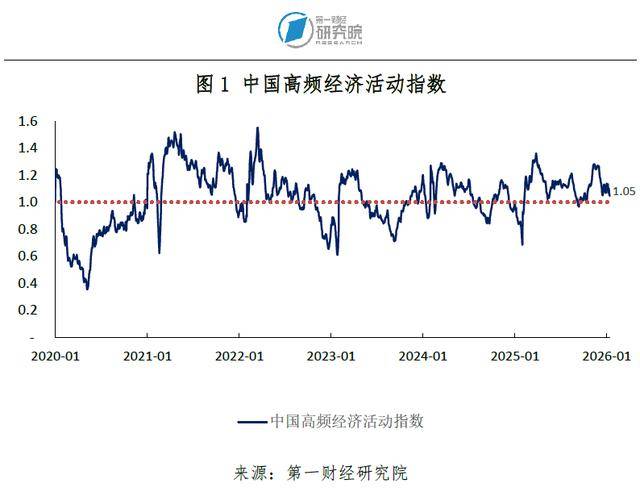
Group 1: Economic Activity Index - The China High-Frequency Economic Activity Index (YHEI) was 1.05 as of January 13, 2026, a decrease of 0.09 from January 6, 2026. The decline was primarily attributed to a drop in the coastal coal freight index by 0.09 [2][1] - The import dry bulk freight index remained stable compared to the previous week [2] Group 2: Monetary Policy - As of January 13, 2026, the central bank net withdrew 77.8 billion yuan through open market operations. The reverse repurchase amount for the week was 517.2 billion yuan, with 595 billion yuan maturing [4][5] Group 3: Interest Rates and Financing - The overnight interbank rate rose by 17 basis points to 1.5% over the past week, and the seven-day repurchase rate increased by 8 basis points to 1.57% [9][10] - The one-year swap rate increased by 1.43 basis points to 1.52%, while the five-year swap rate decreased by 0.42 basis points to 1.64% [12][9] - The yields on one-year, five-year, and ten-year government bonds fell by 10, 2.23, and 3.1 basis points to 1.26%, 1.64%, and 1.85%, respectively [15][9] Group 4: Industrial Sector - As of January 13, 2026, the price of steel billets increased by 1.37% week-on-week, while cement prices decreased by 1.12% [22][23] - The operating rate of short-process steel mills rose from 67.71% to 70.83% over the past month [22] - The operating rate for full steel tire production decreased to 58.02%, down from 58.15% the previous week [22] Group 5: Shipping and Real Estate - The coastal bulk freight index decreased by 5.98 points to 1012.77 points as of January 13, 2026 [30] - In first-tier cities, new and second-hand housing transaction areas increased by 0.05% and 32.04%, respectively [31][33] - The land transaction area in 100 cities was 12.64 million square meters, a week-on-week decrease of 63.63% [31] Group 6: Consumer Prices - In December 2025, the Consumer Price Index (CPI) rose by 0.8% year-on-year, with urban prices increasing by 0.9% and rural prices by 0.6% [39][41] - The Producer Price Index (PPI) fell by 1.9% year-on-year, with a month-on-month increase of 0.2% [39][41] Group 7: Global Perspective - The US dollar index rose by 0.58 points to 99.18, while the RMB/USD exchange rate decreased by 48 basis points to 6.9765 [42][44] - The VIX index increased by 1.23 points to 15.98 [49]
1月15日上期所沪银期货仓单较上一日上涨9703千克
Jin Tou Wang· 2026-01-15 08:11
Group 1 - The total silver futures warehouse receipts in Shanghai reached 638,399 kilograms, with an increase of 9,703 kilograms compared to the previous day [1][2] - The main silver futures contract opened at 23,488 yuan per kilogram, peaked at 23,688 yuan, and closed at 22,665 yuan, reflecting a rise of 1.68% [1] - The increase in warehouse receipts was primarily driven by the performance of the Zhonggongmei Supply Chain warehouse, which saw an addition of 11,716 kilograms [2] Group 2 - In November, the U.S. retail sales month-on-month growth was recorded at 0.6%, exceeding market expectations of 0.4% [2] - The U.S. Producer Price Index (PPI) year-on-year was reported at 3%, higher than the anticipated 2.7% [2] - The increase in retail sales was attributed to a rebound in automobile sales and strong growth during the holiday shopping season, with 10 out of 13 categories showing growth [2]
债市基本面高频数据跟踪:2026年1月第2周:水泥价格再创新低
SINOLINK SECURITIES· 2026-01-14 15:18
Group 1: Economic Growth Production - Power plant daily consumption is higher than the same period last year. On January 13, the average daily consumption of 6 major power generation groups was 826,000 tons, a 2.7% decrease from January 6. On January 6, the daily consumption of power plants in eight southern provinces was 2.278 million tons, a 9.6% increase from December 30 [5][12]. - The blast furnace operating rate has generally recovered moderately. On January 9, the national blast furnace operating rate was 79.3%, a 0.4 - percentage - point increase from January 2; the capacity utilization rate was 86.1%, a 0.8 - percentage - point increase from January 2. However, the blast furnace operating rate of Tangshan steel mills decreased by 3.7 percentage points [5][16]. - The tire operating rate has declined for two consecutive weeks. On January 8, the operating rate of all - steel truck tires was 58.0%, a 0.1 - percentage - point decrease from January 1; the operating rate of semi - steel car tires was 65.9%, a 2.4 - percentage - point decrease from January 1 [5][18]. - The operating rate of looms in the Jiangsu and Zhejiang regions has continued to decline. On January 8, the operating rate of polyester filament in the Jiangsu and Zhejiang regions was 90.5%, a 0.4 - percentage - point increase from January 1, while the operating rate of downstream looms was 57.9%, a 1.7 - percentage - point decrease from January 8 [5][18]. Demand - The sales volume of new homes in 30 cities has weakened month - on - month. From January 1 - 13, the average daily sales area of commercial housing in 30 large and medium - sized cities was 152,000 square meters, a 44.9% decrease from the same period in December, a 41.8% decrease from January of last year, and a 40.8% decrease from January 2024 [5][23]. - The retail growth of the auto market is weak. In January, retail sales decreased by 32% year - on - year, and wholesale sales decreased by 40% year - on - year [5][26]. - Steel prices are oscillating strongly. On January 13, the prices of rebar, wire rod, hot - rolled coil, and cold - rolled coil changed by +0.6%, +1.3%, - 0.3%, and +0.1% respectively compared to January 6 [5][33]. - Cement prices have hit a new low. On January 13, the national cement price index decreased by 1.1% compared to January 6. The cement prices in the East China and Yangtze River regions decreased by 0.5% and 0.6% respectively, performing slightly better than the national average [5][34]. - The rebound strength of glass prices has increased. On January 13, the active futures contract price of glass was 1,119 yuan/ton, an 0.8% increase from January 6 [5][39]. - The container shipping freight rate index has shown a pattern of short - term decline and long - term increase. On January 9, the CCFI index increased by 4.2% compared to December 26, while the SCFI index decreased by 0.5% [5][43]. Group 2: Inflation CPI - The rebound strength of pork prices is weakening. On January 13, the average wholesale price of pork was 18.0 yuan/kg, a 0.3% increase from January 6. Since January, the average wholesale price of pork has increased by 2.0% month - on - month [5][47]. - The agricultural product price index has declined moderately. On January 13, the agricultural product wholesale price index decreased by 0.9% compared to January 6. Since January, the index has increased by 4.0% year - on - year but decreased by 0.6% month - on - month [5][52]. PPI - Oil prices have reached the highest level since October. On January 13, the spot prices of Brent and WTI crude oil were 68.8 and 61.2 dollars/barrel respectively, an 8.4% and 7.0% increase from January 6 [5][55]. - Copper and aluminum prices have continued to rise. On January 13, the prices of LME 3 - month copper and aluminum increased by 0.1% and 2.3% respectively compared to January 6. Since January, the prices of LME 3 - month copper and aluminum have increased by 10.4% and 7.0% month - on - month respectively [5][59]. - The domestic commodity index has changed from a decline to an increase month - on - month. On January 13, the Nanhua Industrial Products Index increased by 1.2% compared to January 6, while the CRB index decreased by 1.5% [5][59].
蔡含篇:基数效应影响,通胀率继续上行
北京大学国民经济研究中心· 2026-01-14 05:22
Group 1: CPI Analysis - In December, the CPI increased by 0.8% year-on-year, up 0.1 percentage points from the previous month, indicating a slight rise in consumer prices but remaining in a low range[7] - The low base effect is the main factor driving the CPI increase, with household appliance prices rising significantly, although overall consumer demand remains weak[9] - Food prices rose by 1.1% year-on-year, with fresh vegetable prices seeing the highest increase at 18.2%[13] Group 2: PPI Analysis - The PPI decreased by 1.9% year-on-year in December, but the decline narrowed by 0.3 percentage points compared to the previous month, indicating a stabilization in industrial prices[29] - Raw material prices increased, contributing to a reduction in the rate of decline for the PPI, while the demand for industrial products remains insufficient[29] - Prices in the non-ferrous metal sector rose significantly, with mining prices increasing by 24.0% and smelting prices by 10.8% year-on-year, reflecting a shift towards higher technology industries[30] Group 3: Future Outlook - The CPI is expected to rise moderately in 2026 due to the low base effect and policies aimed at stabilizing growth and promoting consumption, despite ongoing economic pressures[38] - The PPI may also see an upward trend in 2026, driven by increased competition for resources and policy adjustments, although internal economic pressures persist[38]
基金观察:如何看待债市机会与风险?
Sou Hu Cai Jing· 2026-01-14 02:45
Core Viewpoint - The bond market is expected to experience fluctuations in 2025, with a shift in investor preference towards equities anticipated for 2026 due to declining risk premiums and supportive macroeconomic policies [2][3]. Group 1: Market Trends - The bond market has seen a strong performance over the past four years, primarily due to a lack of attractive returns in the equity market, leading investors to favor lower-risk bond assets [2]. - A significant drop in risk premiums indicates a rising risk appetite among investors, which is likely to result in a decline in bond prices and an increase in stock market performance [2]. - The central economic work conference has set a positive tone for macroeconomic policies, emphasizing proactive fiscal measures and moderately loose monetary policies, which are expected to enhance investor sentiment towards economic recovery [2]. Group 2: Investor Strategies - Investors should adjust their strategies in light of potential economic recovery, focusing on early indicators of corporate profitability such as the Producer Price Index (PPI) [3]. - Recommendations for bond investors include reducing duration by holding shorter-duration bonds and increasing exposure to equity-linked products like convertible bond funds and secondary bond funds to enhance returns [3]. - In the current interest rate environment, the choice between pure bond funds, convertible bond funds, and ETFs tracking government and technology innovation bonds should be based on the investor's outlook on interest rates and economic conditions [4][5]. Group 3: Product Insights - Pure bond funds are focused solely on bond assets, requiring careful attention to the fund manager's ability to adjust the portfolio based on credit and interest rate research [4]. - Government bond ETFs track government bond indices and are sensitive to interest rate changes, while technology innovation bonds carry additional credit risks, potentially offering higher returns [5].
英大证券郑后成说,2026年A股有支撑,年内高点可能在下半年
Sou Hu Cai Jing· 2026-01-13 17:19
Group 1 - The core viewpoint emphasizes that expert predictions are based on probabilities rather than certainties, and the market often misinterprets these insights as definitive forecasts [1][4] - The analysis of the potential for a market peak in the second half of the year is linked to four key factors: Federal Reserve monetary policy, domestic industrial product prices (PPI), RMB exchange rate, and capital flows [1][6] - The current market environment presents both opportunities and risks, with external favorable conditions and internal recovery providing a window for investment, while uncertainties and inflation pressures pose potential threats [3][7] Group 2 - Historical context shows that market cycles are influenced by various factors, and the prediction of a peak in the second half of the year is based on the convergence of macroeconomic indicators [6][9] - The importance of a stable policy environment is highlighted, as it is crucial for market predictability and coherent reform paths, which can support investor confidence [7][9] - Investors are advised to focus on fundamentals and valuations rather than being swayed by short-term market trends, emphasizing the need for disciplined investment strategies [3][11]