
太空光伏

Search documents
禾迈股份(688032.SH):公司的产品目前暂未应用于太空光伏
Ge Long Hui· 2026-01-19 09:55
Group 1 - The company, HeMai Co., Ltd. (688032.SH), has stated that its products are currently not applied in the field of space photovoltaics [1] - The company will continue to monitor developments in the relevant field [1]

光伏50ETF(159864)涨超1.6%,行业发展有望加速
Mei Ri Jing Ji Xin Wen· 2026-01-19 04:34
Group 1 - The photovoltaic industry is rapidly developing, with cumulative installed capacity in China expected to reach 1140 GW from January to October 2025, representing a year-on-year growth of 44% [1] - The growth in the photovoltaic sector is driving demand for third-generation semiconductor power devices, specifically silicon carbide [1] - The overseas ground photovoltaic market is also experiencing strong demand, with the U.S. expected to see a compound annual growth rate of over 20% in installed capacity from 2024 to 2029, potentially exceeding 60 GW in 2025 [1] Group 2 - Chinese photovoltaic equipment holds a dominant position in the global market, with over 80% of global production capacity in silicon materials, wafers, cells, and modules expected in 2024 [1] - The number of global satellite launches is increasing exponentially, leading to a surge in demand for GW-level space photovoltaic applications [1] - Silicon-based HJT technology is identified as the optimal short-term alternative due to its flexibility, lightweight, low cost, and lack of material restrictions, with a long-term shift towards perovskite-HJT tandem cells anticipated [1] Group 3 - The Photovoltaic 50 ETF (159864) tracks the photovoltaic industry index (931151), focusing on upstream and downstream companies in the photovoltaic industry chain, including silicon materials, wafers, cells, modules, and photovoltaic equipment, reflecting the overall performance of related listed companies in China [1]
电网股爆发,多股20CM涨停,A股诞生多只翻倍股,加密货币超24万人爆仓
21世纪经济报道· 2026-01-19 04:02
Market Overview - The A-share market experienced a morning surge followed by a pullback, with the Shanghai Composite Index breaking through 4100 points. By the morning close, the Shanghai Composite Index rose by 0.13%, while the ChiNext Index fell by 0.64%, with 3381 stocks in the market rising [1][2]. Electric Grid Equipment Sector - The electric grid equipment sector saw a surge, with stocks like Double杰电气 hitting the daily limit and 亿能电力 rising over 20%. The State Grid announced a fixed asset investment of 4 trillion yuan during the 14th Five-Year Plan, focusing on technological innovation and new power system construction. This investment is expected to create a full industry chain effect, benefiting five major sectors including ultra-high voltage and distribution network upgrades [3][4]. Commercial Aerospace and Photovoltaic Sectors - The commercial aerospace concept showed active performance, with stocks like 九鼎新材 and 越秀资本 hitting the daily limit. The photovoltaic sector also saw significant gains, particularly in the space photovoltaic direction, with 赛伍技术 reaching the daily limit. However, warnings about potential bubbles in this sector were noted, as several leading photovoltaic companies announced expected losses exceeding 28.9 billion yuan for 2025 [4]. Precious Metals Sector - The precious metals sector was active, with 四川黄金 rising over 9% and other gold stocks like 招金黄金 and 西部黄金 also performing well. International gold and silver prices reached historical highs, with gold prices exceeding $4690 per ounce and silver prices surpassing $94 per ounce. Domestic gold jewelry prices also saw significant increases, with some brands raising prices by 24 yuan per gram in a single day [4]. Declining Stocks - The CPO concept experienced a downturn, with AI applications, semiconductors, and cultivated diamonds showing significant declines. 包钢股份 opened with a drop of 5.6% following a tragic explosion incident at its plant, resulting in casualties and injuries. 容百科技 faced a 20% limit down due to an investigation by the securities regulatory authority for misleading statements [5]. Doubling Stocks - Several stocks in the A-share market have doubled in value, including 易点天下 and 志特新材, which saw increases of over 100% and 138%, respectively. The semiconductor stock 珂玛科技, despite a drop of over 3% recently, had a cumulative increase of over 159% in the past 26 trading days [6][8]. Cryptocurrency Market - The cryptocurrency market faced a downturn, with major cryptocurrencies experiencing significant declines, leading to over 240,000 liquidations and a total liquidation amount of $864 million [9].





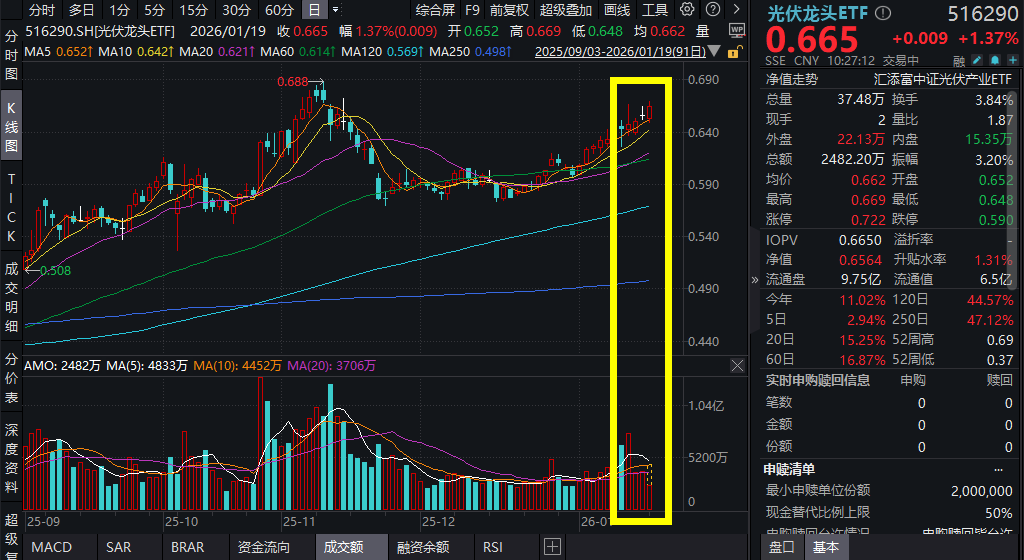
钧达股份3000万元投资抢滩太空光伏! 特变电工涨超7%,光伏龙头ETF(516290)爆量涨超1%冲击四连阳!2026年最强电新主线确定了?
Xin Lang Cai Jing· 2026-01-19 03:01
Core Viewpoint - The A-share market experienced fluctuations with the photovoltaic leader ETF (516290) seeing a significant increase of 1.37%, with a trading volume exceeding 30 million yuan, marking a four-day consecutive rise in daily performance [1]. Group 1: Market Performance - The photovoltaic leader ETF (516290) showed mixed performance among its constituent stocks, with TBEA rising over 7%, Maiwei Co. and Chint Electric increasing over 5%, while Longi Green Energy and Jiejia Weichuang experienced pullbacks [3]. - The top ten constituent stocks of the photovoltaic leader ETF include TBEA, which rose by 7.07%, and TCL Technology, which increased by 2.90%, while Longi Green Energy fell by 2.24% [4]. Group 2: Industry Developments - Junda Co. announced a 30 million yuan investment in Shanghai Xingyi Chip Energy Technology Co., aiming to leverage opportunities in the low-orbit satellite networking and space computing industry, enhancing capabilities in photovoltaic industrialization and perovskite technology [5]. - Space photovoltaic energy is highlighted as a strategic solution for commercial space and high-end applications, with the potential to supply energy to satellites and space stations, marking a pivotal moment for the industry [5]. Group 3: Future Outlook - Huaxi Securities emphasizes that photovoltaic technology is the only viable energy solution in space, with advantages over traditional fossil fuels and nuclear energy, making it suitable for extreme environments [5]. - According to CITIC Securities, the space photovoltaic market is expected to reach a trillion yuan scale, with satellite launches projected to increase from 5,000 to 50,000 between 2025 and 2040, driving demand for photovoltaic batteries from 0.024 GW to 1.8 GW [5]. - Guojin Securities expresses strong confidence in "space photovoltaic" becoming a dominant theme in the energy sector through 2026, driven by surging demand and the urgency for resource competition [6].






十五五-国网投资出台-电力设备再迎景气周期
2026-01-19 02:29
Summary of Conference Call Notes Industry Overview - The conference call discusses the investment plans of the State Grid Corporation of China, indicating a significant increase in investment, which is expected to usher in a new high-intensity construction cycle focused on ultra-high voltage (UHV) construction, benefiting core equipment suppliers like Pinggao Electric and China Western Power [1][2]. Key Points and Arguments Investment Goals - The core goal of the State Grid's investment in 2026 is to build a new power system that aligns with renewable energy and carbon neutrality targets. The investment plan amounts to 4 trillion yuan, a significant increase from 2.85 trillion yuan during the previous five-year period, marking the start of a new high-intensity construction cycle [2]. Strengthening the Power Grid Platform - Specific measures to strengthen the power grid platform include UHV construction and investment in main network equipment. UHV construction is crucial for supporting the development of wind and solar resources in the western regions and hydropower projects in the southwest. Key equipment includes transformers, GIS switchgear, and converters, with companies like Pinggao Electric and China Western Power having significant advantages in these areas [3]. Enhancing Regulation Capabilities - Enhancing regulation capabilities focuses on improving source-side and composite-side regulation. This includes attention to energy storage applications and the prediction of unstable renewable energy generation, such as solar power. The demand for power software and virtual power plants is increasing, necessitating customized development [5]. Strengthening Technological Empowerment - The State Grid is actively adopting emerging technologies such as drone inspections and AI to enhance operational efficiency and automation. These technologies are applied in inspection robots and online monitoring systems, with major technological projects promoting the widespread application of new technologies in society [6]. Investment Focus on Distribution Network - Investment in the distribution network emphasizes digital upgrades, including the integration of primary and secondary systems, smart terminals, distribution automation, and smart meters. Companies like Oriental Electronics lead in distribution automation, while Sanxin Medical and Haixing Electric are prominent in the smart meter sector [7]. Development Trends in New Energy Storage Equipment - New energy storage equipment is focused on enhancing peak regulation capabilities, with independent storage business models becoming clearer due to capacity pricing policies. The domestic market is expected to maintain good growth through 2026, with companies like Sungrow, CATL, and EVE Energy being competitive in system integration and battery cell fields [8]. Opportunities in Power IT and Software - The power IT and software sector requires robust software platforms to support digital transformation, including scheduling, marketing, and asset management. Companies like Yuan Guang Software are deeply integrated with State Grid clients and are expected to benefit from future upgrades [9]. Global Market Impact on Chinese Enterprises - The global market significantly impacts Chinese enterprises, as they possess strong global competitiveness in power equipment. The demand for maintenance and construction in North America, Southeast Asia, Europe, and the Americas presents new opportunities for Chinese companies [10]. Investment Logic in Space Photovoltaics - The space photovoltaic sector has three main investment logics: reduced launch costs due to commercial space initiatives, increased power capacity of satellites, and the potential rise of perovskite technology. These factors are expected to drive future demand in space power applications [12]. Companies to Watch in Space Photovoltaics - Investment in space photovoltaics can be categorized into three tiers: - Tier 1 includes companies like Junda, Oriental Sunrise, and Shanghai Port, which have been early movers in the sector. - Tier 2 includes companies like Mingyang Smart Energy and Tianhe Solar, which have existing or potential layouts in space photovoltaics. - Tier 3 consists of membrane companies and potential equipment manufacturers that may benefit from the sector's growth [13]. AIDC Market Outlook - The AIDC market outlook is positive, with the U.S. government promoting technology companies to bid for long-term power supply contracts to address electricity supply issues. The average retail electricity price in the U.S. is expected to rise by 7.4% in 2026, driven by increased demand from data centers [14]. Current Thematic Investment Opportunities - Current market themes include the recent rollout of grid investment plans, which may drive clear market trends. The space photovoltaic sector, AIDC power supply, and solid-state batteries are identified as areas with significant thematic investment opportunities [15].
太空光伏的发展现状与未来展望
2026-01-19 02:29
Summary of Key Points from the Conference Call on Space Photovoltaics Industry Overview - The discussion centers around the development and future prospects of space photovoltaics, particularly focusing on materials and technologies used in solar panels for satellites, with a specific emphasis on SpaceX's Starlink project [1][3][4]. Core Insights and Arguments - **Solar Panel Specifications**: The Rlink V3 single/double-wing solar panel areas are 130/270-280 square meters, with a power consumption of 50-60 kW. The need for lightweight, flexible, and high-efficiency solar wing materials is emphasized to meet the high power demands of computing satellites [1][4]. - **Material Preferences**: SpaceX prefers using HJT (Heterojunction) materials despite their higher cost (60-70 RMB/Watt) compared to terrestrial photovoltaic materials, due to better adaptability in space environments [1][4]. - **Efficiency Comparisons**: HJT has a conversion efficiency of about 25%, while single-layer perovskite ranges from 22%-25%, and tandem perovskite can exceed 38% in laboratory settings but lacks practical application [1][5]. - **Material Innovations**: UTG glass and CPI films are being tested as external covering materials for space photovoltaics, offering improved durability and radiation resistance while being thinner (50-70 microns) than traditional covers [1][6][7]. - **Increased Power Demands**: The power requirements for space computing devices are significantly increasing, necessitating larger solar wing areas and lightweight materials that can be folded or rolled [8][9]. Additional Important Content - **Challenges in Material Production**: The production of UTG glass is still in its early stages, facing challenges in mass production and mechanical durability during rocket launches [7]. - **Cost Implications**: The cost of HJT in aerospace applications is significantly higher due to the need for additional protective measures against environmental factors, and while there is potential for cost reduction with new materials, it will not reach terrestrial application levels [17][18]. - **Technological Developments**: New designs for flexible solar wing deployment mechanisms are being explored, including push-pull, roll-up, and umbrella-style systems, each with its own advantages and challenges [10][11]. - **Company Comparisons**: Companies like Junda, Mingyang, and Dongfang Risheng are noted for their strengths in the photovoltaic sector, with specific mention of the Fuxi Star team under Port Holdings, which has experience with perovskite products in orbit [19]. - **Future Research Directions**: Ongoing research into perovskite solar wings is highlighted, with a focus on their long-term performance in space, although they have not yet been launched for environmental testing [20][21]. This summary encapsulates the key points discussed in the conference call regarding the advancements and challenges in the field of space photovoltaics, particularly in relation to the technologies and materials being developed for satellite applications.
空天的NV链-SpaceX
2026-01-19 02:29
Summary of Key Points from the Conference Call Industry Overview - The conference call discusses the space photovoltaic industry, highlighting significant developments in North America, particularly in the renewable energy sector and the photovoltaic supply chain, which is expected to benefit from emerging opportunities [1][5][22]. Core Insights and Arguments - **Market Growth**: The space photovoltaic industry aims for an annual capacity of 200-300 GW, with projections for 2026 estimating a scale of 10-15 GW. The HJT technology route is expected to dominate, presenting clear opportunities for both listed and unlisted companies [1][5]. - **Investment Requirements**: Space photovoltaic projects require equipment that is thin, light, and flat, with potential investment costs reaching several hundred million dollars per GW. Traditional solutions may see price premiums that could double, significantly impacting profit margins and competitiveness [1][7]. - **Key Companies**: Companies such as Maiwei Co., Yujing Co., and Xinyi Communication are identified as aligning with North American industry standards and are expected to enter the space photovoltaic sector, showing substantial performance elasticity [1][8]. - **3D Printing Technology**: This technology addresses key pain points in rocket engine manufacturing, such as material redundancy, long delivery cycles, and high costs, making it a crucial technology route for commercial space endeavors [1][12][13]. - **SpaceX's Strategy**: SpaceX's vertical integration strategy relies on a global supply chain network, utilizing consumer electronics-grade supply chains for large-scale production of aerospace hardware, which enhances cost efficiency [1][31]. Additional Important Insights - **User Growth for Starlink**: Starlink's user terminals are produced using consumer electronics manufacturing logic, with user numbers expected to exceed 9 million by the end of 2025, indicating a shift towards large-scale production [1][32]. - **Investment Opportunities**: The call suggests focusing on companies involved in specific satellite constellation projects, such as Starlink, and those with high barriers to entry in laser communication technology [1][20]. - **Challenges in the Photovoltaic Supply Chain**: The U.S. photovoltaic market faces challenges, including a shortage of battery cell production capacity, which is critical for building photovoltaic capacity [1][28]. - **Future Trends**: The call anticipates rapid growth in the space photovoltaic sector, with expectations of exceeding 30 GW by 2027, emphasizing the need for close attention to regulatory pressures and market dynamics [1][9]. This summary encapsulates the key points discussed in the conference call, providing insights into the space photovoltaic industry, the role of technology, and potential investment opportunities.
军工对话机械-寻找通胀-大空间的成长方向
2026-01-19 02:29
Summary of Key Points from the Conference Call Industry Overview - The mechanical industry plays a foundational role in the commercial aerospace sector, involving various segments such as communication satellites and space computing, with significant market potential [1][2] - The domestic commercial aerospace industry is rapidly developing, with projections indicating around 21,000 satellites to be launched by 2030 and approximately 15,000 by 2035 [2] Core Insights and Arguments - **3D Printing Technology**: - 3D printing is expected to see increased penetration in commercial aerospace due to its lightweight and cost-reduction advantages, particularly in the context of reusable rockets [1][4] - SpaceX's Raptor engine, which utilizes 3D printing, has achieved a 90% cost reduction, a 40% weight decrease, and a 22% increase in thrust, serving as a successful case for domestic companies [4] - The current cost of launching a kilogram in China is approximately 50,000 to 100,000 RMB, while SpaceX's Falcon 9 costs around $3,000 per kilogram [4] - **Space Photovoltaics**: - The development prospects for space photovoltaics are promising, with significant global interest. The market for low Earth orbit communication satellites and space computing is expected to be substantial, potentially reaching a trillion-dollar scale [1][6] - The investment required for space photovoltaic equipment is significantly higher than for terrestrial photovoltaic systems, with ground heterojunction systems costing about 100 million RMB per megawatt compared to higher costs for space systems [6] - **Companies to Watch**: - Companies such as CIMC Group, Anruike, Hengyang Holdings, and Hengli Hydraulic are recommended for their stable core businesses and active involvement in commercial aerospace, having secured orders or products in this field [1][7] Additional Important Content - The mechanical industry is closely linked to various manufacturing processes in rocket and satellite launches, with companies like Bolite, Huashu Gaoke, Jiangrong Technology, and Feiou Technology participating in rocket engine production [3] - The mechanical sector is positioned in the midstream manufacturing segment, which is crucial for both rocket and satellite development [3] - The potential for 3D printing in the aerospace sector is expected to grow as domestic companies adopt this technology more widely, following the lead of international firms [5] - The competitive edge of Chinese photovoltaic equipment companies is highlighted, as they not only participate in domestic projects but also aim to capture opportunities in international markets [6]
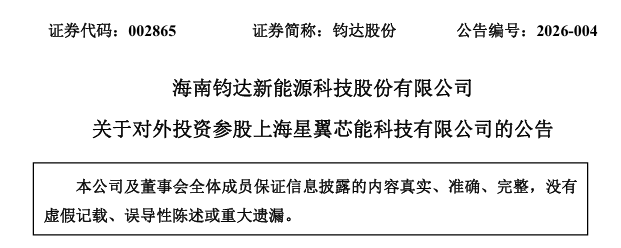
电池片龙头3000万布局太空光伏!
Xin Lang Cai Jing· 2026-01-19 01:20
Core Viewpoint - The company, Hainan Junda New Energy Technology Co., Ltd., announced an investment in Shanghai Xingyi Chip Energy Technology Co., Ltd., acquiring a 16.6667% stake through a cash investment of RMB 30 million [2][9]. Company Overview - Shanghai Xingyi Chip Energy Technology Co., Ltd. was established on January 6, 2026, with a registered capital of RMB 1.5 million. The company focuses on technology services, new materials research, and sales of photovoltaic equipment [3][11]. - The company's legal representative is Zhang Guodong, and it is located in Jiading District, Shanghai [11]. Shareholding Structure - The initial shareholding structure of Shanghai Xingyi includes major shareholders such as Shao Yuchuan (66.67%), Shanghai Shangwan Wing Enterprise Management Partnership (20%), and Hangzhou Detingwo Technology Co., Ltd. (7.84%) [4][11]. - Following the conversion of shares from the original business entity, the adjusted shareholding structure will include Junda holding 16.6667% of the company, with other shareholders' stakes also adjusted accordingly [6][12]. Investment Details - The investment involves an increase in the registered capital of Shanghai Xingyi by RMB 46.1539 million, with Junda's investment aimed at enhancing the company's capabilities in the photovoltaic sector [5][13]. - The total investment from Junda will be RMB 30 million, which will be used to subscribe to the newly issued capital of the target company [5][13]. Purpose of the Transaction - The collaboration aims to leverage opportunities in the global low-orbit satellite networking and space computing industries, enhancing both companies' strengths in photovoltaic industrialization and space technology adaptation [14]. - This partnership is expected to create synergies with the company's existing photovoltaic business, expanding its application scenarios from terrestrial to space photovoltaic fields, aligning with the company's long-term strategic investment plans [14].

固态电池加速产业化,太空光伏潜力可期
Zhong Guo Neng Yuan Wang· 2026-01-19 00:56
Industry Overview - The electrical equipment index (10679) increased by 0.79%, outperforming the market during the week of January 12-16. Lithium batteries rose by 1.5%, new energy vehicles by 1.29%, and photovoltaics by 0.87%. However, wind power, power generation equipment, and nuclear power saw declines of 4.74%, 4.15%, and 2.09% respectively [1][2] - The top five gainers in the sector included Huaguang Co., Yihua Tong, Sanbian Technology, Hezhong Technology, and Baobian Electric. The top five losers were Xiangrikui, Yijing Photovoltaic, Goldwind Technology, Baosheng Co., and Aerospace Machinery [2] Storage Sector - The Ukrainian Prime Minister ordered an acceleration in the import of electricity and additional power equipment. Four departments are strengthening government investment funds towards storage and new energy industries [3] - Jiangxi's virtual power plant is expected to have a regulation capacity exceeding 1GW by 2027, with several pilot projects being implemented [3] - Trina Storage signed a large contract in Latin America, solidifying its position among the top five storage solution providers in the region [3] Electric Vehicle Market - In December, electric vehicle sales reached 1.71 million units, with a year-on-year increase of 28%. Exports accounted for 2.58 million units, up 103% year-on-year [3] - The China Association of Automobile Manufacturers reported a decline in new energy passenger vehicle retail sales in January 2026, with a year-on-year decrease of 38% [3] Company Insights - Keda Technology expects a net profit of 600-660 million yuan for 2025, representing a year-on-year increase of 52.21%-67.43% [4] - Zhenyu Technology anticipates a net profit of 500-550 million yuan for 2025, with a projected increase of 96.9%-116.6% [4] - Rongbai Technology expects a net profit of approximately 30 million yuan in Q4 2025, but a full-year loss of 190-150 million yuan [4] - TCL Zhonghuan plans to invest in a new energy project and has signed a cooperation framework agreement [5] Investment Strategy - The storage sector is expected to see over 60% growth in 2026, driven by strong demand and supply constraints. The U.S. Inflation Reduction Act is anticipated to boost installations [6] - The lithium battery sector is projected to recover in March 2026, with a forecasted 5-10% growth in domestic sales [6] - The wind power sector is expected to see significant growth, with domestic offshore wind capacity projected to exceed 8GW by 2025 [6] Investment Recommendations - Companies such as CATL, Sungrow Power, and Sanyuan Electric are highlighted as strong investment opportunities due to their leadership in their respective sectors [7][8] - The report emphasizes the potential of companies involved in solid-state batteries, energy storage, and electric vehicle components, suggesting a favorable outlook for these sectors [7][8]


