
战略性新兴产业

Search documents
上半年30个省份“半年报”出炉,西藏、甘肃和湖北增速排名前三
Xin Jing Bao· 2025-07-25 08:49
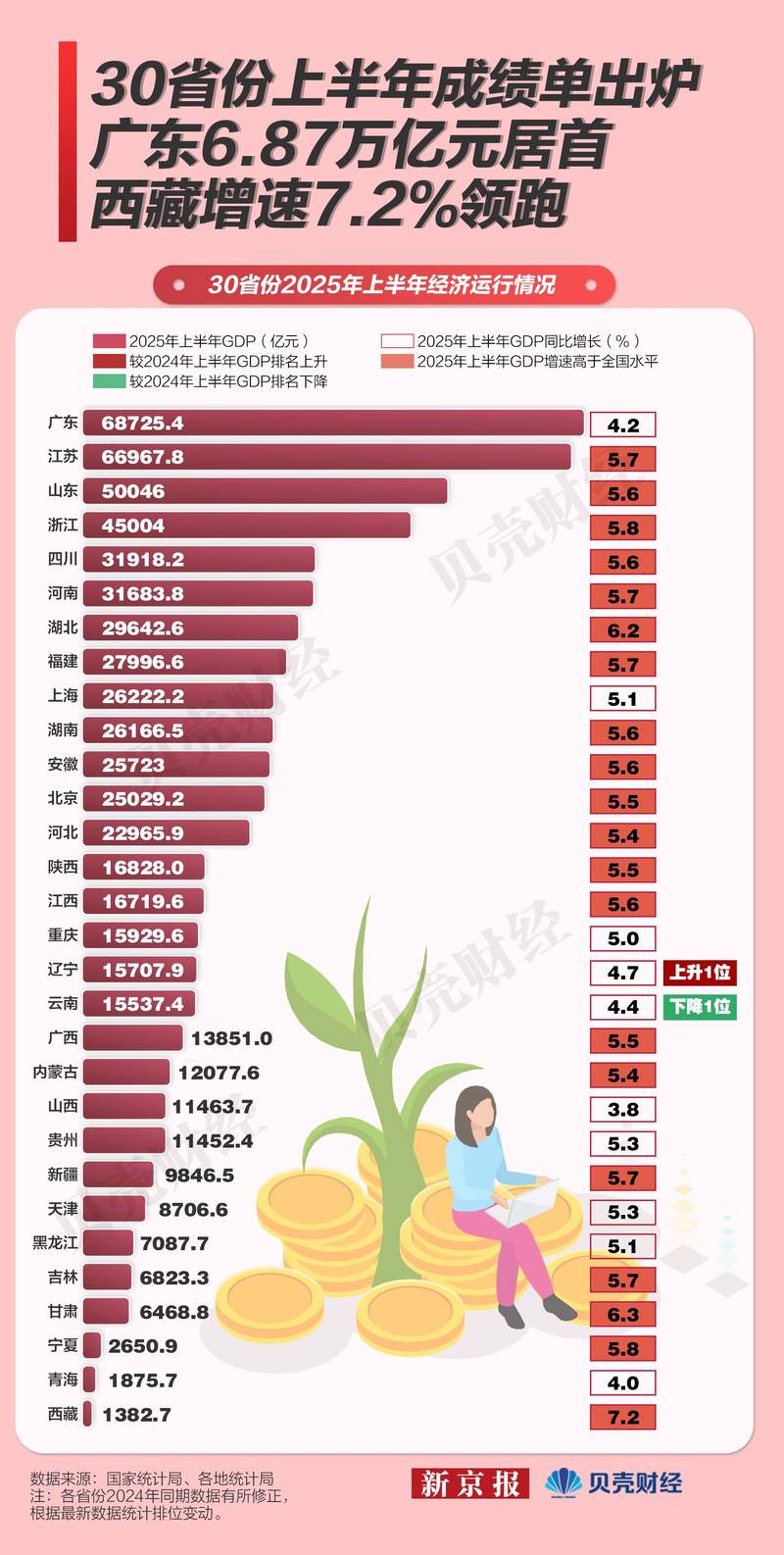
Core Viewpoint - The economic performance of various regions in China for the first half of 2025 has exceeded expectations, with overall stable growth and improvements in the quality of economic output [1][2]. Group 1: Economic Performance by Region - Guangdong province leads with a GDP of 6.87 trillion yuan, a year-on-year growth of 4.2% [2]. - Jiangsu follows closely with a GDP of 6.7 trillion yuan [2]. - Shandong's GDP surpassed 5 trillion yuan with a growth rate of 5.6% [2]. - Zhejiang's GDP reached 4.5 trillion yuan, showing a year-on-year growth of 5.8%, the highest among eastern coastal provinces [2]. - 22 provinces exceeded or matched the national average GDP growth rate of 5.3%, with Tibet, Gansu, and Hubei showing the highest growth rates of 7.2%, 6.3%, and 6.2% respectively [6]. Group 2: Drivers of Economic Growth - The rapid development of emerging industries has been a key driver of GDP growth in various regions, particularly in high-tech manufacturing and strategic emerging industries [2]. - Investment in high-tech industries and digital economy has significantly contributed to economic growth [2]. Group 3: Future Economic Outlook - Economic growth may face pressure in the second half of the year due to high previous year bases, but regions are focusing on technological innovation and industrial upgrades [3]. - The economic gap between regions is expected to gradually narrow, with new development patterns emerging [3]. Group 4: Hubei Province's Economic Highlights - Hubei's GDP grew by 6.2%, with industrial output increasing by 7.9% and high-tech manufacturing growing by 14.4% [7]. - Fixed asset investment in Hubei rose by 6.5%, and retail sales increased by 6.9%, both outperforming national averages [7]. - Hubei's foreign trade reached 402.3 billion yuan, a year-on-year increase of 28.4%, with private enterprises playing a significant role in this growth [8].

【省国资委】上半年省属企业生产经营平稳有序
Shan Xi Ri Bao· 2025-07-25 00:28
Core Insights - As of June 30, the total assets of provincial state-owned enterprises reached 3.42 trillion yuan, a year-on-year increase of 3.2%, while owners' equity reached 1.1 trillion yuan, up 2.6% [1] - In the first half of the year, the production and operation of provincial state-owned enterprises remained stable, with significant year-on-year growth in coal (5.9%), refined oil (6.6%), natural gas (21.5%), and automobile production (0.9%) [1] - Fixed asset investment by provincial state-owned enterprises accelerated, totaling 68.254 billion yuan, a slight increase of 0.1% year-on-year, with strategic emerging industry investments rising by 146.1% to 17.93 billion yuan [1] Industry Performance - The operational indicators of the coal, construction, and road transportation industries of provincial state-owned enterprises outperformed the national average [1] - The scale and efficiency of the petroleum and petrochemical industry also exceeded the national average, while the agricultural, forestry, animal husbandry, and fishery sectors showed better profitability compared to the national level [1] Future Strategies - The provincial state-owned assets system will focus on enhancing production and operational scheduling, monitoring, and analysis to meet annual targets for profit and labor productivity [2] - Emphasis will be placed on production-sales coordination, scientific allocation of production factors, and dynamic adjustment of product structures to ensure stable growth in key product output [2] - There will be a strong focus on project construction, monitoring key projects with investments exceeding 5 billion yuan, and accelerating project progress to contribute more effectively to economic growth [2]
解码东莞经济半年报:向“新”力驱动增长韧性
2 1 Shi Ji Jing Ji Bao Dao· 2025-07-24 11:09
Economic Performance - Dongguan's GDP grew by 4.8% year-on-year in the first half of the year, with industrial added value increasing by 5.1% and foreign trade growth reaching 16.5%, marking a historical high for the same period [1][3] - The city's economic performance is significant on a national scale, showcasing resilience and vitality despite global economic challenges [1][2] Foreign Trade Resilience - Dongguan's foreign trade achieved a record high of 749.28 billion yuan in import and export value, with a year-on-year growth of 16.5%, leading the major foreign trade cities in Guangdong province [3][6] - The city's foreign trade dependency ratio has decreased to 113% in 2024, down from over 400% in previous years, yet it remains one of the highest among major cities in China [2][3] Market Diversification - Dongguan has successfully diversified its trade markets, with ASEAN becoming the largest trading partner, while the U.S. market share decreased from 14% to 12% [6][8] - The city has seen significant growth in exports to emerging markets, with increases of 43.5% to ASEAN, 21.5% to India, and 63.6% to Central Asia [6][8] Manufacturing Sector Growth - The industrial added value for Dongguan's manufacturing sector increased by 5.1%, with notable growth in electronic information manufacturing (9.2%), electrical machinery (8.8%), and chemical manufacturing (12.4%) [10][11] - Advanced and high-tech manufacturing sectors reported growth rates of 7.5% and 9.1%, respectively, indicating a shift towards higher value-added production [10][11] Innovation and New Industries - Strategic emerging industries and future industries are becoming key pillars of Dongguan's economy, with investments in advanced and high-tech manufacturing rising by 30.6% and 31.8% respectively [13][14] - The establishment of innovation consortia in various sectors is enhancing collaboration between enterprises and research institutions, driving technological advancements [14][15] Export Product Trends - Dongguan is the largest toy export base in China, with toy exports reaching 9.97 billion yuan in the first half of the year, reflecting a growth of 6.3% [9] - The city's export structure is evolving, with a focus on high-tech products and self-owned brands, leading to increased competitiveness in the global market [8][9]

广东加大科技创新金融供给,上半年科技保险同比增长76%
Nan Fang Du Shi Bao· 2025-07-24 09:42
Core Insights - Guangdong's financial regulatory authority is enhancing technology-driven financial services, focusing on three pilot projects: AIC equity investment, technology enterprise merger loans, and intellectual property financial ecosystems [2] - By the end of June, the total balance of technology loans in Guangdong reached 3.6 trillion yuan, an increase of 322.7 billion yuan since the beginning of the year; technology insurance provided risk coverage of 3.11 trillion yuan to tech enterprises in the first half of the year, marking a 76% year-on-year growth [2] - The insurance products in Guangdong cover various risks associated with technology enterprises, including property loss, liability, and guarantee insurance, and have introduced several national "first" businesses [2] Policy Support - The National Financial Regulatory Administration has issued a plan to establish a technology insurance policy system and improve supporting measures, encouraging the use of co-insurance mechanisms in key areas [3] - A joint policy initiative aims to optimize technology insurance services and establish a coordination mechanism for its development [3] Challenges in Technology Insurance - Current challenges in technology insurance include insufficient policy support, traditional development models, and the need for enhanced professional capabilities to address the complexities of technology risks [3][4] - There is a lack of unified technology insurance support policies and premium subsidy mechanisms in Guangdong, leading to low awareness among SMEs [3] Future Directions - The company aims to enhance the depth, breadth, and precision of technology insurance services, focusing on major technological projects and strategic emerging industries [4] - As of June 2025, the company has provided risk coverage of 11.84 trillion yuan to nearly 16,000 technology enterprises and introduced innovative products to fill coverage gaps and reduce insurance costs [4] - The evolving technology insurance landscape is expected to provide robust risk protection for high-level technological self-reliance and innovation [4]
杭州经济上半年“成绩单”出炉
Mei Ri Shang Bao· 2025-07-22 22:26
Economic Overview - Hangzhou's economy shows a stable and improving trend, with GDP reaching 11,303 billion yuan in the first half of 2025, a year-on-year increase of 5.5%, accelerating by 0.3 percentage points from the first quarter [1] - The primary industry added value was 157 billion yuan, growing by 2.8%; the secondary industry added value was 2,672 billion yuan, growing by 5.3%; and the tertiary industry added value was 8,474 billion yuan, growing by 5.7% [1] Agricultural Sector - The total output value of agriculture, forestry, animal husbandry, and fishery reached 261 billion yuan, a year-on-year increase of 3.2%, with vegetable production at 1.87 million tons, growing by 3.6% [1] Industrial Sector - The added value of above-scale industries was 2,252 billion yuan, with a year-on-year growth of 6.9%, driven by significant growth in the automotive manufacturing sector, which increased by 29.3% [2] - Investment in fixed assets grew by 4.4%, with notable increases in general equipment manufacturing (27.3%), electrical machinery and equipment manufacturing (22.7%), and automotive manufacturing (20.0%) [2] Consumer Market - The total retail sales of social consumer goods reached 4,585 billion yuan, with a year-on-year growth of 6.0%, supported by the implementation of the old-for-new policy [3] - Retail sales of home appliances and audio-visual equipment surged by 97.5%, while communication equipment sales grew by 40.9% [3] Service Sector - The service industry showed strong recovery, with above-scale service industry revenue reaching 8,898 billion yuan, a year-on-year increase of 8.0% [4] - The digital economy and high-tech service sectors grew by 12.3% and 11.2%, respectively, outpacing overall service industry growth [4] Trade and Exports - The total import and export value was 4,366 billion yuan, with exports growing by 12.5% to 3,098 billion yuan, while imports decreased by 4.2% to 1,268 billion yuan [4] - Private enterprises accounted for 76.8% of total exports, amounting to 2,380 billion yuan, with a growth of 13.4% [4] Income and Consumption - Per capita disposable income reached 44,709 yuan, a year-on-year increase of 4.7%, with rural income growth outpacing urban income by 0.7 percentage points [5] - Prices for other goods and services, clothing, housing, and education showed modest increases, indicating stable demand for essential goods [5]
各地密集设立科技成果转化基金 破解从实验室到市场难题
Zheng Quan Ri Bao· 2025-07-22 17:25
Core Viewpoint - The establishment of a technology achievement transformation fund exceeding 10 billion yuan in Hangzhou aims to address the challenges of commercializing scientific research outcomes and to provide substantial financial support for the transformation of disruptive technologies [1][6]. Group 1: Fund Establishment and Purpose - The Hangzhou Science and Technology Bureau has announced a plan to create a technology achievement transformation fund with an investment of over 10 billion yuan to enhance the commercialization of scientific research [1]. - The fund aims to solve the difficulties in transforming scientific achievements into marketable products, which often face unclear commercialization paths and funding shortages [1][6]. - Various local governments, including Suzhou, Xiamen, and Nanjing, have established similar funds or supportive policies since 2025 to accelerate the commercialization of scientific achievements [3]. Group 2: Investment Strategy and Focus - The technology achievement transformation fund operates under a "policy + market" model, leveraging government guidance to attract social capital for investment in promising laboratory results and key technological breakthroughs [2]. - The funds primarily target early-stage, small-scale, and technology-driven enterprises, focusing on sectors such as artificial intelligence, biomedicine, high-end equipment, and new materials [4][5]. - Innovative investment methods are being explored, such as the "first investment, then equity" model, which supports research teams and tech enterprises through initial funding that can later convert into equity [5]. Group 3: Challenges and Future Outlook - Despite the establishment of these funds, challenges remain, including a lack of focus from researchers on commercialization, insufficient professional transformation personnel, and inadequate risk capital supply for early-stage hard technology [7]. - Experts suggest that optimizing the technology finance ecosystem and establishing a comprehensive nurturing system for enterprises throughout their lifecycle are essential for accelerating the transformation of scientific achievements [7].
交投旺盛,科创债 ETF 迎来发展机遇
Yin He Zheng Quan· 2025-07-22 11:47
1. Report Industry Investment Rating No information provided in the content. 2. Core Viewpoints of the Report - In 2025, with policy focus, the "technology board" of the bond market has accelerated its progress. On July 17, the first batch of Sci - tech Bond ETFs were collectively listed. The Sci - tech Bond ETFs have investment value due to factors such as high - quality index components, better performance in bull and bear markets, spread compression potential, and suitability for certain types of investors [1][8][9]. - The Sci - tech Bond ETFs have differences from other mainstream ETFs in terms of sample range, sample rating, and sample remaining term, and the Shanghai AAA Sci - tech Bond Index has the characteristics of high return, low volatility, and low drawdown [4]. - The GF Shanghai AAA Sci - tech Innovation Corporate Bond ETF has features such as low credit risk, stable coupon income, and suitability for both stable - allocation investors and stock - bond portfolio rotation strategies [5]. 3. Summary According to the Catalog 3.1 How to Evaluate the Investment Value of Sci - tech Bond ETFs? 3.1.1 Index Component Structure - Among the 10 Sci - tech Bond ETF products, 6 track the China Securities AAA Sci - tech Bond Index, 3 track the Shanghai AAA Sci - tech Bond Index, and 1 tracks the Shenzhen AAA Sci - tech Bond Index. The Shanghai AAA Sci - tech Bond Index has better sample subject qualifications, a relatively larger sample size, and uses physical redemption [11]. - The industry distributions of the China Securities AAA Sci - tech Bond Index, Shanghai AAA Sci - tech Bond Index, and Shenzhen AAA Sci - tech Bond Index are similar and highly concentrated. The top four industries of the first two are industry, public utilities, energy, and materials, accounting for 90% of the total scale [13]. 3.1.2 Policy Attributes: Better Returns in Bull Markets and More Resilience in Bear Markets - Since 2025, in bear markets, the yield of sci - tech bonds has increased 3BP less than that of medium - term notes and short - term financing bills; in bull markets, it has decreased 6BP more. The policy attributes of sci - tech bonds provide strong support for their performance in bull - bear cycles [2][18]. 3.1.3 Allocation Demand: Room for Spread Compression - Currently, the 10 - year Treasury yield has been fluctuating narrowly in the range of 1.63% - 1.73% for over 2 months. The 3 - year and 5 - year AAA - rated sci - tech bonds still have an excess spread of 29BP and 5BP compared to medium - term notes of the same term and rating, and their yield levels are still attractive [2][22]. 3.1.4 High Correlation between Sci - tech Bond Index and Dividend Index: Suitable for Conservative Allocation - Oriented Investors - The Shanghai AAA Sci - tech Bond Index has a strong positive correlation with the Shanghai Dividend Index, with a correlation coefficient of 0.56. Sci - tech Bond ETFs are more suitable for conservative allocation - oriented investors and those who prefer stable high - coupon income [3][25]. 3.2 Comparison between Sci - tech Bond ETFs and Other ETFs 3.2.1 Comparison of Indexes Tracked by Mainstream ETFs - Sci - tech Bond ETFs, as a new listing category, differ from other mainstream ETFs in sample range, sample rating, and sample remaining term. For example, the ChinaBond 7 - 10 - year Policy Financial Bond Index and the Shanghai 10 - year Treasury Bond (Net) Index have no restrictions on sample ratings, while the Shanghai Market - Making Corporate Bond Index and the Shanghai AAA Sci - tech Bond Index require high - credit - rated bonds [30][31]. 3.2.2 The Index Tracked by Sci - tech Bond ETFs Has High Return, Low Volatility, and Low Drawdown - The Shanghai AAA Sci - tech Bond Index has the highest annualized return (5.41%), relatively low annualized volatility (1.02%), and relatively low maximum drawdown (- 1.42%) among the four indexes [38][39]. 3.3 Introduction to Sci - tech Bond ETF Products 3.3.1 Product Information of GF Sci - tech Bond ETF - The GF Shanghai AAA Sci - tech Innovation Corporate Bond ETF (fund code: 511120.SH) is a contract - type open - ended index fund tracking the Shanghai AAA Sci - tech Bond Index. As of July 17, 2025, its liquid scale is 5.172 billion yuan [5][43]. 3.3.2 Trading Mechanism: On - exchange Trading with "T + 0" Real - time Trading for Convenient Operation - The ETF supports on - exchange continuous trading, has no subscription and redemption limits, and allows "T + 0" real - time trading. It also has a cash dividend mechanism, providing flexibility and predictable cash flow for investors [46][47]. 3.3.3 The Index Tracked by the ETF Has Medium - to - Short Duration, High Credit Rating, High Industry Concentration, and Many Leading Enterprises - The Shanghai AAA Sci - tech Bond Index has a medium - to - short duration, with bonds with a maturity of less than 5 years accounting for 80% of the total scale and a weighted average duration of 4.40 years. The component bonds are mainly of high - credit rating, and the top four industries account for over 90% of the total scale [48][50][51]. 3.3.4 Good Liquidity and Low Correlation with Stocks Make It Suitable for Stock - Bond Rotation Strategies - The ETF is suitable for stable - allocation investors and stock - bond portfolio rotation strategies due to its low credit risk, stable coupon income, anti - drawdown ability, low correlation with the Shanghai Composite Index, and good secondary - market liquidity [5][55].
一文读懂:不同行业对石英砂的多元需求与应用全景
中国有色金属工业协会硅业分会· 2025-07-22 05:34
Core Viewpoint - The article discusses the various applications and requirements of quartz sand in different industries, highlighting the significance of SiO2 content and the impact of raw material availability on supply and demand dynamics. Group 1: Quartz Sand Composition and Requirements - Different industries have varying requirements for the composition, granularity, and sphericity of quartz sand, with SiO2 content above 99.99% primarily used in high-purity quartz glass and silicon micro-powder, necessitating strict impurity limits [1] - Quartz sand with SiO2 content between 99.9% and 99.99% is used in high-end silicon micro-powder and photovoltaic glass, with supply currently in a "tight balance" state [1] - Quartz sand with SiO2 content below 99.9% is utilized in bulk applications such as flat glass and ceramics, where supply is currently abundant [1] Group 2: Types of Quartz Raw Materials - Various types of quartz raw materials include vein quartz, quartz sandstone, quartzite, natural quartz sand, and others, each with distinct characteristics and applications [5][6][7] - Vein quartz typically has a high SiO2 content exceeding 98% and is used for high-value products like high-end glass and silicon micro-powder [5] - Quartz sandstone, formed from weathered source rocks, generally has a SiO2 content above 90% and is widely used in glass and ceramics [6] - Natural quartz sand has a SiO2 content greater than 90% and is primarily used in metallurgy and ceramics [7] Group 3: Applications of Quartz in Various Industries - The glass industry is the largest consumer of quartz resources, with significant applications in construction, automotive, and medical fields, consuming approximately 3,406 million tons of quartz sand in 2021 [10][11] - The casting sand sector is the second-largest consumer, with an annual consumption of about 3,300 million tons, primarily sourced from quartz sandstone and natural quartz sand [13] - Industrial silicon, produced from quartz and carbon reductants, is crucial for downstream industries like photovoltaics and semiconductors, with a production of 261 million tons in 2021 [14] - Silicon micro-powder, derived from quartz, is widely used in electronics and construction, with a total production of 600,000 tons in 2021 [15] Group 4: High-Purity Quartz Applications - High-purity quartz is essential for high-tech products in industries such as semiconductors and photovoltaics, with applications including quartz crucibles and optical instruments [20][21] - In the photovoltaic sector, high-purity quartz is used to produce quartz crucibles for multi-crystalline silicon, which are critical for high-temperature processes [21][23] - The fiber optic industry relies on quartz glass as a fundamental material for fiber optic preform production, which is vital for communication networks [24]

进一步突破科技成果转化瓶颈
Xin Hua Ri Bao· 2025-07-21 21:58
Core Viewpoint - The article emphasizes the need to deepen the reform of the technology transfer mechanism and strengthen the national technology transfer system to enhance the conversion of scientific and technological achievements into economic benefits, which is crucial for achieving high-level technological self-reliance and building a new quality of productive forces [1] Group 1: Challenges in Technology Transfer - Jiangsu province, despite being one of the most innovative regions, faces bottlenecks in the ecosystem, services, incentives, and evaluation of technology transfer [1] - Key challenges include insufficient prominence of enterprises as innovation subjects, gaps in professional market service supply, and a lack of standards for evaluating the value of technological achievements [1] Group 2: Strategies for Improvement - The province aims to adopt a problem-oriented approach to enhance technology transfer by implementing targeted policies focusing on the ecosystem, service system, incentive system, and evaluation system [1][2] - A collaborative model involving enterprises, government, and academic institutions is proposed to address critical technology challenges and facilitate the local transaction and application of valuable research projects [2] Group 3: Building a High-Level Service System - The establishment of concept verification and pilot testing platforms is crucial for supporting strategic emerging industries and enhancing the production capacity of laboratory results [3] - There is a focus on developing a specialized team of technical managers who possess both technological and business management knowledge to better identify the market value of technological innovations [3] Group 4: Incentive Mechanisms - The article discusses the need for a comprehensive incentive system, including the separate management of occupational scientific achievements and the empowerment of researchers to encourage innovation [4] - The expansion of the reform scope to include more institutions and the promotion of successful reform cases are also highlighted [4] Group 5: Evaluation of Technological Achievements - The article stresses the importance of improving the evaluation methods for technological achievements, including the establishment of a classification index system and the use of market mechanisms for pricing [5][6] - The integration of advanced technologies such as big data and artificial intelligence in the evaluation process is recommended to enhance the accuracy and effectiveness of assessments [5]
股权债券双轮驱动 国金投行差异化赋能实体经济
Zheng Quan Ri Bao· 2025-07-21 09:10
Group 1 - The core viewpoint of the articles highlights the comprehensive reforms in China's capital market in 2025, including the deepening of the registration system, the implementation of the new "National Nine Articles," and the enhancement of green finance policies, which collectively create a favorable environment for investment banking [1] - The regulatory authorities emphasize improving the quality of listed companies and supporting technological innovation and green transformation, prompting investment banks to shift from a "channel-type" to a "value-creation type" of business model [1] - The surge in cross-border financing needs and the accelerated capitalization of emerging industries demand higher industry expertise, resource integration capabilities, and comprehensive service capabilities from investment banks [1] Group 2 - As of June 2025, Guojin Investment Bank has 13 IPO projects under review, ranking seventh in the industry, maintaining a stable market share amid stringent regulations [2] - Guojin Investment Bank has established a differentiated service model focused on small and medium-sized private enterprises and technology companies, providing comprehensive services from early financing stages, with some projects lasting over 5 to 10 years [2] - The company has a market share of 8.89% in the automotive industry IPO projects from 2020 to 2024, ranking first in the industry, and 4.10% in the healthcare sector, ranking seventh [2] Group 3 - Under the "One Guojin" concept, the investment banking, research, and wealth management divisions collaborate deeply to provide "one-stop" comprehensive financial services [3] - For example, Guojin Investment Bank assisted Haohanshen in its 2022 Sci-Tech Innovation Board listing and helped with convertible bond issuance in 2025, showcasing the integration of various financial services [3] - The company continues to promote collaboration among its various business lines, including research, wealth management, and asset management, to meet enterprise needs [3] Group 4 - In the first half of 2025, Guojin Securities' bond underwriting amount reached 54.144 billion yuan, ranking tenth in the industry, with 183 bonds underwritten, ranking eleventh [4] - The company focuses on innovative products such as green bonds and technology innovation bonds, establishing a professional and systematic full-chain service capability [4] - From 2024 to the first half of 2025, Guojin Securities issued 22 special bond varieties with a total issuance amount of 19.95 billion yuan, including notable projects like the first technology innovation bond in Hebei Province [4] Group 5 - Guojin Investment Bank has been building a professional team focused on innovative products like green bonds and technology innovation bonds, cultivating composite talents in "industry + capital" [5] - The company provides pre-issuance services, including policy interpretation and feasibility analysis, to help "hard technology" and "specialized and innovative" enterprises clarify financing paths [5] - Guojin Securities aims to deepen its equity and debt collaboration strategy, focusing on capital strategic consulting services covering the entire lifecycle of enterprises [5][6]
