数字孪生

Search documents
AI正重塑整个研发文明
Hu Xiu· 2025-06-24 06:17
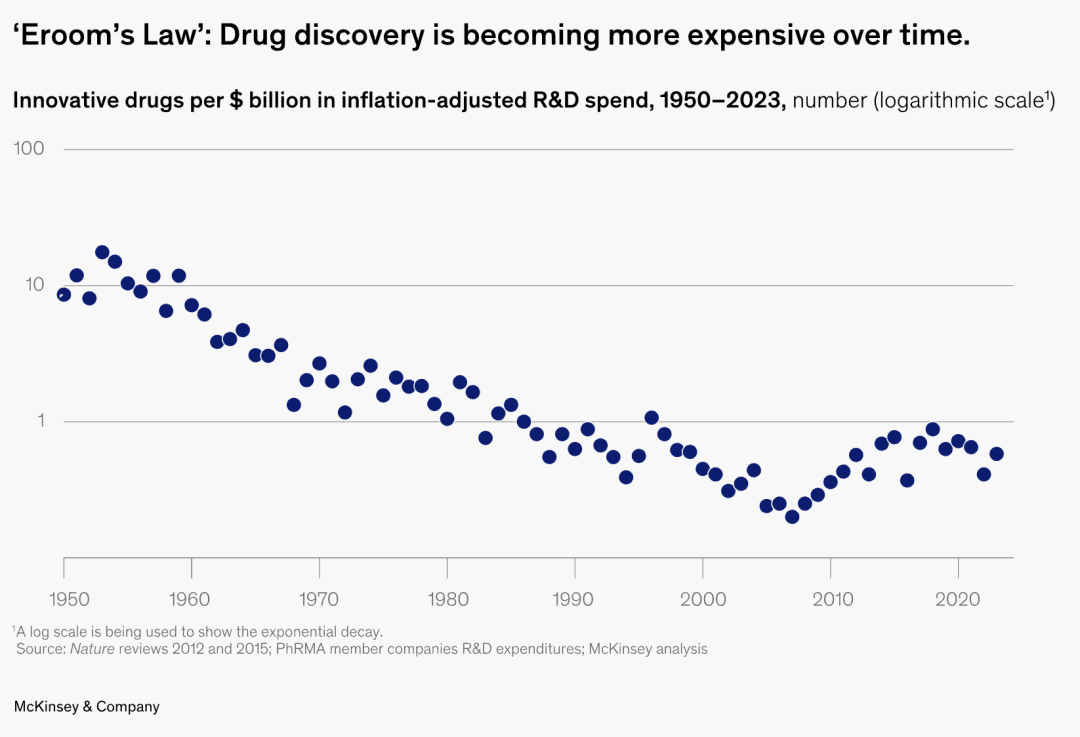
Core Insights - The article posits that while we are in an era of unprecedented technological prosperity, innovation is becoming increasingly difficult to achieve, with AI potentially serving as the key to overcoming this bottleneck [1][8]. Group 1: Innovation Challenges - The cost and difficulty of innovation have escalated globally, affecting various industries [3][5]. - R&D spending in the chip industry is projected to be 18 times higher than in the 1970s by 2024, while the pharmaceutical industry has seen an 80-fold decrease in the number of new drugs developed per $1 billion invested over decades [4][5]. - The overall productivity of R&D in U.S. companies has been declining since the 1950s, a trend observed globally [5][8]. Group 2: AI as a New Pathway - AI is positioned as a transformative force that can propose "questions humans would not think of" and "paths humans would not choose" in the innovation process [11][17]. - AI's ability to generate numerous design candidates and explore unconsidered paths is highlighted, with examples from various fields such as protein synthesis and retail space design [15][16]. Group 3: Revolutionizing Validation - The validation phase of R&D, often the most time-consuming, can be expedited through AI, which can simulate and predict outcomes much faster than traditional methods [19][24]. - AI models, known as surrogate models or digital twins, can replicate complex physical processes with minimal computational resources, significantly reducing the time and cost of validation [26][30]. Group 4: AI's Role in Knowledge Integration - AI is redefining the management of implicit knowledge within organizations, enabling the aggregation of insights from various sources, including social media and internal communications [40][41]. - The ability of AI to process vast amounts of data allows for the identification of trends and user needs that may not be immediately apparent to human researchers [42][44]. Group 5: Industry-Specific Applications - In software and gaming, AI is automating code generation and content creation, significantly reducing development time [54][55]. - In life sciences, AI is being utilized to identify molecular targets and predict protein structures, enhancing drug discovery processes [57][60]. - In materials science, AI accelerates the discovery of new materials by predicting properties without physical experiments [62][63]. - In aerospace and complex manufacturing, AI integrates multi-disciplinary engineering processes, improving design accuracy and efficiency [66][67]. - In consumer goods, AI analyzes consumer feedback to inform product development, reducing the risk of market failure [70][71]. Group 6: Future of Innovation - The article concludes that AI is not just a tool but a collaborative partner in the innovation process, transforming R&D into a co-creative ecosystem rather than a linear workflow [74][80]. - The potential for AI to reverse the decline in innovation rates could significantly impact economic growth and societal well-being in the future [81][82].

事关黄金产业发展!工信部等九部门:到2027年黄金资源量增长5%-10%
Sou Hu Cai Jing· 2025-06-24 03:09
Core Viewpoint - The implementation plan aims to enhance the high-quality development of China's gold industry by leveraging its advantages in smelting, processing, and management, while promoting advancements in high-end, intelligent, green, and safe development [1] Group 1: Industry Overview - China's gold industry has rapidly developed, becoming the world's largest producer and consumer of gold, with a gold production of 377 tons in 2024, maintaining the global lead for 18 consecutive years, and a consumption of 985 tons, leading for 12 consecutive years [3] - Technological advancements have been made, including deep mining reaching over 1,000 meters and improvements in the green treatment of cyanide tailings, as well as breakthroughs in new materials for electronic information and aerospace [3] Group 2: Implementation Goals - By 2027, the plan aims to increase gold resource capacity by 5%-10% and gold and silver production by over 5%, with 70% of mines processing over 500 tons of ore per day [3] - The comprehensive utilization rate of solid waste from gold production is targeted to rise to 35%, and key technologies for mining and extraction are expected to be applied, including those for depths below 2,000 meters and cyanide-free gold extraction [3] Group 3: Technological Innovation - The plan emphasizes enhancing technological innovation in the industry, focusing on high-end new materials for specific applications in next-generation electronic information, and improving product quality through collaborative evaluation with downstream users [4] Group 4: Enterprise Development - The plan encourages enterprises to integrate through capital to form globally competitive groups and to cultivate specialized "little giants" and champion enterprises in the gold and silver new materials sector [4] - Support for digital transformation is highlighted, including the application of digital twins and artificial intelligence for precise resource management and intelligent mining operations [4]

一周一刻钟,大事快评(W112):机器人展会、长城汽车更新
Shenwan Hongyuan Securities· 2025-06-23 10:11
Investment Rating - The industry investment rating is "Overweight" [3][20]. Core Insights - The report highlights significant developments in the robotics sector, particularly in simulation training and sensor technology, indicating a potential increase in industry value density [4][5]. - Great Wall Motors is undergoing a transformation with improved sales performance and a shift towards a scale-oriented pricing strategy, suggesting a strong outlook for net profit in 2024 [4][7][10]. - The report recommends focusing on domestic leading manufacturers and companies with strong performance growth and overseas expansion capabilities in the automotive and robotics sectors [4][10]. Summary by Sections Robotics Exhibition - The robotics exhibition in Hangzhou showcased limited participation from whole machine manufacturers but highlighted advancements in simulation training and sensor technologies [4][5]. - Companies focusing on simulation training data services are emerging, with a business model centered on customized data fees, similar to the approach of Giant Technology using the Omniverse platform [5]. - The glass micro-melting process for torque sensors shows potential to replace traditional six-dimensional sensors, with expected prices in the hundreds of yuan range [6]. Great Wall Motors Update - Great Wall Motors has seen a significant increase in sales for key models, with the Haval brand's new model deliveries reaching 8,000 units in May [7][10]. - The company is shifting its pricing strategy towards high cost-performance, exemplified by the new Ora model priced at 89,800 yuan [7]. - The report anticipates significant advancements in intelligent driving features across various models, enhancing the overall product experience [8][10]. Investment Recommendations - The report suggests investing in leading domestic manufacturers such as BYD, Geely, and XPeng, as well as companies involved in intelligent driving trends [4]. - It also recommends focusing on state-owned enterprise consolidations and component manufacturers with strong growth potential [4][10].

摩尔线程与沐曦集成相继完成上市辅导 很快将冲刺A股
Sou Hu Cai Jing· 2025-06-23 05:34
Group 1 - Muxi Integrated Circuit (Shanghai) Co., Ltd. has completed its listing guidance, with Huatai United as the advisory institution [2] - Moore Threads has also completed its listing guidance, with CITIC Securities as the advisory institution [3] - Both companies are preparing to submit their prospectuses for an A-share listing [4] Group 2 - Moore Threads focuses on the research and design of full-featured GPU chips and related products, supporting AI computing acceleration, 3D graphics rendering, ultra-high-definition video encoding and decoding, physical simulation, and scientific computing [4] - The company aims to meet the growing demand for large model training and inference, facilitating the application of large models, AIGC, scientific computing, digital twins, physical simulation, and the metaverse across various industries [4] - The founder and CEO of Moore Threads, Zhang Jianzhong, controls 44.07% of the company and emphasizes the vast computational power needed for future AI applications beyond just large language models [4][6] Group 3 - Muxi, established in September 2020 in Shanghai, has set up wholly-owned subsidiaries and R&D centers in several cities including Beijing, Nanjing, Chengdu, Hangzhou, Shenzhen, Wuhan, and Changsha [5] - Muxi is dedicated to providing full-stack GPU chips and solutions for heterogeneous computing, applicable in intelligent computing, smart cities, cloud computing, autonomous driving, digital twins, and the metaverse [5] - The company has launched various GPU product lines, including the Xisi® N series for intelligent computing inference, the Xiyun® C series for general computing, and the Xicai® G series for graphics rendering, focusing on high efficiency and versatility [5]
“数字蓝海”起宏图
Liao Ning Ri Bao· 2025-06-23 00:52
Core Insights - The company, Liaoning Hongtu Chuangzhan Surveying and Mapping Co., Ltd., has grown from a small startup with 4 employees and an annual output value of 500,000 yuan to a leading digital enterprise with thousands of employees and a peak annual output value of 800 million yuan, showcasing high growth potential and being recognized as a "gazelle enterprise" in Liaoning Province [1][2] - The company specializes in spatial information big data services and information system development, having obtained over 120 software copyrights and nearly 20 patents, along with more than 100 awards at national and provincial levels [1][3] - The company focuses on core technology areas of the future digital economy, including smart cities, high-precision navigation, autonomous driving, and digital twins, utilizing advanced technologies such as remote sensing, big data, IoT, cloud computing, and AI to provide high-quality, personalized solutions [1][3] Company Achievements - The company was recently recognized by the National Data Bureau as one of the four excellent cases from Liaoning Province for its project on high-quality spatial data collection for rural collective land, which has significantly improved land management efficiency and reduced land dispute rates by 42% [3][4] - The company has established partnerships with universities, including Wuhan University and Shenyang Agricultural University, to foster talent and technological innovation, contributing to the development of the spatial information field [5][6] - The company has obtained various industry certifications, including top-level surveying qualifications and multiple management system certifications, positioning itself as a comprehensive player in the data service market [6] Market Positioning - The company has successfully entered the intelligent driving sector by leveraging its expertise in navigation electronic maps, having obtained a top-level qualification in this area, and has built a robust service framework for various navigation and autonomous driving companies [7][8] - The company is actively investing in research and development in cutting-edge technologies related to three-dimensional digital twin data processing and sensor fusion, aiming to enhance the intelligence and adaptability of its smart driving maps [8][9] - The company has undergone mixed-ownership reform, setting a precedent for private surveying enterprises in the industry, reflecting its commitment to innovation and adaptability in a competitive market [9]
起重机变聪明了
He Nan Ri Bao· 2025-06-20 23:39
Core Insights - Wehua Group has evolved from a small town factory to the world's largest industrial crane manufacturer, with projected revenue of 28.916 billion yuan in 2024 [1] - The company has developed an intelligent control system, AICrane, which enhances operational efficiency and precision in crane operations [1][3] - Wehua Group has invested 4% to 6% of its sales revenue into R&D for 20 consecutive years, achieving 100% domestic replacement of core components [2] Group 1 - The AICrane system utilizes laser scanning and digital twin technology for precise crane operations, showcasing a significant advancement in flexible manufacturing [1] - The world's first large-scale structural component robotic welding production line operates efficiently, producing one double-beam crane per hour [1] - Wehua Group's innovations are not limited to cranes; they have developed intelligent systems applicable in various high-end sectors, including aerospace and nuclear power [3] Group 2 - The company has established 33 national and provincial R&D platforms and has received over 150 provincial and ministerial science and technology progress awards [3] - The ASW intelligent positioning system allows for continuous multi-target positioning, enhancing operational safety and efficiency [3] - Wehua Group's advancements represent a significant shift from traditional manufacturing to intelligent manufacturing in China [3]
天润科技(430564) - 投资者关系活动记录表
2025-06-20 12:45
Group 1: Investor Relations Activities - The company participated in a broker strategy meeting from June 17 to June 18, 2025, at the Ritz-Carlton Hotel in Beijing, with various financial institutions attending [3][4]. Group 2: Core Business Directions - The company focuses on remote sensing and geographic information data services, including spatial information system development and integration [4]. - Key business areas include: - Construction of spatiotemporal information infrastructure for smart city development and resource management [4]. - Application of remote sensing technology for natural resource monitoring and disaster warning [4]. - Development of high-precision 3D models and digital twin services [4]. - Integration of digital and physical applications in cultural heritage protection and virtual reality [4]. - Cloud platform services for various industries [4][5]. Group 3: R&D Innovations - In 2024, the company enhanced remote sensing applications and digital twin technology, adding over 300 city data sets to its information model platform [5]. - The company upgraded its multi-source remote sensing interpretation platform, improving accuracy and application levels [5]. - New products include an intelligent pipeline inspection system, contributing to smart city and cultural tourism applications [5][6]. Group 4: Long-term Business Development Plans - The company aims to strengthen its business through: - Expanding spatiotemporal information infrastructure and cloud service platforms [6]. - Deepening the remote sensing industry chain and forming strategic partnerships [6]. - Building a smart application ecosystem for various sectors [6]. - Exploring innovative applications for individual users, such as AR navigation and online tourism [7]. Group 5: Market Expansion Strategies - The company plans to optimize its customer structure and focus on sectors like aerospace, energy, and emergency services [7]. - It aims to establish a nationwide service network and enhance localized service capabilities [7]. - Internationally, the company will leverage its Hong Kong location to promote global applications of spatiotemporal information technology [7]. Group 6: Future R&D Directions - The company will focus on: - Enhancing multi-source remote sensing data integration and analysis capabilities [8]. - Applying AI in remote sensing image interpretation [8]. - Advancing digital twin technology for urban planning and disaster management [8]. - Exploring digital content industry development for various sectors [8]. Group 7: Industry Development Status - The spatiotemporal information industry is growing, driven by policy support and technological advancements, with increasing demand in smart cities and low-altitude economies [6][8].
开放的、软件定义的自动化赋能,施耐德电气塑造智慧物流“新范式”
Zhong Guo Chan Ye Jing Ji Xin Xi Wang· 2025-06-20 04:26
Core Insights - Schneider Electric's Beijing Logistics Center is a modern logistics hub that utilizes advanced technologies such as software-defined automation and digital twin to set a benchmark for smart logistics [1][7] - The logistics center is designed to meet the evolving demands of manufacturing and sales, focusing on flexibility, efficiency, and sustainability in its operations [2][7] Group 1: Technological Innovations - The logistics center has upgraded its operations by implementing the EcoStruxure Automation Expert (EAE) platform, which enhances flexibility and efficiency in programming and deployment [3][4] - EAE allows for modular programming, significantly reducing the time and effort required for system deployment, with a 20% reduction in deployment cycles compared to traditional methods [5] - The platform's open nature enables seamless integration with various industrial devices and systems, breaking down vendor-specific barriers and enhancing operational efficiency [4][5] Group 2: Operational Efficiency - The logistics center processes nearly 10 billion in sales annually, handling a diverse range of goods with complex logistics flows [2] - EAE has enabled the center to achieve over 20,000 inbound and outbound tasks daily, with 100% accuracy in deliveries and a 99% operational stability rate [5] - The implementation of digital twin technology has led to an 8% increase in storage utilization, a 15% improvement in material delivery efficiency, and an 11% reduction in operational costs [6] Group 3: Sustainability and Future Outlook - The logistics center is actively optimizing energy management to align with carbon reduction goals, contributing to sustainable development [2][6] - Schneider Electric plans to continue exploring advanced digital solutions to further enhance the logistics industry's smart and green transformation [7]
雄安新区首创智能管网检测新模式
Huan Qiu Wang Zi Xun· 2025-06-20 02:19
来源:河北日报 原标题:雄安新区首创智能管网检测新模式 近日,一个搭载多模块检测设备与AI(人工智能)算法的机器人在雄安新区容西片区地下管网投入使 用。这标志着雄安新区率先将市政管网全地形智能检测系统投入使用,为及时发现和处理城市地下生命 线"看不见的隐患"提供了创新解决方案。 项目团队融合多模态感知技术,构建起立体检测网络。管道剖面声呐每秒采集2000个三维坐标点,配合 高帧率摄像头,可自动生成高精度的管网数字孪生模型。此项综合技术的应用,使检测效率大幅度提 升,误检率大幅度降低,相比传统运维方式,运维成本降低53%。 此项技术的突破不仅提升了检测与运维的基础能力,更在智能化层面实现跨越式发展。在雄安新区数字 城市建设标准框架下,该项技术通过数十万个缺陷样本训练,能自动识别各类管道病害,就像给管网 做"CT检查",AI诊断准确率超90%。雄安集团水务有限公司相关负责人表示:"这套系统让我们对地下 管网维护实现了从被动抢险到主动防护的转变,为智慧城市运营提供了可推广、可复制的经验。" 据悉,此项装备的带水作业、防爆设计等技术填补了国内空白。(记者郝金钰) "传统管道检测需要停水断流,且作业环境复杂,不仅影响居 ...
AI在工业铺开应用,英伟达的“AI工厂”并非唯一解
第一财经· 2025-06-19 13:47
Core Viewpoint - Nvidia is increasingly emphasizing the concept of AI factories, which are designed to leverage AI for value creation, contrasting with traditional data centers that focus on general computing [1][2]. Group 1: Nvidia's AI Factory Concept - Nvidia's CEO Jensen Huang announced collaborations to build AI factories in Taiwan and Germany, featuring supercomputers equipped with 10,000 Blackwell GPUs [1]. - The AI factory concept includes a computational center and a platform to upgrade factories into AI factories, with a focus on simulation and digital twin technologies [4]. - The Omniverse platform is integral to Nvidia's strategy, allowing manufacturers to utilize AI for simulation and digital twin applications [2][3]. Group 2: Industry Applications and Collaborations - Various manufacturers are integrating Nvidia's AI technology through software from companies like Siemens and Ansys, enhancing applications in autonomous vehicle simulations and digital factory planning [3]. - Companies like Schaeffler and BMW are utilizing Nvidia's technology for real-time collaboration and optimization in manufacturing systems [3]. Group 3: AI Model Utilization - The industrial sector has been using small models for AI applications prior to the emergence of large models, focusing on data intelligence and visual intelligence [6][10]. - Small models are expected to continue to dominate industrial AI spending, with estimates suggesting they will account for 60-70% of the market [10][11]. Group 4: Cloud and Computational Needs - Nvidia's approach to building large-scale AI clouds is one option, but many companies prefer private cloud solutions due to data security concerns [13][14]. - The demand for computational power is expected to grow as AI applications become more prevalent, although current infrastructure may not be a bottleneck [15].