
战略性新兴产业

Search documents
深化“十五五”时期未来产业领域方向遴选工作
Ke Ji Ri Bao· 2025-07-21 07:41
Core Viewpoint - The emphasis on developing new quality productivity during the "14th Five-Year Plan" period, with a focus on technological innovation and the transformation of traditional industries, is crucial for building a modern industrial system [1]. Group 1: Importance of Future Industry Selection - The selection of future industry directions is a key task for the "14th Five-Year Plan" period, reflecting the strategic deployment and development orientation of the national modern industrial system [2]. - The concept of "future industries" was first introduced in the "14th Five-Year Plan," planning for six major directions including brain-like intelligence, quantum information, and hydrogen energy [2]. - The evolution from the "12th Five-Year Plan" to the "14th Five-Year Plan" demonstrates China's industrial development hierarchy and the top-level design for a modern industrial system [2]. Group 2: Characteristics and Challenges of Future Industries - Future industries are characterized by their frontier, growth, disruptive, and uncertain nature, requiring a deep understanding of global technological innovation and industrial transformation trends [3]. - The current challenges include a lack of unified guidance from the national level for selecting future industry directions, leading to fragmented efforts across different departments and regions [6]. - Local governments exhibit a tendency to converge in their future industry layouts, lacking clear focus and leading to resource misallocation [7]. Group 3: Recommendations for Improvement - Strengthening national planning and guidance for future industry direction selection is essential, including the establishment of a dynamic monitoring and evaluation system [8]. - Local selections should be tailored to regional technological levels and industrial foundations, focusing on a limited number of key industries to avoid redundancy [8]. - Enhancing the scientific standards and methods for selecting future industry directions is necessary, incorporating a comprehensive evaluation system that considers both technological supply and market demand [9].
新动能集聚 新业态涌现 新产业壮大(活力中国调研行)
Ren Min Ri Bao· 2025-07-20 21:52
Group 1: Industry Innovation and Growth - The commercial aerospace industry in Beijing has surpassed a scale of 260 billion yuan, with the production of medium-sized commercial satellites occurring every three days by Galaxy Aerospace [1] - Guangdong's industrial robot production reached over 240,000 units last year, marking a year-on-year growth of 31.2%, accounting for 44% of the national market [1] - In Anhui, the production of new energy vehicles doubled compared to two years ago, with 467,000 units produced from January to May this year [1] Group 2: Technological Advancements - The Guangdong Aerospace Technology Research Institute developed a single-person jetpack capable of reaching speeds of 100 km/h, suitable for various applications including emergency rescue [3] - Anhui is establishing ten provincial future industry pilot zones focusing on quantum technology, aerospace information, and general intelligence, with over 100 key enterprises in the first quarter of this year [4] - The use of flexible solar wings in satellites by Galaxy Aerospace has reduced thickness to 1/20 of rigid solar wings, enhancing energy absorption [7] Group 3: Future Industry Development - Beijing has identified 23 future industry development directions, including general artificial intelligence and the metaverse, with over 2,400 AI companies and a core industry scale of nearly 350 billion yuan [5] - The establishment of a 10 billion yuan angel fund in Guangzhou supports technology transfer and innovation, with over 1,100 direct investment projects reserved [3] - Anhui's strategic emerging industries have seen an average annual growth of 16.1% since the 14th Five-Year Plan, with the output value accounting for 43.6% of industrial output [8] Group 4: Traditional Industry Transformation - The Beijing Economic and Technological Development Zone has implemented intelligent infrastructure across 600 square kilometers, facilitating the transition to high-end manufacturing [9] - The application of 5G technology in the Tongling Nonferrous Metals Group has led to a 90% automation rate in production lines [10] - Guangdong has created 490 national green factories and aims for a 2.8% reduction in energy consumption for industrial units by 2024 [11]
AIC基金跑步进场,是挤出吗?
母基金研究中心· 2025-07-20 08:50
Core Viewpoint - The article discusses the expansion of the pilot program for Asset Investment Companies (AICs) in China, highlighting their shift from market-oriented debt-to-equity swaps to direct equity investments, which is expected to enhance capital market support for technological innovation and industrial upgrading [2][3][11]. Group 1: Expansion of AICs - In September 2024, the National Financial Supervision Administration announced the expansion of AICs' direct equity investment pilot program from Shanghai to 18 major cities, increasing the proportion of equity investment from 4% to 10% of total assets [2]. - By the end of 2024, five AICs had established over 30 new equity investment funds, with a total signed fund intention amount exceeding 4,200 billion yuan [2]. Group 2: Transition to Equity Investment - AICs were initially established in 2017 to engage primarily in market-oriented debt-to-equity swaps, with total assets reaching 5,869.90 billion yuan by June 2024 [3][4]. - In 2020, AICs began exploring pure equity investment business, establishing subsidiary institutions to manage these investments [6]. Group 3: Role of Patient Capital - AICs are becoming a significant source of patient capital, which is essential for long-term investments in high-tech enterprises, aligning with government policies encouraging the development of such capital [11][12]. - The funding sources for AICs include capital contributions, targeted reserve requirements, interbank loans, and issuance of financial bonds, indicating a robust financial backing for their investment activities [12]. Group 4: Focus on Strategic Emerging Industries - AICs are focusing their equity investments on strategic emerging industries such as integrated circuits, new energy, and high-end equipment, contributing to the advancement of China's semiconductor industry [14][15]. - New funds established in cities like Shenzhen and Wuhan are targeting sectors like artificial intelligence and new materials, reflecting a strategic alignment with national priorities [15][16]. Group 5: Investment Ecosystem Dynamics - AICs leverage their parent banks' resources to identify quality investment targets and provide integrated financial services, creating a closed-loop ecosystem of data, capital, and industry [20]. - While AICs' entry into the investment market may initially pressure private capital, a long-term differentiation between "short money" and "long money" is expected to emerge, allowing both to coexist and thrive in different investment tracks [20][21].


这个市一口气设立三支百亿引导基金
母基金研究中心· 2025-07-18 12:03
Core Insights - The article discusses the recent developments in China's mother fund industry, highlighting a total management scale of 272.34 billion yuan, with investments focused on green low-carbon, marine economy, and high-end equipment manufacturing [1][2]. Group 1: Fund Establishments - Shandong: Three guiding funds, each with a scale of 10 billion yuan, were established in Qingdao [3][4]. - Jiangsu: A new industrial special fund with a scale of 155 billion yuan has been officially launched [7][17]. - Inner Mongolia: The first national-level sub-fund has been established with a scale of 1.6 billion yuan [18]. - Yunnan: The Yunnan Province Advanced Manufacturing Equity Investment Mother Fund has been set up with a scale of 50.08 million yuan [23][24]. - Guangdong: The Guangdong-Huizhou Industrial Investment Mother Fund has been established with a total scale of 1 billion yuan [25][26]. - Henan: The Jiyuan Industrial Mother Fund is set to be established [33]. - Shaanxi: The total scale of the Shaanxi Provincial Government Investment Guiding Fund has surpassed 100 billion yuan [34]. Group 2: Fund Characteristics and Focus Areas - Jiangsu's third batch of industrial special funds focuses on strategic emerging industries such as new energy, integrated circuits, and green technology [17][18]. - The national small and medium-sized enterprise development fund aims to support advanced manufacturing, information technology, and life sciences sectors [18]. - The Yunnan fund aims to enhance the competitiveness of the manufacturing sector and promote the development of strategic emerging industries [24]. - The Guangdong fund focuses on attracting key enterprises to enhance local economic development [26]. Group 3: Strategic Collaborations - Jiangsu's cooperation with China Chengtong Holdings Group aims to establish a 10 billion yuan fund to support technological innovation and industrial upgrades [19][22]. - The collaboration between Zhejiang Securities and the government of Huizhou City aims to deepen industry development and enhance investment efficiency [25][26]. - The establishment of the 明月湖科创基金丛林 in Chongqing aims to integrate innovation, industry, and capital to foster a new production capacity [37][38].


央企上半年成绩单来了!完成固定投资2万亿元,战新产业投资占比近四成|2025中国经济半年报
Hua Xia Shi Bao· 2025-07-18 10:04
Core Insights - The overall economic operation of central enterprises has remained stable in the first half of the year, with key indicators such as electricity generation, crude oil production, and container throughput showing steady growth [2][6] - Central enterprises completed fixed asset investments of 2 trillion yuan in the first half of the year, which is nearly half of last year's total investment, indicating a strong commitment to long-term strategic planning [3][4] - The investment in strategic emerging industries accounted for nearly 40% of total investments, reflecting a significant focus on innovation and modernization [5][6] Investment and Economic Performance - Central enterprises achieved a value-added output of 5.2 trillion yuan from January to June, demonstrating their role as a pillar of the national economy [2] - The fixed asset investment of 2 trillion yuan is crucial for sustaining development, focusing on industrial renewal, technological innovation, and equipment upgrades [3][4] - The investment in strategic emerging industries increased by 6.6% year-on-year in the first quarter, with over 800 application scenarios developed under the "Artificial Intelligence+" initiative [5][6] Strategic Focus and Reforms - The deepening reform of state-owned enterprises is on track, with an average completion rate of over 80% for key reform tasks as of the end of the first quarter [7] - The State-owned Assets Supervision and Administration Commission (SASAC) emphasizes enhancing core functions and competitiveness while ensuring stable operations and optimizing investment structures [7][8] - The focus for the second half of the year includes fostering new productive forces, improving overall productivity, and transitioning to innovation-driven growth [8][9]

厦门同安区属国企直投基金招GP.
Sou Hu Cai Jing· 2025-07-18 06:35
Core Viewpoint - The establishment of a state-owned enterprise direct investment fund in Tong'an District aims to support the development of high-quality small and medium-sized enterprises through state-owned capital participation [1] Fund Basic Information - Fund Name: Xiamen Su Song No.1 Innovation and Entrepreneurship Investment Fund Partnership (Limited Partnership) (tentative name, subject to business registration) [2] - Fund Size: RMB 200 million [2] - Contribution Structure: The fund adopts a dual general partner (GP) model, with Xiamen Chen Shi Investment Co., Ltd. as one of the general partners and Xiamen Tongyu Venture Capital Co., Ltd. as the limited partner [2] Investment Arrangement - Initial capital contribution shall not exceed 10% of the total fund size, with subsequent payments based on project investment progress [3] - Duration: 10 years, including a 5-year investment period and a 5-year exit period, with the possibility of extending twice for one year each [3] - Management Fees: Up to 2% per year during the investment period and exit period, with no management fees during the extension period [3] Investment Focus - Investment areas include strategic emerging industries such as new generation information technology, artificial intelligence, biotechnology, new energy, new materials, high-end equipment, and green environmental protection [3] - Investment will primarily target high-quality enterprises registered or operating in Tong'an District, with the possibility of investing in external quality enterprises with relevant industry connections [3] Profit Distribution - Profit distribution follows a "return of capital first, then profit sharing" principle, with a threshold return of 6% per year for all investors [3] - Excess returns are distributed between general partners and all partners at a ratio of 20% to 80% [3] Investment Restrictions - Single investment shall not exceed 20% of the total fund size, and the fund shall not become the largest shareholder of the invested enterprise [4] - Fund operations must comply with legal regulations and partnership agreements [4] Management Institution Selection Criteria - Fund management institutions must be registered in Fujian Province and possess qualifications as private equity fund managers [5] - Institutions should have a minimum paid-in capital of RMB 10 million and a management team with at least three members having over five years of relevant experience [6][7] Selection Process - The selection process includes public solicitation, submission of application materials, preliminary review, expert evaluation, and final decision announcement [10][11][12][13][14]
央企上半年“成绩单”发布,完成固定资产投资2万亿
Di Yi Cai Jing· 2025-07-18 05:38
Core Viewpoint - The State-owned Assets Supervision and Administration Commission (SASAC) emphasizes the need for central enterprises to accelerate the cultivation of new productive forces, aiming to create new momentum and advantages for corporate reform and development [1][4]. Group 1: Economic Performance - In the first half of the year, central enterprises achieved a value-added output of 5.2 trillion yuan and completed fixed asset investments of 2 trillion yuan, with investments in strategic emerging industries remaining at a high level [1][2]. - Key operational metrics such as electricity generation, crude oil production, air transport turnover, and container throughput have all shown steady year-on-year increases, reinforcing the role of central enterprises as a pillar of the national economy [1]. Group 2: Strategic Goals and Initiatives - SASAC has set a 2025 operational goal for central enterprises, termed "one increase and five stability," which includes stable profit growth, stable asset-liability ratios, and improvements in net asset return rate, R&D expenditure intensity, labor productivity, and revenue collection rate [3]. - The focus for the second half of the year includes optimizing investment structures, enhancing investment quality and returns, ensuring national security, and promoting collaborative development to support market entities and improve livelihoods [3][4]. Group 3: Innovation and Reform - The SASAC highlights the importance of developing new productive forces and increasing total factor productivity to transition from "sweat-type growth" driven by extensive input to "wisdom-type growth" driven by technological innovation [4][5]. - There is an expectation for increased investment in strategic emerging industries, particularly in key areas like renewable energy, with a push for more projects and funding to be realized [4][6]. - The SASAC aims to foster an environment conducive to the growth of new industries and business models, while also addressing existing challenges in the integration of technology and industry innovation [5][6]. Group 4: Reform Progress - As of the first quarter of this year, the average completion rate of key reform tasks under the deepening reform action plan for state-owned enterprises has exceeded 80% [7]. - Future reform efforts will focus on balancing flexibility and control, optimizing policies for new fields, and ensuring effective management of financial flows and risk [7].
2994.8亿斤、5.2万亿元、22.4亿人次……看中国经济“答卷”中的“含金量”
Yang Shi Wang· 2025-07-18 01:24
Agriculture and Rural Economy - The overall operation of China's agriculture and rural economy is stable and improving in the first half of the year [1][3] - Summer grain production reached 299.48 million tons, marking the second highest yield in history [3] - The average yield of summer grain per mu is 375.6 kg, an increase of 0.1 kg from last year [3] - Early rice harvest is approximately 60% complete, with a good harvest expected [3] - The area for autumn grain is expected to slightly increase, with normal growth conditions [3] Mechanization and Technology - The comprehensive mechanization rate for crop farming has exceeded 75% nationwide [4][6] - The mechanization rates for major crops are over 97% for wheat, 91% for corn, and 88% for rice, indicating nearly full mechanization [6] Disaster Resilience and Food Security - China's agricultural disaster resistance capabilities have improved, enhancing the resilience of food production [7][9] - Over 1 billion mu of high-standard farmland has been established, and agricultural water conservancy facilities are being improved [9] - More than 3,300 regional agricultural emergency rescue centers have been built, along with 13,600 emergency service teams [9] Supply of Agricultural Products - The supply of "vegetable basket" products is abundant, with an increase in both the area and yield of vegetables in the first half of the year [11] - The area planted for vegetables reached 11 million mu, with a production of 26.23 million tons, showing significant year-on-year growth [11] - The total meat production (pork, beef, lamb, and poultry) reached 48.43 million tons, a year-on-year increase of 2.8% [11] Poverty Alleviation and Rural Development - Achievements in poverty alleviation are being consolidated, with over 6.8 million monitored individuals stabilized against falling back into poverty [12][14] - The scale of rural labor employment reached 32.83 million [14] - Rural reforms are deepening, with the extension of land contracts for another 30 years in seven provinces [14] - The value-added of the agricultural product processing industry increased by 7.5% in the first half of the year [14] Economic Performance of Central Enterprises - Central enterprises achieved a value-added of 5.2 trillion yuan in the first half of the year, a year-on-year increase of 0.5% [18] - The total profit reached 1.4 trillion yuan, with a profit margin of 7.4% [18] - R&D expenditure for central enterprises was 413.98 billion yuan, maintaining a stable investment intensity compared to last year [18] - Investment in strategic emerging industries by central enterprises reached 892.4 billion yuan, accounting for 38% of total investment [20] Railway Transportation - The national railway sent 2.24 billion passengers in the first half of the year, a year-on-year increase of 6.7%, setting a historical record for the same period [22] - The average daily operation of passenger trains reached 11,183, an increase of 7.5% [22] - The number of foreign passengers transported by rail reached 9.148 million, a year-on-year increase of 30.1% [22]
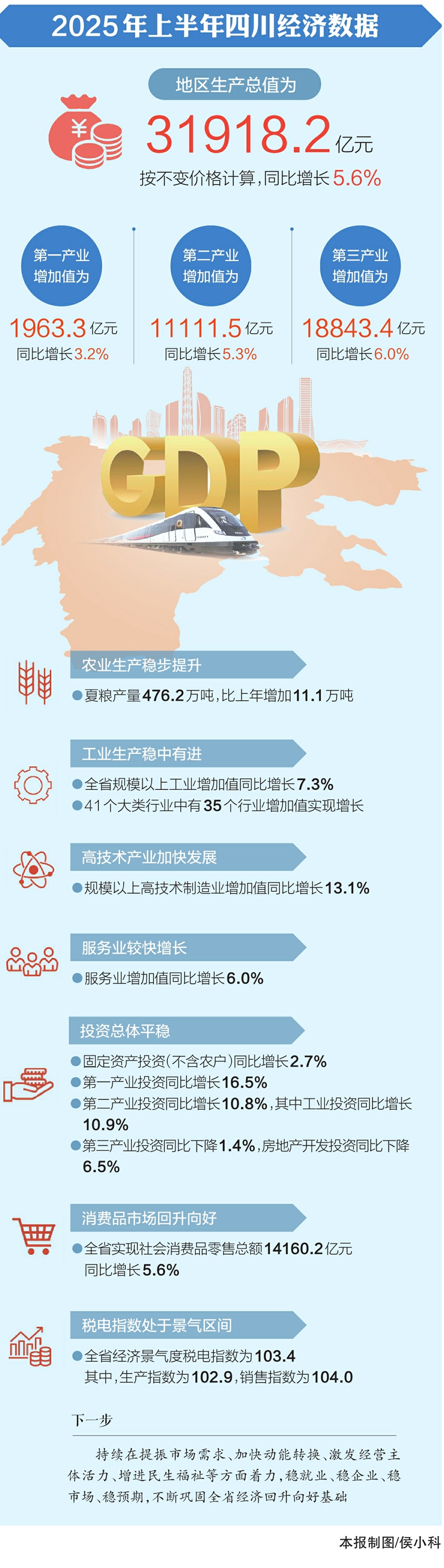
2025年四川经济“半年报”发布,透视经济发展“期中考”成绩单 “含新量”“含绿量”提升发展“含金量”
Si Chuan Ri Bao· 2025-07-18 00:24
Economic Overview - The GDP of Sichuan for the first half of 2025 reached 31,918.2 billion yuan, with a year-on-year growth of 5.6% [2][5] - The growth rate is 0.1 percentage points higher than the first quarter and 0.3 percentage points above the national average [6] Sector Performance - The primary industry added value was 1,963.3 billion yuan, growing by 3.2% year-on-year [2] - The secondary industry added value was 18,843.4 billion yuan, with a growth of 5.3% [2] - The tertiary industry added value was 1,111.5 billion yuan, increasing by 6.0% [2] Agricultural Production - Summer grain production reached 4.762 million tons, an increase of 111,000 tons compared to the previous year [3] Industrial Growth - The industrial added value for large-scale enterprises grew by 7.3% year-on-year, with 35 out of 41 major industries reporting growth [8] - The automotive manufacturing sector saw a significant increase, with added value growing by 21.0% [8] - High-tech manufacturing added value increased by 13.1% [8] Service Sector - The service sector's added value grew by 6.0%, contributing 62.3% to the overall economic growth [6][7] - The rental and business service industry increased by 12.4%, while information transmission, software, and IT services grew by 10.9% [7] Investment Trends - Fixed asset investment (excluding rural households) increased by 2.7% year-on-year [3] - Investment in the primary industry rose by 16.5%, while the secondary industry saw a 10.8% increase [3] - The third industry investment decreased by 1.4%, with real estate development investment down by 6.5% [3] Consumer Market - The total retail sales of consumer goods reached 14,160.2 billion yuan, reflecting a year-on-year growth of 5.6% [4] Policy Impact - The implementation of "two new" policies led to a 50.8% increase in retail sales of communication equipment among large enterprises [11] - Private investment turned around from a decline of 1.3% last year to a growth of 2.4% this year [12]
海淀将在街镇建立营商环境工作站
Sou Hu Cai Jing· 2025-07-17 23:25
Core Insights - Haidian District has shown significant economic vitality with 14,800 new registered companies in the first half of the year, including 6,902 technology companies, indicating a robust innovation environment [1][2] - The district has introduced the "Haidian Eight Measures" to enhance business resilience, innovation vitality, and global competitiveness [2][3] Group 1: Economic Development - Haidian District's economic output has consistently ranked first in the city, supported by a strong economic foundation [1] - The district is accelerating the construction of a modern industrial system characterized by "1+X+1," focusing on becoming a global hub for artificial intelligence innovation [1][2] Group 2: Artificial Intelligence and Emerging Industries - Haidian leads the nation in the artificial intelligence sector with over 1,900 AI companies and 95 registered large models, accounting for nearly 70% of the city's total [2] - The district is fostering strategic emerging industry clusters in fields such as healthcare, integrated circuits, and commercial aerospace, and has been approved as the city's first pilot area for future industries [2] Group 3: Business Support Measures - The "Haidian Eight Measures" include 9 specific initiatives aimed at reducing hidden costs for businesses through institutional innovation and technological empowerment [2][3] - Establishment of business environment workstations in neighborhoods to provide direct policy consultation and resource matching for companies [2][3] Group 4: Talent Development - Haidian District has a talent pool of 2.0045 million, representing about one-quarter of the city's total, and houses 646 academicians, accounting for 35.8% of the national total [3] - The district is piloting a youth talent innovation and entrepreneurship ecosystem, offering various housing options and financial support for talent development [3] Group 5: Innovation Ecosystem - The district is developing China's first artificial intelligence innovation district, creating 100 AI demonstration application scenarios to support talent development [4] - Initiatives include hosting international forums and forming alliances to enhance collaboration with global talent organizations [4]