AI芯片

Search documents
英伟达、AMD大涨,GPU出口“松绑”后仍需面临激烈竞争
第一财经· 2025-07-16 00:00
Core Viewpoint - The article discusses the recent developments in the AI chip market, particularly focusing on AMD and NVIDIA's efforts to re-enter the Chinese market and the competitive landscape they face from domestic suppliers and ASIC chip manufacturers [1][2]. Group 1: Market Developments - NVIDIA's announcement to resume sales of its AI chip H20 in China and the introduction of a new GPU for the Chinese market has positively impacted its stock price, which rose by 4.04% [1]. - AMD's MI308 product is under review for export to China, with potential losses of $800 million due to previous export restrictions [2]. - In 2024, sales from China accounted for over 24% of AMD's total revenue, highlighting the importance of the Chinese market for both companies [2]. Group 2: Competitive Landscape - The competition in the AI chip market is intensifying, with domestic Chinese suppliers increasing their market share. IDC data indicates that domestic AI chip market share rose to over 40% in the first half of the year, while NVIDIA's share was 65.2% last year [2][3]. - TrendForce predicts that the market share of foreign AI server chips will decrease from 63% last year to 41.5% by 2025, indicating a shift towards domestic suppliers [3]. - Domestic cloud providers are currently relying on NVIDIA chips but are also exploring self-developed ASIC chips as alternatives [3]. Group 3: Strategic Initiatives - NVIDIA is actively promoting the construction of "AI factories" globally, targeting industrial enterprises to expand its market presence [4]. - AMD is working to integrate its chips into data centers of major AI firms like OpenAI and Meta, while also collaborating with governments and research institutions to build high-performance computing and AI infrastructure [4].


英伟达、AMD股价开盘大涨,GPU出口“松绑”后仍需面临激烈竞争
Di Yi Cai Jing· 2025-07-15 14:36
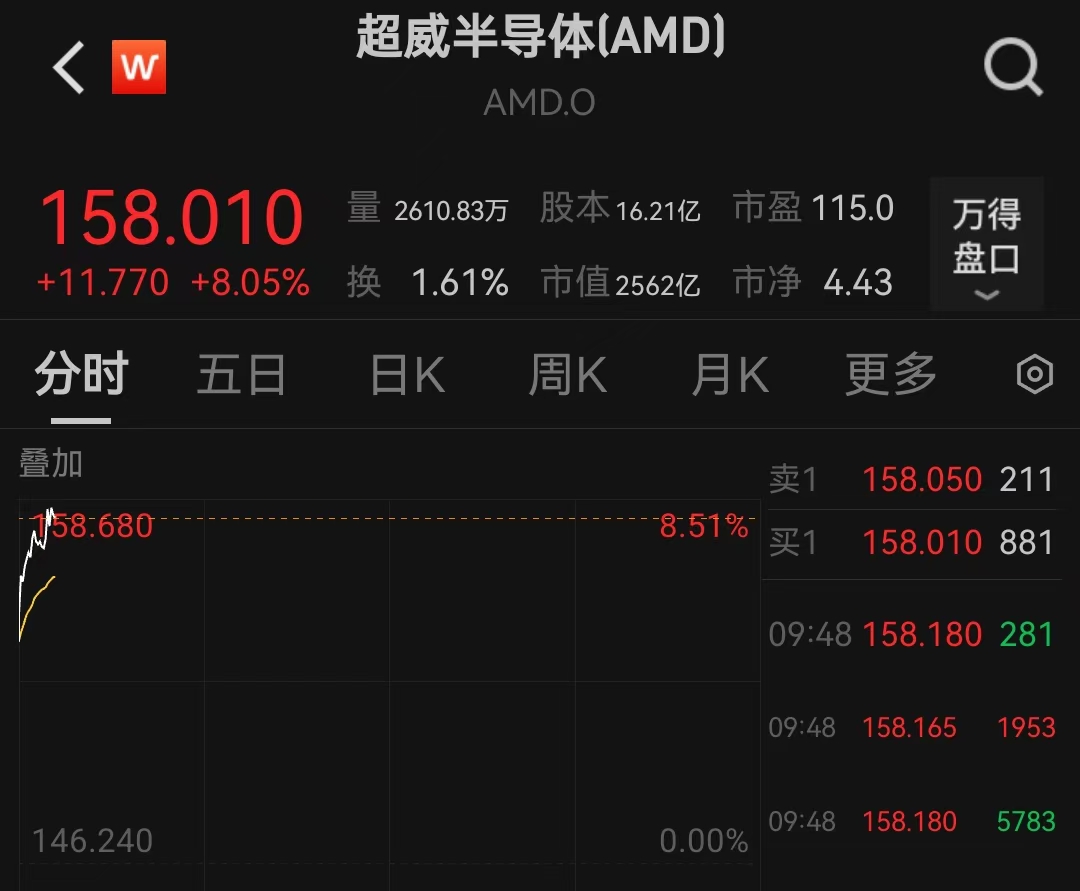
在美国出口限制、国内芯片厂商抢占市场等因素作用下,一些市场机构预计,国内的进口AI芯片的市场份额将下降。 美股周二开盘,AMD股价涨超8%,英伟达也涨超4%。消息面上,英伟达今日宣布将恢复AI芯片H20在中国的销售,并将推出面向中国市场的全新GPU。 随后,又有消息称,美国商务部将对AMD MI308产品的许可申请进行审核,审核通过后AMD将向中国运送MI308。对于该消息的真实性,截至发稿前, AMD相关负责人仍未向记者明确回复。 | 超威半导体(AMD) < W | | | --- | --- | | AMD.O | | | 1 5 8 . 0 1 0 量 2610.83万 股本 16.21亿 市盈 115.0 | 万得 | | +11.770 +8.05% 换 1.61% 市值2562亿 市净 4.43 | 盘口 | | स्टेबिय 五日 日K 周K 月K 更多 | | | 叠加 英1 | 158.050 211 | | 158.680 | -----8.51% 买1 158.010 881 | | 09:48 158.180 281 | | | 09:48 158.165 1953 | | | 1 ...
7月公募持续调研高新科技企业!
券商中国· 2025-07-15 13:43
Core Viewpoint - The future movements of high-tech companies continue to attract investor attention, particularly in the fields of smart manufacturing, AI chips, and humanoid robots [1][2]. Group 1: Company Research - Leading public funds such as China Europe Fund, E Fund, and Huatai-PB Fund have recently conducted intensive research on companies like Taotao Automotive, Juguang Technology, and Lexin Technology, focusing on their advancements in cutting-edge fields [2]. - Taotao Automotive, a high-tech enterprise specializing in electric vehicles and related products, is entering the humanoid robot industry to support its smart transformation [3][4]. - Juguang Technology, established in 2002, provides high-end analytical instruments and solutions across various industries, with a focus on the demand for mass spectrometers and the impact of "dual carbon" policies [5][6]. - Lexin Technology, a global fabless semiconductor company, has seen significant interest in its AI edge chips, which have generated revenues in the hundreds of millions, and emphasizes a diversified product strategy [7][8][9]. Group 2: Industry Trends - The investment community is particularly interested in the technological upgrade paths, policy implementation timelines, and the commercialization potential of new businesses in the high-tech sector [2]. - Companies are committed to steadily advancing their strategies while focusing on long-term technological accumulation and industry collaboration [2].




信达证券:英伟达(NVDA.US)H20解禁 或驱动供应链业绩进一步提升
智通财经网· 2025-07-15 07:48
Core Viewpoint - Nvidia's CEO Jensen Huang announced the submission of an application to resume sales of the H20 GPU to China, with the U.S. government guaranteeing the issuance of the necessary license, aiming for prompt delivery [1][2] Group 1: H20 GPU Resumption - The resumption of H20 GPU sales is expected to alleviate the backlog of computing power demand in China, which had been impacted by previous licensing uncertainties [1][3] - The H20 chip, a simplified version of the H100, is designed to meet U.S. export control policies and is crucial for AI applications in China, despite having only one-sixth the computing power of the H100 [2][3] Group 2: Impact on Supply Chain - The recovery of H20 supply is likely to enhance visibility and shipment rhythm for Nvidia's core suppliers, potentially restoring previous pessimistic expectations and driving performance growth in the second half of the year [3] Group 3: Investment Opportunities - Suggested companies to watch include those in the overseas AI supply chain such as Industrial Fulian, Huadian Technology, and others, as well as domestic AI supply chain companies like Chipone, Cambricon, and others [4]

H20获得“口头放行”之后,英伟达需要重新认识中国市场
经济观察报· 2025-07-15 07:47
Core Viewpoint - NVIDIA is seeking to resume the sale of its H20 GPU in China, having received assurances from the U.S. government regarding the granting of necessary licenses, which is crucial for initiating commercial activities in the Chinese market [2][10]. Group 1: H20 GPU Development and Compliance - The H20 GPU was developed in response to U.S. export control regulations that were updated in October 2023, which set specific performance thresholds for chips sold to China [5]. - The H20's design adheres to the U.S. Bureau of Industry and Security (BIS) regulations, ensuring its total processing performance (TPP) is below the 4800 TPP limit, despite its performance being significantly lower than the banned H100 chip [6][8]. - The H20 features a floating-point performance of 148 TFLOPS, compared to the H100's 1979 TFLOPS, and has increased HBM3 memory capacity from 80GB to 96GB [6][7]. Group 2: Market Dynamics and Competition - The announcement of H20's potential return comes amid a rapidly evolving competitive landscape in China, where local AI chip manufacturers are gaining market share due to U.S. export restrictions [12][13]. - By 2025, the share of AI servers in China sourced from local suppliers is expected to rise to 40%, nearly equal to that of foreign suppliers, indicating a significant shift in the market [13]. - Local companies have made substantial investments in AI infrastructure, with a notable example being China Mobile's procurement of 7994 AI servers, predominantly from Huawei's ecosystem [14]. Group 3: Strategic Shifts and Future Outlook - NVIDIA is also introducing the NVIDIA RTX PRO GPU, aimed at industrial AI applications, which aligns with China's push for manufacturing upgrades and presents lower export control risks [10]. - The competitive landscape for NVIDIA's H20 is challenging, as local firms have established strong footholds in the AI infrastructure market, necessitating NVIDIA to justify its product's performance reductions and adapt to local market conditions [11][16]. - The decision for Chinese customers to return to NVIDIA's technology ecosystem will be complex, given their investments in local alternatives [17].
H20获得“口头放行”之后,英伟达需要重新认识中国市场
Jing Ji Guan Cha Wang· 2025-07-15 07:09
Core Insights - NVIDIA's CEO Jensen Huang visited China for the third time in 2025, coinciding with NVIDIA's market capitalization surpassing $4 trillion [2] - NVIDIA is seeking to resume sales of the H20 GPU, which was previously restricted by U.S. export controls, with assurances from the U.S. government for licensing [2][8] - The H20 chip was developed in response to U.S. export regulations, designed to comply with specific performance metrics set by the U.S. Department of Commerce [4][5] Product Development and Compliance - The H20 chip was created following the U.S. export control updates in October 2023, which imposed strict performance thresholds for chips sold to China [4] - The H20's specifications show a significant reduction in performance compared to the restricted H100, with H20 achieving 148 TFLOPS in FP16/BF16 performance, while H100 reached 1979 TFLOPS [5] - H20's memory capacity increased from 80GB in H100 to 96GB, and its memory bandwidth improved from 3.35 TB/s to 4.0 TB/s, while maintaining interconnect performance [6] Market Dynamics and Competition - The introduction of H20 and the new NVIDIA RTX PRO GPU aims to tap into the industrial AI applications market, aligning with China's manufacturing upgrade policies [8] - The Chinese AI chip market is rapidly evolving, with local suppliers expected to capture 40% of the AI server market by 2025, reducing reliance on foreign chips [10] - Local AI chip manufacturers are gaining market share, with significant contracts awarded to companies within the Huawei Ascend ecosystem, indicating a shift towards domestic solutions [11][12] Challenges Ahead - Despite the potential re-entry of H20, NVIDIA faces intense competition from local players who have established a strong foothold in the AI infrastructure market [9][12] - The need for Chinese customers to adapt to NVIDIA's compliance-driven performance adjustments poses a challenge, as they have invested in local AI infrastructure [12]
红宝书20250713
2025-07-15 01:58
Summary of Key Points from Conference Call Records Industry or Company Involved - **RDA (Real Digital Assets)** and **RWA (Real World Assets)** industry, focusing on digital asset integration and trading platforms - **Shanghai Steel Union** and its subsidiaries, particularly in the context of RWA listings and digital asset trading - **Healthcare IT** sector, specifically **JiuYuan YinHai** and its role in medical insurance data integration - **Stablecoin** and blockchain technology companies, including **GuAo Technology** and **ShiBei GaoXin** - **Natural Uranium** production and related companies, including **China National Nuclear Corporation** and **China General Nuclear Power Group** Core Points and Arguments - **RDA Development**: The Shanghai Municipal State-owned Assets Supervision and Administration Commission discussed the development trends of stablecoins and RDA, emphasizing the integration of data with physical assets [3][15] - **RWA Financing Channels**: RDA is expected to help establish four funding channels for RWA, including credit financing and global fundraising, addressing the core bottleneck in financing for physical assets [3] - **Shanghai Steel Union's RWA Listing**: The company held the world's first RWA listing for a steel trading enterprise, enhancing financing efficiency through real-time asset confirmation and flow, improving fund recovery efficiency by 70% [15] - **Healthcare IT Growth**: JiuYuan YinHai reported a revenue increase of 5%-15% year-on-year for H1 2025, with a significant rise in net profit due to its role in medical insurance data integration [4] - **Stablecoin Infrastructure**: Companies like GuAo Technology and ShiBei GaoXin are developing stablecoin infrastructure, with GuAo focusing on digital RMB hardware wallets and ShiBei collaborating with Ant Group on blockchain projects [4] - **Natural Uranium Production**: The successful production of the first barrel of uranium by the "National Uranium No. 1" project marks a breakthrough in China's uranium production capabilities, which is crucial for energy resource security [11] - **Uranium Supply Challenges**: Global uranium supply is tight, with a mismatch between demand and supply expected in the coming years, as new nuclear power installations increase while production remains limited [12] Other Important but Possibly Overlooked Content - **Data Trading Platforms**: Several companies are involved in data trading platforms, including Shanghai Data Exchange and various regional exchanges, indicating a growing trend in data asset trading [5] - **Market Dynamics**: The report highlights the sensitivity of uranium prices to market dynamics, noting that price increases may not significantly suppress demand due to the low cost proportion of uranium in nuclear power generation [12] - **Emerging Technologies**: The conference discussed the potential of AI and advanced semiconductor technologies, with companies like Nvidia planning to launch specialized chips for the Chinese market [6][10] - **Robotics and Automation**: Companies like DaYiLong are focusing on high-end robotics, with significant expected growth in net profit due to market expansion and product optimization [18] This summary encapsulates the key insights from the conference call records, providing a comprehensive overview of the discussed industries and companies, their growth prospects, and the challenges they face.

如何看待AIDC估值和空间?
2025-07-15 01:58
Summary of AIDC Market and Company Insights Industry Overview - The AIDC (Artificial Intelligence Data Center) market has significant long-term potential driven by demand for AI chips and servers, with the early stages of multimodal AI development yet to fully unleash its application explosion potential [1][4][12] - The market is expected to see a recovery in chip supply by Q3 2025, with major tech companies resuming bidding activities, potentially marking a turning point in Q4 2025 [1][4][14] Key Insights on AIDC Companies - Growth for AIDC companies hinges on capacity expansion, particularly effective capacity that aligns with geographic location and customer structure [1][5] - The rental rates for large-scale data centers are stable in the short term, with medium to long-term growth potential dependent on supply-demand dynamics [1][5] Valuation Methods - Traditional PE valuation methods are not suitable for AIDC; instead, EV/EBITDA is recommended due to the stable cash flow characteristics similar to REITs [1][6][7] - Adjusted funds from operations (AFFO) should be monitored, as seen in the case of Equinix, to reflect operational performance improvements [1][6] Factors Influencing Company Valuation - When assessing a company's market value, focus on company distribution, customer structure, and the demand for CPU and GPU, especially the rapid growth in AI server deployments [1][8] - Key regions for AIDC projects include Ulanqab and Zhangbei, which benefit from policy support, low electricity prices, and favorable climate conditions [1][8] Changes in AIDC Compared to Traditional IDC - AIDC represents three major transformations compared to traditional IDC: enhanced power supply efficiency, advanced cooling technologies due to increased heat generation from AI servers, and faster delivery speeds for data centers [2] Mid-term Plans and Market Estimates for Major AIDC Companies 1. **GDS Holdings**: Mid-term plan of 2.6GW with an estimated EBITDA of at least 8 billion yuan, targeting a market value of approximately 160 billion yuan at a 20x EV/EBITDA multiple [10] 2. **Century Internet**: Mid-term plan of 1.5-2GW with an expected EBITDA exceeding 5 billion yuan, aiming for a market value of around 100 billion yuan [10] 3. **New Network Group**: Mid-term plan of 280MW with an EBITDA of over 3.4 billion yuan, targeting a market value of about 68 billion yuan [10] 4. **Huaneng New Network**: Mid-term EBITDA forecast of 3.5-4 billion yuan, with a target market value of 70-80 billion yuan [11] 5. **Aofei Data**: Mid-term plan of 600MW with an expected EBITDA of over 2.5 billion yuan, aiming for a market value of over 50 billion yuan [11] 6. **Daiwei Technology**: Current base of 172MW with an EBITDA of 400-500 million yuan, with future plans potentially increasing the market value to over 70 billion yuan [11] 7. **Runze Technology**: Mid-term layout of 1-2GW with an EBITDA of over 6 billion yuan, targeting a market value of around 120 billion yuan [11] Future Market Outlook - The demand for AIDC is not yet at its peak, with substantial long-term growth potential anticipated [12] - The development of AI chips is crucial for AIDC demand, as the proliferation of domestic computing chips will further drive the need for AIDC due to their higher power consumption [13] - By Q3 2025, improvements in bidding activities from major tech companies are expected, with a potential turning point in Q4 2025 [14][15]
重磅快讯:中国批准新思科技收购Ansys
是说芯语· 2025-07-14 06:28
Core Viewpoint - The acquisition of Ansys by Synopsys, valued at $35 billion, has been approved by China's regulatory authority with additional restrictive conditions to mitigate market concentration risks in specific software sectors [1][2]. Group 1: Regulatory Approval and Conditions - China's State Administration for Market Regulation approved the acquisition but identified significant market concentration risks in optical software, photonic software, and RTL power analysis tools, with a combined market share of 65%-70% in China's optical software market [1]. - The HHI index for the combined entity is projected to rise from 2527.65 to 4802.49, exceeding international antitrust thresholds, prompting China to require divestitures of certain business units [1]. - Synopsys must divest its Optical Solutions Group to Keysight Technologies, while Ansys is required to divest its PowerArtist power analysis business [1]. Group 2: Market Impact and Strategic Goals - The merger aims to create a comprehensive "chip-to-system" solution, addressing the collaborative design needs for advanced processes like 3DIC and photonic chips, with an expected total addressable market (TAM) increase of 1.5 times to $28 billion [2]. - Cost synergies of $400 million are anticipated by the third year post-merger, with long-term benefits potentially exceeding $1 billion [2]. - The merger is seen as a strategic move to enhance technological advantages in AI chips and autonomous driving, while also allowing local Chinese companies to carve out space in the market amid international consolidation [2]. Group 3: Competitive Landscape - In response to the merger of international giants, Chinese EDA companies are accelerating their development, with Jiutongfang launching six RF EDA tools and plans for a complete toolchain replacement by 2025 [2]. - Chip and semiconductor companies are focusing on 3DIC packaging simulation to compete with Ansys's Totem product line [2]. - Continued investment from initiatives like the "Big Fund" Phase II is aimed at promoting local solutions among companies like Huawei and SMIC [2].



传LG电子研发HBM混合键合设备 瞄准AI芯片关键技术
智通财经网· 2025-07-14 03:54
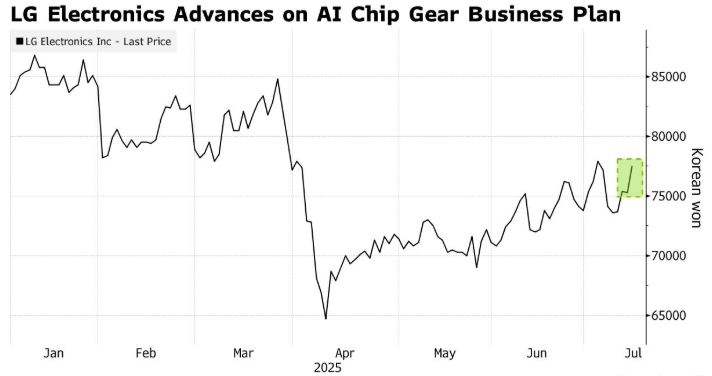
Group 1 - LG Electronics' stock rose in the Seoul market following reports of its development of advanced tools for manufacturing storage chips that work with AI processors designed by Nvidia and others [1] - The company plans to achieve mass production of HBM chip hybrid bonding machines by 2028, although the specific timeline for mass production has not been confirmed [1] - Hybrid bonding is crucial for HBM manufacturing, allowing for thinner chip stacking by directly bonding the electrodes of adjacent layers [1] Group 2 - Other Korean companies producing hybrid packaging equipment include Hanmi Semiconductor, Samsung Electronics' Semes, and Hanwha Vision's semiconductor technology division [4] - Hanmi Semiconductor's stock fell by 6.5%, Hanwha Vision's stock dropped by 4.7%, and Samsung Electronics' stock decreased by 1.3% [4] - Analysts note that the hybrid bonding market has high entry barriers, and established companies with years of expertise hold significant advantages [4] Group 3 - LG Electronics may face competition from foreign companies such as ASMPT listed in Hong Kong and BE Semiconductor Industries NV based in the Netherlands [4] - Increased R&D and capital expenditures may lead to profit pressure for LG Electronics, with sales contributions potentially limited before 2030 [4]