AI Agent

Search documents
手搓第一个AI程序后,这位95后决定“反共识”创业|AI原生100
Hu Xiu· 2025-07-16 01:25
Group 1 - The core idea of the article revolves around the entrepreneurial journey of a young founder in the AI industry, emphasizing the unique opportunities presented by generative AI and the shift from traditional SaaS models to result-oriented business solutions [2][5][6] - The company, Yuhua Technology, was founded by a team of young innovators, including a co-founder who is a technical prodigy, highlighting the trend of new-generation AI startups being led by individuals born in the 1990s and 2000s [3][5] - Yuhua Technology has successfully secured seed funding from Qiji Chuangtan, a notable incubator in China, which is seen as a significant endorsement of its business model and potential [2][5] Group 2 - The company focuses on the manufacturing sector, which is viewed as a "反共识" (anti-consensus) choice, as many believe sales in this industry are challenging. However, the company sees it as an area where product value can be emphasized over resource competition [5][24] - Yuhua Technology's business model is based on a pay-for-results approach, contrasting with traditional SaaS models that charge for tools. This shift is seen as a fundamental change in how AI solutions are delivered and monetized [5][38] - The company has achieved significant early success, with its first client experiencing a sales conversion rate increase from 5% to 7%, leading to a 20% revenue boost, which validates the effectiveness of its AI solutions [7][22] Group 3 - The company aims to address specific pain points in the sales process, particularly in the pre-sales phase, by automating tasks that are typically repetitive and low-value, thereby freeing up human resources for more creative work [42][43] - Yuhua Technology is strategically avoiding sectors like government and finance due to high competition and low product value perception, instead focusing on high-end manufacturing where digital transformation is urgently needed [24][25] - The company plans to expand its market reach internationally, targeting regions like Japan and Southeast Asia, where there is a strong demand for AI solutions in manufacturing and retail [59][62]



中金2025下半年展望 | 消费电子:AI重构创新边界
中金点睛· 2025-07-15 23:49
Core Viewpoint - The consumer electronics industry is expected to grow in the second half of 2025, driven by the gradual implementation of edge AI across multiple terminals, hardware upgrades in AI smartphones, innovations in AI wearable devices, and a revival in the optical industry [1]. Group 1: Mobile & Optical Market - The smartphone market demand is expected to remain stable in the second half of 2025, with IDC projecting a global smartphone shipment growth rate of 0.6% for 2025 and a CAGR of 1.4% over the next five years [4]. - The trend of optical upgrades in smartphones is anticipated to continue, leading to double-digit market growth, with a focus on innovations such as larger sensors, hybrid glass-plastic lenses, and module structure upgrades [4]. - The optical industry is expected to see improved profitability due to capacity utilization recovery and rational price competition [26][31]. Group 2: Edge AI Hardware - The penetration of AI smartphones into mid-range price segments is expected to accelerate, with Canalys forecasting a global AI smartphone penetration rate of 34% by 2025, increasing to 50% by 2027 [5]. - Innovations in AI wearable devices, particularly AR/MR products, are expected to enhance user interaction and experience, with lightweight designs becoming a trend in 2024 [5]. - The emergence of new terminal forms, such as panoramic cameras, is anticipated to meet the growing demand for "recording life" [5]. Group 3: Edge AI Software - The rapid development of AI Agent technology is expected to reshape human-computer interaction and create new ecological models, with AI Agents likely to become new traffic entry points on mobile devices [5]. - The introduction of innovative AI Agents, such as Manus, demonstrates the potential for multi-agent models to facilitate the widespread adoption of AI in consumer applications [50][51]. Group 4: Market Review and Outlook - The consumer electronics sector in A-shares has seen a decline in valuation due to tariff uncertainties, with the overall PE ratio for the sector at 29.2 times as of July 4 [9]. - The Hong Kong stock market for consumer electronics has experienced significant valuation fluctuations, with the PE ratio recovering to 17.1 times, slightly above the historical median [12]. - The smartphone market is expected to maintain stable demand, with a focus on innovations in edge AI and foldable screens [13]. Group 5: Performance and Growth - The consumer electronics sector reported a revenue growth of 21% and a net profit growth of 2% in the first quarter of 2025, driven by the launch of new iPhone models and expansion into new business areas [23]. - The global smartphone camera module market is projected to see a mild recovery, with shipments expected to reach 45.6 billion units in 2025, reflecting a 2.2% year-on-year growth [27]. Group 6: AI and Innovation - The integration of AI into smartphones is expected to drive upgrades in components such as chips, thermal management, and battery technology, enhancing user upgrade intentions [39][40]. - The rise of consumer-grade 3D printing is anticipated to support the growth of the consumer electronics supply chain, with significant increases in production and sales volumes [42][44]. - The demand for handheld smart imaging devices is projected to grow, with the market size expected to reach 600 billion yuan by 2027 [45].

What's an AI Agent?
OpenAI· 2025-07-15 17:20
Agent Definition & Requirements - Agents must reliably handle complex, novel work autonomously and proficiently, leveraging reasoning abilities rather than mere copying [1][2] - The core requirement for agents is the ability to work in tandem with professionals like scientists, software engineers, and data scientists, handling tasks effectively [3] Applications Across Industries - Software engineering benefits from agents that can write code, perform QA, conduct unit testing, and automate coding processes [4] - Sales teams can leverage agents to improve efficiency by processing, qualifying, and recommending follow-up steps for a high volume of inbound leads, driving conversions [5] - The concept of agents is generalizable and applicable across various domains beyond enterprise productivity, science, and software engineering [2][5]

晚报 | 7月16日主题前瞻
Xuan Gu Bao· 2025-07-15 14:33
Group 1: Urban Development and Smart Cities - The Central Urban Work Conference emphasized optimizing modern urban systems and developing modern urban clusters and metropolitan areas [1] - Smart city construction is identified as a core driver of economic growth and urban governance modernization in China, with a projected market size of 45.3 trillion yuan by 2025 and a CAGR of 25.2% from 2020 to 2025 [1] Group 2: Methanol Industry - The first batch of green methanol products from a biomass coupling project in Jilin Province has been successfully produced, with an initial annual capacity of 50,000 tons and a projected total capacity of 250,000 tons upon full production [2] - Green methanol is seen as a key carrier for low-carbon transition, with global production expected to exceed 30 million tons by 2030, and China's planned capacity exceeding 14.95 million tons [2] Group 3: Robotaxi Market - Tesla is testing its Robotaxi technology in Texas and plans to expand to the San Francisco Bay Area, with the U.S. Robotaxi market expected to reach $36.5 billion by 2035 [3] - The Chinese Robotaxi market is projected to reach $44.5 billion by 2035, with a CAGR of 96% from 2025 to 2035, driven by numerous domestic players [3] Group 4: Humanoid Robots - Huawei has launched the first embodied intelligence industry innovation center in Shenzhen, aiming to accelerate the development of the humanoid robot industry [4] - The market for embodied intelligence in China is expected to reach 5.295 billion yuan by 2025, with humanoid robots projected to account for 50% of the global market [4] Group 5: Semiconductor Industry - Nvidia's stock saw significant gains following the announcement of the H20 chip approved for sale in China, which is designed for AI acceleration [5] - The demand for high-performance chips is expected to drive growth in related equipment sectors, benefiting leading domestic manufacturers [6] Group 6: AI Agents - The AI agent concept is gaining traction, with new standards for AI agent operation safety being released, indicating a growing focus on autonomous AI applications [7]

那些超出想象的AI Agent
3 6 Ke· 2025-07-15 11:41
Group 1 - The article discusses the rapid evolution of AI agents, highlighting their ability to solve complex problems and outperform human capabilities in various fields [2][3][6] - A specific AI agent named Shortcut demonstrated the ability to solve a challenging financial modeling problem in just 10 minutes with over 80% accuracy, significantly faster than human analysts [3][6] - Another AI agent, Agentforce, achieved a sales conversion rate of 50%, far exceeding the typical 10%-15% rate of traditional sales personnel, showcasing the effectiveness of AI in sales [9][11][12] Group 2 - The medical AI agent Polaris has a diagnostic accuracy exceeding 99%, outperforming the average accuracy of registered nurses, and has gained high patient satisfaction ratings [14][17] - Polaris operates through a collaborative approach involving multiple agents to ensure accurate medical advice, which has led to its FDA recognition [16][17] - The article emphasizes that these AI agents are not meant to replace humans but to enhance human capabilities by improving efficiency and accuracy in various tasks [19][20]
OpenAI失手、谷歌拆骨,AI编程赛道讲述另一种收购方案
Di Yi Cai Jing· 2025-07-15 11:32
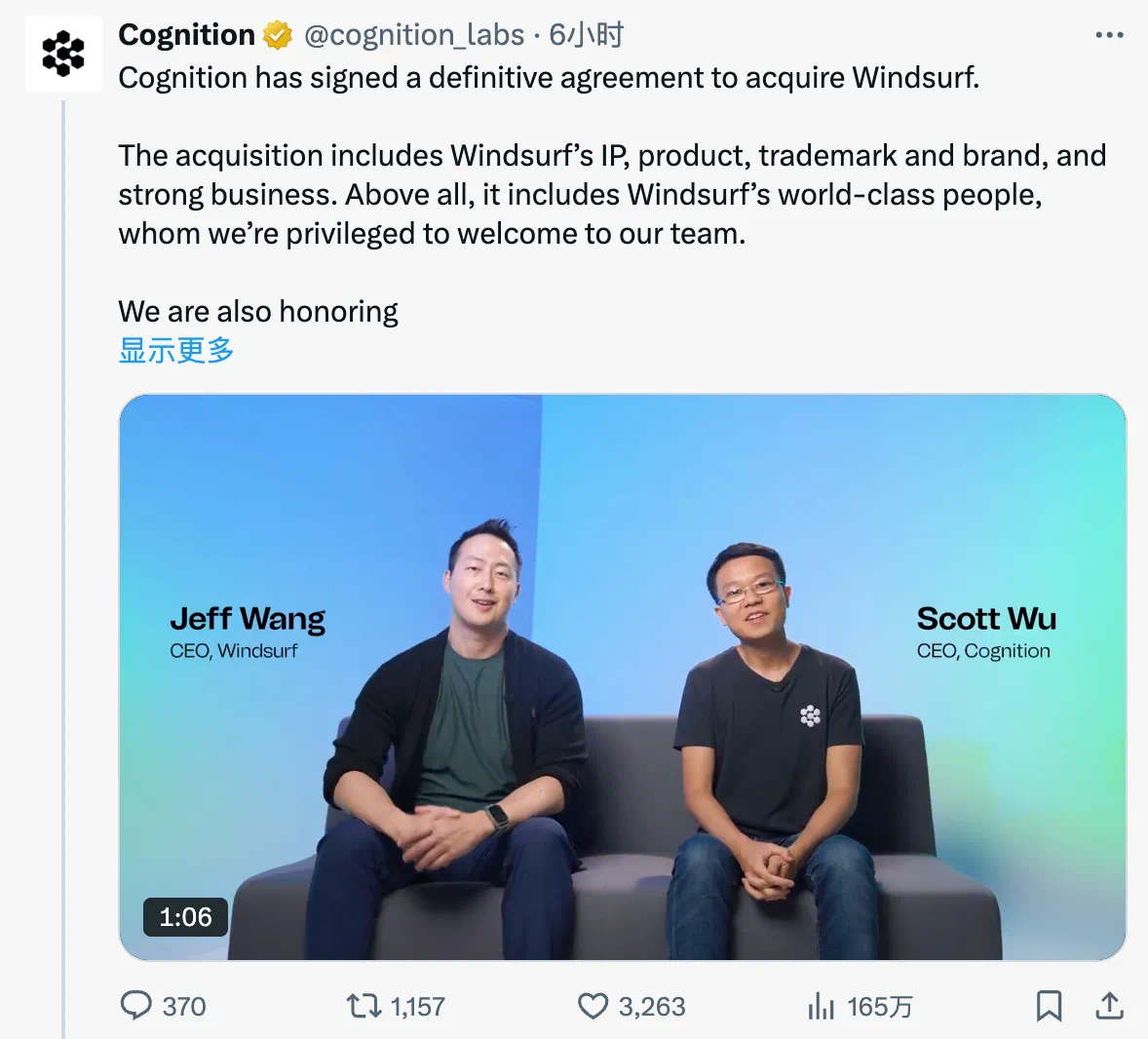
Core Insights - The acquisition of AI programming startup Windsurf has concluded, with Cognition AI acquiring its remaining assets after OpenAI's failed bid of approximately $3 billion due to competitive pressures from Google and Microsoft [1][5][6] - Google secured the core components of Windsurf for a licensing fee of $2.4 billion, enhancing its competitive position in the AI sector without acquiring equity [1][6] - The AI programming market is experiencing rapid growth, with projections indicating a market size of $29.57 billion by 2025 and $64.68 billion by 2030, reflecting a compound annual growth rate of approximately 17.1% [8][9] Acquisition Dynamics - Windsurf, founded in 2021, has amassed over 800,000 developer users and approximately 1,000 enterprise clients, achieving an annual recurring revenue (ARR) nearing $100 million [4] - OpenAI's initial acquisition attempt was thwarted by Microsoft's demands for control over Windsurf's technology, which OpenAI rejected, leading to concerns from Windsurf's team [5][6] - The acquisition process highlighted the power dynamics among AI giants, revealing that capital ties can become constraints when core interests are at stake [6] Competitive Landscape - The AI programming sector is characterized by intense competition, with major players like OpenAI, Google, and Anthropic vying for dominance [8][9] - The current landscape features tools that have evolved from basic code completion to sophisticated programming partners capable of executing complex tasks [9] - The usage of AI programming tools varies significantly, with 30% of developers in China utilizing such tools compared to 91% in the United States [9] Market Trends - The AI programming tools market is one of the most profitable segments within the AI industry, primarily driven by subscription and freemium models [9] - Recent funding activity in the AI programming space has been robust, with over 18 billion yuan raised globally in 2024 alone, indicating strong investor interest [9] - The emergence of AI agents with autonomous planning and execution capabilities is being recognized as a significant trend beyond traditional AI programming tools [10]


月入5万美元的AI副业靠这几个工具就能跑起来?我把这十类热门工具都试了一遍
3 6 Ke· 2025-07-15 10:11
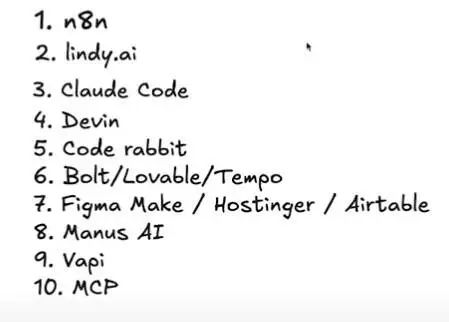
Core Insights - The article discusses the potential of AI tools for generating income, specifically focusing on the possibility of earning $50,000 per month through AI side projects. It emphasizes the importance of understanding the capabilities and limitations of various AI tools available in the market [1][31][39]. Group 1: AI Tools Overview - n8n is considered overrated for non-technical users, as it requires a certain level of technical knowledge to be effective. It is seen as a tool that is more beneficial for those with some technical background [3][12]. - Lindy.ai is highlighted for its marketing capabilities, offering numerous templates that can inspire users and facilitate automated outreach [4][6]. - Claude Code is regarded as a powerful tool that is underestimated, capable of automating tasks such as writing tests and managing workflows. It is recommended for both developers and non-developers, despite its higher entry barrier [7][10][11]. - Devin and Code Rabbit are described as practical AI assistant tools that help users build projects from scratch, with features that integrate well with existing codebases and project management tools [13][14][19][20]. - Bolt and Lovable are seen as tools that can enhance productivity but are not substitutes for engineers. They require users to have a good understanding of how to write effective prompts [21][22][23]. Group 2: Market Trends and Opportunities - The article suggests that the current environment is favorable for individuals to create profitable products without needing significant funding, as demonstrated by various success stories [31][32][34]. - The notion of "vibe coding" is introduced, indicating a shift in how products can be developed quickly and efficiently, allowing even non-technical individuals to participate in product creation [30][39]. - The discussion includes the potential for AI tools to empower non-technical users, enabling them to access capabilities that were previously limited to developers [27][28]. Group 3: Future Considerations - The article raises concerns about the sustainability of certain AI tools, such as Manus AI, in a rapidly evolving market dominated by larger players like OpenAI [25]. - It emphasizes the need for continuous adaptation and learning in the tech landscape, where the ability to quickly iterate and find product-market fit is crucial for success [38][39].
“AI六小虎”开抢IPO,MiniMax要超智谱?
3 6 Ke· 2025-07-15 08:05
Group 1 - MiniMax has secured nearly $300 million in new financing, bringing its post-financing valuation to over $4 billion (approximately 30 billion RMB) [1][3][4] - The company, founded in 2021 by former SenseTime vice president Yan Junjie, is rapidly transitioning from "technical showcase" to "commercial closure" by launching a full-stack product suite covering foundational models, video, voice, and agents [1][3] - MiniMax's Talkie app has achieved over 10 million downloads globally, generating $70 million in revenue from user payments and advertising in the previous year [4][6] Group 2 - MiniMax has released a series of core technologies and products, including the MiniMax-M1 model series and the Hailuo Video Agent, which aims to generate professional-grade short videos from simple text prompts [3][11] - The company is preparing for an IPO, having attracted top-tier investors such as Sequoia China, Alibaba, Tencent, IDG Capital, and Mihayou [4][5] - The competitive landscape among the "AI Six Tigers" is intensifying, with MiniMax leading the charge in this new narrative [2][3] Group 3 - The AI industry is facing a challenge of product differentiation due to high levels of homogeneity in AI applications, making it essential for companies to innovate and stand out [9][10] - MiniMax's Hailuo AI has gained recognition for its video generation capabilities, with users praising its quality and realism [6][14] - The emergence of AI agents is seen as a significant opportunity for commercialization, with various applications being explored across different industries [11][16]

朱啸虎:大模型会吃掉90%Agent
Tai Mei Ti A P P· 2025-07-15 03:19
Group 1: Core Insights - Zhu Xiaohu believes that large models will dominate 90% of AI agents, expressing strong optimism about the AI sector despite existing bubbles in the embodied intelligence space [2] - Zhu's investment firm, Jingshan Capital, has invested in various AI-related startups, including Robopoet, Aha Lab, LiblibAI, and FancyTech, indicating a strategic focus on AI innovation [2] - The current AI agent entrepreneurship is likened to the early days of personal website creators in the internet era, suggesting that today's AI entrepreneurs can learn from those historical examples [2] Group 2: Characteristics of Early Internet Entrepreneurs - Successful early internet entrepreneurs often started by addressing fundamental user needs such as information access, communication, and navigation, which helped build user loyalty [3][9] - The early personal website creators were characterized by a practical approach to technology, focusing on real-world problem-solving and grassroots promotion methods [3][9] - These entrepreneurs capitalized on the rapid growth of internet users in China during the late 1990s to early 2000s, a period marked by an undefined competitive landscape [3][9] Group 3: Notable Examples of Early Internet Success - Netease, founded by Ding Lei in 1997, evolved from providing personal homepage services to becoming a major internet giant, successfully listing on NASDAQ [6][7] - Tencent, established by Ma Huateng and a small team in 1998, initially developed OICQ (later QQ) and expanded into a vast ecosystem including social media, gaming, and payment services [7][9] - Hao123, created by Li Xingping, gained massive traffic by meeting the needs of novice internet users and was acquired by Baidu for a significant sum, exemplifying the potential for personal websites to achieve substantial commercial success [8][9]



月费200刀的AI浏览器,Perplexity Comet的真实体验如何?
Founder Park· 2025-07-14 13:34
Core Viewpoint - The article discusses the launch of Comet, an AI Agent browser by Perplexity, which aims to redefine the browsing experience by integrating AI capabilities to enhance information understanding and usage, moving from mere browsing to thinking [1][2][25]. Group 1: Comet's Features and Innovations - Comet is designed to address the challenge of understanding and utilizing information, connecting isolated tabs into a unified intelligent environment [3][7]. - The Comet Assistant enables users to issue commands that allow the browser to read and summarize content from multiple tabs, transforming the browsing experience into a more efficient and integrated process [11][19]. - Comet's ability to perform complex tasks by simultaneously reading and acting on multiple web pages positions it as a workflow executor rather than just an information aggregator [20][22]. Group 2: Market Positioning and Strategy - Comet represents a radical shift in browser design, aiming to create an AI-driven environment rather than merely enhancing existing tools with AI features [24][25]. - The browser's strategy is categorized as "environment reconstruction," which seeks to redefine the relationship between users and information [24][29]. - Perplexity's approach contrasts with more conservative strategies adopted by competitors like Chrome and Edge, which integrate AI as an additional feature rather than a core component [23][24]. Group 3: Challenges and User Adoption - Comet's high subscription fee of $200 per month for early access has sparked controversy and disappointment among existing users, potentially hindering its initial adoption [27][28]. - The challenge of user habits poses a significant barrier, as users accustomed to traditional browsing may find the new interface and functionalities daunting [28][30]. - The success of Comet will depend on its ability to demonstrate clear value that justifies the learning curve associated with its innovative features [28][30].