反垄断

Search documents
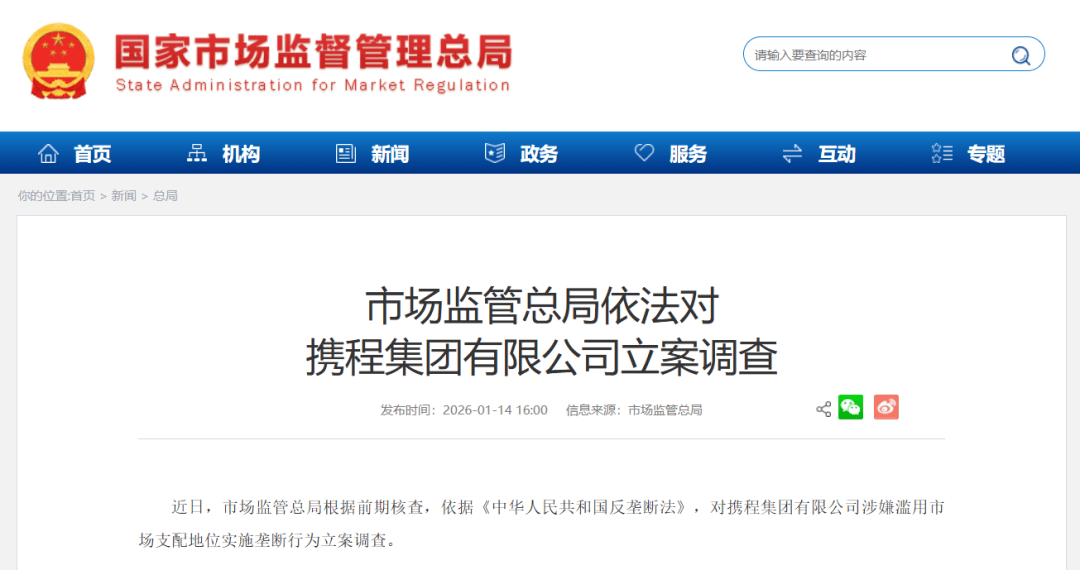
携程,被立案调查!
Sou Hu Cai Jing· 2026-01-19 10:14
Core Viewpoint - The State Administration for Market Regulation has initiated an investigation into Ctrip Group for suspected monopolistic behavior due to abuse of market dominance [3][14]. Group 1: Investigation Details - The investigation is based on prior checks and is conducted under the Anti-Monopoly Law of the People's Republic of China [3]. - Ctrip has been previously warned multiple times for practices such as unauthorized price changes and setting unreasonable trading conditions [10]. - In August 2025, the Guizhou Provincial Market Supervision Administration held a meeting with Ctrip and other travel platform companies to address price irregularities and potential issues like "choose one from two" practices [11]. - In September 2025, the Zhengzhou Market Supervision Administration conducted an administrative interview with Ctrip for unreasonable restrictions on transaction prices and practices [12]. - In December 2025, the Yunnan Provincial Tourism Homestay Industry Association initiated anti-monopoly protection efforts against online travel agencies, citing Ctrip's unfair trading conditions [13]. Group 2: Company Response - Ctrip has acknowledged the investigation and stated it will cooperate with regulatory authorities while ensuring normal business operations [15]. - The company emphasizes its commitment to providing quality services to users and partners [15].


招期新能源ESG工业硅多晶硅周报(2026年1月12日-2026年1月16日):工业硅上下游均有减产扰动,多晶硅关注反垄断后续回应-20260119
Zhao Shang Qi Huo· 2026-01-19 08:06
Report Overview - Report Title: Industrial Silicon and Polysilicon Weekly Report (January 12 - January 16, 2026) [1] - Report Date: January 18, 2026 [2] - Researcher: Shi Enbing [2] 1. Report Industry Investment Rating No relevant content provided. 2. Core Views Industrial Silicon - The market is expected to oscillate. Supply-side: The number of open furnaces decreased by 7 this week, mainly from Sichuan. Social and warehouse inventories increased slightly. Demand-side: Both the polysilicon and organic silicon industries are promoting anti-involution. Polysilicon production in January is expected to decline to 100,000 tons. The organic silicon industry is supporting prices, with weekly production continuously decreasing slightly. The aluminum alloy开工率remains stable. The market is expected to oscillate between 8400 - 9200 yuan, and short positions can be considered at high prices [3]. Polysilicon - The market is expected to oscillate. The National Energy Administration commented on the "anti-involution" in the photovoltaic industry. For mature sectors such as silicon materials and wafers, backward production capacity should be eliminated. For the component sector, sales below cost should be rectified. The spot market is in a wait-and-see state this week. Supply-side: Weekly production decreased by over 10%, and industry inventory increased slightly. Demand-side: Wafer production in January remains stable, while cell and component production decreased by over 10% month-on-month. The cancellation of photovoltaic export tax rebates on the 9th supports component exports during the window period, and demand is expected to remain stable in the off-season. After the "anti-monopoly" event, the market has fully priced in the negative news, and the near-term balance sheet has shifted from loose to tight supply-demand balance. Next week, attention should be paid to the emotional impact of the follow-up feedback from industry associations [4]. 3. Summary by Catalogue 01 Futures Data - **Industrial Silicon**: The main contract price oscillated between 8605 - 8755 yuan/ton. The spread between the first and fourth contracts was 65. The trading volume decreased by 8100 lots to 371,900 lots. The capital inflow decreased by 70 million yuan to 3.233 billion yuan. The warehousing receipts increased to 56,415 tons [3]. - **Polysilicon**: The main contract 2605 oscillated widely between 48,670 - 50,200 yuan. The warehousing receipts increased by 390 tons to 13,680 tons. The capital inflow decreased by 735 million yuan to 3.797 billion yuan [4]. 02 Industrial Silicon - **Price**: The spot price remained stable. Xinjiang Tongyang 553 was reported at 8700 yuan/ton, Kunming 421 at 10,000 yuan/ton, and Sichuan 421 at 9800 yuan/ton [3]. - **Valuation**: The electricity price in the southwest region has gradually recovered after switching to the dry-season electricity price. The production costs in Xinjiang, Yunnan, and Sichuan are estimated to be 8487.5 yuan/ton, 9720 yuan/ton, and 9600 yuan/ton respectively, with profits of 312.5 yuan/ton, -380 yuan/ton, and -400 yuan/ton respectively [3]. - **Supply**: This week's production was 78,420 tons, a decrease of 1860 tons (-2.3%) from last week. The number of open furnaces decreased by 7, with an overall furnace opening rate of 27.76%. Xinjiang's production increased by 43.94% year-on-year, Sichuan's decreased by 24.73%, and Yunnan's decreased by 7.96% [3]. - **Inventory**: Social inventory increased by 3000 tons to 555,000 tons. The Guangzhou Futures Exchange's warehousing receipts increased by 1975 tons to 56,415 tons [3]. - **Demand**: - **Polysilicon**: Production this week was 22,030 tons, a decrease of 13.3% week-on-week. The industry's total inventory was approximately 316,800 tons, an increase of 1.6% week-on-week [3]. - **Organic Silicon**: The average price of DMC remained unchanged at 13,850 yuan/ton (+1.8%). The prices of industrial chain products increased by 250 - 350 yuan. DMC production decreased by 400 tons to 43,600 tons, a decrease of 0.9% week-on-week. Weekly inventory decreased by 1300 tons, a decrease of 2.9% [3]. - **Aluminum Alloy**: The average price of ADC12 was 23,900 yuan/ton, an increase of 200 yuan week-on-week; the average price of A356 was 24,300 yuan/ton, with the price rising first and then falling. The regenerative 开工率this week was 58%. In December, passenger car production decreased by 4.2% year-on-year, and new energy vehicle production increased by 18.5% year-on-year in November [3]. - **Export**: Industrial silicon exports in November showed a year-on-year improvement, with a year-on-year increase of 3.7% and a month-on-month increase of 21.8% [3]. 03 Polysilicon - **Price**: This week, the prices of silicon materials and wafers remained stable, while the price of cell sheets increased slightly by 4% [3][4]. - **Valuation**: The production costs in Inner Mongolia, Sichuan, Qinghai, and Xinjiang are 42,465 yuan/ton, 39,540 yuan/ton, 45,415 yuan/ton, and 43,963 yuan/ton respectively, with profits of 17,135 yuan/ton, 20,460 yuan/ton, 14,585 yuan/ton, and 14,370 yuan/ton respectively [4]. - **Supply**: This week's production was 22,030 tons, a decrease of 13.3% week-on-week. Production in January is expected to decline to 100,000 tons month-on-month [4]. - **Inventory**: The industry's total inventory increased by 5000 tons to approximately 316,800 tons, an increase of 1.6% week-on-week [4]. - **Silicon Wafers**: The price of N-type wafers remained stable this week. In December, wafer inventory increased by 18.92% month-on-month and 17.4% year-on-year. Wafer production in January is planned to be 45.2 GW, a decrease of 2% year-on-year and an increase of 3% month-on-month [4]. - **Cell Sheets**: The price of cell sheets increased slightly by 4% this week. Cell production in January is planned to be 39.36 GW, a decrease of 18.3% year-on-year and 15.8% month-on-month [4]. - **Components**: The price of components increased slightly by 3 - 5% this week. The latest weekly inventory was 30.4 GW, an increase of 1.33% week-on-week. Production in January is planned to be 32.47 GW, a decrease of 19% month-on-month and 17% year-on-year. Component exports in November were 20.09 GW, an increase of 22.92% year-on-year and 3.6% month-on-month. In November 2025, new photovoltaic installations were 22.02 GW, a decrease of 11.9% year-on-year and an increase of 74.8% month-on-month. The year-end installation intensity slightly exceeded expectations, and the annual total is expected to exceed 300 GW. The latest average winning bid price for photovoltaic components was 0.71 yuan/watt, with a winning bid procurement capacity of only 0.2 GW [4]. 04 Organic Silicon, Aluminum Alloy, and Export - **Organic Silicon (DMC)**: The price increased to 13,850 yuan/ton (+1.8%) this week. Weekly production decreased by 0.9% week-on-week, and inventory decreased by 2.9% week-on-week. The gross profit margin was 13.73% [3][53][55]. - **Aluminum Alloy**: The prices of ADC12 and A356 oscillated within a range this week. The regenerative aluminum alloy 开工率this week was 58%. In December, passenger car production decreased by 4.2% year-on-year [3][59][61]. - **Export**: Industrial silicon exports in November decreased by 3.7% year-on-year and increased by 21.78% month-on-month [3][65].
腾讯音乐(TME):音乐盘点
citic securities· 2026-01-19 07:23
Investment Rating - The report indicates a favorable investment opportunity for Tencent Music (TME US/1698 HK), suggesting that the current sell-off is excessive and presents a good entry point due to attractive risk-reward dynamics [4]. Core Insights - Tencent Music's stock has underperformed year-to-date, influenced by competitive narratives, expectations around the K-pop concert restart, and heightened antitrust concerns regarding the acquisition of Himalaya [4]. - The stock price has retraced 38% from its peak of $26.7 on September 17, 2025, primarily driven by a reduction in valuation multiples [4]. - The report aligns with the views of CITIC Lyon Research, emphasizing the sustainability of Tencent Music's subscription model and its competitive product offerings built around fan-artist relationships [4]. Company Overview - Tencent Music was established in 2016 and operates several well-known music platforms, including QQ Music, Kugou Music, Kuwo Music, and 全民 K 歌. The company has developed a diversified business model centered around music and audio content discovery, listening, singing, viewing, performing, and social interaction [10]. - The primary revenue sources include online music subscriptions, online karaoke and live streaming, advertising, content licensing, and digital album sales. After a challenging transition in 2022-2023, the company has established a more sustainable business structure, with online music business growth driven by successful subscription strategies [10]. Revenue Breakdown - Online music services account for 62.4% of total revenue, while social entertainment services and others contribute 37.6% [11]. - The company generates 100% of its revenue from Asia, with no contributions from the Americas, Europe, or the Middle East and Africa [11]. Market Consensus - The market consensus target price for Tencent Music is $25.80 [12]. - As of January 15, 2026, the stock price is $16.6, with a market capitalization of $27.09 billion [11].

国家反垄断局政务微信公众号、微博和抖音号上线开通
Xin Lang Cai Jing· 2026-01-19 06:51
Core Viewpoint - The National Anti-Monopoly Bureau has launched its official WeChat, Weibo, and Douyin accounts to promote anti-monopoly and fair competition policies, aiming to create a favorable environment for fair competition in society [1] Group 1: Platform Launch - The official accounts are named "China Anti-Monopoly" and will focus on authoritative releases, important activities, policy interpretations, case information, and local exchanges [1] - The initiative aims to build a comprehensive national anti-monopoly publicity service platform that integrates news information, information release, policy interpretation, law enforcement transparency, and interactive services [1] Group 2: Commitment to Fair Competition - The bureau emphasizes its commitment to protecting and promoting fair competition, aiming to effectively communicate the importance of anti-monopoly and fair competition [1] - The initiative encourages public engagement and support in maintaining and promoting fair competition [1]

国家反垄断局政务微信公众号、微博和抖音号今日上线开通
Zheng Quan Shi Bao Wang· 2026-01-19 06:12
Core Viewpoint - The establishment of the "China Antitrust" official accounts on WeChat, Weibo, and Douyin aims to promote antitrust and fair competition policies, fostering a favorable environment for fair competition in society [1][2] Group 1 - The National Antitrust Bureau has launched its official accounts to enhance public awareness and understanding of antitrust policies [1][2] - The accounts will provide authoritative releases, important activities, policy interpretations, case information, and local exchanges [1][2] - The initiative aims to create a comprehensive national antitrust publicity service platform that integrates news information, policy interpretation, law enforcement transparency, and interactive services [1][2]
崔传刚:反垄断监管让市场回归公平竞争本源
Sou Hu Cai Jing· 2026-01-18 22:52
Core Viewpoint - The recent actions by China's market regulatory authorities in various sectors indicate a robust and precise approach to antitrust regulation, aimed at fostering a unified and competitive market system while addressing specific industry challenges [1][2][3] Group 1: Regulatory Actions - The regulatory body has initiated discussions with the photovoltaic industry association and leading companies to halt price coordination and market segmentation under the guise of "self-discipline" [1] - A competition assessment was launched for the food delivery platform industry to address "involution" subsidy issues [1] - An official investigation was opened against Ctrip for alleged abuse of market dominance, showcasing a commitment to stringent enforcement against monopolistic practices [1][2] Group 2: Antitrust Policy Significance - The essence of antitrust regulation is to ensure the healthy operation of the market economy and to support high-quality development, as fair competition is crucial for optimal resource allocation [2][3] - Over-reliance on market self-regulation can lead to risks, necessitating a differentiated and precise approach to antitrust policies to balance regulation and development [2] Group 3: Benefits of Strengthening Antitrust Regulation - Strengthening antitrust oversight creates a virtuous cycle benefiting consumers, empowering businesses, and enhancing national interests, leading to a solid foundation for high-quality development [3] - For consumers, it means more transparent pricing, diverse choices, and a fair competitive environment, while for small and medium enterprises, it removes barriers to growth and fosters innovation [3] Group 4: Misconceptions about Antitrust - Antitrust measures are not aimed at suppressing large enterprises or denying market competition but are intended to correct market distortions and eliminate unfair competitive barriers [4] - Compliance with antitrust regulations is essential for sustainable business development, as evidenced by various cases in different sectors, reinforcing that fair competition stimulates innovation and efficiency [4]
携程将面临怎样的处罚
Zhong Guo Qing Nian Bao· 2026-01-18 11:34
Group 1 - The core issue revolves around Ctrip facing potential penalties due to antitrust investigations, with estimates suggesting fines could range from 533 million to 5.33 billion yuan based on 2024 revenue, and possibly exceeding 6.5 billion yuan when considering 2025 projections [1] - The focus should not only be on the fines but also on the legal responsibilities that may require Ctrip to alter its current profit model and rules, as well as the potential for confiscation of illegal gains, which could exceed the fines calculated based on sales revenue [1] - The complexity of calculating "illegal gains" is highlighted, as distinguishing between illegal and legal income poses significant challenges, with past antitrust cases showing a lack of precedents for confiscating platform companies' illegal gains [1] Group 2 - From a legal perspective, Ctrip may be involved in three types of market dominance abuse related to small and medium-sized merchants, including unfair pricing practices and unreasonable transaction conditions, particularly concerning its pricing assistant mechanism and high commission rates [2] - Ctrip's practices may also violate consumer protection laws, such as imposing unreasonable conditions on transactions and differential treatment of trading partners under similar conditions [2]
携程被立案调查背后,谁在博弈
Di Yi Cai Jing Zi Xun· 2026-01-17 10:37
Core Viewpoint - The online travel agency (OTA) industry is facing significant scrutiny as Ctrip Group is under investigation for alleged monopolistic practices, which may impact its operations and market dynamics [2] Group 1: Regulatory Actions - The State Administration for Market Regulation has initiated an investigation into Ctrip Group for suspected abuse of market dominance under the Anti-Monopoly Law of the People's Republic of China [2] - Ctrip has stated that its business operations are normal and that it will cooperate with regulatory authorities to ensure compliance [2] - Ctrip has faced multiple regulatory discussions since 2025, including issues related to "choose one from two" practices and price manipulation [2] Group 2: Financial Performance - In Q3 2025, Ctrip reported a net operating revenue of 18.3 billion RMB, a year-on-year increase of 16% and a quarter-on-quarter increase of 24% [3] - For the first three quarters of 2025, Ctrip's total revenue reached 47.011 billion RMB, with a net profit attributable to shareholders of 29.013 billion RMB [3] - The accommodation booking segment contributed over 40% of Ctrip's revenue [3] Group 3: Market Dynamics - The hotel industry in China has approximately 570,000 facilities and 19.27 million rooms, with a chain rate of 26.75% for hotels and 40.09% for rooms, indicating significant room for growth compared to developed countries [3] - The low chain rate suggests many hotels lack strong direct sales capabilities, relying heavily on large OTAs for room distribution, which strengthens the market position of major OTAs [3] Group 4: Pricing and Competition Issues - Some OTAs exert pressure on hotels regarding pricing, promotion, and platform rankings, leading to conflicts where hotels may have to subsidize lower prices while OTAs profit [4][5] - Smaller accommodation providers, such as guesthouses, face challenges without reliance on large OTAs, exacerbating the power imbalance between platforms and merchants [5] - The imbalance in revenue and commission structures has led to dissatisfaction among merchants, particularly in the hospitality sector [5] Group 5: Regulatory Framework - In December 2025, new regulations were issued to govern pricing behaviors on internet platforms, emphasizing that platform operators cannot force merchants to lower prices or impose unfair fees [6] - These regulations reflect a governmental effort to address conflicts between channels and merchants, ensuring fair practices in the OTA industry [6][7] Group 6: Future Considerations - The necessity of OTAs and e-commerce platforms is acknowledged, but there is a call for a balanced approach to commission structures to prevent merchant losses and market shrinkage [7] - The rise of live streaming and fragmented sales channels may divert consumers and merchants from traditional OTAs, prompting a need for these platforms to explore diversified business models [7]

携程被立案调查,背后OTA博弈该如何平衡
Di Yi Cai Jing· 2026-01-17 10:24
Core Viewpoint - The OTA (Online Travel Agency) industry is facing significant scrutiny due to long-standing imbalances between platform and merchant interests, highlighted by an investigation into Ctrip for alleged monopolistic practices [1][7]. Group 1: Regulatory Actions - The State Administration for Market Regulation has initiated an investigation into Ctrip for suspected abuse of market dominance under the Anti-Monopoly Law [1]. - Ctrip has stated that its operations are normal and that it will cooperate with regulatory authorities to foster a sustainable market environment [1]. - Since 2025, the OTA industry has faced multiple regulatory inquiries, including discussions about practices like "choose one from two," price manipulation, and other unfair practices [1][7]. Group 2: Financial Performance - Ctrip's revenue has remained robust, with a reported net operating income of 18.3 billion RMB in Q3 2025, marking a 16% year-over-year increase and a 24% quarter-over-quarter increase [2][8]. - For the first three quarters of 2025, Ctrip's total revenue reached 47.011 billion RMB, with a net profit attributable to shareholders of 29.013 billion RMB, where accommodation booking contributed over 40% of the revenue [2][8]. Group 3: Market Dynamics - The hotel industry in China has approximately 570,000 facilities and 19.27 million rooms, with a chain rate of 26.75% for hotel stores and 40.09% for rooms, indicating significant room for growth compared to over 70% in developed countries [2][8]. - The low chain rate suggests many hotels operate independently, lacking strong direct sales capabilities, which increases reliance on large OTAs for room distribution [2][8]. Group 4: Merchant-Platform Relations - Some OTAs exert pressure on hotels regarding pricing, promotion, and platform ranking, often requiring hotels to subsidize lower room rates, leading to profit erosion for hotels [3][9]. - Smaller accommodation providers, such as guesthouses and small restaurants, face challenges without the support of large OTAs, exacerbating the tension between merchants and platforms [3][9]. - The imbalance in revenue between OTAs and merchants has intensified post-pandemic, particularly affecting the hospitality sector [3][9]. Group 5: Regulatory Framework - In December 2025, new regulations were issued to govern pricing behavior on internet platforms, emphasizing that platform operators cannot force merchants to lower prices or impose unfair fees [4][10]. - These regulations reflect a governmental effort to address the conflicts between channels and merchants, aiming to create a more equitable environment [5][10]. Group 6: Future Considerations - The necessity of OTAs and e-commerce platforms is acknowledged, but there is a call for a balanced approach to commission structures to prevent merchant losses and market shrinkage [6][10]. - The rise of live streaming and fragmented sales channels is expected to diversify consumer options, prompting OTAs to explore varied business models for sustainable growth [6][10].
反携程,到底反的什么?
商业洞察· 2026-01-17 09:22
Core Viewpoint - The article discusses the recent antitrust investigation against Ctrip, highlighting the shift from a reminder to serious action against monopolistic practices in the online travel industry. It emphasizes that antitrust measures aim to ensure fair competition and prevent platforms from exploiting their market dominance to the detriment of merchants and consumers [4][5][14]. Group 1: Antitrust Investigation - The State Administration for Market Regulation has initiated an investigation into Ctrip for alleged monopolistic practices, marking a significant escalation in regulatory scrutiny [4]. - Ctrip holds over 56% of the domestic online travel market and reported a daily net profit of 216 million yuan in Q3 2025, which exceeds the total net profit of the entire A-share tourism sector [5]. Group 2: Platform Dynamics - Platforms, initially designed to connect merchants and consumers, have increasingly become "harvesters," extracting commissions from merchants while inflating prices for consumers [7][10]. - The article notes that platforms like Ctrip have evolved from being helpful intermediaries to monopolistic entities that dictate terms to merchants, often leading to unsustainable business practices for those merchants [11][12]. Group 3: Revenue Models and Practices - Ctrip's commission structure includes three tiers: 10% for basic cooperation, 12% for gold cooperation with price guarantees, and 15% for exclusive partnerships, which can pressure merchants into unfavorable agreements [13]. - The investigation likely stems from practices such as "choose one from two," which restricts merchants' options and creates a coercive environment [13][14]. Group 4: Long-term Business Models - The article argues that a successful business model should focus on creating value for all participants rather than exploiting them, advocating for a shift back to a cooperative approach where platforms help merchants succeed [16][18]. - It emphasizes that sustainable business practices should prioritize long-term relationships and mutual benefits among platforms, merchants, and consumers [19][20]. Group 5: Regulatory Perspective - Effective antitrust measures should restore competition rather than impose blanket restrictions, allowing platforms to innovate while preventing exploitative practices [24][25]. - The article suggests that healthy competition will naturally regulate commission rates and service quality, benefiting both merchants and consumers [24]. Group 6: Conclusion - The article concludes that platforms must remember their original purpose of facilitating commerce rather than dominating it, advocating for a collaborative ecosystem where all parties can thrive [28][29].