
算力需求

Search documents
电子行业周报:谷歌资本支出超预期,算力需求强劲增长-20250727
Xiangcai Securities· 2025-07-27 12:13
Investment Rating - The industry investment rating is maintained at "Overweight" [2] Core Insights - The electronic industry index rose by 2.85% last week, outperforming the CSI 300 by 1.16 percentage points [10] - Google's capital expenditure exceeded expectations, indicating strong growth in computing power demand, with a projected capital expenditure of approximately $85 billion for 2025, up from an earlier estimate of $75 billion [5][6] - The overall PE (TTM) for the electronic industry is 48.38X, which is in the 30.00% percentile of the past 10 years, while the PB (LF) is 3.83X, in the 38.05% percentile [4][10] Market Performance - The electronic industry index closed at 4854.41 points, with notable performances from companies such as Tonglian Precision and Suzhou Tianmai, which saw increases of 39.97% and 33.58% respectively [3][19] - The semiconductor sector reported a 4.65% increase, while components saw a decline of 0.85% [3] Valuation Metrics - The electronic industry's PE (TTM) increased by 1.55X week-on-week, with a maximum of 52.14X and a minimum of 32.14X over the past year [4][10] - The PB (LF) also saw a week-on-week increase of 0.10X, with historical maximum and minimum values of 4.07X and 2.39X respectively [4] Industry Dynamics - The demand for AI applications is significantly increasing, as evidenced by Google's reported growth in search queries and the rapid adoption of AI features across its platforms [6] - The Gemini app has over 450 million monthly active users, and the usage of AI video generation has surged, indicating a robust growth trajectory for AI applications [6] Investment Recommendations - The report suggests focusing on investment opportunities in AI infrastructure, edge SOC, and the supply chain for foldable smartphones, with specific companies recommended for attention [8][22]

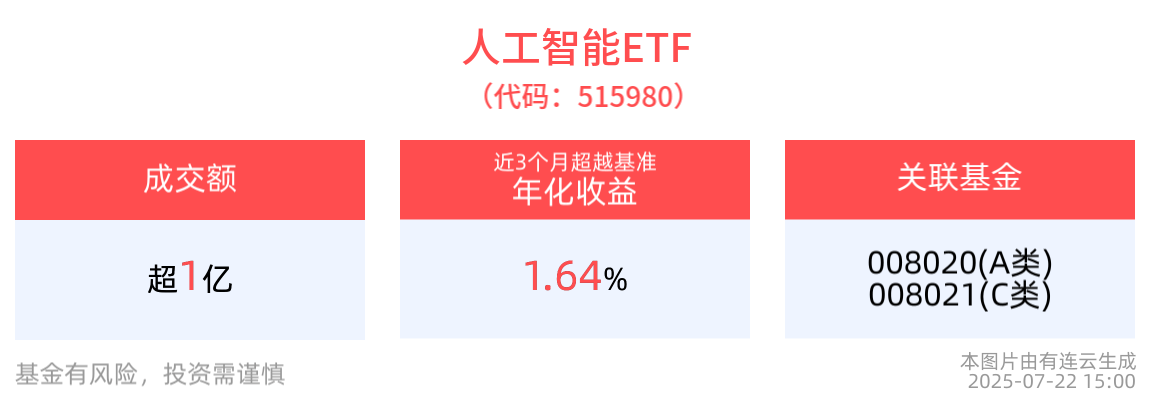
算力需求持续火热,人工智能ETF(515980)交投活跃,近1周累计上涨7.50%
Sou Hu Cai Jing· 2025-07-22 07:46
Core Viewpoint - The artificial intelligence (AI) sector is experiencing fluctuations in stock performance, with the China Securities Artificial Intelligence Industry Index showing a slight decline, while the AI ETF has demonstrated significant growth over the past week and year [1][3]. Group 1: Market Performance - As of July 22, 2025, the China Securities Artificial Intelligence Industry Index (931071) decreased by 0.82%, with mixed performance among constituent stocks [1]. - The AI ETF (515980) was priced at 1.11 yuan, reflecting a 7.50% increase over the past week as of July 21, 2025 [1][3]. - The AI ETF recorded a turnover rate of 5.45% and a total trading volume of 173 million yuan on the same day [3]. Group 2: Fund Performance Metrics - The AI ETF's latest scale reached 3.183 billion yuan, with a financing buy-in amount of 12.3129 million yuan and a financing balance of 89.6029 million yuan [3]. - Over the past year, the AI ETF's net value increased by 44.82%, ranking 425 out of 2929 index stock funds, placing it in the top 14.51% [3]. - The AI ETF achieved a maximum monthly return of 30.38% since its inception, with an average monthly return of 6.80% during rising months [3]. Group 3: Index Composition - The China Securities Artificial Intelligence Industry Index is constructed from 50 representative listed companies based on their AI business proportion, growth level, and market capitalization [4]. - As of June 30, 2025, the top ten weighted stocks in the index accounted for 52.07% of the total index weight, including companies like Zhongji Xuchuang and Keda Xunfei [4][6]. Group 4: Industry Insights - The demand for computing power in AI applications is increasing, with the return of H20 providing more options for AI application companies and alleviating the shortage of high-end chips [7]. - This shift is expected to encourage domestic manufacturers to accelerate product iterations and support the trend of domestic substitution in the industry [7].

人工智能ETF领涨,机构:看好算力需求爆发丨ETF基金周报
2 1 Shi Ji Jing Ji Bao Dao· 2025-07-21 03:27
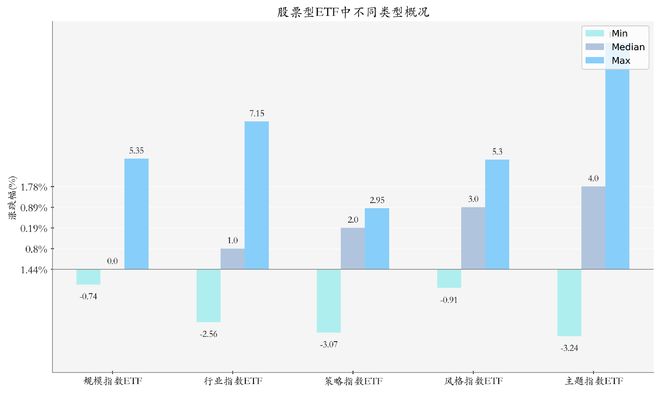
Market Overview - The Shanghai Composite Index rose by 0.69% to close at 3534.48 points, with a weekly high of 3536.01 points [1] - The Shenzhen Component Index increased by 2.04% to 10913.84 points, reaching a high of 10946.4 points [1] - The ChiNext Index saw a rise of 3.17%, closing at 2277.15 points, with a peak of 2296.91 points [1] - In global markets, the Nasdaq Composite Index increased by 1.51%, while the Dow Jones Industrial Average fell by 0.07% and the S&P 500 rose by 0.59% [1] - The Hang Seng Index in the Asia-Pacific region rose by 2.84%, and the Nikkei 225 Index increased by 0.63% [1] ETF Market Performance - The median weekly return for stock ETFs was 1.32% [2] - The highest weekly return among scale index ETFs was 5.35% for the Jiashi Shanghai Stock Exchange Science and Technology Innovation Board Comprehensive Enhanced Strategy ETF [2] - The highest return in industry index ETFs was 7.15% for the Guangfa National Communication ETF [2] - The top-performing thematic index ETF was the Fuguo ChiNext Artificial Intelligence ETF, with a return of 10.95% [2] ETF Liquidity - Average daily trading volume for stock ETFs increased by 4.9%, while average daily turnover rose by 13.6% [7] ETF Fund Flows - The top five stock ETFs with the highest inflows included the Huaxia CSI Animation Game ETF with an inflow of 690 million yuan [10] - The top five stock ETFs with the highest outflows included the Huaxia Shanghai Stock Exchange Science and Technology Innovation Board 50 Component ETF, which saw an outflow of 391 million yuan [11] ETF Financing and Margin Trading - The financing balance for stock ETFs decreased from 41.396 billion yuan to 41.057 billion yuan [12] - The highest financing buy amount was 646 million yuan for the Huaxia Shanghai Stock Exchange Science and Technology Innovation Board 50 Component ETF [12] ETF Market Size - The total market size for ETFs reached 45,347.71 billion yuan, with stock ETFs accounting for 30,953.21 billion yuan [15] - Stock ETFs represented 80.4% of the total number of ETFs and 68.3% of the total market size [17] ETF Issuance and Establishment - No new ETFs were issued last week, but ten new ETFs were established, including the Jiashi CSI All-Index Securities Company ETF and the Huaxia Shanghai Stock Exchange Intelligent Selection Science and Technology Innovation Board Value 50 Strategy ETF [18] Institutional Insights - Everbright Securities highlighted the explosive growth potential for computing chips and data centers driven by rapid advancements in artificial intelligence [18] - Industrial Securities expressed optimism regarding the surge in demand for computing power and innovations in edge AI hardware [18]
应流股份20250718
2025-07-19 14:02
Summary of Conference Call for Yingliu Co., Ltd. Company and Industry Overview - **Company**: Yingliu Co., Ltd. (应流股份) - **Industry**: Gas Turbine and Aerospace Engine Components Key Points and Arguments 1. **AI Demand and Market Growth**: The significant investments by global tech giants in AI indicate a sustained high demand for computing power, potentially leading to a competitive landscape in the computing sector [2][5][3] 2. **Partnership with Siemens**: The collaboration between Yingliu and Siemens is expected to unlock substantial growth opportunities, particularly with the increasing demand for gas turbines in the context of Saudi Arabia's energy transition [2][6] 3. **SGT 9,000 HR Turbine Blades**: Yingliu's focus on the SGT 9,000 HR turbine blades, one of the most advanced gas turbines globally, is projected to generate at least 1 billion yuan in demand, highlighting significant future growth potential [2][7] 4. **Market Position**: After ten years of development, Yingliu has established itself as a leading domestic supplier of turbine blades, successfully supplying major clients like Safran, MTU, and Rolls-Royce, demonstrating its industry-leading product capabilities [2][8] 5. **Investment in R&D**: Yingliu has consistently invested in heavy assets and R&D, particularly during industry downturns, positioning itself to benefit from the upcoming growth in AI infrastructure and energy transitions [2][9] 6. **Financial Performance**: Yingliu's stock price has nearly doubled since late 2024, driven by the investment logic surrounding AI data centers, with significant capital expenditures from companies like Meta and Trump’s investment in AI [3][4] 7. **Gas Turbine Market Growth**: The gas turbine industry is expected to see accelerated growth, with sales projected to reach 100 GW by 2029, doubling in five years, driven by the expansion of AI data centers [4][12] 8. **Domestic Market Trends**: The domestic gas turbine market is rapidly advancing towards localization, with companies like Dongfang Electric showing significant revenue growth, indicating a shift away from foreign suppliers [4][18] 9. **Order Backlog**: Major manufacturers have substantial order backlogs, with some orders extending to 2029 or 2030, indicating a robust demand outlook for gas turbines [14][17] 10. **Profitability Outlook**: Yingliu's gross margin for turbine blade business is around 40%, with expectations for high-margin business share to increase from 38% to 60% in the coming years, significantly enhancing profitability [12][27] Additional Important Insights 1. **Technological Barriers**: The gas turbine industry has high technical barriers, particularly in turbine blades, which account for about 25% of the total turbine value, creating opportunities for domestic suppliers like Yingliu [12][4] 2. **Investment in Fixed Assets**: Yingliu has maintained a growth trend in fixed assets and construction projects, which is crucial for its role as a key component supplier in the gas turbine market [9][10] 3. **Future Growth Projections**: The company anticipates a significant increase in orders and revenue, with expectations for a 55% year-on-year growth in 2025, marking it as a pivotal year for performance [27][28] 4. **Market Valuation**: Yingliu's current market valuation is seen as having substantial upside potential, with estimates suggesting a market cap increase to between 20 billion to 24 billion yuan based on projected earnings growth [29][32] This summary encapsulates the critical insights from the conference call, highlighting Yingliu's strategic positioning, market dynamics, and future growth potential in the gas turbine and aerospace engine components industry.

国产光模块被“错杀”,多重叙事大反转
2 1 Shi Ji Jing Ji Bao Dao· 2025-07-18 11:21
Core Viewpoint - The rapid growth of the optical module market in China, particularly for leading companies like Zhongji Xuchuang and Xinyi Sheng, is driven by increasing demand for AI data center communication equipment, with significant stock price increases observed in recent months [1][2][3]. Group 1: Market Performance - Xinyi Sheng and Zhongji Xuchuang saw stock price increases of 43.90% and 56.54% in June, followed by further increases of 41.96% and 27.22% by mid-July [1]. - The global market share of Chinese optical module companies has risen from 32% in 2018 to 55% in 2023, indicating strong competitiveness [1][6]. Group 2: Technology and Demand - Optical modules are essential for converting optical and electrical signals, with increasing demand driven by AI, cloud computing, and 5G technologies [3][4]. - The introduction of new AI models has significantly increased the demand for inference computing power, further boosting the need for optical modules [7][8]. Group 3: Financial Performance - Xinyi Sheng is projected to achieve a revenue of 8.647 billion yuan in 2024, a year-on-year increase of 179.15%, with a net profit of 2.838 billion yuan, up 312.26% [3]. - Zhongji Xuchuang expects to report a revenue of 23.8 billion yuan in 2024, reflecting a 122.64% year-on-year growth, and a net profit of 5.171 billion yuan, up 138.66% [4]. Group 4: Market Misjudgments - Initial market perceptions underestimated the growth potential of optical modules due to concerns over AI training costs and competition from new entrants like DeepSeek [5][6]. - The anticipated impact of international trade restrictions on domestic optical module manufacturers has not materialized, leading to improved market expectations [6]. Group 5: Future Outlook - The global shipment of 400G and above optical modules is expected to reach 6.4 million units in 2023, with projections of 20.4 million in 2024 and over 31.9 million in 2025, representing a year-on-year growth rate of 56.5% [8]. - The penetration rate of silicon optical modules is expected to reach 50% by 2025, driven by advancements in technology and market acceptance [10].


Token推动计算Compute需求:非线形增长
HTSC· 2025-07-17 10:46
Investment Rating - The report maintains an "Overweight" rating for the technology and computer sectors [6]. Core Insights - The demand for computing power is expected to grow non-linearly due to the rise of Agentic AI, with token usage projected to increase by over 10 times, leading to a corresponding increase in computing power demand by over 100 times [1][90]. - The report highlights three scaling laws: pre-training scaling, post-training scaling, and inference scaling, which collectively indicate that the demand for computing power will continue to grow significantly [10][11]. - The relationship between token consumption and computing power demand is not linear, with a 10-fold increase in token usage potentially resulting in a 100-fold increase in required computing power [60][90]. Summary by Sections Token Demand and Computing Power - Token usage and computing power demand are expected to grow non-linearly, with the complexity of inference processes requiring significantly more computing resources as token usage increases [1][60]. - The report cites Huang Renxun's statement that a 10-fold increase in token volume could lead to a 100-fold increase in computing power requirements due to the complexity of inference processes [1][60]. Scaling Laws - The report discusses three scaling laws: pre-training scaling, post-training scaling, and inference scaling, emphasizing that the market may be underestimating the future demand for computing power due to concerns about the peak of pre-training scaling [10][11]. - Inference scaling is particularly important for improving model performance on difficult problems, which is essential for the development of Agentic AI [15][19]. Agentic AI and Token Consumption - The report identifies Deep Research as a significant driver of token consumption, with estimates suggesting that its token usage could be up to 50 times that of a single chat interaction [3][50]. - The complexity of tasks handled by Agentic AI leads to higher token consumption, with the potential for token usage to exceed 100 times that of traditional chat interactions in more complex scenarios [57][58]. Future Outlook - The report concludes that the future demand for computing power will be driven by the dual factors of increasing token usage and the complexity of inference tasks, indicating a broad space for growth in computing power demand [89][90].
Grok 4长流程工作应用潜力初显 带动AI Infra与算力需求
智通财经网· 2025-07-12 07:50
Core Viewpoint - The release of Grok 4 by XAI demonstrates significant advancements in reasoning capabilities for professional disciplines and complex tasks, indicating potential applications in high-value scenarios and driving demand for AI infrastructure and computing power [1][2]. Group 1: Product Release and Pricing - Grok 4 has been officially launched, featuring two versions: Grok 4 and Grok 4 Heavy, with enhanced performance in professional tasks [2]. - The pricing for the B-end API is set at $3 per million tokens for input and $15 per million tokens for output, approximately 50% higher than the previous version [2]. - C-end users can access Grok 4 for a subscription fee of $30 per month, while the high-performance Grok 4 Heavy version costs $300 per month [2]. Group 2: Performance Enhancements - Grok 4 significantly outperforms previous state-of-the-art models in reasoning tasks, achieving a 26.9% accuracy rate without tools and 41.0% with tools on the Humanity's Last Exam (HLE) test set, with potential to reach 50.7% through increased reinforcement learning (RL) computation [3]. - In the Vending-Bench test, Grok 4 scored twice as high as the second-place model, Claude Opus 4, indicating its capability in solving complex real-world problems [3]. - Grok 4 Heavy excelled in several academic knowledge tests, achieving near-perfect scores in AIME25 and HMMT25 [3]. Group 3: Computational Demand and Technical Innovations - The training volume for Grok 4 has increased by 100 times compared to Grok 2, and the computational load for post-training reinforcement learning has increased tenfold compared to Grok 3 [4]. - Grok 4 Heavy has validated the effectiveness of increased RL computation in enhancing model performance, demonstrating superior cost-effectiveness in reasoning compared to all previous models [4]. - Key engineering innovations include the importance of tool usage in improving reasoning performance and the development of reliable reward signal schemes in post-training reinforcement learning [4]. Group 4: Future Developments and Multimodal Capabilities - The new voice assistant, Eve, has reduced conversation latency by 50% and increased daily user engagement by tenfold, showcasing advanced conversational abilities [5]. - There are plans to enhance visual understanding and generation capabilities in upcoming updates, with a focus on multimodal intelligence [5]. - Future releases include a code model in August, a multimodal agent in September, and a video generation model in October [5].
从Grok-4看AI产业发展
2025-07-11 01:05
Summary of Conference Call on AI Industry Development Industry Overview - The conference call primarily discusses the advancements in the AI industry, focusing on the performance and features of the GROX4 model and the anticipated release of GPT-5. [1][2][4] Key Points and Arguments GROX4 Model Advancements 1. **Significant Improvement in Reasoning Ability**: GROX4 achieved a score of 50 in the Humans Last Examination (HLE), surpassing OpenAI's score of 23, and excelled in the US Olympic Math Competition with scores of 97 and 90 in HNMT and USAMO respectively, indicating a doubling of previous performance levels. [3][4] 2. **Parameter Optimization and Efficiency**: The model reduced its parameter count by 40% through sparse activation strategies, using only 1.7 trillion tokens compared to GROX3's 2.7 trillion tokens while significantly enhancing performance. [3][4] 3. **Multimodal Fusion and Real-time Search**: GROX4 integrates audio, images, real-time search, and tool invocation, allowing it to handle complex tasks more intelligently and support real-time internet functionality. [3][4] 4. **High API Pricing**: The API pricing for GROX4 is set at $3 per million tokens for input and $15 per million tokens for output, reflecting a significant increase in costs due to performance enhancements. [1][6] GPT-5 Expectations 1. **Release Timeline**: GPT-5 is expected to be released between late July and September 2025, with a focus on deep multimodal integration, including text-to-image, text-to-video, and audio interaction capabilities. [5][26] 2. **Technical Improvements**: The model aims to enhance agent functionalities and address shortcomings in product experience, although it may face challenges in achieving satisfactory benchmark results. [5][26] Market Trends and Implications 1. **Growing Demand for High-Performance Computing**: The rapid development of AI large models and reinforcement learning technologies is driving an increasing demand for computational resources, as evidenced by Nvidia's market valuation surpassing significant thresholds. [2][8][19] 2. **Impact on AI Industry Structure**: The introduction of Grok's innovative training methods may alter the division of labor within the AI industry, potentially squeezing out smaller startups while creating new opportunities for those with unique data or capabilities. [11][12] 3. **Future GPU Demand**: The AI industry's growth is expected to lead to exponential increases in GPU demand, with projections indicating a need for up to 1 million high-performance GPUs in the coming years. [19][20] Additional Insights 1. **Challenges in Programming Capabilities**: Despite high benchmark scores, GROX4's programming capabilities may not meet expectations due to potential contamination in training data and limitations in user interaction history. [14][15] 2. **Pricing Strategy Justification**: The high subscription fee of $300 per month for GROX4 reflects both confidence in its capabilities and cost considerations, although it may not significantly outperform other leading models for average users. [15][16] 3. **Potential for New Opportunities**: The evolving technical paradigms in AI may create new opportunities, particularly in fields like scientific research, where AI could lead to breakthroughs in areas such as drug development and DNA research. [13][12] Conclusion The conference call highlights significant advancements in AI technology, particularly with the GROX4 model, while also addressing the anticipated developments with GPT-5. The ongoing demand for computational resources and the potential restructuring of the AI industry present both challenges and opportunities for various stakeholders.
港股概念追踪|柴发板块调整时长近3个月 机构重新关注行业变化(附概念股)
智通财经网· 2025-06-26 00:42
Group 1 - The diesel generator sector is undergoing adjustments primarily due to the impact of chip bans, leading to lower-than-expected capex intensity and pace from domestic manufacturers [1] - Nvidia is developing a new chip, B30, specifically for the Chinese market, with plans to produce over 1 million units this year [1] - Despite slow progress in data center construction in Q2, overall demand remains strong, extending the industry's prosperity until at least the end of next year [2] Group 2 - Major manufacturers plan to initiate bidding for diesel generators for 2026 in advance, with both the bidding volume and prices expected to exceed previous expectations from April to May [3] - Weichai Power (02338) anticipates selling over 8,100 units of its M series large-bore engines in 2024, with overseas sales accounting for 62% and a 20% year-on-year revenue increase, driven by a 148% surge in data center product sales [4] - Chongqing Machinery and Electric (02722) projects a net profit of approximately 431 million yuan for 2024, reflecting a 42% increase, benefiting from the sustained high demand for high-end diesel generators due to ongoing AIDC and data center construction [4]

通信ETF(515880)涨超2%,端侧AI加速落地与算力需求高景气共振
Mei Ri Jing Ji Xin Wen· 2025-06-18 07:43
Group 1 - The core viewpoint of the article highlights the strong growth in AI computing infrastructure globally, with significant investments from companies like Nvidia and Oracle, indicating a robust demand for cloud services and AI capabilities [1] - Nvidia plans to establish 20 new "AI factories" in Europe, aiming for a tenfold increase in AI computing capacity within two years, equipped with 10,000 GPUs, while also enhancing collaborations in quantum computing and industrial AI [1] - Oracle's cloud infrastructure revenue has increased by 52% year-on-year, with expectations of over 70% growth in the fiscal year 2026, alongside a capital expenditure projection of $25 billion, reflecting strong demand in the cloud services sector [1] Group 2 - The communication industry, particularly in the optical module and optical device sectors, has shown a notable performance with a weekly increase of 2.07%, driven by the demand for AI computing [1] - The upcoming 2025 Mobile World Congress (MWC) will focus on themes such as 5G integration and AI, further promoting innovation within the industry [1] - The communication ETF (515880) tracks the communication equipment index (931160), which includes listed companies involved in communication network equipment, terminal devices, and related services, reflecting the overall performance of the communication equipment sector [1]