人工智能ETF

Search documents
市场混沌中-科技主线还在吗
2026-03-26 13:20
Summary of Key Points from Conference Call Records Industry Overview - The conference call discusses the Hong Kong stock market, particularly focusing on the technology sector and its performance in 2026 amid various pressures [1][3][4]. Core Insights and Arguments 1. **Market Conditions**: The Hong Kong stock market is expected to face dual pressures from both the numerator and denominator sides, with a challenging valuation logic anticipated for the upcoming quarter due to rising global risk-free rates and stagnant corporate earnings [1][4]. 2. **Liquidity Pressures**: The market is experiencing three main liquidity pressures: reduced inflow of southbound funds, lack of significant foreign investment, and a substantial number of IPOs (around 300 companies) creating a "bloodletting" effect on market liquidity [1][3]. 3. **Technology Sector Outlook**: Despite recent declines, the technology sector remains a key trading theme for 2026, characterized by high beta attributes and strong capital support. The semiconductor equipment segment is particularly highlighted due to expected demand from the construction of 30 new wafer fabs in China from 2024 to 2030 [1][10]. 4. **Valuation Concerns**: The current PE valuation for the technology sector is at the 80th percentile of the past five years, indicating a high valuation environment that may create favorable conditions for large tech IPOs later in the year [1][10]. 5. **Investment Strategies**: Investors are advised to adopt trading strategies such as wave trading or grid trading to capitalize on emotional sell-offs and to take profits after rebounds [1][10][6]. Additional Important Insights 1. **Differentiated Strategies for Investors**: Different strategies are recommended for trading and allocation investors. Trading investors should view market rebounds as technical corrections, while allocation investors should focus on longer-term positions and cost management [6][7]. 2. **Market Sentiment and Behavior**: The technology sector's recent performance indicates that it is still viewed as a mainline investment, with funds shifting towards it during market volatility, despite overall market declines [8][9]. 3. **Global Economic Context**: The macroeconomic environment is shifting from a loose to a moderately tight monetary policy, impacting the valuation of offshore markets like Hong Kong. This shift is evidenced by changes in interest rate expectations from the Federal Reserve [4][5]. 4. **Sector-Specific Challenges**: The technology sector faces challenges such as fierce competition and reliance on consumer spending, which have not shown significant improvement, leading to cautious investor sentiment regarding earnings prospects [5][6]. 5. **Future Market Dynamics**: The market is expected to experience increased differentiation in 2026 compared to 2025, with a more challenging environment for achieving returns due to high asset prices and volatility [12][27]. Conclusion The Hong Kong stock market, particularly the technology sector, is navigating a complex landscape of liquidity pressures, valuation concerns, and macroeconomic shifts. Investors are encouraged to adopt flexible strategies that account for market volatility and sector-specific dynamics while remaining cautious about the overall economic outlook.
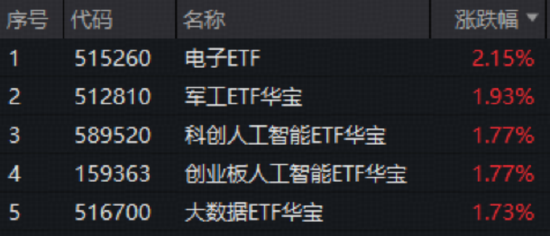
英伟达财报提振AI信心!创业板人工智能ETF+科创人工智能ETF默契同涨1.77%!军工ETF拾级攀升1.93%豪取五连阳
Xin Lang Ji Jin· 2026-02-26 11:47
Group 1: Market Overview - The A-share market experienced a rebound with mixed performance across the three major indices, driven by Nvidia's strong earnings, which boosted the computing power sector [1] - The total trading volume in the Shanghai, Shenzhen, and Beijing markets reached 2.56 trillion yuan, an increase of 756 billion yuan compared to the previous day [1] Group 2: Nvidia's Impact - Nvidia's earnings report exceeded market expectations, dispelling concerns about an AI bubble and confirming the exponential growth in AI computing power demand [1][9] - The AI-focused ETFs, including the ChiNext AI ETF and the Sci-Tech AI ETF, saw significant price increases of 1.77% and 1.77% respectively [1] Group 3: Sector Performance - Over 29.3 billion yuan of main funds flowed into the electronics sector, with PCB stocks experiencing a strong surge, particularly Huadian Co., which topped the A-share fundraising list [1] - The Sci-Tech Chip ETF rose by 1.44%, reflecting a strong performance in the computing chip sector, with stocks like Cambrian Technologies seeing gains of nearly 10% [1][11] Group 4: Military Industry - The military sector continued its upward trend, with the military ETF gaining 1.93% and achieving five consecutive days of gains [2][4] - Factors contributing to this momentum include developments in commercial aerospace, large aircraft production, and low-altitude economy initiatives [6] Group 5: Lithium and Chemical Sectors - A ban on lithium exports from Zimbabwe may lead to a short-term supply shortage in China, potentially driving up lithium prices [2] - The chemical ETF closed in the green, influenced by the U.S. designating phosphorus-based agricultural resources as strategic [2] Group 6: Investment Recommendations - Dongwu Securities suggests focusing on mid-term industry trends and cyclical recovery opportunities, particularly in AI, commercial aerospace, and strategic resources [3][15] - The Sci-Tech Chip ETF is highlighted for its comprehensive exposure to semiconductor materials, equipment, and design, with over 90% weight in core sectors [15]


主动量化周报:春节特别篇:低起点,大空间,维持乐观-20260223
ZHESHANG SECURITIES· 2026-02-23 13:33
- The report does not contain specific quantitative models or factors, nor does it provide detailed construction processes, formulas, or backtesting results for any quantitative models or factors. The content primarily focuses on market analysis, investment opportunities, and thematic discussions such as AI technology and price increase logic[2][3][10][11][12][13]
恒生科技指数“越跌越买”,近5日净流入超69亿元
Jing Ji Wang· 2026-02-09 02:06
Market Overview - The A-share market saw a rebound with the Shanghai Composite Index returning to 4100 points, while the ChiNext Index experienced a recovery after hitting a low [1] - The coal sector showed significant gains, and the space photovoltaic concept stocks continued their upward trend, whereas AI application stocks declined [1] ETF Market Dynamics - The stock ETF market experienced a net outflow of approximately 1.6 billion yuan, with notable outflows from products like the Huatai-PB CSI 300 ETF and the CSI 500 ETF [1] - The total scale of the stock ETF market reached 4.15 trillion yuan, with the Hang Seng Technology Index seeing a net inflow of 2.884 billion yuan, marking it as the top sector for fund inflows [3][5] Fund Inflows and Outflows - The top three ETFs by net inflow included the Hang Seng Technology Index ETF (1.021 billion yuan), the Hang Seng Internet ETF (957 million yuan), and the Sci-Tech 50 ETF (910 million yuan) [4] - The Huatai-PB CSI 300 ETF experienced the largest net outflow at 2.597 billion yuan, followed by the CSI 500 ETF with 1.662 billion yuan [8] Fund Management Insights - Leading fund companies like E Fund and Huaxia Fund reported significant net inflows across their ETFs, with E Fund's total ETF scale reaching 655.65 billion yuan, reflecting a net inflow of 2.33 billion yuan [5] - The market remains active with a high trading volume, particularly in the context of approaching the Chinese New Year holiday, indicating sustained liquidity support [9]

开年以来公募超八成自购投向权益基金;新基金建仓加速
Sou Hu Cai Jing· 2026-02-04 07:33
Group 1: Fund News Overview - Over 80% of public funds' self-purchases are directed towards equity funds, with a total scale of 406 million yuan from 24 fund companies as of February 3, 2026 [1] - New funds are accelerating their investment operations, with some funds like Mingya Yuan Zhen Zhi Xuan Mixed A starting to build positions shortly after their establishment [2] - Regulatory requirements have led to the removal of features like "real-time valuation" and "position rankings" from several fund sales platforms to prevent misleading investors [3] Group 2: Notable Fund Manager Updates - Zhang Yan has resigned from multiple funds managed under Agricultural Bank of China Fund due to personal reasons, having achieved a return of 193.55% over more than 8 years [4][5] Group 3: ETF Market Commentary - The market saw a rebound with the Shanghai Composite Index rising by 0.85% and the Shenzhen Component Index increasing by 0.21%, while the ChiNext Index fell by 0.4% [6] - The coal sector experienced significant gains, with over 10 stocks hitting the daily limit up, and the Coal ETF leading with a rise of 9.07% [7] - Conversely, the artificial intelligence ETFs faced declines, with the leading AI ETF dropping by 4.15% [9] Group 4: ETF Thematic Opportunities - The recent increase in international energy prices and stable supply-demand dynamics are expected to support coal prices, making coal ETFs a potential area of interest [10]
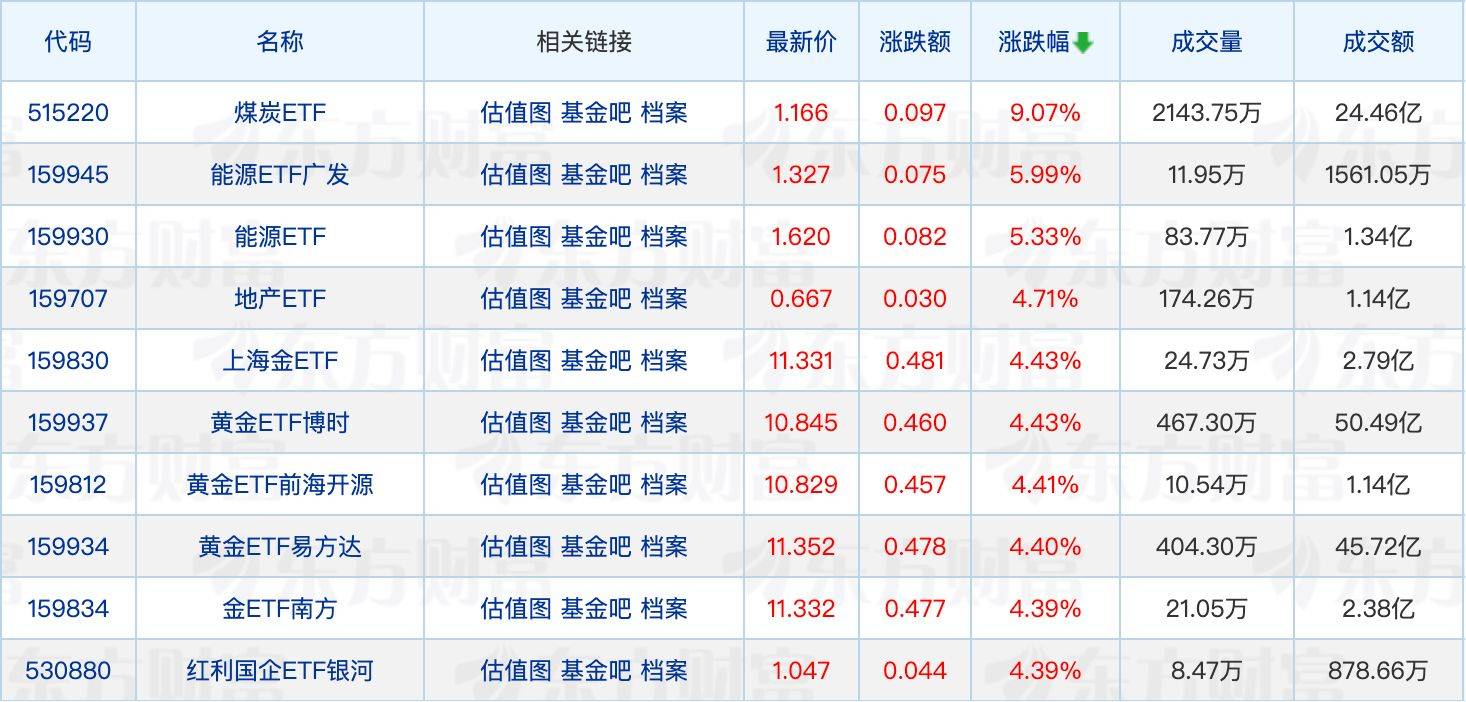
ETF今日收评 | 煤炭ETF涨超9% 能源相关ETF涨超5% 人工智能ETF跌超4%
Mei Ri Jing Ji Xin Wen· 2026-02-04 07:30
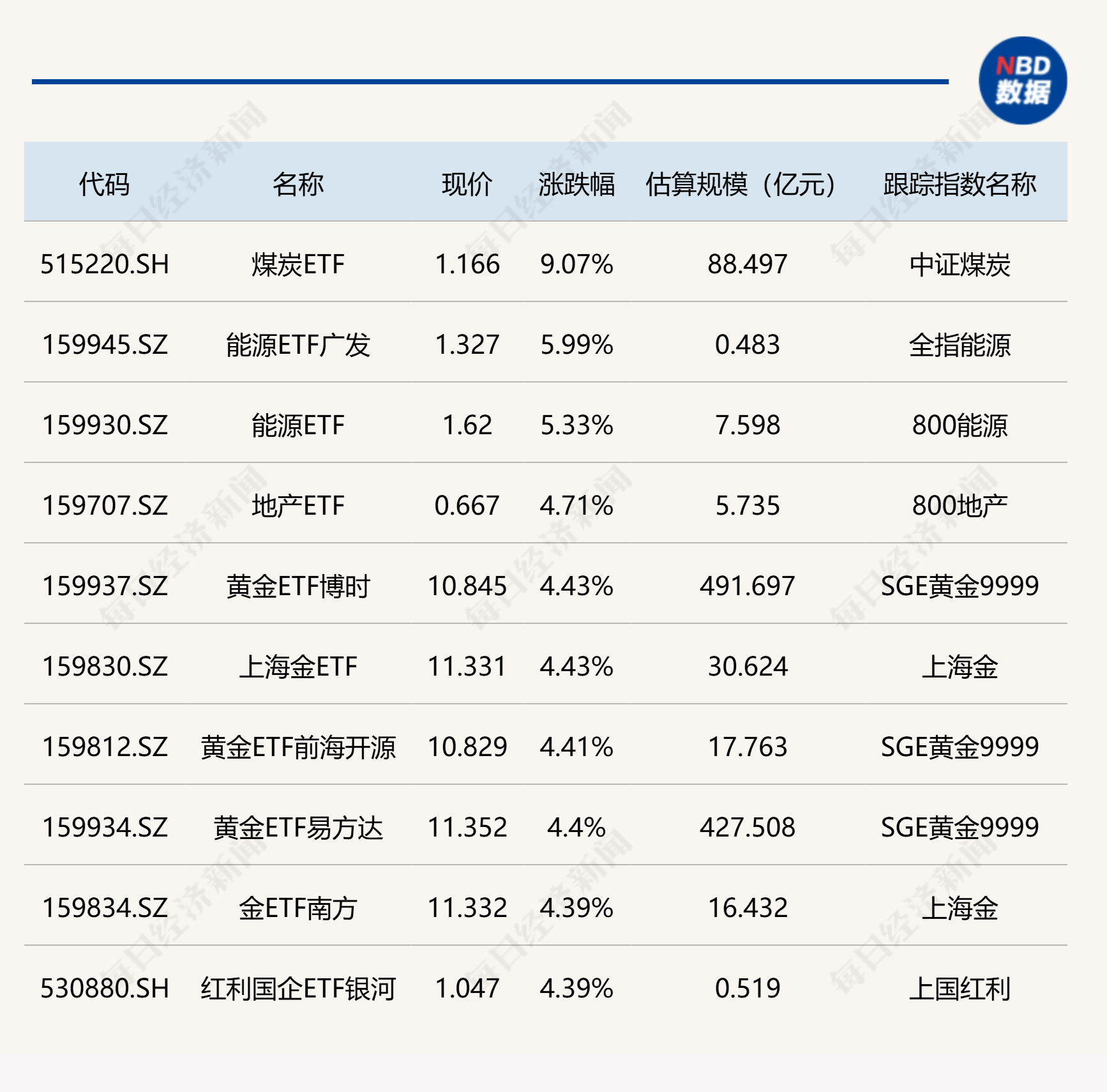
Market Overview - The Shanghai Composite Index has rebounded, returning to the 4100-point level, with significant gains in the coal sector, space photovoltaic concepts, airport and shipping sectors, and active performance in the real estate sector [1] - Conversely, sectors such as AI applications, precious metals, and computing hardware have seen notable declines [1] ETF Performance - The Coal ETF surged over 9%, while energy-related ETFs increased by more than 5% [1] - Specific ETF performance includes: - Coal ETF (515220.SH) at 1.166, up 9.07% - Energy ETF (159945.SZ) at 1.327, up 5.99% - Real Estate ETF (159707.SZ) at 0.667, up 4.71% [2] Coal Market Insights - Current prices for thermal coal and coking coal remain at historical lows, providing room for a rebound [3] - Supply-side policies aimed at curbing overproduction and the seasonal increase in demand for heating are expected to improve the coal supply-demand fundamentals [3] - Thermal coal benefits from long-term contract mechanisms and profit-sharing logic between coal and power companies, while coking coal is more sensitive to market dynamics, potentially showing greater price elasticity [3] AI Sector Analysis - The AI ETF has declined over 4%, with specific ETFs showing the following performance: - AI ETF (515980.SH) at 0.924, down 4.15% - Various other AI-related ETFs also reported declines ranging from 3.63% to 3.95% [4][5] - Analysts suggest that AI, as a core driver of the new technological revolution, holds significant potential for creating new possibilities and driving industries towards intelligence [5] - The development of large model technologies is expected to reshape global industry dynamics, potentially generating trillions in commercial value for the financial sector, while facing challenges such as technical bottlenecks and regulatory balance [5]
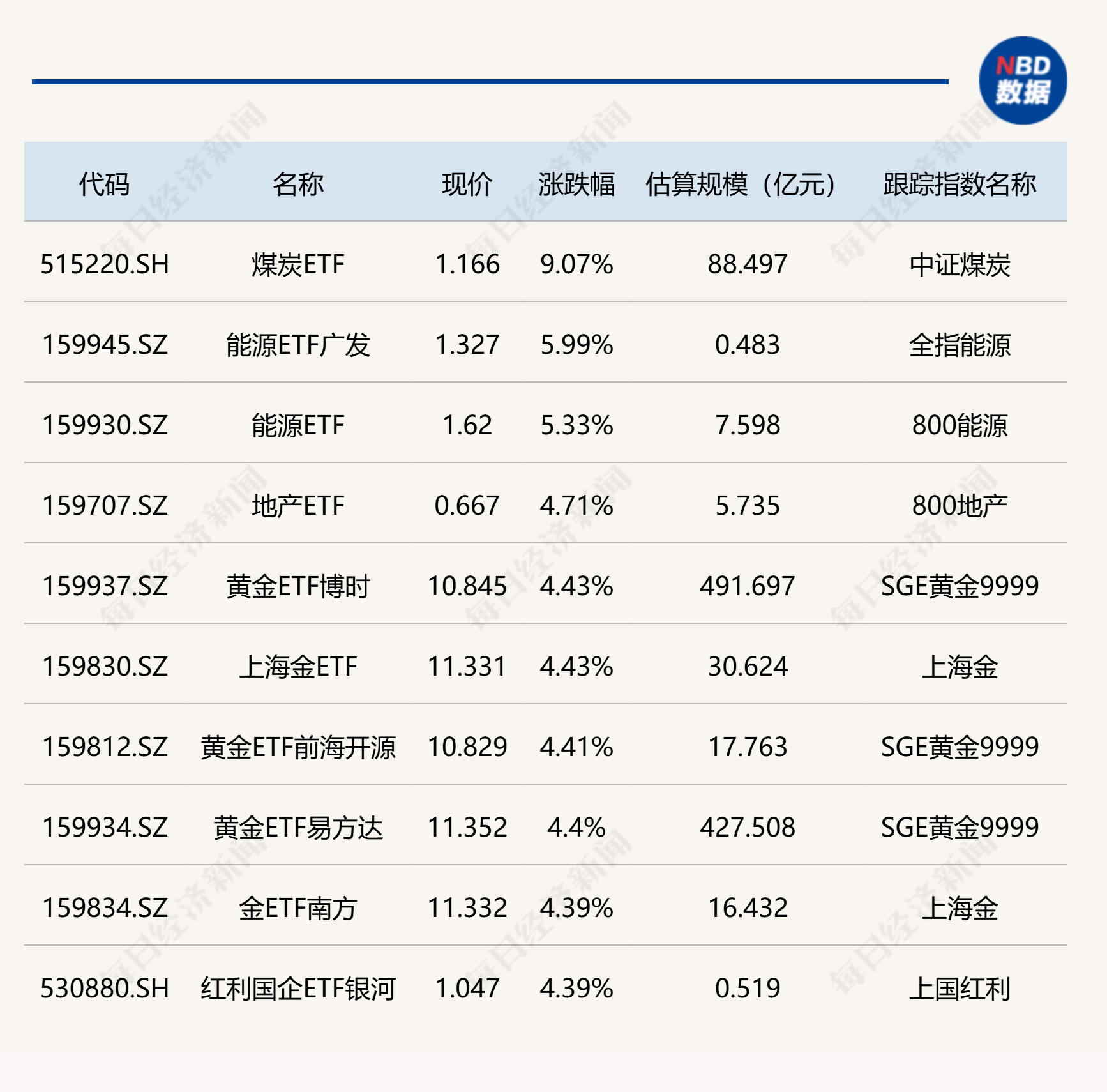
ETF今日收评 | 煤炭ETF涨超9%,能源相关ETF涨超5%,人工智能ETF跌超4%
Sou Hu Cai Jing· 2026-02-04 07:13
Market Overview - The Shanghai Composite Index has rebounded above 4100 points, indicating a market recovery [1] - The coal sector has seen a surge, with coal-related ETFs rising over 9% and energy-related ETFs increasing by more than 5% [1][2] Sector Performance - The coal concept has triggered a wave of limit-up stocks, while the real estate sector has shown active performance [1] - Conversely, sectors such as AI applications, precious metals, and computing hardware have experienced significant declines [1] ETF Performance - Coal ETF (515220.SH) rose by 9.07% to a price of 1.166 [2] - Energy ETFs also performed well, with the Guangfa Energy ETF (159945.SZ) increasing by 5.99% to 1.327 and another Energy ETF (159930.SZ) rising by 5.33% to 1.62 [2] - In contrast, the AI ETF (515980.SH) fell by 4.15% to 0.924, reflecting a downturn in the AI sector [4] Coal Market Insights - Analysts indicate that thermal coal and coking coal prices are still at historical lows, providing room for a rebound [3] - The supply-side "overproduction checks" are expected to reduce output, while the demand side is entering a peak heating season, suggesting a potential improvement in coal supply-demand fundamentals [3] - Thermal coal benefits from long-term contract mechanisms and profit-sharing logic between coal and power companies, while coking coal is more sensitive to market changes [3] AI Sector Analysis - AI is viewed as a core driver of the new technological revolution, with its value lying in creating new possibilities rather than just improving efficiency [5] - The development of large model technologies is reshaping global industrial patterns and is expected to bring significant commercial value to the financial sector, potentially reaching trillions of yuan [5] - However, challenges such as technological bottlenecks, high investment costs, and regulatory balance need to be addressed for further advancement [5]
超710亿元,跑了!
中国基金报· 2026-01-26 07:20
Core Viewpoint - The A-share market experienced a broad increase, but there was a significant outflow of funds from stock ETFs, totaling over 717 billion yuan on January 23, indicating a trend of profit-taking among investors [2][7][8]. Group 1: Market Performance - On January 23, the A-share market saw all three major indices rise, with total trading volume exceeding 30 trillion yuan [2]. - The total scale of stock ETFs in the market reached 4.58 trillion yuan as of January 23, 2026 [4]. - The trading volume of stock ETFs on that day was 368.61 billion yuan, an increase of over 68 billion yuan compared to the previous trading day [4]. Group 2: Fund Flows - Stock ETFs experienced a cumulative net outflow of nearly 450 billion yuan over the past five trading days, with 26 ETFs seeing outflows exceeding 1 billion yuan on January 23 [8][10]. - The largest net outflows were observed in broad-based ETFs, with four ETFs experiencing single-day outflows exceeding 100 billion yuan, and one ETF exceeding 200 billion yuan [8][10]. Group 3: Sector Performance - The solar and satellite sectors led the gains among stock ETFs, with four solar ETFs and six satellite ETFs among the top ten performers [5]. - On January 23, 21 stock ETFs had an increase of over 8%, with the top performers being the Sci-Tech Innovation Board New Energy ETF and various satellite ETFs, each rising by 10% [5][6]. Group 4: Fund Inflows - Despite the overall outflow, 58 stock ETFs saw inflows exceeding 100 million yuan, with the CSI 500 ETF, Sci-Tech Chip ETF, and Chemical ETF leading the inflows [8][9]. - Notable inflows were recorded for ETFs managed by leading fund companies, such as E Fund and Huaxia Fund, indicating continued interest in specific sectors [12].
净流出,超400亿元
Zhong Guo Ji Jin Bao· 2026-01-20 06:37
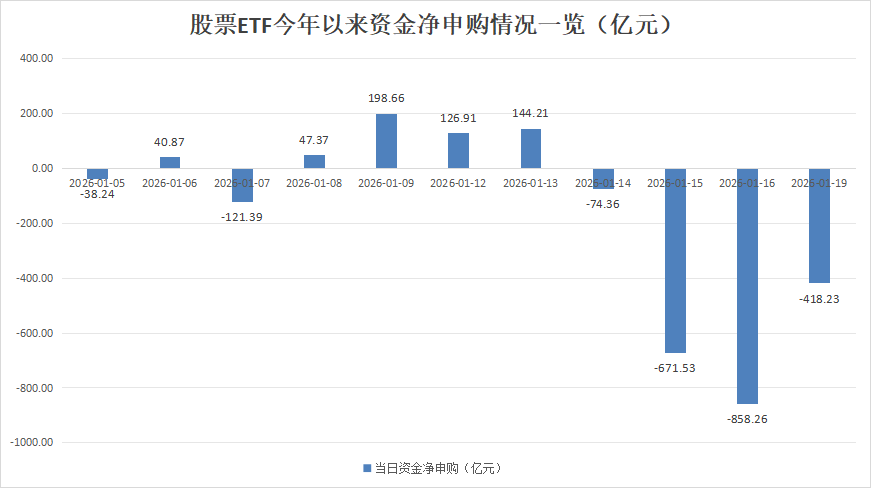
Core Viewpoint - The stock ETF market continues to show a trend of significant capital outflow, indicating a cooling effect on the A-share market amidst recent volatility [1][2][10]. Group 1: Market Overview - On January 19, the A-share market experienced a net outflow of over 400 billion yuan from stock ETFs, marking the third consecutive day of significant outflows [1][2]. - The total scale of all stock ETFs reached 4.61 trillion yuan, with a net outflow of 418.23 billion yuan on the same day [2][4]. - The overall trading volume in the two markets decreased to 2.73 trillion yuan, with a relatively weak performance from large-cap stocks [2]. Group 2: ETF Performance - Industry and commodity ETFs saw net inflows of 155.04 billion yuan and 22.44 billion yuan, respectively, while broad-based ETFs experienced a net outflow of 586.07 billion yuan [4]. - The largest outflows were observed in the four major Hu-Shen 300 ETFs, which collectively saw over 300 billion yuan in net outflows [5][8]. - Specific ETFs such as the Huaxia Electric Grid Equipment ETF led the inflows with over 25 billion yuan, while the Hu-Shen 300 ETFs faced significant outflows, with individual ETFs seeing net outflows exceeding 50 billion yuan [6][8]. Group 3: Fund Management Insights - Major fund companies like E Fund and Huaxia Fund reported continued inflows in certain ETFs, with E Fund's Robot ETF reaching a historical high of 174 billion yuan [4][6]. - The market is characterized by a resilient overall performance, with active trading and significant inflows into industry-themed ETFs supported by strong fundamentals [10].
人工智能ETF这么多,为什么唯独这只“孤勇者”ETF近期被融资抢筹?
市值风云· 2026-01-19 10:09
Group 1 - The article highlights the significance of financing data in a bull market, emphasizing that it acts as an amplifier for market trends [3] - Recent observations indicate that among the top ETFs with net financing inflows, an AI-focused ETF has gained notable attention alongside semiconductor-related ETFs [3] - The article raises a question regarding the popularity of this specific AI ETF over others, suggesting a unique characteristic that warrants further exploration [4] Group 2 - The research indicates that the AI ETF in question possesses distinctive features that make it stand out in the crowded market of AI-themed ETFs [4]