
通胀压力

Search documents
李鑫恒:黄金大涨周线收官谨防逆转 回踩接多
Xin Lang Cai Jing· 2025-12-12 05:29
12月12日,周五,亚市早盘,现货黄金在经历前一夜大涨之后,目前在开盘价稍低点位开始横盘震荡。 昨天黄金的走势也如我们预期的一样,白盘一直在4215美元附近横盘震荡,最低点位在4205美元附近, 美盘强势拉升至4285美元。昨天文章给到的就是黄金回踩4200-4205多进场,不过目标只给到4250附 近,没想到晚间的涨势如此凶猛,还好利润也比较可观。 在全球经济不确定性笼罩下,黄金作为传统避险资产再次闪耀光芒。周四(12月11日),随着美联储连 续第三次降息25个基点,黄金价格强势反弹,现货黄金上涨约1.2%,触及每盎司4285美元的逾一个月 高点,而白银更是创下每盎司64.30美元的历史新高。这一轮贵金属行情的爆发,不仅源于美元走软和 通胀压力持续,还受到了即将公布的非农就业报告以及全球地缘政治动荡的推动。投资者们应密切关注 这些因素如何交织影响黄金的未来走势。 基本消息面: 美联储的货币政策调整无疑是此次黄金价格上涨的核心催化剂,尽管市场对此已有广泛预期,但美联储 决策者的措辞和预测显示出鸽派倾向,他们强调将监测劳动力市场趋势,并承认通胀"仍然偏高",这种 表态让投资者解读为进一步降息的可能性并未完全关闭 ...
国际观察|美联储内部分歧加剧 进一步降息空间有限
Sou Hu Cai Jing· 2025-12-11 04:56
新华社纽约12月10日电 题:美联储内部分歧加剧 进一步降息空间有限 新华社记者刘亚南 这一表述曾在2024年12月货币政策声明中出现,美联储此后暂停降息,直至今年9月。市场据此认为, 美联储释放了暂时不会再降息的信号。 鲍威尔当天在记者会上说,自2024年9月开启本轮降息周期以来,联邦基金利率已下调175个基点。他 说:"联邦基金利率现在位于宽泛的中性利率估测区间,我们现在处于良好位置,可以等待和观察经济 形势如何发展。" 同时,美联储发布的经济预测摘要显示,美联储官员预测的2025年和2026年联邦基金利率中位数维持在 3.4%和3.1%不变。与当前3.5%至3.75%的利率目标区间相比,美联储明年和后年预计将分别再降息25个 基点。 芝加哥商品交易所美联储观察工具显示,截至当日下午6时许,市场认为美联储在明年1月货币政策会议 上维持利率不变的概率为77.%,高于前一日的69.8%。 内部分歧加大 美国联邦储备委员会10日结束为期两天的货币政策会议,宣布降息25个基点。这是美联储自9月以来连 续第三次降息,也是自2024年9月启动本轮降息周期以来第六次降息。 分析人士认为,美联储内部围绕是否进一步降息分歧 ...
白银疯涨破60美元创新高!盛宝银行:多重利好共振 2026年牛市仍可期
智通财经网· 2025-12-10 12:28
Core Viewpoint - Silver prices are projected to exceed $60 per ounce by 2025, driven by favorable monetary policy, market structure, and supply-demand dynamics, with a continued bullish outlook into 2026, although potential risks must be monitored [1] Group 1: Price Movement and Market Dynamics - As of the report, spot silver has risen approximately 0.3% to $61.03 per ounce, marking a year-to-date increase of 111%, contrasting with a 0.3% decline in spot gold to $4199.46 per ounce [1] - The surge in silver prices is attributed to supply tightness, insufficient price elasticity in industrial demand, and policy-driven market mismatches, leading to a price increase that exceeds what gold price movements alone can explain [1] Group 2: Supply and Demand Fundamentals - The current loose monetary policy cycle supports silver prices, while ongoing tightness in the spot market persists [1] - Increased demand from sectors such as electrification, solar energy, electric vehicles, and data centers has outpaced mining capacity, further highlighting the supply-demand imbalance [1] - The inclusion of silver in the U.S. critical minerals list underscores this supply-demand disparity [1] Group 3: Risks and Valuation Concerns - The high valuations in the artificial intelligence sector pose a risk; a potential valuation correction could significantly reduce silver demand from chip and data center infrastructure, impacting overall market risk appetite [1] - The gold-silver ratio has fallen to around 68, aligning with the 30-year historical average, indicating that silver has moved out of a significantly undervalued range [2] - In a normalized market environment where supply-demand constraints weaken, silver may enter a consolidation phase, with some funds potentially reallocating to gold, although both metals remain valuable for hedging against fiscal risks, inflation, and geopolitical volatility [2] Group 4: Technical Analysis - Market participants are closely monitoring whether silver can maintain a position within the $54-$55 range [2] - If silver prices can break above this range and hold, it would strengthen expectations for an upward shift in trading ranges for 2026, especially as gold prices are anticipated to approach $5000, which would also support silver prices [2]
加拿大央行政策 支撑加元偏强
Jin Tou Wang· 2025-12-10 02:40
Group 1 - The USD/CAD exchange rate is currently at 1.3853, showing a slight increase of 0.0001 from the previous trading day, with a fluctuation range indicating stability in the market [1] - Recent Canadian employment data exceeded expectations, reinforcing the Bank of Canada's strong policy stance, which supports the Canadian dollar [1] - Global trade concerns are affecting the Canadian export environment, limiting the appreciation potential of the Canadian dollar [1] Group 2 - The USD/CAD pair is experiencing a balance of forces, with key resistance at 1.3875 and support at 1.3800, indicating a potential range-bound movement [2] - Technical indicators suggest a market in a wait-and-see mode, with MACD convergence and RSI in a neutral zone [2] - Upcoming U.S. employment data and central bank policy decisions are expected to influence short-term volatility in the USD/CAD exchange rate [2]
直线大跳水!美联储突传重磅!
天天基金网· 2025-12-10 01:09
上天天基金APP搜索777注册即可领500元券包,优选基金10元起投!限量发放!先到先得! 特朗普突然释放重磅信号。 美国总统特朗普在最新访谈中明确表示,支持立即大幅降息将成为其选择新任美联储主席的关键标准。有分析 指出,这一表态凸显了特朗普对货币政策的干预意图,可能加剧白宫与美联储之间的紧张关系。 在美联储公布利率决议前夕,隔夜美股市场窄幅震荡,三大指数收盘涨跌不一。其中,华尔街巨头摩根大通股 价盘中大幅跳水,暴跌超4%,拖累道指走低、由涨转跌。 消息面上,摩根大通高管警告2026年支出将大幅 增加,投资者担忧其业绩增速或将放缓。 特朗普最新发声 当地时间12月9日,美国政治新闻网站Politico报道,特朗普明确表示,支持大幅降息将成为他挑选下一任美 联储主席的决定性因素。 在最新的采访中,当被问及是否将支持大幅降息作为美联储主席提名人选的考察标准时,特朗普明确回应 称:"是的。" 报道称,这一表态打破了历届总统在美联储人事任命上保持相对克制的传统,可能对美联储的独立性构成挑 战。 美联储主席的任命将直接影响未来数年的货币政策走向。特朗普对降息的明确偏好,可能促使其选择倾向于宽 松货币政策的候选人,这与市 ...



特朗普:降息是美联储主席的试金石,可能通过调整关税降低部分商品价格
Sou Hu Cai Jing· 2025-12-09 11:46
Group 1: Core Views - Trump's support for immediate significant interest rate cuts will be a key criterion for selecting the next Federal Reserve Chair, indicating his intention to intervene in monetary policy and potentially escalating tensions between the White House and the Fed [1][2] - Despite Trump's optimistic assessment of the economy, dissatisfaction among voters regarding living costs is rising, with about half of voters and nearly 40% of Trump supporters indicating that living costs are at their worst level ever [1][3] Group 2: Economic Assessment - There is a notable gap between Trump's optimistic evaluation of the economy and the reality experienced by voters, as he attributes dissatisfaction with prices to the Biden administration while claiming that "everything is getting cheaper" [3] - The latest consumer price index data shows a 3% increase in prices over the past 12 months, contradicting Trump's claims of declining prices [1][3] Group 3: Healthcare Subsidy Concerns - The expiration of enhanced healthcare subsidies under the Affordable Care Act is a looming threat to many Americans, with expected significant increases in healthcare costs by 2026 [4] - Trump's vague response regarding the temporary extension of these subsidies and his absence from healthcare policy negotiations highlight potential challenges in reaching a bipartisan agreement [4] - Despite repeated promises to unveil a comprehensive alternative to the Affordable Care Act, Trump has not provided specific plans on how to achieve lower healthcare costs [4]
德勤:通胀数据成关键 未来几个月澳洲联储料将采取数据导向的观望政策
Sou Hu Cai Jing· 2025-12-09 04:55
Core Viewpoint - Deloitte emphasizes the increasing importance of the upcoming Australian inflation data, set to be released in January, for the Reserve Bank of Australia's interest rate decisions [1] Group 1: Economic Outlook - Stephen Smith, a partner at Deloitte Economic Consulting, indicates that all attention will be on the CPI data for November and December following the RBA's decision to maintain the cash rate at 3.60% [1] - Smith anticipates that the RBA will adopt a data-driven "wait-and-see" approach in the coming months [1] Group 2: Inflation and Economic Growth - The central bank faces a dilemma as the Australian economy is currently stagnating, but a potential acceleration in economic growth could reignite inflationary pressures [1]
刚宣布!不降息
中国基金报· 2025-12-09 04:27
【导读】 澳洲央行如期维持利率不变 市场预期宽松周期或已结束 中国基金报记者 泰勒 大家好,超级央行周,澳洲央行"第一枪"来了,刚刚宣布不降息。 这也使得2026年的前景颇具挑战性。利率期货市场目前已经消化了最早在明年5月加息一次、概率约"五五开 " 的预期,而大多数经济学家 则认为本轮宽松周期已经结束,此前他们普遍预计利率至少还会再降一次至3.35%。 高盛、瑞银以及Barrenjoey的分析师已转向与市场相似的判断,认为澳洲央行下一步更有可能是加息而非继续降息。 12月9日, 澳大利亚 央行连续第三次按兵不动, 未能给房贷持有人提前送上 " 圣诞礼物",在今年最后一次会议上维持利率不变, 继续 强调"看数据决策"。 澳大利亚央行在本次会议上如市场普遍预期的那样,连续第三次按兵不动,将关键政策利率维持在3.6%。央行同时重申,未来政策走向将 继续取决于后续公布的经济数据。 央行称,当前物价压力再度抬头,劳动力市场依然偏紧。声明称,九名董事一致赞成这一决定。 利率决策委员会在声明中表示:"最新数据表明,通胀风险已偏向上行,但仍需要更长时间来评估通胀压力的持续性。董事会将在决策中密 切关注数据表现以及对前景和风 ...

全球长债收益率上行,美债收益率创两个月新高
Hua Er Jie Jian Wen· 2025-12-09 00:22
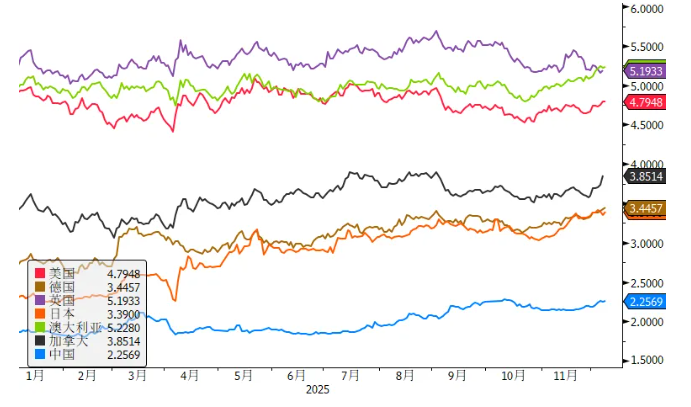
Core Viewpoint - A new wave of selling in global long-term bonds has emerged, with U.S. 10-year Treasury yields rising to 4.17% and 30-year yields approaching 4.82%, both reaching new highs since September [1] Group 1: U.S. Treasury Market - The market is focused on the upcoming Federal Reserve interest rate decision, with traders expecting a 90% probability of a 25 basis point cut [1][3] - Analysts anticipate that the Fed's decision will carry a hawkish tone, suggesting a potential extension of the pause on rate cuts into next year [3] - The swap market indicates that the terminal rate has risen from below 3% to 3.2%, the highest level since July [1] Group 2: Global Bond Market Trends - Concerns over fiscal sustainability and inflation pressures are leading markets to bet on multiple countries, including Japan, Australia, and Canada, resuming rate hikes by 2026 [5] - Japan's 30-year bond yield has increased by 34 basis points to 3.39%, leading the global long bond sell-off [5] - Australia's inflation unexpectedly rose to 3.8%, with market expectations for a 34 basis point rate hike by the next Reserve Bank meeting [5] - Canada's employment data has led to a 25 basis point rate hike expectation for 2026, with its 30-year bond yield rising by 28 basis points to 3.85% [5] Group 3: Market Reactions and Implications - The U.S. Treasury yield curve has seen an overall increase of 2 to 3 basis points, with mid-term bonds performing the weakest [4] - The Treasury adjusted its auction schedule to align with the Fed's two-day meeting, indicating a strategic response to market conditions [4] - High expectations for continued easing have paradoxically led to higher yields rather than lower ones [4]
张尧浠:通胀减弱就业担忧 金价调整仍不改看涨前景
Xin Lang Cai Jing· 2025-12-08 10:05
12月08日:黄金市场上周:国际现货黄金震荡收跌,相对于前周振幅明显收窄,多头动力减弱,但目前 仍运行在5-10周均线上方,布林带保持向上发展,基本面也未有持续且较大的利空因素,故此,前景 上,仍具有看涨新高预期。 具体走势上,金价自周初开于4221.37美元/盎司,先行录得当周高点4264.57美元,之后遇阻回撤,于周 二录得当周低点4163.81美元,据此开始连续不断冲高回落和触底回升走盘,延续至周五触及周高点附 近后,再度回撤走低,最终收于4194.36美元,周振幅100.76美元,收跌27.01美元,跌幅0.64%。 周线级别,金价在近几周震荡调整,低点不断上移的同时,持续受到10周均线支撑,而在前周强势反弹 走强拉升,多头占据优势,布林带向上延伸,看涨前景良好,虽然上周多头动力虽有减弱,但未跌至5- 10周均线下方,故此在此之上,仍可继续看涨入场,等待再度上探历史高点附近或更高位置。 影响上,虽然周内受到12月降息预期的提振,以及部分数据的疲软支撑,而展现看涨预期,但在技术阻 力压制之下,以及在等待众多数据公布指引政策前景之前的等待和观望,而不断调整波动; 虽然周五美国9月核心PCE物价指数年率显示 ...
