
数字货币

Search documents
青蒿素概念涨0.65%,主力资金净流入4股
Zheng Quan Shi Bao Wang· 2025-07-04 08:38
Group 1 - The Artemisinin concept index increased by 0.65%, ranking 10th among concept sectors, with four stocks rising, including Haizheng Pharmaceutical which hit the daily limit, and Zhejiang Medicine, Huaren Shuanghe, and Baiyunshan also showing gains of 0.79%, 0.69%, and 0.08% respectively [1] - The leading decliners in the sector included Rundu Co., New Harmony, and Kunming Pharmaceutical, which fell by 1.41%, 1.36%, and 1.17% respectively [1] - The net inflow of main funds into the Artemisinin concept sector was 95 million yuan, with Haizheng Pharmaceutical receiving the highest net inflow of 105 million yuan, followed by Zhejiang Medicine, New Harmony, and Baihua Pharmaceutical with net inflows of 25.71 million yuan, 9.91 million yuan, and 2.14 million yuan respectively [2][3] Group 2 - In terms of fund inflow ratios, Haizheng Pharmaceutical, Zhejiang Medicine, and Baihua Pharmaceutical had the highest net inflow rates of 9.03%, 5.48%, and 2.27% respectively [3] - The trading performance of key stocks in the Artemisinin concept included Haizheng Pharmaceutical with a daily increase of 10.02% and a turnover rate of 9.22%, while Zhejiang Medicine rose by 0.79% with a turnover rate of 3.19% [3][4] - Other stocks such as New Harmony and Baihua Pharmaceutical experienced declines of 1.36% and 0.41% respectively, with turnover rates of 1.04% and 3.34% [3][4]



超4100只个股下跌
第一财经· 2025-07-04 07:52
Market Overview - The three major stock indices closed mixed, with the Shanghai Composite Index at 3472.32 points, up 0.32%, while the Shenzhen Component Index fell 0.25% to 10508.76 points, and the ChiNext Index decreased by 0.36% to 2156.23 points [1][2]. Stock Performance - Over 1100 stocks rose, while more than 4100 stocks declined, indicating a bearish market sentiment overall [2]. - The banking sector showed strong performance, with major banks like China CITIC Bank, Industrial Bank, and China Everbright Bank rising over 3% [5]. - The cross-border payment concept stocks were notably active, with Longbright Technology rising over 13% and Tianyang Technology increasing by over 10% [5]. Sector Analysis - The financial sector saw a midday surge, while sectors such as military, solid-state batteries, marine economy, and rare earth permanent magnets weakened [3]. - The energy metals sector faced significant declines, with YH Precision dropping nearly 10% and Tengyuan Cobalt falling over 4% [5]. Capital Flow - Main capital flows showed net inflows into banking, pharmaceutical, and computer sectors, while there were net outflows from power equipment and non-ferrous metals sectors [7]. - Specific stocks like Wolong Nuclear Materials, Xiexin Energy, and Data Port saw net inflows of 1.183 billion, 532 million, and 474 million respectively [8]. Institutional Insights - Jianghai Securities noted that a breakthrough of previous highs is imminent but requires support from the financial sector [11]. - Galaxy Securities suggested that the Shanghai Composite Index may continue to rise but needs volume support, while Guotai Junan Securities indicated a potential upward trend in the fourth quarter due to a weak dollar environment [12].


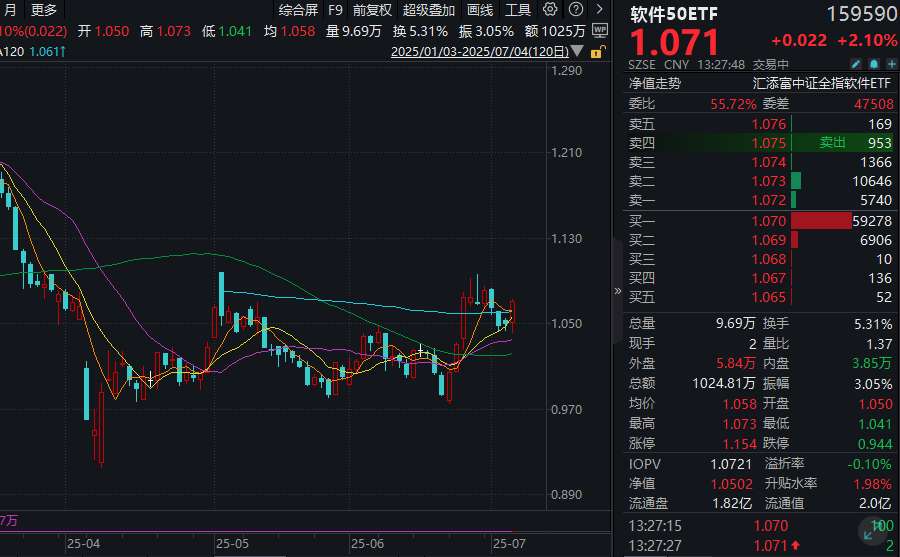
数字贸易再迎重磅文件支持!京北方、大智慧涨停,软件50ETF(159590)翻红冲高涨超2%!信创50ETF(560850)涨超1%!
Xin Lang Cai Jing· 2025-07-04 05:59
Group 1 - A-shares experienced a significant afternoon rally, with Software 50 ETF (159590) rising over 2% and having net inflows on 2 out of the last 5 days [1] - Digital currency concepts surged, influenced by a government notice promoting high-level institutional reforms in free trade zones, including measures for digital trade and risk prevention [3] - The EDA software market in China is dominated by three major suppliers, which accounted for approximately 82% of the market share last year, following the U.S. decision to lift licensing requirements for these companies [4] Group 2 - The Software 50 ETF closely tracks the CSI Software Index, which includes 50 stocks with a focus on application software (67% weight), AI-related fields (over 15%), and information security (10%) [4] - The DeepSeek concept stocks within the CSI Xinchuang Index have a weight of 48.1%, indicating a strong correlation with the "domestic substitution" trend in the market [5] - The computer industry is expected to see steady revenue growth by Q2 2025, with a focus on AI applications and computing power as key growth areas [4]




英大证券晨会纪要-20250704
British Securities· 2025-07-04 05:29
Core Views - The A-share market is expected to experience a likely upward trend with fluctuations, driven by performance support and favorable policies [1][8] - The market is currently facing uncertainties due to the approaching deadline for tariff suspensions, leading to cautious investor sentiment [1][8] Market Overview - On Thursday, the three major indices in the A-share market rose, reaching new recent highs, with increased individual stock activity and a recovery in market profitability [4][5] - The trading volume showed some contraction, indicating a lack of strong enthusiasm from investors to chase prices [1][8] - The market is influenced by external factors such as U.S. Federal Reserve monetary policy and geopolitical tensions, particularly in U.S.-China relations [4][8] Sector Performance - The pharmaceutical sector showed strong performance, particularly in innovative drugs, supported by new measures from the National Healthcare Security Administration aimed at promoting high-quality development in innovative drugs [6] - The consumer electronics sector also saw significant gains, attributed to trade agreements affecting import tariffs on products from Vietnam, which may enhance the competitive edge of Chinese manufacturers [7] Investment Opportunities - Three main investment themes are highlighted: 1. Stocks with better-than-expected mid-year performance, focusing on those with anticipated improvements [9] 2. Technology sectors including military, robotics, AI, semiconductors, and digital economy, with a caution to avoid overvalued speculative stocks [9] 3. Rebound opportunities in sectors like new energy and brokerage firms, suggesting strategic buying during pullbacks [9]
盘中!沪指、A50拉升
证券时报· 2025-07-04 04:21
Core Viewpoint - The A-share market experienced a slight upward trend driven by the banking sector, with major indices turning positive, while the Hong Kong market showed significant volatility, particularly with a notable surge in the stock of Ocean Group [2][3][12]. A-share Market Summary - The A-share market on July 4th saw a narrow fluctuation in the morning, with the banking sector leading the gains. The Shanghai Composite Index rose by 0.41% to 3475.24 points, while the Shenzhen Component and ChiNext Index increased by 0.05% and 0.18%, respectively [3][4]. - The banking sector saw a near 2% increase, with stocks like Shanghai Pudong Development Bank and Industrial Bank reaching historical highs [5][6]. - Other sectors such as internet, public transportation, water services, software services, and insurance performed well, while daily chemicals, mineral products, non-ferrous metals, and shipbuilding lagged behind [6][11]. Conceptual Sector Performance - The digital currency concept surged, with stocks like Jinyi Culture, Desheng Technology, and Jingbeifang hitting the daily limit [6]. - The brain engineering concept also saw significant gains, with stocks like Beiyikang rising over 17% [7]. Regulatory News Impact - On July 3rd, the National Medical Products Administration announced measures to optimize the lifecycle supervision of high-end medical devices, which may support innovation and expedite the approval process for high-end medical devices [9][10]. Hong Kong Market Summary - The Hong Kong market opened significantly lower but narrowed its losses during the morning session. The Hang Seng Index experienced a drop of over 1% [13][15]. - Ocean Group's stock saw a dramatic increase of nearly 75% during the session, attributed to a subscription agreement for issuing new shares [12][17]. - Other notable movements included declines in stocks like Alibaba Health and AIA Insurance, while China Biologic Products and China Unicom led the gains [14]. Company-Specific Developments - Multi-Point Intelligence experienced a rise of over 25% after announcing plans to purchase Bitcoin and apply for a stablecoin license, aligning with the Hong Kong government's push for Web3 industry development [18].

A股三大股指早盘盘尾全线翻红,游戏、数字货币概念涨幅居前,沪深京三市上涨个股近1500只。
news flash· 2025-07-04 03:23
A股三大股指早盘盘尾全线翻红,游戏、数字货币概念涨幅居前,沪深京三市上涨个股近1500只。 ...
公司互动丨这些公司披露在汽车、固态电池等方面最新情况
Di Yi Cai Jing· 2025-07-03 13:45
Group 1: Company Updates - Ganfeng Lithium responded to rumors of "financial fraud," stating that the information is false and the company's operational and financial situation is stable [1] - Jiabei Fang announced a strategic cooperation with Guofu Quantum, focusing on virtual assets and digital currency business [1] - Tianyang Technology is actively connecting with core participants in the stablecoin ecosystem and has RWA technology and solutions in the risk field [1] - Haineng Industrial's power bank products are all exported overseas, with no domestic sales currently [1] - Dayang Electric's subsidiary is researching hub motors but is not involved in the electric bicycle sector [1] - Wanxiang Qianchao's products can be applied to military vehicles [1] - Shanghai Wumao is actively engaging with leading brands in the new energy sector [1] Group 2: Solid-State Battery Developments - Dazhongnan's product CPP aluminum-plastic film is suitable for solid-state lithium battery packaging, but the company is not currently producing this product [1] - Wanxiang Qianchao has built multiple patent reserves around core technologies for solid-state batteries and is actively promoting commercialization [1] - Huaya Intelligent is producing a 200MWh solid-state battery production line for clients [1] - Zhongying Electronics' BMIC is adaptable to solid-state battery scenarios [1] - Daoshi Technology will focus on solid-state battery materials and AI to lead industry transformation and upgrading [1] Group 3: Other Industry News - Liyade is developing AR glasses with Saphlux that include a microprocessor and can connect to AI models for interactive functions [1] - Guanghong Technology has not provided sensing components for Xiaomi's AI glasses [1] - Fenjun Media's "Tap to Connect" project in collaboration with Alipay is currently in the pilot phase [1] - Tianchuang Fashion has not established a partnership with Pop Mart [1] - Delong Laser has sufficient orders on hand [1] - Songcheng Performing Arts maintains cooperation with Douyin in brand promotion and ticketing [1] - Jiu Dian Pharmaceutical currently has no products in the medical beauty or weight loss drug sectors [2]
京北方:与国富量子签署战略合作协议
news flash· 2025-07-03 12:52
京北方(002987)在投资者关系活动记录表中称,公司近日与国富量子创新有限公司签署战略合作协 议,双方将聚焦虚拟资产及数字货币业务,围绕IT技术创新、虚拟资产及稳定币生态圈合作创新、金融 业务创新三个层面展开深度合作。 ...
京北方(002987) - 2025年7月2日-7月3日投资者关系活动记录表
2025-07-03 12:37
Group 1: Strategic Cooperation and Business Model - The company has signed a strategic cooperation agreement with Guofu Quantum, a cross-border financial technology investment platform based in Hong Kong, which holds multiple licenses from the Hong Kong Securities and Futures Commission [4] - The collaboration aims to focus on virtual assets and digital currency businesses, leveraging both parties' resources in capital markets and financial technology [4] - The company plans to explore various business models with Guofu Quantum, including consulting services and asset tokenization technology services [6] Group 2: Stablecoin Applications and Market Potential - Stablecoins are expected to be widely used in cross-border payments, settlement, and RWA (Real World Assets) financing, offering advantages such as higher efficiency and lower costs compared to traditional methods [5] - The company aims to integrate stablecoins into the virtual asset ecosystem and explore potential cooperation opportunities in stablecoin issuance and virtual asset exchanges [5] Group 3: Technological Advantages and Experience - The company has accumulated significant technical experience in the digital renminbi system and possesses a mature technology framework in blockchain, smart contracts, and privacy computing [7] - It has established a localized delivery team for digital currency in the Greater Bay Area, enhancing its capability to support clients in various aspects of digital asset management [7] Group 4: Competitive Advantages and Client Base - The company has developed a diverse client base primarily consisting of banks, insurance, securities, trust, and asset management firms, creating a robust resource layout [8] - Its extensive industry experience, combined with a systematic R&D organization and innovative capabilities, forms a sustainable competitive advantage [8] Group 5: International Business Expansion - The company has established business relationships with Chinese clients in Hong Kong and is actively pursuing collaborations in Southeast Asia [9] - It plans to optimize its business delivery model in Hong Kong and gradually expand into Southeast Asia and countries along the Belt and Road Initiative [9]