算力

Search documents
三季度“冠军基”集体押注AI、算力,金梓才顶格配置多只个股
Mei Ri Jing Ji Xin Wen· 2025-10-28 06:16
Core Insights - The top-performing funds in Q3 2023, including ordinary equity, mixed equity, and flexible allocation funds, have heavily invested in technology sectors such as overseas computing power and semiconductors [1][2] - Notably, several stocks have reached the maximum allocation limit of 10% of the fund's net asset value, indicating strong confidence in these sectors [1][2] Fund Performance - The champions of ordinary equity funds for Q3 2023 are identified as Caifeng Integrated Circuit Industry A, Hengyue Advantage Selection, and Caifeng Multi-Strategy Fuxin [1] - Caifeng Integrated Circuit Industry A achieved a quarterly net value growth rate of 86.49%, making it the top performer among ordinary equity funds [2] Stock Holdings - Caifeng Multi-Strategy Fuxin reported a significant holding in Industrial Fulian, with a market value of 27.07 million yuan, which constitutes 10% of the fund's net value [2] - Other major holdings in Caifeng Multi-Strategy Fuxin, such as Shengyi Technology and Zhongji Xuchuang, also have market values exceeding 9% of the fund's net value [2] Investment Strategy - Fund manager Jin Zicai has shown a strong inclination towards the overseas computing power sector, anticipating accelerated growth in demand for computing power in 2026 and 2027 [2] - Hengyue Advantage Selection, managed by Wu Haining, has seen its scale grow over twofold in Q3, reaching 24.6 million yuan, with a focus on AI computing power and storage sectors [3] Sector Focus - The storage sector is highlighted as a key area of investment, with expectations of a price increase in storage chips driven by AI applications [3] - The domestic semiconductor equipment and energy storage sectors are also viewed positively, with a strong outlook for growth as production capabilities reach international standards [3]



AI算力股走强,A股冲破4000点!逾20只算力相关ETF涨超2%
Sou Hu Cai Jing· 2025-10-28 06:15
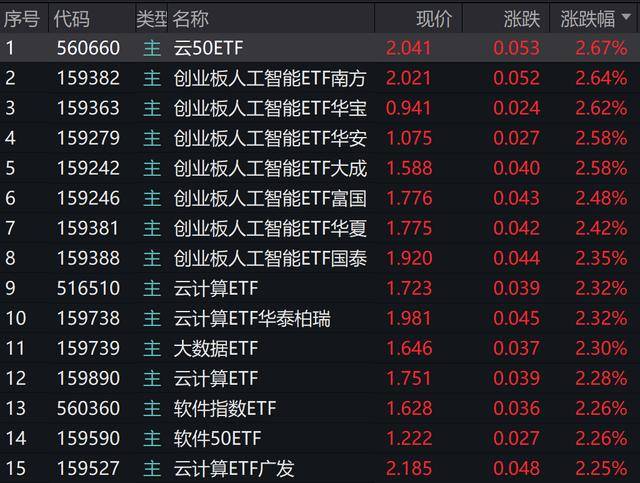
Core Viewpoint - The A-share market has surpassed the 4000-point mark, driven by strong performance in AI-related sectors such as computing hardware and domestic software [1] Group 1: Market Performance - AI and computing hardware concepts have shown significant strength, contributing to the A-share index crossing the 4000-point threshold [1] - Zhongji Xuchuang has reached a new historical high, while Jingwang Electronics has achieved two consecutive trading limits, and Rongji Software has hit a daily limit [1] Group 2: ETF Performance - AI and computing ETFs are leading the market, with the Cloud 50 ETF (560660) showing a 2.67% increase, the highest in the market [2] - Over 20 AI-related ETFs have risen more than 2%, including Southern AI ETF (159382), Huabao AI ETF (159363), and others [2] Group 3: Market Outlook - Huaxi Securities reports that short-term risk appetite is expected to improve, indicating that the "slow bull" market in A-shares will continue [1] - The focus will be on the upcoming earnings reports from A-share companies and US tech giants, with AI capital expenditure guidance becoming a key point of interest [1]

股市必读:闽东电力(000993)10月27日董秘有最新回复
Sou Hu Cai Jing· 2025-10-27 19:27
Group 1 - The stock price of Mindong Electric Power (000993) closed at 10.54 yuan on October 27, 2025, with an increase of 2.53% and a turnover rate of 3.7% [1] - The trading volume was 162,700 shares, with a total transaction amount of 171 million yuan on the same day [1] Group 2 - As of October 20, 2025, the number of shareholders for the company was 40,449 [3][4] - The company is monitoring market dynamics and policy directions, indicating potential interest in mergers and acquisitions in sectors like semiconductors, AI, and computing power, although no specific plans have been disclosed [3] Group 3 - On October 27, 2025, the net inflow of funds from major investors was 7.7443 million yuan, while retail investors experienced a net outflow of 15.6137 million yuan, suggesting a mixed sentiment among different investor types [4]

“算电协同”现状及未来趋势展望
Sou Hu Cai Jing· 2025-10-27 16:13
Core Insights - China's computing power and electricity have been rapidly developing, with total computing power expected to exceed 280 EFlops by the end of 2024, averaging a growth rate of nearly 30% over the past five years [1] - Annual electricity consumption of data centers has surpassed 150 billion kilowatt-hours, highlighting the increasing demand for energy [1] - The structural contradiction between the over 50% share of renewable energy installations in the western region and the electricity shortages in the eastern region is becoming more pronounced [1] - The dual pressure of surging computing demand and energy transition necessitates a deep integration of computing power and electricity [1] - The essence of "computing-electricity synergy" is to break down the barriers between bits (computing power) and watts (electricity), allowing computing power to act as a "regulator" in the electricity system [1] - This synergy aims to promote renewable energy consumption, reduce electricity costs, and optimize resource allocation through the two-way matching of computing load and electricity supply [1]
科技龙头“全军出击”,5G通信ETF(515050)收涨5.07%居全市场ETF首位
Mei Ri Jing Ji Xin Wen· 2025-10-27 14:04
Core Viewpoint - The A-share market continues its strong upward trend, with significant gains in technology sectors, particularly in communication and electronics, driven by positive market sentiment from recent US-China trade talks and strong performance expectations in the optical module sector [1][2][3]. Group 1: Market Performance - On October 27, the A-share market saw a trading volume exceeding 2 trillion yuan, with the Shanghai Composite Index rising by 1.18% to close at 3996.94 points, just shy of the 4000-point mark [1]. - Leading stocks in the technology sector, such as Shengyi Technology, Jingwang Electronics, and Zhaoyi Innovation, experienced significant price increases, with several stocks hitting the daily limit [1]. Group 2: Optical Module Sector - The optical module market is expected to see continued high growth, with leading companies like Zhongji Xuchuang and Tianfu Communication projected to achieve over 100% year-on-year net profit growth in Q3, and New Yisheng potentially experiencing a 300% increase [2]. - The demand for optical modules is driven by the increasing performance requirements of AI chips, with IDC forecasting the global AI server market to reach $125.1 billion in 2024, growing to $222.7 billion by 2028 [3]. Group 3: Supply and Demand Dynamics - There is a significant supply-demand gap in the optical module market, with the value of 1.6T optical modules doubling due to rising demand [3]. - McKinsey predicts that by 2027, the production capacity for 800Gbps optical transceivers will fall short of market demand by 40% to 60%, and by 2029, the supply gap for 1.6Tbps transceivers may reach 30% to 40% [3]. Group 4: Related ETFs - The 5G Communication ETF (515050) tracks the CSI 5G Communication Theme Index and has a scale exceeding 8 billion yuan, focusing on the supply chain of major companies like NVIDIA, Apple, and Huawei [4]. - The Huaxia Entrepreneurial AI ETF (159381) tracks the Entrepreneurial AI Index, with a significant allocation to optical module CPOs, covering domestic software and AI application companies, and has a low fee structure [4].

探底回升,算力、可控核聚变、煤炭等强势爆发,风电概念陷入调整
Ge Long Hui· 2025-10-27 11:28
Market Performance - The three major indices collectively rose, with the Shanghai Composite Index up by 1.04%, the Shenzhen Component Index up by 1.26%, and the ChiNext Index up by 1.54% [1] - Over 3,500 stocks in the two markets experienced gains, with a total trading volume of 1.565 trillion yuan [1] Sector Highlights - Computing hardware sector saw strong gains, with Dongtian Micro reaching a 20% limit up, and companies like Xinyi Sheng and Huilyu Ecology hitting historical highs [3] - Controlled nuclear fusion concept stocks were active, with Dongfang Tantalum hitting a historical high [3] - Local stocks in Fujian province surged, with Haixia Innovation reaching a 20% limit up and Pingtan Development achieving five consecutive trading limits [3] - The coal sector showed signs of recovery, with Zhengzhou Coal Electricity achieving three trading limits in six days [3] Sector Adjustments - Wind power equipment sector faced a decline, down by 1.59%, with companies like Haili Wind Power and Daosheng Tianhe experiencing significant drops [3] - Other sectors such as gaming, SenseTime concept, electronic sports, and horse racing concepts followed suit in the downward trend [3] Consumer Trends - Over 76 million consumers have purchased over 126 million units of 12 categories of home appliances through the old-for-new program this year [3] Commodity Prices - The London Metal Exchange's three-month copper futures reached a historical high of $11,035 per ton [3] - Ethereum surpassed $4,200, with an intraday increase of over 3% [3]

新力量NewForce总第4890期
First Shanghai Securities· 2025-10-27 11:18
Group 1: Company Research - Cameco (CCJ.US) is rated as a "Buy" with a target price of $101, indicating a potential upside of 20.9% from the current price of $83.5[7] - The company holds an 18% global market share in uranium production, with a 2023 average extraction cost of $26–32 per pound U3O8, which is competitive compared to other regions[5] - Expected revenues for Cameco are projected at RMB 348.9 billion, RMB 403.7 billion, and RMB 436.7 billion for 2025, 2026, and 2027 respectively, with net profits of RMB 70.7 billion, RMB 111 billion, and RMB 133.5 billion[7] Group 2: Industry Commentary - Centrus Energy (LEU.US) is rated as a "Sell" with a target price of $231, reflecting a downside of 26.6% from the current price of $314.8[11] - The company is one of only two authorized to produce commercial low-enriched uranium (LEU), with a significant market opportunity due to U.S. policies reducing reliance on Russian uranium[11] - Oklo (OKLO.US) is also rated as a "Sell" with a target price of $92.5, indicating a potential downside of 23% from the current price of $120.1[17]




首批“翻倍基”最新持仓曝光!
Zheng Quan Shi Bao· 2025-10-27 09:57
Core Insights - The article highlights the significant performance of "doubling funds" in 2023, particularly those focused on the AI industry, which have seen substantial returns due to strategic investments in key sectors like optical communication, PCB, and semiconductors [1][2][4] Fund Performance - As of October 24, over 30 funds have achieved doubling returns, with the top performer, Yongying Technology Smart Selection A, reporting a total return of 206.10% and a management scale increase to 11.52 billion yuan from 1.166 billion yuan [2] - The top holdings of Yongying Technology Smart Selection A include NewEase, Zhongji Xuchuang, Tianfu Communication, and others, with significant quarterly gains exceeding 100% for several stocks [2][3] - Another fund, China Europe Digital Economy A, has achieved a year-to-date return of 138.72%, with its top holdings also showing strong performance, including NewEase and Alibaba [3] Market Trends - The AI industry has accelerated significantly, with major tech companies investing heavily in data centers and computing clusters, indicating a competitive landscape for AI development [5][6] - The article notes that the valuation of AI-related stocks has risen, leading to increased scrutiny on performance expectations, which may result in higher volatility in the sector [7] Investment Insights - The concentration of certain core stocks across multiple "doubling funds" suggests a strong market consensus on specific investment opportunities within the AI sector [3][4] - The anticipated growth in the computing, communication, and storage sectors is expected to create further opportunities in the industry, particularly in light of upcoming technological advancements [6]
科信技术(300565) - 2025年10月27日投资者关系活动记录表
2025-10-27 09:50
Group 1: Financial Performance - The company achieved a revenue of 42,910.97 million yuan in the first three quarters of 2025, an increase of 24.05% compared to the same period last year [2] - The net profit for the same period was -6,970.96 million yuan, reflecting a growth of 46.43% year-on-year [2] - The decline in international business orders was noted, but cumulative growth for the year was observed [2] Group 2: Employee Incentives - The company approved a restricted stock incentive plan for 2024, granting 10.77 million shares to eligible employees [3] - This plan aims to establish a long-term incentive mechanism to attract and retain talent, aligning the interests of shareholders, the company, and the core team [3] Group 3: Market and Customer Insights - Direct export revenue to the U.S. accounts for a low percentage of total revenue, indicating limited exposure to U.S. trade policies [3] - Major overseas clients include Ericsson and Nokia, located in Sweden and Finland, respectively [3] Group 4: Product Compliance and Innovation - The company's energy storage products meet national green low-carbon requirements and have received multiple international certifications [4] - The development of AI technology is expected to increase demand for high-efficiency power systems, which the company is strategically positioning itself to meet [5]
5G通信ETF(515050)盘中涨超5%领涨市场ETF,聚焦算力硬件龙头
Mei Ri Jing Ji Xin Wen· 2025-10-27 06:28
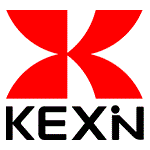
Group 1 - The A-share market is making a strong push towards the 4000-point mark, with the 5G Communication ETF (515050) leading the market by rising over 5% during the afternoon session [1][3] - Key stocks within the 5G Communication ETF, such as Jingwang Electronics, Shengyi Technology, and Zhaoyi Innovation, have hit the daily limit, while several others like Xinyisheng, Huanxu Electronics, Dongshan Precision, and Industrial Fulian have seen increases of over 7% [1][3] Group 2 - The National Bureau of Statistics announced an investment of over 100 billion yuan to support AI computing power infrastructure, with CPO being a core solution for cost reduction and efficiency improvement in data centers [3] - The upcoming mass production and delivery of NVIDIA's Blackwell platform CPO switches in November 2025 is expected to drive a surge in demand for CPO optical engines and reshape global computing infrastructure [3] - The 5G Communication ETF (515050) tracks the CSI 5G Communication Theme Index and currently has a scale exceeding 8 billion yuan, focusing on the supply chains of NVIDIA, Apple, and Huawei [3] - The ETF is characterized by high exposure to TMT and technology leaders, with a rapid valuation recovery and strong growth potential in earnings expected in the future [3] Group 3 - According to a report from Galaxy Securities, the increasing investment by internet giants in AI and large models is likely to make GPU servers a primary development direction for intelligent computing [4] - The demand for 1.6T optical modules is expected to rise significantly in the second half of 2025, further empowering the performance of industry companies [4] - The optical module market is experiencing rapid growth and technological iteration driven by sustained demand for AI computing power, with leading companies in the optical module sector expected to maintain strong profitability and competitive advantages [4]