创新药

Search documents
【港股收盘快报】港股恒指涨0.13% 科指涨0.11% 科网股、内房股走弱创新药概念走强万科跌...
Xin Lang Cai Jing· 2025-11-26 11:37
Core Viewpoint - The Hong Kong stock market experienced a collective rise on November 26, with the Hang Seng Index increasing by 0.13% to close at 25,928.08 points, while the Hang Seng Tech Index rose by 0.11% and the State-Owned Enterprises Index increased by 0.04% [1] Group 1: Market Performance - The technology sector showed mixed results, with Bilibili declining by 3%, Kuaishou and Baidu falling over 2%, and NetEase and Alibaba dropping more than 1%. Conversely, Meituan saw an increase of over 5%, and JD.com rose by more than 2% [1] - Airline stocks performed strongly, with China Eastern Airlines rising nearly 7% [1] - The innovative drug concept stocks led the gains, with Hengrui Medicine increasing by over 4% [1] - Chip stocks were active, with ZTE Corporation rising by over 3% [1] - The domestic real estate sector weakened, with Vanke experiencing a decline of over 6% [1]

数据复盘丨CPO、创新药等概念走强 63股获主力资金净流入超1亿元
Zheng Quan Shi Bao Wang· 2025-11-26 10:40
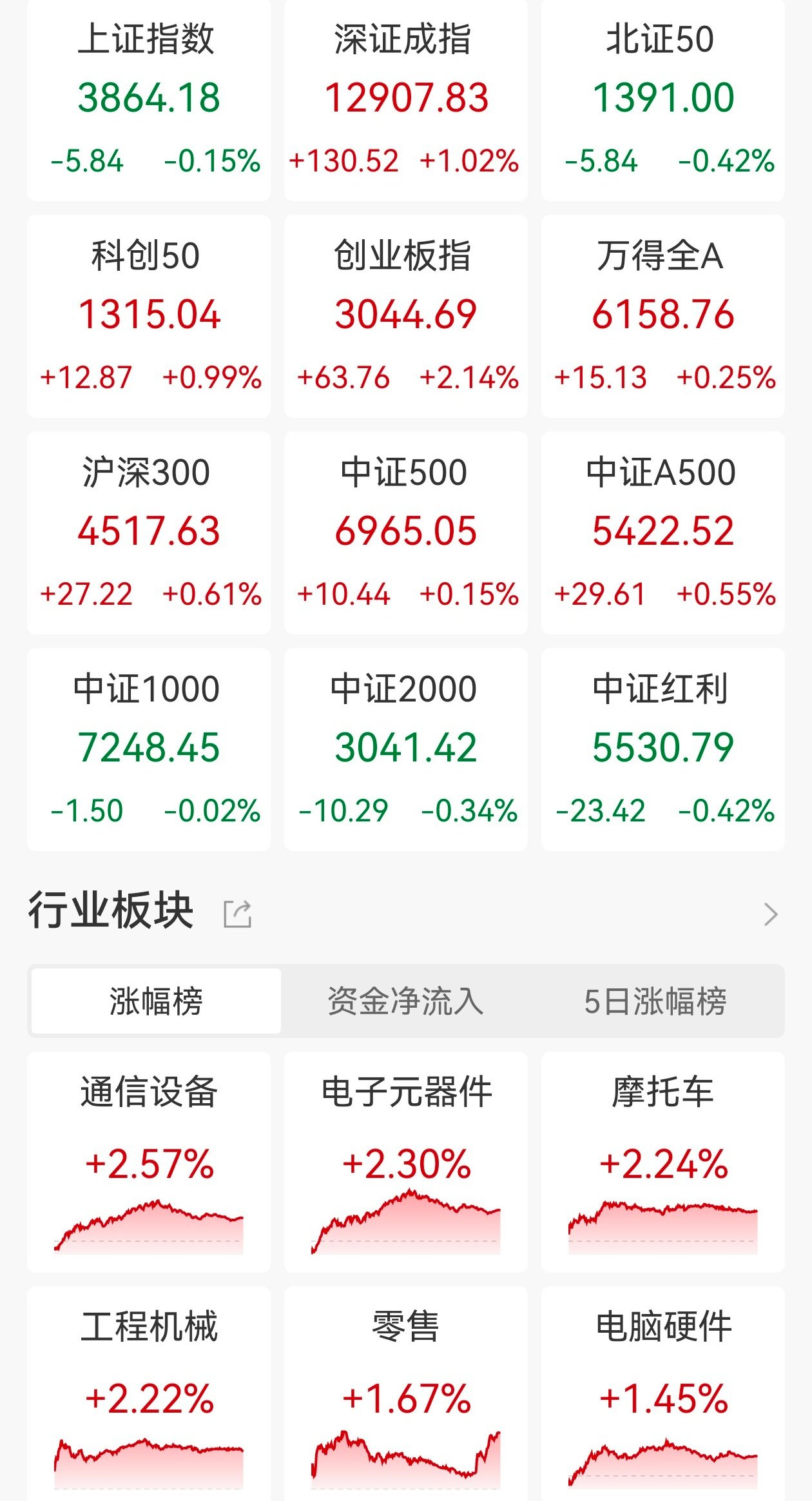
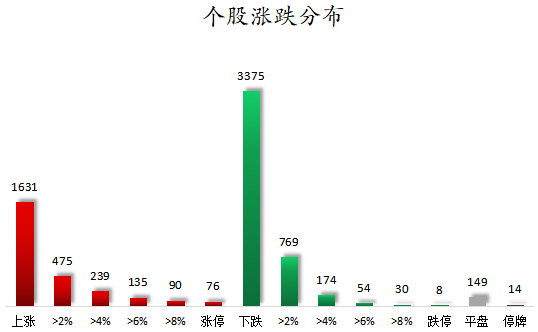
Market Overview - The Shanghai Composite Index closed at 3864.18 points, down 0.15%, with a trading volume of 701 billion [1] - The Shenzhen Component Index closed at 12907.83 points, up 1.02%, with a trading volume of 1082.3 billion [1] - The ChiNext Index closed at 3044.69 points, up 2.14%, with a trading volume of 529 billion [1] - The STAR Market 50 Index closed at 1315.04 points, up 0.99%, with a trading volume of 57.6 billion [1] - Total trading volume for both markets was 1783.3 billion, a decrease of 28.8 billion from the previous trading day [1] Sector Performance - Strong sectors included telecommunications, electronics, home appliances, pharmaceutical biology, retail, and automotive [3] - Active concepts included CPO, innovative drugs, cultivated diamonds, optical communication modules, synchronous reluctance motors, and duty-free [3] - Weak sectors included defense, media, beauty care, oil and petrochemicals, banking, environmental protection, agriculture, forestry, animal husbandry, and coal [3] - The number of stocks that rose was 1631, while 3375 stocks fell, with 149 stocks remaining flat and 14 stocks suspended [3] Capital Flow - The net outflow of main funds in the Shanghai and Shenzhen markets was 11.01 billion [6] - The ChiNext saw a net outflow of 5.64 billion, while the CSI 300 experienced a net inflow of 5.23 billion [6] - The electronic sector had the highest net inflow of 3.16 billion, followed by telecommunications, home appliances, retail, banking, and automotive [6] - The media sector had the largest net outflow of 4.44 billion, followed by computer, defense, non-ferrous metals, and electrical equipment [6] Individual Stock Performance - 2386 stocks saw net inflows from main funds, with 63 stocks receiving over 1 billion in net inflow [7][8] - The stock with the highest net inflow was Xinyi Technology, with 1.646 billion, followed by Zhongji Xuchuang, Yangguang Electric, and others [9] - 2765 stocks experienced net outflows, with 108 stocks seeing over 1 billion in net outflow [11] - The stock with the highest net outflow was Aerospace Development, with 1.312 billion, followed by Guangku Technology, Kunlun Wanwei, and others [12][13] Institutional Activity - Institutional net buying totaled approximately 1.9 billion, with 13 stocks seeing net buying and 13 stocks seeing net selling [15][16] - The stock with the highest institutional net buying was Changguang Huaxin, with approximately 232 million, followed by China International Marine Containers and others [17]







创新药ETF国泰(517110)涨超1.5%,创新药产业趋势不变
Mei Ri Jing Ji Xin Wen· 2025-11-26 10:33
Group 1 - The core viewpoint is that the innovative pharmaceutical sector is experiencing sustainable growth due to the continuous implementation of BD, with a trend towards "innovation + internationalization" remaining unchanged [1] - After a short-term adjustment, the elasticity of the innovative pharmaceutical sector has further increased, indicating a positive outlook [1] - There is a noticeable improvement in the fundamentals of the innovative pharmaceutical industry chain, with positive trends observed in investment and financing data, orders, and performance [1] Group 2 - The Guotai Innovative Drug ETF (517110) tracks the SHS Innovative Drug Index (931409), which focuses on listed companies in the A-share and Hong Kong markets engaged in innovative drug research and biopharmaceuticals [1] - The index selects 50 high-growth and volatile constituent stocks, reflecting the overall performance of innovative pharmaceutical enterprises, with a growth-oriented style primarily allocated in the healthcare sector [1]
疫苗ETF(159643)涨超1.6%,小核酸药物商业化提速引关注
Mei Ri Jing Ji Xin Wen· 2025-11-26 10:31
Group 1 - The small nucleic acid industry is expected to enter its first explosive growth cycle in 2025, with commercialization progress and new platform validations exceeding market expectations [1] - Alnylam's drug AMVUTTRA for treating ATTR is projected to become the first small nucleic acid drug with sales exceeding $2 billion this year [1] - Ionis's drug for treating sHTG saw a 35% stock price increase after positive data was released in September, with key phase 3 data and commercialization progress in 2026 being noteworthy [1] Group 2 - Arrowhead is focusing on weight loss and CNS projects leveraging its leading liver-external Trim platform, with the first commercial product for treating FCS, Plozasiran, expected in November [1] - The acceleration of small nucleic acid drug commercialization is driving continuous growth in demand for related raw materials and outsourced R&D [1] - The sentiment in the pharmaceutical sector is currently low, but upcoming data releases from the ASH conference, new medical insurance catalogs, and the first version of the commercial health insurance innovative drug catalog are expected to improve the outlook for innovative drugs, CXO, and the medical device industry [1] Group 3 - The vaccine ETF (159643) tracks the vaccine biotech index (980015), which selects listed companies involved in vaccine development, production, and sales, reflecting the overall performance of the vaccine sector within the biopharmaceutical industry [1] - This index exhibits high growth potential and strong specialization characteristics [1]
A股整体强势,零售股爆发,AI产业链股活跃
Zheng Quan Shi Bao· 2025-11-26 10:30
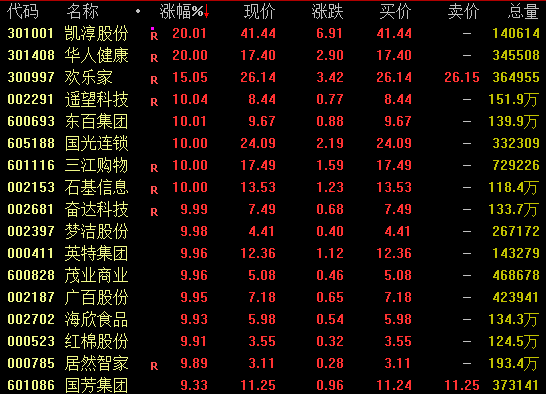
Market Overview - Major Asia-Pacific stock indices mostly rose, with Japan's Nikkei 225 up 1.85% to 49,559.07 points and South Korea's KOSPI up 2.67% to 3,960.87 points [1] - A-shares showed strength, with the ChiNext Index surging over 3% at one point; however, the Shanghai Composite Index closed down 0.15% at 3,864.18 points [1] Retail Sector Performance - Retail stocks experienced a significant surge, with companies like Kai Chun Co. and Huaren Health hitting the 20% limit up, and Huanle Jia rising over 15% [3][4] - The Ministry of Industry and Information Technology and other departments released a plan to enhance consumer goods supply and demand adaptability, aiming for a noticeable optimization of the supply structure by 2027 [5] AI Industry Activity - AI-related stocks were active, with companies like Changguang Huaxin and Saiwei Electronics seeing gains of 20% and over 16% respectively [7][8] - Alibaba reported a 34% year-on-year increase in cloud revenue for Q2 FY2026, with AI-related product revenue growing for nine consecutive quarters [9] Pharmaceutical Sector Strength - The pharmaceutical sector saw strong performance, particularly in innovative drugs and vaccines, with companies like Yue Wannianqing and Huaren Health reaching the 20% limit up [11][12] - The small nucleic acid drug sector is gaining attention due to recent advancements, indicating a potential golden development period driven by technological breakthroughs and commercial validation [13]



国盛证券熊园:2026年继续看好黄金和股票
2 1 Shi Ji Jing Ji Bao Dao· 2025-11-26 10:22
Core Viewpoint - The article emphasizes the long-term bullish outlook on gold prices, driven by macroeconomic factors and strategic asset allocation considerations, particularly in the context of U.S. political developments and global monetary policies [1][2]. Group 1: Gold Market Insights - The chief economist of Guosheng Securities, Dr. Xiong Yuan, holds a strong "strategic and tactical bullish" view on gold, predicting significant price movements around the U.S. midterm elections in 2026 [1]. - Historical data shows that consistent investment in gold since 2000 has yielded positive cumulative returns, indicating its importance as a key asset class beyond being a traditional safe haven [1]. - The ongoing trend of central banks increasing gold reserves reflects a long-term weakening of the dollar's credibility, reinforcing the bullish logic for gold [2]. Group 2: Macroeconomic Factors - The article highlights that the global monetary expansion over the past few decades, particularly in the last ten years, has created a favorable environment for gold as a hedge against inflation [2]. - The expectation of continued loose monetary policies in both the U.S. and China, including potential "double easing" in the U.S. by 2026, supports the strategic focus on gold [2]. Group 3: A-Share Market Outlook - The A-share market is viewed optimistically, supported by unexpected industrial competitiveness, particularly in sectors like innovative pharmaceuticals and artificial intelligence [3]. - Recent government policies aimed at stabilizing the economy and boosting market confidence, such as local government debt management and financial support mechanisms, are seen as positive indicators for the stock market [3]. - The transition phase of the Chinese economy from a real estate downturn to exploring new growth pillars positions the stock market as a key area for policy focus, potentially leading to a "slow bull" market [3]. Group 4: Bond Market Analysis - The bond market is expected to maintain a volatile trend in 2026, influenced by factors such as economic performance, inflation levels, monetary policy, and regulatory environment [4]. - The analysis suggests that without strong catalysts, various asset classes, including bonds, are likely to experience fluctuations rather than extreme movements, particularly in the year-end period [4].

尾盘,集体拉升!
证券时报· 2025-11-26 10:10
Market Overview - Major stock indices in the Asia-Pacific region mostly rose, with Japan's Nikkei 225 up 1.85% to 49,559.07 points, and South Korea's Composite Index up 2.67% to 3,960.87 points [1] - A-shares showed overall strength, with the ChiNext Index surging over 3% at one point [2] A-Shares Performance - The Shanghai Composite Index experienced narrow fluctuations, closing down 0.15% at 3,864.18 points, while the Shenzhen Component Index rose 1.02% to 12,907.83 points, and the ChiNext Index increased by 2.14% to 3,044.69 points [3] - Total trading volume in the Shanghai, Shenzhen, and Beijing markets was 17,973 billion yuan, a decrease of approximately 290 billion yuan from the previous day [3] - The retail sector saw significant gains, with stocks like Dongbai Group, Guoguang Chain, and Sanjiang Shopping hitting the daily limit [4] Retail Sector Highlights - Retail stocks surged in the afternoon, with notable gains including Kai Chun Co. and Huaren Health both hitting the 20% limit up [4] - Other retail stocks such as Huanle Jia and Dongbai Group also saw substantial increases, with Huanle Jia up over 15% [4] AI Industry Activity - AI-related stocks were active, with companies like Zhongji Xuchuang and Xinyi Sheng seeing significant price increases, with Zhongji Xuchuang up over 13% and Xinyi Sheng nearly 9% [10] - The AI industry is expected to continue its growth trajectory, driven by increasing demand for cloud computing and AI infrastructure [11][12] Pharmaceutical Sector Performance - The pharmaceutical sector showed strong performance, particularly in innovative drugs and vaccine concepts, with stocks like Yue Wannianqing and Huaren Health both hitting the 20% limit up [13] - The small nucleic acid drug sector is gaining attention due to recent advancements, with many domestic companies entering clinical research phases [16] Consumption and Economic Policy - The Ministry of Industry and Information Technology and other departments released a plan to enhance the adaptability of consumer goods supply and demand, aiming for significant improvements by 2027 [6] - The plan encourages the development of new retail formats and the use of technologies like AI and virtual reality to enhance consumer experiences [6] - Analysts suggest focusing on high-end domestic beauty care brands and emotional consumption-related industries as domestic consumption capacity and willingness are expected to rise [7]

海通国际:维持石药集团“优于大市”评级 成药各板块收入环比改善
Zhi Tong Cai Jing· 2025-11-26 08:11
Core Viewpoint - Haitong International maintains an "outperform" rating for CSPC Pharmaceutical Group (01093) with a target price of HKD 11.34, noting a revenue decline in the first three quarters but signs of recovery in Q3, with a 10% quarter-on-quarter growth in prescription drug revenue and a 27% year-on-year increase in net profit attributable to shareholders [1][2]. Financial Performance - For the first nine months of 2025, CSPC achieved revenue of CNY 19.9 billion, a 12% year-on-year decline, with prescription drug revenue at CNY 15.5 billion (down 17%), API revenue at CNY 3 billion (up 10%), and functional foods and other businesses at CNY 1.4 billion (up 11%) [2]. - The gross margin was 65.6%, down 4.9 percentage points year-on-year; R&D expenses were CNY 4.2 billion (up 8%), with an R&D expense ratio of 21.0% (up 3.9 percentage points); the sales expense ratio was 24.1% (down 5.1 percentage points) [2]. - In Q3 2025, CSPC reported revenue of CNY 6.6 billion, a 3% year-on-year increase and a 6% quarter-on-quarter increase, with prescription drug revenue at CNY 5.2 billion (up 2% year-on-year, up 10% quarter-on-quarter) [2]. Prescription Drug Business - In Q3 2025, all segments of the prescription drug business showed improvement, confirming the bottom of the fundamentals, with total prescription drug revenue of CNY 4.7 billion and drug revenue of CNY 4.7 billion (up 8% quarter-on-quarter) [3]. - Specific revenue breakdown includes: - Neurological system: CNY 1.91 billion (down 4% year-on-year, up 4% quarter-on-quarter) - Oncology: CNY 590 million (down 47% year-on-year, up 19% quarter-on-quarter) - Anti-infection: CNY 830 million (down 9% year-on-year, up 12% quarter-on-quarter) - Cardiovascular: CNY 470 million (up 18% year-on-year, up 4% quarter-on-quarter) - Respiratory: CNY 320 million (up 73% year-on-year, up 28% quarter-on-quarter) - Metabolism: CNY 250 million (up 14% year-on-year, up 8% quarter-on-quarter) - Other therapeutic areas: CNY 360 million (up 26% year-on-year, down 4% quarter-on-quarter) [3]. - The company expects a 5% revenue growth in the second half of the year for the prescription drug segment (excluding authorized revenue) [3]. Asset Expansion and R&D Progress - The SYS6010 (EGFRADC) clinical trial is progressing well, with significant potential for external licensing; multiple technology platforms and products are also expected to expand internationally [4]. - Management plans to present clinical data for SYS6010 at major conferences next year and publish data in top academic journals [5]. - The small RNA platform has five assets entering clinical stages, focusing on liver-targeted and multi-target products, with plans for new products in weight loss and muscle gain to enter clinical trials next year [6]. - The PD-1/IL15 pipeline is a key focus, with over 90 patients enrolled in dose-exploration trials, showing promising safety and efficacy results [6].
海普瑞涨0.51%,成交额3671.43万元,近5日主力净流入-854.81万
Xin Lang Cai Jing· 2025-11-26 07:27
Core Viewpoint - The article discusses the performance and business operations of Shenzhen Hepalink Pharmaceutical Group Co., Ltd., highlighting its growth in overseas revenue and the impact of currency depreciation on its financials [2][3]. Company Overview - Shenzhen Hepalink Pharmaceutical Group Co., Ltd. was established in 1998 and is a leading multinational pharmaceutical company with A+H dual financing platforms, focusing on the heparin industry chain, biopharmaceutical CDMO, and innovative drug investment, development, and commercialization [2]. - The company's main business segments include: - Formulations: 63.06% - CDMO: 18.59% - Heparin sodium and low molecular weight heparin raw materials: 16.05% - Others: 2.30% [7]. Financial Performance - For the period from January to September 2025, the company achieved a revenue of 4.194 billion yuan, representing a year-on-year growth of 3.09%, while the net profit attributable to shareholders decreased by 29.04% to 554 million yuan [7]. - The company reported that 93.04% of its revenue comes from overseas, benefiting from the depreciation of the Renminbi [3]. Market Activity - On November 26, the stock price of Hepalink increased by 0.51%, with a trading volume of 36.7143 million yuan and a turnover rate of 0.25%, leading to a total market capitalization of 17.402 billion yuan [1]. - The stock has seen a net outflow of 223,600 yuan from major funds today, with a ranking of 74 out of 159 in its industry [4]. Shareholder Information - As of September 30, 2025, the number of shareholders increased to 27,000, with an average of 0 circulating shares per person [7]. - The eighth largest circulating shareholder is Hong Kong Central Clearing Limited, holding 12.0093 million shares, an increase of 691,700 shares compared to the previous period [9]. Dividend Information - Since its A-share listing, Hepalink has distributed a total of 4.21 billion yuan in dividends, with 514 million yuan distributed over the past three years [8].

A股收评:三大指数涨跌不一,创业板指涨超2%,医药商业、商业百货板块涨幅居前
Ge Long Hui· 2025-11-26 07:07
Market Overview - The A-share market showed mixed performance with the Shanghai Composite Index down by 0.15% closing at 3864 points, while the Shenzhen Component Index rose by 1.02% and the ChiNext Index increased by 2.14% [1] - The total market turnover was 1.8 trillion yuan, a decrease of 29 billion yuan compared to the previous trading day, with nearly 3600 stocks declining [1] Sector Performance - The pharmaceutical retail sector saw gains, with companies like Huaren Health and Ruikang Pharmaceutical hitting the daily limit [1] - The commercial retail and tax refund store sectors also performed well, with Dongbai Group and Sanjiang Shopping both reaching the daily limit [1] - The CPO concept remained active, with Yongding Co. hitting the daily limit and Zhongji Xuchuang rising over 13% to a new high [1] - Other sectors with notable gains included duty-free concepts, cultivated diamonds, and innovative drugs [1] Declining Sectors - The shipbuilding sector experienced a downturn, with Jianglong Shipbuilding dropping over 12% [1] - The aerospace sector also fell, with Chenxi Aviation declining by over 11% [1] - The nuclear pollution prevention sector showed weak performance, with Rongji Software hitting the daily limit down [1] - The aquaculture sector faced volatility, with Zhongshui Fishery hitting the daily limit down [1] - Other sectors with significant declines included aircraft carrier concepts, digital watermarking, and offshore engineering equipment [1] Top Gainers - The top gainers included sectors such as communication equipment, electronic components, and motorcycles, with respective increases of 2.30%, 2.249%, and 2.57% [2] - Other sectors with positive performance included engineering machinery, retail, and computer hardware, with increases of 2.22%, 1.67%, and 1.45% respectively [2]