自主可控

Search documents
消电ETF(561310)涨超2.2%,内资半导体IPO提速或强化硬件自主逻辑
Mei Ri Jing Ji Xin Wen· 2025-07-17 06:22
Group 1 - The AI wave is driving a surge in demand for computing power, significantly increasing the value in sectors such as servers, optical modules, storage, and PCBs [1] - 3D printing is set to accelerate penetration in the consumer electronics sector, with potential applications in precision components like foldable device hinges and watch/phone frames, marking the beginning of a new era for 3D printing in consumer electronics [1] - The reduction in training and inference costs is expected to foster the prosperity of AI applications, with significant potential for edge AI, particularly in devices like headphones and glasses [1] Group 2 - Amidst rising tensions between China and the US, China is vigorously promoting domestic production substitution, leading to a surge in orders for Korean 8-inch wafer foundries and a rapid increase in the global market share of domestic wafer foundry companies [1] - The next three years will see "advanced process expansion" as a key focus for self-sufficiency, with CoWoS and HBM positioning themselves in line with AI industry trends, highlighting the importance of advanced packaging [1] - OLED panel revenue is projected to grow by 2% year-on-year in Q1 2025, driven by increased shipments of AR glasses, automobiles, and smartwatches, while upstream sectors such as passive components, digital SoCs, RF, storage, and testing are showing signs of recovery [1]

外资龙头生科企业专家交流
2025-07-16 15:25
Summary of Key Points from Conference Call Industry Overview - The conference call discusses the **Chinese research service market**, particularly focusing on the **biotechnology sector** and the challenges faced in the **domestic and foreign markets** [1][5][7]. Core Insights and Arguments - **High Domestic Replacement Rates**: The domestic market has a high localization rate for general and high-purity reagents, such as HQC reagents. However, high-end mass spectrometry and ultra-pure reagents still face significant technical barriers for domestic replacement [1][2][4]. - **Impact of US-China Relations**: The US-China trade relations and tariffs have affected the ability of Chinese research service companies to expand internationally. There is a growing desire for self-sufficiency, but the short-term increase in domestic replacement rates is not significant [5][6]. - **Foreign Investment in China**: Foreign companies like Thermo Fisher and Merck are increasing their investments in local production lines in China to mitigate the impact of tariffs. This includes establishing factories in Wuxi and Nantong [1][6]. - **Market Growth Projections**: The overall growth rate for biotechnology companies is expected to be low in 2025 due to tariffs, increased domestic inventory, and the impact of domestic replacement [3][13]. - **Customer Behavior**: Customers are increasingly concerned about supply chain stability, leading to panic buying and stockpiling of products [5][15]. Additional Important Content - **Product Categories**: The research service sector is divided into biological design and chemical design, with significant growth in areas like LVD and CRO due to the pandemic [2]. - **Barriers to Entry**: High-end products in the mass spectrometry and ultra-pure reagent categories have high barriers to entry, with customers requiring strong quality and technical reputation [4][8]. - **Price Trends**: Prices for certain reagents are declining due to increased competition and inventory pressures, with some imported reagents seeing price reductions of 5% to 10% [15][16]. - **Future Strategies for Companies**: Companies are advised to either focus on a large market segment to achieve monopolistic status or pursue acquisitions to create a comprehensive product line [20]. - **Market Dynamics**: The market is experiencing a potential shakeout, with smaller manufacturers facing intense competition, which may lead to consolidation through mergers and acquisitions [21][23]. Conclusion - The Chinese research service market is navigating complex challenges due to international relations, domestic competition, and evolving customer needs. While there are opportunities for growth, particularly in domestic production, the overall outlook remains cautious with significant barriers to entry in high-end product categories.
贸易战缓和,化工投资机会探讨
2025-07-16 06:13
Summary of Conference Call Notes Industry Overview - The conference primarily discusses the **oil and petrochemical sector** and its investment outlook, particularly focusing on the impact of oil prices and production adjustments by OPEC. - The discussion also touches on **chemical additives** and **agricultural chemicals**, highlighting market dynamics and pricing trends. Key Points on Oil and Petrochemical Sector - Oil prices have shown a trend of **decline followed by recovery** since May, influenced by OPEC's decision to increase production by approximately **40 million barrels** in June, which was above market expectations, creating downward pressure on prices [1][2]. - OPEC's production increase aligns with both its internal interests and the U.S. inflation control efforts, suggesting a strategic move to stabilize market share while addressing economic pressures [2][4]. - The **operating rate** in the petrochemical sector remains below **50%**, indicating a tightening supply domestically, while older power plants in Europe are also facing high energy costs, contributing to a global supply adjustment [6]. - Despite pressures, the market has adjusted expectations, and there is a belief that the sector will see a **long-term recovery** as it approaches a bottoming out phase [6][8]. - Companies like **Sinopec** and **CNOOC** are highlighted for their operational resilience despite falling oil prices, with Sinopec showing significant year-on-year growth [10]. Key Points on Chemical Additives and Agricultural Chemicals - The **demand for health-related additives** has increased, with significant growth in the first quarter driven by rising consumer health awareness [12]. - The **sugar substitute market** is experiencing robust demand, with companies in this sector seeing substantial year-on-year growth due to price increases and strong market demand [12]. - The **export cycle** for agricultural chemicals has been shortened this year, with a notable decrease in export volumes compared to last year, primarily due to regulatory changes [13][14]. - The **price disparity** between domestic and international markets for certain chemicals is significant, with domestic prices being over **1,000 yuan per ton** lower than international rates, indicating potential for export growth if regulations ease [14]. - The **herbicide market** is expected to benefit from tariff adjustments, which may enhance domestic producers' competitiveness in the U.S. market [41]. Additional Insights - The **chemical industry** is expected to see a **price increase** in the second half of the year as inventory levels normalize, with a projected demand growth rate of **8-10%** annually [11]. - The **organic silicon sector** is anticipated to grow despite previous trade tensions, with a long-term upward trend in demand expected as tariffs are adjusted [39]. - The **agricultural chemicals sector** is also poised for growth, particularly in products like glyphosate, which may see price increases due to supply constraints in the U.S. market [40][41]. - The **robotics materials sector** is highlighted for its potential growth, driven by increasing demand for advanced materials in robotics and automation applications [34]. Conclusion - The overall sentiment in the oil and petrochemical sector is cautiously optimistic, with expectations of recovery and growth in specific segments, particularly as market conditions stabilize and regulatory environments evolve. - The chemical additives and agricultural chemicals markets are also positioned for growth, driven by changing consumer preferences and favorable regulatory adjustments.
自主可控,坚定不移——计算机行业最新投资策略
2025-07-16 06:13
Summary of Conference Call Notes Industry Overview - The macroeconomic environment is influenced by multiple factors including national economic development, new productivity advancements, and national security concerns, with the ongoing US-China rivalry being a significant theme for the foreseeable future [1] - The focus on domestic autonomy and control is expected to create new opportunities in both software and hardware sectors, driven by national policies [1] Key Points on Software Sector - The software sector includes major areas such as large AI models, basic software (operating systems, databases), and industrial software (ERP, EDA, CAD) which have potential for domestic replacement [2][3] - Current domestic production of CPUs and GPUs is heavily reliant on foreign suppliers, with estimates indicating that 70-80% of server CPUs are sourced from Intel and AMD [2][3] - The domestic AI chip market is led by companies like Shenwei and Haiguang, with significant contributions from domestic models in the AI sector [3][4] Key Points on Hardware Sector - The hardware sector is primarily focused on core components like CPUs and GPUs, with a strong emphasis on domestic production capabilities [2][3] - The domestic CPU market is projected to have a substantial replacement space, with a market size exceeding 100 billion RMB [27] - The GPU market is also seeing potential for domestic alternatives, especially in light of US export controls affecting companies like NVIDIA and AMD [28][30] Policy and Market Dynamics - The US has intensified sanctions against China, particularly in advanced technology sectors, which has led to a tightening of export controls and tariffs [6][7][8] - The Chinese government is pushing for self-sufficiency in technology, with policies aimed at achieving autonomy in core technologies, including software and hardware [9][10] - The domestic market for AI servers is expected to grow significantly, with projections indicating that over 60% of AI server purchases will come from domestic sources by 2024 [10][11] Emerging Trends - The development of domestic operating systems, such as HarmonyOS, has gained traction, becoming the second-largest mobile OS in China, with a growing ecosystem of applications [12][18] - The shift towards distributed databases and cloud-based solutions is evident, with domestic companies like Alibaba and Tencent leading the market [21] - The industrial software sector is also evolving, with domestic firms capturing significant market shares in ERP and EDA solutions [23][24] Risks and Challenges - Potential risks include macroeconomic impacts on business demand, slower-than-expected development of large models and industries, and escalating US-China tensions [34] - The ongoing tariff and sanction environment poses uncertainties for the domestic technology sector, particularly in the CPU and GPU markets [15][16] Conclusion - The drive for self-sufficiency in technology is a critical aspect of the ongoing US-China rivalry, with significant implications for the software and hardware industries in China [33]





策略-业绩线、政策博弈和产业趋势
2025-07-16 06:13
Summary of Conference Call Notes Industry or Company Involved - The discussion primarily revolves around the A-share market and various sectors including technology, real estate, and semiconductor industries. Core Points and Arguments 1. **Market Performance**: The A-share market experienced a significant increase in trading volume, rising from approximately 1.2 trillion to 1.7 trillion, with the Shanghai Composite Index reaching a new high for the year [1][2] 2. **ETF Activity**: There was notable activity in ETFs, particularly on Fridays, indicating potential involvement from state-backed funds, although overall inflows were not consistent throughout the week [2] 3. **Tariff Agreements**: The initial phases of U.S. tariff agreements were better than expected, leading to a temporary recovery in risk appetite among investors. However, ongoing uncertainties regarding tariffs remain a concern [3][4] 4. **Economic Policies**: The urgency for policies aimed at stabilizing prices and addressing economic pressures has increased, with recent measures including subsidies for families and employment stabilization policies [5][6] 5. **Sector Performance**: The technology sector, particularly companies like Alibaba, JD, and Meituan, faced significant pressure due to competition in the food delivery market, although there was a slight recovery noted in the week [7] 6. **Banking Sector**: The banking sector underperformed compared to the overall market, with low volatility dividend stocks lagging behind growth sectors like the ChiNext [8] 7. **Market Sentiment**: Despite a rebound in market sentiment, the overall enthusiasm among investors appears muted, with rapid sector rotation and challenges in generating consistent profits for many investors [10][11] 8. **Rare Earth Prices**: There has been an upward trend in the prices of rare earth materials, with leading companies like Northern Rare Earth reporting better-than-expected performance [12] 9. **AI and Semiconductor Industry**: The AI sector, particularly companies like Nvidia, reached a historic market cap of $4 trillion, indicating strong growth potential in the tech space [13][19] 10. **Real Estate Policies**: The government is focusing on stabilizing the real estate market, with indications that weaker fundamentals may lead to more supportive policies [15][16] 11. **Emerging Technologies**: There is a growing interest in sectors like robotics and 3D printing, with potential for significant investment opportunities as market conditions evolve [22][20] Other Important but Possibly Overlooked Content 1. **Data Assets**: The concept of Real Data Assets (RDA) is gaining traction, indicating a shift towards integrating data as a valuable asset in investment strategies [17][18] 2. **Investment Strategies**: Investors are advised to focus on leading companies in sectors facing supply excess, such as silicon materials, as these firms are expected to have better resilience and pricing power in the long term [16] 3. **Market Dynamics**: The current market environment is characterized by a lack of clear leadership among sectors, with mixed signals and volatility affecting investor confidence [18][19]
消电ETF(561310)涨超1.2%,半导体国产化与AI硬件需求提振行业预期
Mei Ri Jing Ji Xin Wen· 2025-07-16 04:33
Group 1 - The AI wave is driving a surge in demand for computing power, significantly increasing the value in sectors such as servers, AI chips, optical chips, storage, and PCB boards [1] - 3D printing is expected to accelerate penetration in the consumer electronics sector, with potential applications in foldable device hinges, watch/mobile phone frames, and other precision components, marking the beginning of a new era for 3D printing in consumer electronics [1] - Amid escalating tensions between China and the US, China is vigorously promoting domestic semiconductor production, leading to a surge in orders flowing to Korean 8-inch wafer foundries, benefiting China's mature chip manufacturing industry [1] Group 2 - Domestic wafer foundries in China have absorbed most of the demand from local IT companies, rapidly increasing their market share in the global wafer foundry market [1] - In 2024, advancements in lithography and continuous progress in domestic equipment for advanced processes will be prioritized, with "expansion of advanced processes" becoming a key focus for self-sufficiency over the next three years [1] - The importance of advanced packaging is highlighted by CoWoS and HBM positioning in the AI industry trend [1] Group 3 - OLED panel revenue is expected to grow by 2% year-on-year in the first quarter of 2025, driven by accelerated shipments in categories such as AR glasses, automobiles, smartwatches, televisions, and monitors [1] - There is a sustained optimistic outlook for the recovery trend in upstream sectors represented by passive components, digital SoC, RF, storage, testing, and panels [1]
20cm速递|科创芯片ETF(589100)涨超1.7%,AI算力需求与3D打印渗透成焦点
Mei Ri Jing Ji Xin Wen· 2025-07-16 04:32
Group 1 - The AI wave is driving a surge in demand for computing power, significantly increasing the value in sectors such as servers, AI chips, optical chips, storage, and PCB boards [1] - 3D printing is accelerating penetration in the consumer electronics sector, with potential applications in foldable device hinges and watch/mobile phone frames, marking the beginning of a new era for 3D printing in consumer electronics [1] - The potential for edge AI is substantial, with headphones and glasses expected to become key carriers for edge AI agents [1] Group 2 - In the context of rising tensions between China and the US, China is vigorously promoting domestic semiconductor production, leading to a surge in orders for Korean 8-inch wafer foundries and a rapid increase in the global market share of domestic wafer foundry companies [1] - The next three years will see "advanced process expansion" as a main line for self-sufficiency, with CoWoS and HBM positioning to capitalize on AI industry trends, highlighting the importance of advanced packaging [1] - OLED panel revenue is projected to grow by 2% year-on-year in Q1 2025, driven by increased shipments in categories such as AR glasses, automobiles, and smartwatches [1] - There is a sustained positive outlook for the recovery trends in upstream sectors such as passive components, digital SoC, RF, storage, testing, and panels [1] Group 3 - The Guotai ETF tracking the Sci-Tech Chip Index can experience daily fluctuations of up to 20%, reflecting the overall performance of listed companies in the semiconductor industry across the entire supply chain [2] - The index is compiled by the China Securities Index Co., and it captures companies involved in semiconductor materials, equipment, design, manufacturing, and packaging/testing, showcasing the development trends in China's chip industry [2]
申万宏源证券晨会报告-20250716
Shenwan Hongyuan Securities· 2025-07-16 00:42
Economic Overview - The June economic data reveals five "anomalies," indicating new changes in the economy that may affect the second half of the year [9] - The GDP growth for Q2 was in line with expectations at 5.2%, while retail sales and fixed asset investment showed signs of decline [9] - The construction industry has weakened significantly, impacting overall economic performance [9] Company Analysis: 德源药业 (DeYuan Pharmaceutical) - The company focuses on chronic metabolic diseases and has a robust portfolio of generic drugs, with plans to transition to innovative drug development [12] - Forecasted net profits for 2025-2027 are 192 million, 218 million, and 200 million yuan respectively, with a target market capitalization of 5.6 billion yuan, indicating a potential 42% upside [12] - The company is advancing in innovative drug development, particularly in diabetes and hypertension treatments, with significant market opportunities identified [12] Industry Analysis: Chemical Sector - The chemical industry is experiencing a recovery after price declines, with signs of bottoming out and increased supply disruptions [11][14] - Key sub-sectors such as pesticides, fluorochemicals, and explosives are expected to see profit growth in Q2 2025, driven by improved demand and pricing [11] - The industry is shifting from inventory reduction to capacity reduction, indicating a more stable supply-demand balance moving forward [14] Investment Recommendations - The report suggests a "buy" rating for 德源药业 based on its growth potential and market positioning in the pharmaceutical sector [12] - The chemical sector is rated positively, with a focus on companies that can benefit from the ongoing recovery and supply chain improvements [11][14]





20cm速递|自主可控主线明确,创业板人工智能ETF(159388)盘中涨超5%
Mei Ri Jing Ji Xin Wen· 2025-07-15 02:31
Group 1 - The core viewpoint is that the escalating tensions between China and the US have led to a significant increase in orders for 8-inch wafer foundries in South Korea, benefiting China's mature chip manufacturing industry due to a comprehensive "trade-in" subsidy plan [1] - The US government's restrictions on exporting semiconductor equipment using American technology have intensified China's drive to enhance its self-sufficiency in chip manufacturing [1] - Domestic wafer foundry companies in China have absorbed most of the demand from local IT firms, rapidly increasing their market share in the global wafer foundry market [1] Group 2 - In 2024, advancements in lithography and continuous breakthroughs in domestic equipment for advanced processes are expected, with "advanced process expansion" likely becoming a key focus for the next three years [1] - The Guotai AI ETF (159388) tracks the ChiNext AI Index (970070) and is characterized by high volatility, with daily price fluctuations reaching up to 20%, making it noteworthy for investors in the ChiNext segment [1]

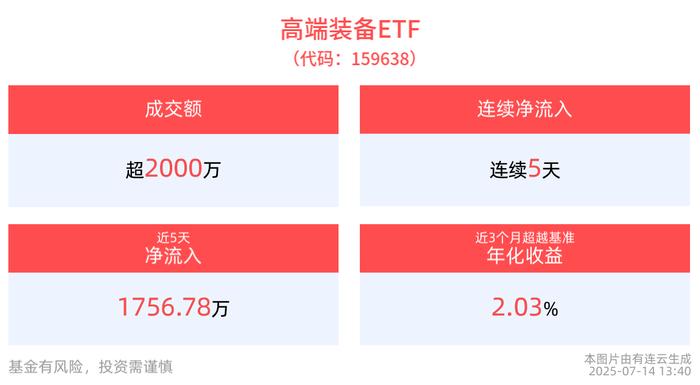
高端装备行业结构性成长机会显著,高端装备ETF(159638)近5天获得连续资金净流入
Xin Lang Cai Jing· 2025-07-14 06:12
Core Viewpoint - The high-end equipment sector is experiencing mixed performance, with notable movements in specific stocks and a positive outlook for military and defense industries due to global political tensions and domestic production trends [1][3][4]. Group 1: Market Performance - As of July 14, 2025, the CSI High-end Equipment Sub-index fell by 0.25%, with stocks showing varied performance; Huajin Technology led with a 4.56% increase, while companies like Les Information and Haige Communication saw declines [1]. - The High-end Equipment ETF (159638) recorded a turnover rate of 1.89% and a transaction volume of 22.41 million yuan, with an average daily transaction of 53.10 million yuan over the past month [3]. Group 2: Fund Flows and ETF Performance - The latest scale of the High-end Equipment ETF reached 1.187 billion yuan, with a net inflow of 17.57 million yuan over the past five days, including a single-day peak of 7.55 million yuan [3]. - The ETF has seen a 29.59% increase in net value over the past year, with the highest monthly return since inception being 19.30% and an average monthly return of 6.55% [3]. Group 3: Industry Outlook - According to Guosen Securities, the defense and aerospace equipment sector benefits from industrial upgrades and the trend towards self-sufficiency, with core equipment localization being fundamental for the industry's rise [4]. - Emerging fields such as humanoid robots and gas turbines are making significant breakthroughs, indicating long-term growth potential, while traditional sectors like shipbuilding and nuclear power equipment maintain stable demand [4]. - The top ten weighted stocks in the CSI High-end Equipment Sub-index account for 45.22% of the index, with significant players including AVIC Shenyang Aircraft, Aero Engine Corporation, and AVIC Optical [4][6].