
主权AI

Search documents
黄仁勋:将恢复H20在中国销售,并推出新款GPU
21世纪经济报道· 2025-07-15 02:52
Core Viewpoint - Nvidia is set to resume sales of its H20 GPU in China and has introduced a new fully compatible GPU, the NVIDIA RTX PRO, aimed at digital twin AI applications for smart factories and logistics [1][2]. Group 1: Nvidia's Product Developments - Nvidia's CEO Jensen Huang announced the submission of a request to the U.S. government for the resumption of H20 GPU sales, with assurances of receiving the necessary licenses [1]. - The H20 GPU is designed specifically for the Chinese market, utilizing the Hopper architecture and advanced CoWoS packaging technology, although it is not suitable for training trillion-parameter models [2]. Group 2: Strategic Vision and Market Positioning - Huang emphasized that AI has become a fundamental resource, comparable to energy, water, and the internet, and expressed Nvidia's commitment to supporting open-source research and application development globally [1]. - The company aims to provide support for emerging economies in Latin America, Europe, Asia, and beyond [1]. Group 3: Recent Engagements and Events - Jensen Huang's recent visit to China marks his third trip this year, where he participated in the third Chain Conference and is scheduled to hold a media briefing [4][5].



美股4万亿美元市值第一股,英伟达下一站剑指6万亿?
Jin Rong Jie· 2025-07-14 07:40
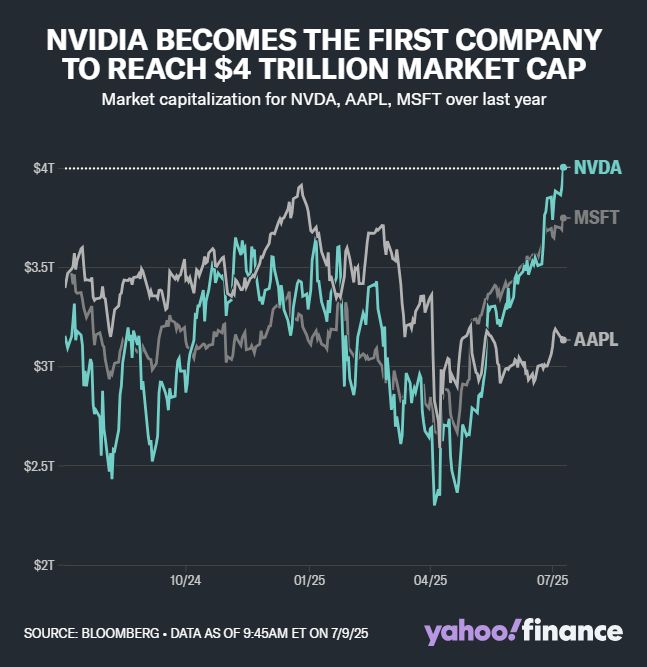
Core Insights - Nvidia has become the first publicly traded company to reach a market capitalization of $4 trillion, surpassing Microsoft, Apple, and Saudi Aramco, marking a significant milestone in the AI era [1][3][12] Group 1: Nvidia's Market Position - Nvidia's achievement highlights its dominant position in the AI chip sector, indicating a new wave of AI-driven technological advancements [3] - The $4 trillion market cap exceeds Germany's annual GDP, is double the total market cap of the Russell 2000 index, and is greater than the combined market cap of three Meta companies [4] - Nvidia's market cap has doubled three times in less than two years, showcasing rapid growth: from $1 trillion in June 2023 to $4 trillion in July 2025 [5] Group 2: AI Chip Dominance - Nvidia nearly monopolizes the underlying computing power for generative AI training, with its GPUs and proprietary CUDA platform widely used by major companies like OpenAI, Meta, Google, and Amazon [5][6] - Major tech companies are investing billions in Nvidia hardware to build AI data centers, further solidifying Nvidia's role as a critical supplier in the AI infrastructure [6] Group 3: Market Resilience - Despite initial market concerns regarding competition and export restrictions, Nvidia has proven its irreplaceability in the AI chip market, maintaining a strong demand for its high-performance GPUs [7] - The company is adapting to U.S. export restrictions by planning to launch a new AI chip specifically designed for the Chinese market, aiming to sustain its market share and revenue [8][9] Group 4: Valuation and Analyst Sentiment - Nvidia's forward P/E ratio averages around 38, making it one of the most expensive large-cap stocks, yet its valuation appears to be decreasing as its market cap increases [10] - Analysts are optimistic about Nvidia's future, with 58 out of 65 analysts rating it as a "buy" or "strong buy," and some predicting a potential market cap of $6 trillion [11]
早报 (07.12)| 险资入市重磅变化!引导长投、价投;美、加关税战缓和?特朗普称豁免“拭目以待”;黄仁勋身家赶超巴菲特
Ge Long Hui· 2025-07-12 00:12
Group 1 - Nvidia's market capitalization reached $4.02 trillion, with CEO Jensen Huang's net worth surpassing $144 billion, ranking him ninth globally [2] - President Trump met with Jensen Huang to discuss a 50% import tariff on refined copper, effective August 1, aimed at boosting U.S. production in this sector [2] - The U.S. stock market saw declines across major indices, with the Dow Jones down 0.63%, Nasdaq down 0.22%, and S&P 500 down 0.33% [3][5] Group 2 - Major tech stocks showed mixed performance, with Google up 1.45%, Amazon up 1.24%, and Nvidia up 0.5%, while Apple fell 0.59% and Meta dropped 1.34% [3][5] - The Nasdaq Golden Dragon Index, which tracks Chinese stocks, fell 0.43%, with notable movements in companies like NIO and Li Auto [3] - Global asset performance was influenced by speculation regarding U.S. sanctions on Russian oil, leading to a rise in oil prices by over 2% [5] Group 3 - The U.S. fiscal year saw tariff revenues exceed $100 billion for the first time, with June's tariff revenue reaching $27 billion, a 301% year-over-year increase [22] - The Canadian government postponed retaliatory tariffs against U.S. aluminum and steel, extending negotiation periods until August 1 [8][9] - The demand for electricity from AI data centers has led U.S. power companies to seek significant rate increases, with applications totaling $29 billion, a 142% increase from the previous year [29]



国产GPU厂商的“烧钱与梦想”
经济观察报· 2025-07-11 12:17
Core Viewpoint - The future defined by "sovereign AI" represents both a technological and capital competition, prompting Chinese GPU companies to seek funding urgently in the secondary market [2][5]. Group 1: Market Dynamics - NVIDIA's market capitalization surpassed $4 trillion, making it the largest publicly traded company globally, which has created significant market potential for domestic GPU companies [2][3]. - The surge in interest for domestic GPU firms is driven by the need for a comparable company to NVIDIA in the A-share market, as highlighted by industry experts [7][8]. - The valuation logic in the market has led to speculative methods, such as the "market probability" approach, where companies like Cambricon are valued based on their perceived chances of becoming the Chinese equivalent of NVIDIA [8]. Group 2: Financial Performance - Both Moer Technology and Muxi Integrated Circuit have reported substantial losses, with Moer Technology's net profit from 2022 to 2024 showing losses of approximately 1.84 billion yuan, 1.67 billion yuan, and 1.49 billion yuan, totaling around 5 billion yuan [11]. - Muxi Integrated Circuit reported cumulative losses of 3.29 billion yuan from 2022 to the first quarter of 2025, with R&D expenses significantly exceeding revenue [12]. - Cambricon has also faced long-term losses, accumulating over 3.3 billion yuan since its IPO in 2020 [13]. Group 3: Investment and Funding - Moer Technology has undergone eight rounds of financing in less than five years, achieving a valuation of 21.071 billion yuan by March 2025 [5]. - The urgency for IPOs among domestic GPU companies is seen as a "lifeline" to secure necessary capital for survival and growth [22][23]. - The capital raised is intended for advancing core GPU technologies and enhancing governance to create value for investors [24][25]. Group 4: Customer Base and Revenue Quality - The customer base for domestic GPU companies is heavily concentrated, with Moer Technology's top five clients accounting for over 89% of its revenue from 2022 to 2024 [28]. - The reliance on large clients, particularly government projects, raises concerns about the sustainability and quality of revenue [28][32]. - The shifting customer dynamics for Muxi Integrated Circuit indicate potential instability in business relationships, as evidenced by significant changes in its top clients from 2023 to 2024 [32][33]. Group 5: Competitive Landscape and Challenges - Domestic GPU companies face challenges in performance and compatibility, particularly in the consumer market, where user experience is critical [36][39]. - The lack of a robust software ecosystem compared to established players like NVIDIA and AMD poses a significant barrier to market penetration [39]. - Supply chain vulnerabilities, particularly in accessing advanced manufacturing processes, could hinder the development of next-generation chips [41][42]. Group 6: Strategic Considerations - Industry experts suggest that the key to success for domestic GPU companies lies in maintaining strategic focus and resilience rather than merely chasing rapid growth [42]. - The importance of securing strong backing from established firms or ecosystems is emphasized as a critical factor for long-term viability [45].


国产GPU厂商的“烧钱与梦想”
Jing Ji Guan Cha Wang· 2025-07-11 11:55
Core Viewpoint - Nvidia's market capitalization has reached $4 trillion, making it the largest publicly traded company in history, which has created significant investment opportunities for domestic GPU manufacturers in China [2][3]. Group 1: Market Dynamics - The concept of "sovereign AI" emphasizes the need for each country to develop its own AI capabilities, leading to a competitive landscape where capital investment is crucial for Chinese GPU companies [2]. - The surge in Nvidia's valuation has prompted a wave of IPOs among domestic GPU firms, as investors seek companies that can rival Nvidia [5][17]. - The financial performance of domestic GPU companies is concerning, with significant losses reported over recent years, highlighting the challenges they face in achieving profitability [8][9]. Group 2: Financial Performance - Moer Technology reported net losses of approximately 50 billion yuan from 2022 to 2024, with R&D expenses totaling 38.1 billion yuan against revenues of only about 6 billion yuan [8]. - Similarly, Nuxi Technology has accumulated losses of 32.90 billion yuan from 2022 to the first quarter of 2025, with R&D investments far exceeding total revenues [8]. - Cambrian, another player in the market, has also faced substantial losses, exceeding 33 billion yuan since its IPO in 2020 [9]. Group 3: Investment and Valuation - The valuation logic in the market has led to speculative estimates, such as Cambrian being valued at 1% of Nvidia's market cap based on its potential to become a Chinese equivalent [5]. - Early investors are betting on the potential of these companies to replicate the success of international giants, given the strong backgrounds of their founders [7][6]. Group 4: Customer Dependency and Revenue Quality - Domestic GPU companies are heavily reliant on a small number of clients, with Moer Technology's top five customers accounting for over 98% of its revenue in recent years [20]. - The instability in customer relationships poses risks, as seen in Nuxi Technology's rapidly changing client base, which reflects a lack of long-term partnerships [24]. - The revenue generated from system integration and large clients raises questions about the sustainability and quality of income for these companies [19][21]. Group 5: Supply Chain and Production Challenges - The reliance on external supply chains for chip production introduces risks, particularly as some companies face restrictions on accessing advanced manufacturing processes [30]. - The financial burden of chip design and production, including high "tape-out" costs, adds to the financial strain on these companies [15][16]. Group 6: Future Outlook and Strategic Considerations - The future success of domestic GPU firms may hinge on their ability to secure funding and develop competitive products that can match or exceed the performance of established players like Nvidia [32][33]. - There is a debate within the industry regarding whether the focus should be on securing financing or on building a sustainable business model that emphasizes product performance and market fit [31][32].

英伟达冲破4万亿美元市值大关 AI霸主还能走多远?
Jin Shi Shu Ju· 2025-07-11 08:47
Group 1 - Nvidia successfully achieved a market capitalization milestone of $4 trillion, closing at $164.10, above the required price of $163.93 [2] - Nvidia's stock has rebounded significantly since hitting a year-to-date low of $94.31 on April 4 [2] - Analysts express optimism regarding Nvidia's resolution of capacity issues with its Blackwell AI platform, with some considering it a dominant player in the AI revolution [2] Group 2 - Wall Street analysts believe Nvidia's market value has further upside potential, with Barclays raising the target price to $200, suggesting a market cap of $4.9 trillion [3] - Loop Capital set a target price of $250 for Nvidia, which would elevate its market cap to $6 trillion [3] - Analysts anticipate Nvidia could generate "billions" in revenue from "sovereign AI" infrastructure established by various countries [3] Group 3 - Mizuho Securities analyst Jordan Klein expressed skepticism about Nvidia's ability to develop a compliant chip for China without facing quick restrictions, citing potential for future impairments [4] - Klein noted that any improvement in Nvidia's revenue from the Chinese market could serve as a positive catalyst, but warned that such gains might be fleeting [4]
创造历史!英伟达成为首家市值达4万亿美元的公司
Xin Hua Cai Jing· 2025-07-09 14:24
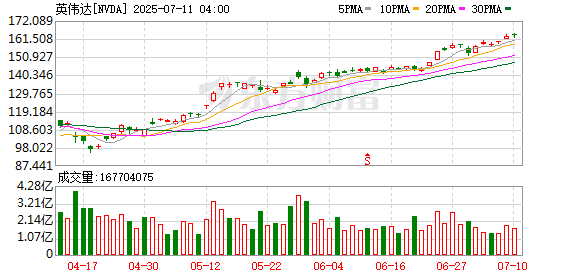
Core Viewpoint - Nvidia's stock price has surged, reaching a historic high of $163.56, with a market capitalization of $4 trillion, driven by strong expectations for AI demand and a significant increase of 89% since April [2] Group 1: Stock Performance - Nvidia's stock rose over 2% on July 9, 2023, marking a new all-time high [2] - The company's market capitalization has surpassed that of entire countries like the UK, France, and Germany [2] - Analysts predict a further 7.6% upside potential in Nvidia's stock price, with an average target price of $176.47 from 37 out of 42 analysts recommending a "buy" rating [3] Group 2: AI Demand and Business Strategy - Market expectations for sustained AI demand have significantly boosted Nvidia's earnings outlook [2] - Citigroup analysts have raised Nvidia's data center sales forecasts for fiscal years 2027 and 2028 by 5% and 11%, respectively, anticipating growth from sovereign AI demand [2] - Nvidia is transitioning to an AI infrastructure company, emphasizing the importance of AI infrastructure deployment globally [2] Group 3: Product Development - Nvidia plans to release new generations of AI chips annually, preparing for products like Blackwell and Vera Rubin to meet increasing model inference and training demands [3] - The company is expanding its offerings beyond AI chips to include software, cloud services, and networking chips, positioning itself as an "AI infrastructure" or "computing platform" provider [2]
见证历史!刚刚,英伟达,突破4万亿美元!
证券时报· 2025-07-09 14:19
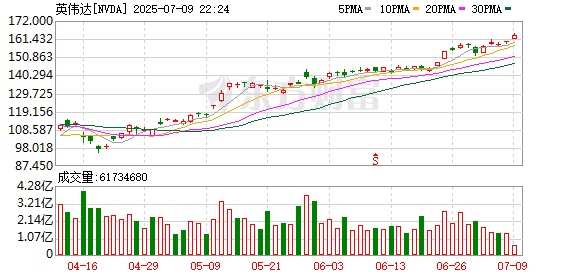
见证历史! 当地时间7月9日, 英伟达股价达到一个新的里程碑,成为首家市值达到4万亿美元的公司。 当天,美股三大股指全线高开,截至发稿,道指上涨0.65%,标普500指数上涨0.64%,纳指上涨0.95%。 | 0 △ ■ 田 0 | 价格 = | 涨跌幅 ◆ | | --- | --- | --- | | 道琼斯指数 | 44526.47 | +0.65% | | .DJI | | | | 标普500指数 | 6265.17 | +0.64% | | .SPX | | | | 纳斯达克综合指数 | 20613.00 | +0.95% | | .IXIC | | | 投资者将重点关注美联储上次会议纪要的公布情况,这份报告将于北京时间周四(7月10日)凌晨2点公布。 消息面上,据央视新闻,欧洲议会国际贸易委员会主席贝恩德·朗格当地时间7月9日在比利时布鲁塞尔举行发布会时表示,当前欧盟与美国的贸易争端仍集中 在具体行业的关税领域,特别是钢铁、汽车、铜以及可能涉及的制药产品。 朗格表示,欧盟主要出口药品、汽车和机械设备,因此迫切需要尽快与美方达成一项协议,取得明确的最终结果和决定。但他同时表示,美方目前尚未承诺 降 ...

历史首个4万亿美元市值公司,即将诞生?
财联社· 2025-07-09 05:28
以下文章来源于科创板日报 ,作者马兰 花旗还指出,基于主权AI(通常是国家政府开发的人工智能)的需求高于预期,到2028年, AI数据中心市场规模将达到5630亿美元,高于此前预估的5000亿美元,而这将利好英伟达, 因为该公司几乎参与了所有的主权交易。 分析师看好 英伟达股价自4月下旬以来持续上涨,因市场预期人工智能需求激增将持续提振其盈利。尽管 公司首席执行官黄仁勋在5月份曾警告,美国限制对华芯片出口政策可能会对投资者造成不利 影响,但投资者似乎已经克服了对美国贸易政策的最严重担忧。 另一方面,机构投资者持续看好英伟达,因为该公司在人工智能领域的优势地位将继续帮助该 公司盈利并扩大业务。 花旗分析师Atif Malik将英伟达的目标价从180美元上调至190美元,还有34位华尔街分析师 也给出了"买入"评级,平均目标价为175.97美元,意味着英伟达股价在未来几个月还可能再 上涨10%。 科创板日报 . 科创圈都在关注的新型主流媒体,上海报业集团主管主办,界面财联社出品。 英伟达股价周二收于160美元,只要其股价超过160.46美元,就能刷新全球的市值纪录。而 一旦英伟达股价升至163.93美元,该公司将 ...

电子行业动态:Oracle签300亿美元大单,英伟达算力需求旺盛
Minsheng Securities· 2025-07-09 01:54
Investment Rating - The report maintains a "Recommended" rating for several key companies in the semiconductor and AI infrastructure sectors, including Chipone Technology, Industrial Fulian, and Huakong Technology [4][45]. Core Insights - Oracle has signed a significant cloud service agreement expected to generate over $30 billion annually starting from FY2028, which will account for approximately 52% of its total revenue for FY2025 [1][8]. - The demand for AI computing power is driven by three main application scenarios: third-party large language model (LLM) training, sovereign AI infrastructure development, and customized private cloud solutions for enterprise clients [2][33]. - The global AI computing landscape is evolving with both GPGPU and ASIC technologies advancing rapidly, indicating a dual-track growth in the market [3][12]. Summary by Sections Oracle's Major Contract and GPU Demand - Oracle's recent contract is a record-breaking deal that significantly impacts its revenue structure, highlighting the rapid growth in AI model and cloud service demand [1][8]. - To meet this demand, Oracle has procured approximately 400,000 NVIDIA GB200 high-end computing cards, making it the second-largest holder of NVIDIA's high-end computing cards globally [1][9]. Global AI Computing Landscape - The AI computing market is bifurcating into two main technology camps: GPGPU, led by NVIDIA, and ASIC, driven by companies like Google and Amazon [3][12]. - GPGPU technology is particularly suited for large model training and general AI applications, while ASIC technology focuses on optimizing specific tasks such as AI inference and cost efficiency [3][22]. New Growth Drivers for NVIDIA GPGPU Demand - The demand for NVIDIA's GPGPU is primarily fueled by three areas: third-party LLM training, sovereign AI initiatives, and enterprise-level private cloud deployments [33][34]. - The training of large models, such as GPT-3, requires substantial computational power, which NVIDIA's GPUs provide efficiently [34][35]. Investment Recommendations - The report suggests focusing on companies with strong core technologies and competitive advantages in the AI computing supply chain, including Chipone Technology, Industrial Fulian, and Huakong Technology [4][43]. - The long-term demand for computing power is expected to be robust, driven by sovereign AI, accelerated large model training, and enterprise private cloud deployments [4][44].
