
夜间经济

Search documents
入境游火了 上海市委常委答21: 前九月入境游超630万人次
2 1 Shi Ji Jing Ji Bao Dao· 2025-10-28 07:20
Group 1 - The total retail sales of consumer goods in Shanghai increased significantly, with a growth rate exceeding 10% in the third quarter of this year [1] - The 8th China International Import Expo will be held from November 5 to 10, with participation from 155 countries and regions, and over 4,108 foreign enterprises exhibiting [1] - The expo will feature a total exhibition area of over 430,000 square meters, setting a new record for scale [1] Group 2 - Shanghai has implemented various policies to stimulate consumption, including initiatives for the elderly economy, night economy, and service consumption, leading to significant sales boosts [2] - The "Five-Five Shopping Festival" contributed to a 10.2% increase in offline consumption, while the "Shanghai Summer" international consumption season saw a 72.4% increase in tax refund sales from July to September [2] - The upcoming expo will coincide with the "2025 Boutique Consumption Month" and various promotional activities to enhance the expo's impact on local consumption [2] Group 3 - New business models and consumption scenarios are being rapidly developed, with over 2,000 launch events held this year and 787 new stores opened in the first nine months [3] - E-commerce transactions in Shanghai exceeded 3.27 trillion yuan, with a year-on-year growth of 12.7%, and live-streaming retail sales reached 369 billion yuan, growing by 23.6% [3] - The city is enhancing its commercial infrastructure, with 23 new or renovated commercial projects completed this year [3] Group 4 - Service consumption is being expanded and improved, with the introduction of the "Le·Shanghai" service consumption vouchers boosting spending in dining, tourism, and entertainment [4] - Over 6.3 million inbound tourists visited Shanghai in the first nine months, with tourism consumption increasing by nearly 30% year-on-year [4] - The city hosted nearly 1,000 cultural exhibitions and events, attracting 40 million visitors, with significant attendance at major exhibitions like the "Ancient Egyptian Civilization Exhibition" [4]
观览夜幕下的灯火(金台随笔)
Ren Min Ri Bao· 2025-10-27 22:25
Core Insights - The article highlights the growing trend of nighttime tourism and consumption in China, with 60% of urban consumption occurring at night and over 50% of daily sales in large shopping malls happening between 6 PM and 10 PM [1][2] Group 1: Night Economy Development - Nighttime attractions are becoming increasingly popular, with various cities enhancing their nightscapes through cultural and entertainment offerings, such as night markets and light shows [2][3] - The integration of local cultural elements and modern business models is essential for the sustainable development of the night economy, avoiding a one-size-fits-all approach [3][4] Group 2: Consumer Experience - Consumers are seeking emotional satisfaction and unique experiences during nighttime outings, moving beyond mere dining and shopping to enjoying leisure and cultural activities [1][3] - Warm and thoughtful services, such as improved public transport and family-friendly facilities, are crucial for enhancing the nighttime economy and attracting more visitors [3][4] Group 3: Urban Planning and Innovation - Cities are encouraged to strengthen planning and coordination between large commercial areas and smaller streets, creating a vibrant nighttime atmosphere that caters to diverse consumer needs [2][4] - Innovative business models, such as late-night dining and cultural events, are being introduced to meet the evolving demands of consumers [2][3]
固原市“城中大集”释放消费新动能
Sou Hu Cai Jing· 2025-10-27 21:41
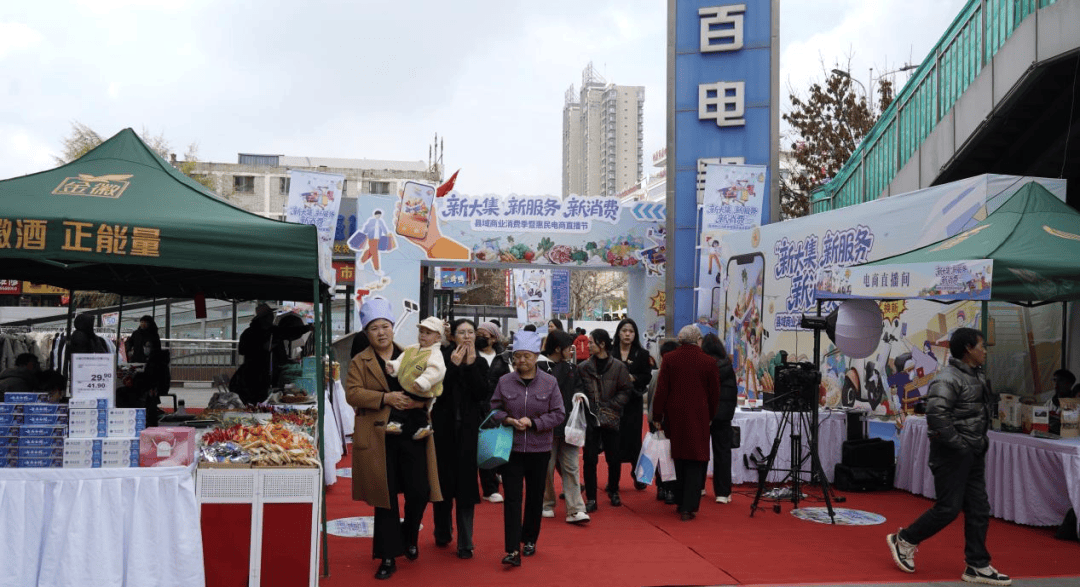
Core Insights - The event "New Big Market New Services New Consumption" aims to stimulate consumer spending and market potential in Guyuan City, aligning with national and local government initiatives to boost consumption [1][12] Group 1: Event Overview - The event took place from October 24 to 26, organized by the Guyuan Municipal Bureau of Commerce and Investment Promotion [1] - It features innovative formats and rich content focusing on three dimensions: "New Big Market, New Services, New Consumption" [3] Group 2: Consumer Engagement - The event includes a variety of activities such as special markets, quality product exhibitions, live-stream promotions, and diverse discount subsidies [3][6] - A "36-hour non-stop" shopping event at Xinhua Department Store aims to enhance consumer enthusiasm, complemented by food experiences like a large hot pot banquet and free tastings of local specialties [4] Group 3: Online and Offline Integration - The event integrates online and offline activities, featuring live-streaming sessions with popular hosts promoting local agricultural products and crafts [6] - Special pricing strategies such as one yuan flash sales and 9.9 yuan shipping deals are implemented to benefit consumers and expand local product sales [6][9] Group 4: Economic Impact - The event is a strategic move to adapt to new consumption trends and enhance the commercial ecosystem in Guyuan, integrating resources from various sectors including culture, tourism, and e-commerce [12] - It significantly boosts related industries such as dining, retail, and cultural tourism, contributing to consumer confidence and internal demand [12]

2025四川省文化和旅游发展大会将于10月29日在绵阳举行 四川将打造“1+10+N”文旅消费精品品牌体系
Si Chuan Ri Bao· 2025-10-24 00:43
Core Points - The 2025 Sichuan Cultural and Tourism Development Conference and the 11th China (Sichuan) International Tourism Investment Conference will be held on October 29 in Mianyang, focusing on cultural and tourism integration [1][2] - The conference will feature a "1+2" activity plan, including one main meeting and a series of supporting events, aimed at promoting the "Jin Xiu Tian Fu · An Yi Si Chuan" cultural tourism brand [1][2] - A total of 480 cultural tourism investment projects will be showcased, covering ten sub-sectors within the cultural and tourism industry [2] Group 1 - The conference will promote Sichuan's cultural tourism investment environment and new opportunities, targeting ten sub-sectors and major cross-regional projects [2] - A themed exhibition titled "Jin Xiu Tian Fu · An Yi Si Chuan" will be held to showcase the achievements of cultural tourism integration since the 12th Provincial Party Committee's seventh plenary session [2] - A series of supporting activities will include an international cultural and tourism promotion event on the evening of October 28, featuring 17 artistic programs that integrate technology and art [2] Group 2 - The Sichuan Cultural and Tourism Department plans to create a "1+10+N" cultural tourism consumption brand system to stimulate cultural and tourism consumption potential [3] - This system will include ten provincial-level cultural tourism consumption brands and encourage local cities to develop their unique brands [3] - The focus will be on high-quality supply, high-energy platforms, and efficient mechanisms to enhance the overall cultural tourism experience [3] Group 3 - Sichuan will emphasize various economic sectors, including night economy and winter tourism, by launching a "Winter Tour Sichuan" consumption season [4] - The initiative will include over 2,000 cultural tourism promotion activities and enhance transportation links between event venues and tourist attractions [4] - Policies such as visa exemptions and tax refunds will be utilized to attract more inbound tourists and convert first-time visitors into repeat customers [4]
哪座城市夜间经济最嗨,24小时便利店数据揭秘
2 1 Shi Ji Jing Ji Bao Dao· 2025-10-23 23:22
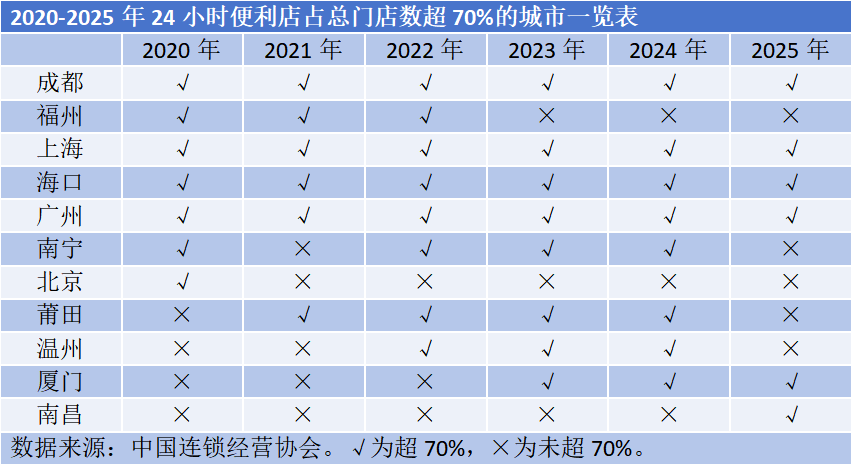
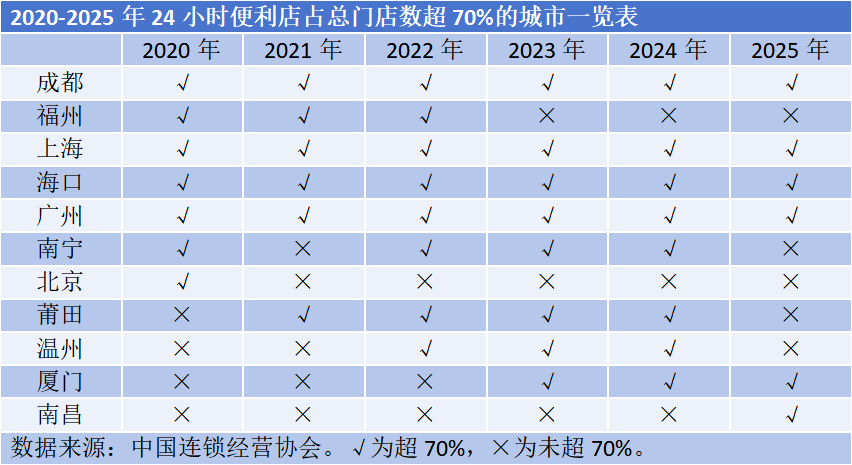
Core Viewpoint - The vitality of a city's night economy is positively correlated with the proportion of 24-hour convenience stores, as higher nighttime sales can boost operators' confidence in maintaining round-the-clock operations [1][2]. Group 1: Convenience Store Data - According to the "2025 China Urban Convenience Store Development Index," Guangzhou has the highest proportion of 24-hour convenience stores at 78.0%, with approximately 5,150 out of over 6,600 stores operating 24 hours [2]. - Eleven cities have a 24-hour convenience store proportion exceeding 70%, including Guangzhou, Shanghai, Chengdu, Fuzhou, Haikou, Nanning, Beijing, Putian, Wenzhou, Xiamen, and Nanchang [2][3]. - Only four cities—Guangzhou, Shanghai, Chengdu, and Haikou—have maintained a 24-hour convenience store proportion above 70% for six consecutive years [2]. Group 2: Night Economy Development - Cities like Guangzhou and Shanghai are leading in developing their night economies through diverse nighttime cultural and tourism activities [4]. - Chengdu's vibrant nightlife, including bars and restaurants, provides a conducive environment for the growth of 24-hour convenience stores [4]. - Haikou is enhancing its night economy by allowing 24-hour bars and entertainment venues, which may further benefit local convenience stores [4]. Group 3: Growth Trends - The rapid development of convenience stores in China began around 2019, with various cities implementing policies to promote brand chain convenience stores [5][6]. - From 2019 to 2025, Chengdu experienced the most significant increase in the proportion of 24-hour convenience stores, rising from 30.0% to 76.9%, a growth of 46.9% [7][8]. - Despite a smaller growth rate, Guangzhou remains the leader in absolute proportion, increasing from 67.4% in 2019 to 78.0% in 2025 [7][8].
哪座城市夜间经济最嗨,24小时便利店数据揭秘
21世纪经济报道· 2025-10-23 23:18
Core Viewpoint - The vitality of a city's night economy is positively correlated with the proportion of 24-hour convenience stores, as higher nighttime sales can encourage more businesses to operate around the clock [1][3]. Group 1: Night Economy and Convenience Stores - In 2018, a survey in Guangzhou indicated that nighttime sales at some 24-hour convenience stores accounted for up to 90% of their total sales [1]. - The "2025 China Urban Convenience Store Development Index" shows that Guangzhou has the highest proportion of 24-hour convenience stores at 78.0%, with approximately 5,150 out of over 6,600 stores operating 24 hours [3]. - Other cities with over 70% of convenience stores operating 24 hours include Chengdu, Shanghai, Xiamen, Haikou, and Nanchang [3]. Group 2: Long-term Trends - An analysis of data from 2020 to 2025 reveals that 11 cities consistently maintain a 24-hour convenience store proportion above 70%, with only Guangzhou, Shanghai, Chengdu, and Haikou achieving this for six consecutive years [3][4]. - The report indicates that the rapid growth of convenience stores in China began around 2019, driven by government policies promoting brand chain convenience stores [7]. Group 3: Growth Rates and Comparisons - Chengdu experienced the most significant increase in the proportion of 24-hour convenience stores, rising from 30.0% in 2019 to 76.9% in 2025, a growth of 46.9% [8]. - Other cities with notable increases include Dongguan (45.8%) and Qingdao (30.4%), while Guangzhou remains the leader in absolute proportion despite a smaller growth rate [8]. - The report also highlights that 14 out of 40 cities have a proportion of 24-hour convenience stores below 50%, particularly in central, northeastern, or northwestern regions [9].
哪座城市夜间经济更嗨?24小时便利店数据揭秘
2 1 Shi Ji Jing Ji Bao Dao· 2025-10-23 12:49
21世纪经济研究院研究员 李果 哪些城市的夜间经济更具有活力? 一种观点认为,一座城市24小时便利店占比越高,其夜间经济越具有活力。支撑这一观点的理由是,若便利店在夜间 (18:00—次日6:00)销售额越高,越能激发从业者24小时营业的信心。如2018年,广州的一项调查显示,当地部分24小 时便利店的夜间经济营业额占比可达90%。 为此,通过分析中国连锁经营协会从2020年-2025年发布的《中国城市便利店发展指数》,或能从一个侧面去观察国内城 市的夜间经济活跃度。 11城24小时便利店数量占比超70% 日前,中国连锁经营协会发布"2025中国城市便利店发展指数"(以下简称《2025报告》)。全国有40个城市纳入了该协会 的调查名单中,《2025报告》指出,24小时便利店数量占比最高的城市是广州,达到78.0%,换句话说,在广州6600余家 便利店中,有接近5150家便利店是24小时营业,足以可见当地夜间经济整体的活跃程度。此外,《2025报告》显示,成 都、上海、厦门、海口、南昌的24小时便利店占比都超过70%,其余34座城市的24小时便利店数量占比未达到这一比例。 如果以70%为界限,那么从更长的时间尺 ...
张伊娜:上海前三季度消费回暖增强势头及关键指标排名表现并非偶然
Sou Hu Cai Jing· 2025-10-23 00:46
Core Insights - Shanghai's consumer market shows signs of recovery and increased vitality, with a 4.3% year-on-year growth in social retail sales in the first three quarters of 2025, ranking first among five international consumption centers despite being slightly below the national average of 4.5% [3][4] Group 1: Policy Impact - The implementation of the "2025 Consumption Expansion Action Plan" has led to increased consumption subsidies, particularly in major consumption areas, generating nearly 110 billion yuan in consumption through "trade-in" policies for appliances, furniture, and automobiles [3] - The "Le Shanghai" consumption vouchers have effectively stimulated consumer enthusiasm across various sectors, including dining, retail, and tourism, while also promoting supply-side innovation to enhance consumption scenarios [3] Group 2: Local Consumption Trends - The stabilization of the stock market, with the Shanghai Composite Index maintaining above 3,800 points, has positively influenced local consumption, supported by a 4.3% increase in per capita disposable income [4] - There is a notable shift in consumer preferences from basic needs to quality demands, with significant year-on-year retail growth in sports and entertainment goods (27.7%), furniture (22.1%), and home appliances (28.2%) [4] Group 3: Tourism and External Consumption - The relaxation of visa policies has led to a 37% year-on-year increase in inbound tourism, significantly boosting related sectors such as culture, tourism, and retail [5] - Events like the "Shanghai Summer" and "Tourism Festival" have further enhanced the synergy between inbound and local consumption, contributing to substantial economic growth [5] Group 4: Growth Dynamics - The low base effect from the previous year, when the consumer market was in recovery, has accentuated the growth trend observed in 2025, characterized by a dual pathway of recovery and structural upgrade in the consumption market [6]
打造开放型经济高地 激活消费主引擎动能
Sou Hu Cai Jing· 2025-10-22 00:51
Group 1: Consumer Market Performance - During the National Day and Mid-Autumn Festival period from October 1 to October 8, Shanghai's online and offline consumption payment reached 79.6 billion yuan, a year-on-year increase of 3.0% [1] - Key commercial districts in Shanghai saw sales increase by 10.2% year-on-year during the holiday period [1] - The number of tax refund claims from foreign visitors increased sixfold, with sales amounting to a year-on-year growth of 7.2% [1] Group 2: Foreign Trade Growth - From January to September, Shanghai's total foreign trade import and export reached 3.34 trillion yuan, growing by 5.4% [1] - In September alone, foreign trade exceeded 400 billion yuan, marking the fastest growth rate in nearly two years with eight consecutive months of growth [1] Group 3: Economic Planning and Strategy - The Shanghai Municipal Commission of Commerce emphasized the goal of becoming a crucial hub in the global industrial chain, supply chain, and value chain, driven by national strategies and high-level openness [1] - The focus will be on enhancing trade hub functions, accelerating trade transformation and upgrading, and fostering a highland for an open economy [1] Group 4: Retail and E-commerce Development - The total retail sales of consumer goods in Shanghai are projected to grow from 1.59 trillion yuan in 2020 to 1.79 trillion yuan in 2024, indicating a robust market for consumption upgrades and brand innovation [4] - E-commerce transactions in Shanghai are expected to reach 3.9 trillion yuan in 2024, representing a growth of over 30% compared to 2020 [5] Group 5: Trade and Logistics Infrastructure - Shanghai has established 11 billion-level and 6 hundred-billion-level platforms for bulk commodities, enhancing its position as a key player in the Asia-Pacific supply chain management [7] - The Shanghai Port has maintained its status as the world's largest container port for 15 consecutive years, with a container throughput exceeding 50 million TEUs annually [9] Group 6: Foreign Investment and Corporate Environment - Shanghai has attracted over 100 billion USD in foreign investment over the past five years, with an average of more than 5,700 new foreign enterprises established annually [13] - The city has recognized 1,060 multinational company regional headquarters and 631 foreign R&D centers, reinforcing its status as a hub for foreign investment [13] Group 7: Trade Innovation and New Business Models - Shanghai has become a pioneer in cross-border e-commerce, achieving an annual growth rate of over 35% and establishing itself as a new engine for foreign trade growth [10] - The city has implemented various innovative measures in service trade, with service imports and exports reaching 252.17 billion USD in 2024, reflecting a sustained annual growth rate [10]
聊城“十四五”商务发展动能澎湃
Qi Lu Wan Bao· 2025-10-21 23:01
Core Insights - The article highlights the achievements of Liaocheng during the "14th Five-Year Plan" period, focusing on economic development, consumption growth, and external trade expansion, which are aligned with the city's goals of becoming a prosperous, innovative, open, beautiful, and happy city [1] Economic Development - Liaocheng's social retail sales reached 108.53 billion yuan in 2024, a 35.5% increase from the end of the "13th Five-Year Plan," with an average annual growth rate of 7.89% [2] - The city implemented over 20 consumption promotion policies, including measures to boost appliance consumption and a digital platform for recycling, which collectively stimulated consumption by 9.2 billion yuan [2] Consumption Upgrade - The city has enhanced its commercial areas, with successful upgrades to several key districts and recognition for green business practices [3] - The development of smart business districts and stores has progressed, with 22 new brands introduced to stimulate the local economy [3] Digital Economy - Liaocheng has established nine provincial-level e-commerce live streaming bases and ten supply chain bases, with significant growth in local e-commerce enterprises [4] - The city won championships in both industry and talent categories at the provincial e-commerce live streaming competition [4] Foreign Trade and Investment - In 2024, Liaocheng's total import and export value reached 62.92 billion yuan, a 55.6% increase from the end of the "13th Five-Year Plan," with an average annual growth rate of 11.7% [5] - The city has established trade relations with 205 countries and regions, with significant growth in trade with "Belt and Road" partners and RCEP member countries [6] Foreign Investment - Liaocheng has attracted 249 new foreign enterprises, with actual foreign investment in the manufacturing sector reaching 584 million USD [6][7] - The city has improved its foreign investment environment, enhancing service mechanisms for foreign enterprises [7] Development Zones - Liaocheng's development zones contribute over 50% of tax revenue and 70% of industrial investment, showcasing their importance in the local economy [8] - The city has cultivated nine industry clusters with over 10 billion yuan in output, highlighting the effectiveness of targeted development strategies [8]
