直播经济

Search documents
奔赴“春天的约定”,在希望的田野上描摹“三农”壮美画卷
Xin Lang Cai Jing· 2026-02-06 08:35
Core Viewpoint - The central document outlines a clear roadmap for agricultural and rural development in China, emphasizing the modernization of agriculture, improvement of rural living conditions, and enhancement of farmers' livelihoods as key objectives for the new journey ahead [1][2]. Group 1: Agricultural Production and Food Security - The document sets a target to stabilize grain production at approximately 1.4 trillion jin (around 700 million tons) and emphasizes the implementation of a new round of actions to increase grain production capacity by 100 billion jin [2][3]. - It highlights the importance of maintaining arable land and promoting integrated practices for high-yield crops, thereby ensuring food security and enhancing agricultural productivity [2][3]. Group 2: Farmers' Income and Economic Development - A dedicated section focuses on promoting stable income growth for farmers, with a strong emphasis on developing local industries to create job opportunities [3][4]. - The document encourages the integration of technology, green practices, and quality agriculture to enhance the value of agricultural products, as well as the development of rural e-commerce and small enterprises [3][4]. Group 3: Rural Living Conditions and Community Development - New requirements for building livable and workable beautiful villages are outlined, aiming to transform rural areas into attractive destinations for tourism and entrepreneurship [4]. - The document stresses the need for tailored approaches that respect local conditions and farmers' wishes, avoiding one-size-fits-all policies, and addressing critical issues in education, healthcare, and elder care to improve the quality of life in rural areas [4].
去年三大先导产业规模突破2万亿元,上海今年GDP目标增长5%
2 1 Shi Ji Jing Ji Bao Dao· 2026-02-03 12:57
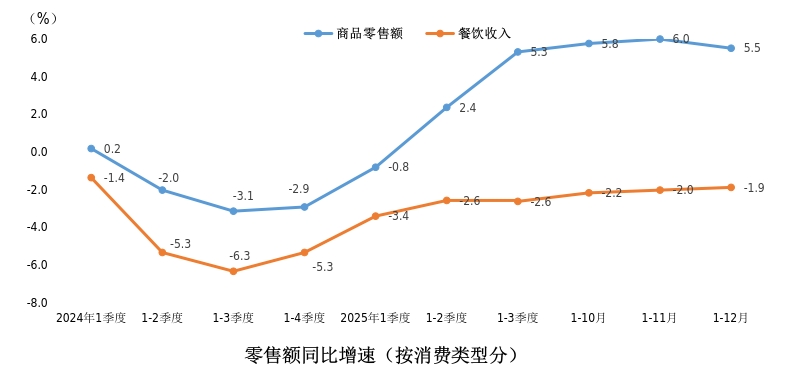
Core Viewpoint - The Shanghai government report for 2026 indicates a GDP growth target of around 5% for the city, maintaining the same target set for 2025, reflecting a shift towards high-quality development and a focus on building a self-reliant industrial and supply chain system [2][6]. Economic Performance - In 2025, Shanghai's GDP reached 5.67 trillion yuan, growing by 5.4%, which was better than expected [1]. - The total retail sales of consumer goods in Shanghai grew by 4.6% in 2025, surpassing the national average growth rate of 3.7% and reversing a decline of 3.1% in 2024 [1][6]. Consumption and Retail Strategies - Shanghai implemented various initiatives to boost consumption in 2025, including the issuance of "Le Shanghai" service consumption vouchers and the promotion of night economy and cultural tourism events [5][7]. - The number of tax refund stores for outbound tourists increased to 1,837, a growth of 136%, contributing significantly to the retail sales growth [6]. Industrial Development - The three leading industries in Shanghai—integrated circuits, biomedicine, and artificial intelligence—surpassed a combined scale of 2 trillion yuan in 2025 [8]. - Shanghai's focus on high-end industrial structure is evident, with significant advancements in strategic emerging industries [2][8]. Innovation and R&D - In 2025, Shanghai's total R&D expenditure was approximately 4.5% of its GDP, with a target of increasing this to 4.6% in 2026 [9]. - The city aims to enhance its innovation capabilities by establishing high-quality incubators and concept verification platforms, and by promoting the integration of technology and industry [8][9].

上海今年GDP目标增长5%:强化内需主导,全力稳外资外贸
第一财经· 2026-02-03 06:31
Core Viewpoint - Shanghai's economy is showing resilience with a GDP growth of 5.4% in 2025, exceeding expectations, and a clear target of 5% growth for 2026, emphasizing the importance of domestic demand and external trade stability [5][8]. Economic Performance - Shanghai's GDP reached 5.67 trillion yuan, with a growth rate of 5.4%, outperforming expectations [5]. - The total import and export volume reached 4.51 trillion yuan, growing by 5.6%, with exports increasing by 10.8% [5]. - Actual foreign investment amounted to 16.06 billion USD, equivalent to 114.8 billion yuan [5]. Foreign Trade and Investment - Shanghai's foreign trade achieved counter-cyclical growth, attributed to targeted policies and diversified trade partnerships, with imports and exports to ASEAN and Belt and Road countries growing by 10.4% and 12.1%, respectively [6]. - The city has implemented measures to support foreign investment, including a plan to encourage reinvestment by foreign enterprises and the establishment of foreign-funded projects in key sectors like new energy vehicles and biomedicine [6][11]. Future Economic Goals - The government aims for a GDP growth target of around 5% for 2026, focusing on enhancing domestic demand and integrating consumption and investment strategies [9]. - Plans include boosting consumption through various initiatives, such as enhancing service consumption and promoting tourism, while also stabilizing foreign trade and investment [10][11]. Five-Year Plan and Development Goals - The "15th Five-Year Plan" outlines ambitious goals for Shanghai, including doubling per capita GDP from 2020 levels by 2035 and achieving significant advancements in high-quality development and urban governance [13][14]. - The plan emphasizes the development of five centers: international economic, trade, shipping, financial, and technological innovation centers, with a focus on enhancing the service sector and fostering world-class enterprises [15][16]. Collaborative Development - The government stresses the importance of synergistic development among the five centers to enhance overall effectiveness and regional coordination [17].

上海市市长龚正:加强科创板制度建设,培育壮大长期资本、耐心资本丨聚焦2026地方两会
证券时报· 2026-02-03 04:23
Economic Growth and Development - Shanghai's GDP is projected to reach 5.67 trillion yuan with a growth rate of 5.4% by 2025 [2] - The total import and export volume is expected to reach 4.51 trillion yuan, with exports growing by 10.8% [6] Financial and Technological Reforms - The government aims to enhance the construction of the Sci-Tech Innovation Board and promote financial system reforms [2] - A focus on developing offshore financial systems and improving cross-border financial services is highlighted [2] Industry and Innovation - R&D expenditure is expected to account for approximately 4.5% of Shanghai's GDP by 2025 [4] - The output of strategic emerging industries is projected to grow by 6.5%, with integrated circuits, biomedicine, and artificial intelligence expected to exceed 2 trillion yuan [4] Foreign Investment and Projects - Actual foreign investment is anticipated to reach 16.06 billion USD (approximately 114.8 billion yuan) [6] - The government plans to attract foreign investment in advanced manufacturing, modern services, and high-tech industries [6] Consumer Market and Tourism - The government aims to boost consumption and develop Shanghai into an international consumption center [8] - Plans include enhancing service consumption and promoting various tourism initiatives [8] Cultural and Creative Industries - The report emphasizes the importance of cultural industry projects and the development of new cultural formats [9] - The government aims to improve the capabilities of the cultural industry, including film production and creative design [9]

我市多措并举助推电商产业“加速跑”
Sou Hu Cai Jing· 2026-01-26 12:43
Core Insights - The e-commerce industry in the city is experiencing rapid growth, with a projected online retail sales of 9.14 billion yuan in 2025, marking a year-on-year increase of 7.9%, ranking fourth in the region [1] - The agricultural products online retail sales reached 1.21 billion yuan, ranking third in the region, with live streaming retail sales amounting to 318 million yuan [1] Group 1: E-commerce Development - The city has implemented various measures to enhance the quality and efficiency of the e-commerce industry, including optimizing policy and funding application guidance to support business development [3] - A total of 563 live streamers were involved in promoting products, with over 350 million interactions during live broadcasts [3] Group 2: Talent Development - The city launched a "Rural E-commerce Talent Cultivation" initiative, conducting over 20 specialized training sessions and nurturing more than 2,000 rural e-commerce professionals [4] - The initiative has successfully incubated over 300 live streamers and established 9 live streaming bases and 47 standard live streaming rooms, contributing to over 200 million yuan in increased income for farmers [4] Group 3: Promotion of Specialty Products - The city is focusing on promoting the sea duck egg industry by participating in major trade fairs and conducting promotional activities in key e-commerce hubs [4] - Successful entry of sea duck egg products into international markets, including exports to Australia, has been achieved [4] Group 4: Future Plans - In 2026, the city will continue to focus on cultivating e-commerce entities and specialty industries, launching a "Network Store Empowerment Action" to enhance service and expand online retail scale [4]


从“网红”到“长红”,直播经济进入精耕细作时代
Zhong Guo Xin Wen Wang· 2026-01-21 08:02
Core Insights - The live streaming economy is transitioning into a more refined and regulated phase, moving from a focus on traffic-driven growth to value creation and sustainable development [2][3] Group 1: Governance and Regulation - The report highlights a significant decrease in consumer complaint reports by 47.4% since the beginning of the year, alongside the indefinite suspension of 370,000 accounts for live streaming [1] - A total of 39 criminal organizations involved in fraud, pornography, and gambling have been dismantled, showcasing the effectiveness of governance measures [1] - Douyin has implemented an innovative "host health score" system to dynamically assess and manage hosts based on their streaming behavior, with a 60% increase in the number of hosts covered by this system compared to the previous year [1] Group 2: Industry Trends - The live streaming industry is evolving from a phase characterized by traffic bonuses (2018-2022) to a more organized and standardized phase, reflecting a rational correction to previous overdevelopment [2] - The industry is expected to inject more vitality into economic and social development, as it has demonstrated strong real-time interactivity, high scene integration, and precise data accuracy [2] Group 3: Employment and Economic Impact - The live streaming e-commerce sector is projected to create approximately 1,200 jobs for every 100 million yuan increase in GMV [3] - New professions such as online hosts, live recruitment specialists, and user growth operators have emerged from the live streaming sector, contributing to employment stability and economic growth [3] Group 4: Future Directions - The sustainable development of the live streaming economy requires collaboration among various stakeholders, emphasizing the importance of quality content and engaging interactions over sensationalism [3][4] - Regulatory bodies are encouraged to monitor emerging challenges and provide guidance, allowing for innovation while ensuring consumer protection [3]
上海“十五五”:增强内需主动力、壮大服贸优势
Di Yi Cai Jing· 2026-01-19 12:45
Core Viewpoint - Shanghai aims to strengthen its role as a "key node in the global city network" during a period of globalization headwinds by enhancing domestic consumption and service engines while improving its discourse power in trade and shipping rules [1][2] Economic Development Goals - The "15th Five-Year Plan" outlines major goals for Shanghai's economic and social development, emphasizing high-quality development, new leaps in urban core functions, breakthroughs in high-level reform and opening up, and significant improvements in social civilization [3] - The plan highlights the importance of building an international consumption center and enhancing domestic demand as the main driver of economic growth [3] Service Sector Expansion - Shanghai plans to expand service consumption, focusing on cultural, tourism, sports, and health services, while promoting green and smart consumption [4] - The city encourages innovation in consumption models and formats, integrating online and offline consumption, and enhancing the international influence of large consumption events [4] Policy Measures - Recent policies include the "Measures to Promote the Quality Improvement and Consumption Expansion of the Service Industry," which proposes 28 initiatives aimed at optimizing supply and expanding consumption [5] - The focus is on quality competition in the service sector, shifting from scale expansion to value enhancement [5][6] Trade and Shipping Enhancements - Shanghai's "15th Five-Year Plan" emphasizes the enhancement of trade hub functions and the optimization of trade structures, aiming to strengthen global supply chain management [7][8] - The city plans to promote high-value product exports and develop knowledge-intensive service trade, including cultural and technical trade [7] Foreign Trade Performance - In 2025, Shanghai's foreign trade is projected to reach 4.51 trillion yuan, with exports growing by 10.8% and imports by 1.8%, outperforming national averages [8] - The export of high-end manufacturing products, particularly electric vehicles and industrial robots, has shown significant growth, indicating a shift towards "Shanghai Intelligent Manufacturing" [9] Maritime and Shipping Development - Shanghai aims to solidify its position as a global maritime hub by developing modern shipping services and promoting digital and green transformations in the shipping industry [9] - Plans include establishing a world-class shipping exchange and enhancing the global service network of shipping insurance institutions [9]
今日A股市场重要快讯汇总|2026年1月19日
Xin Lang Cai Jing· 2026-01-19 00:47
Group 1: Macroeconomic and Market Analysis - The People's Daily highlights the "14th Five-Year Plan" kickoff, focusing on Zhejiang's technological innovation to create new development advantages and Hainan's free trade port's first month of full closure operations, indicating a new chapter in openness [1][7] Group 2: Regulatory Dynamics and Policy Guidance - Shanghai's "14th Five-Year Plan" suggests accelerating the establishment of a global RMB asset allocation center and risk management center, expanding cross-border and offshore financial services, deepening financial market connectivity, and exploring RMB foreign exchange futures trading trials, while emphasizing financial regulation and risk prevention [2][8] - The plan also aims to develop green and smart consumption, promote the upgrade of commodity consumption, and encourage innovations in new business formats such as "AI + consumption" and live-streaming economy [2][8] Group 3: International Economic and Trade Dynamics - Several EU countries are considering imposing tariffs or market access restrictions on US goods valued at €93 billion as a countermeasure to previous US tariff actions, with the related deferred retaliatory tariffs set to automatically take effect on February 6 [12]
拒绝“被入镜”!勇于对隐形拍摄说“不”
Xin Lang Cai Jing· 2026-01-16 00:33
Core Viewpoint - The phenomenon of consumers unknowingly becoming part of live broadcasts in commercial spaces reflects a conflict between business ethics, legal regulation, and privacy concepts in the digital age [1][2]. Group 1: Commercial Spaces and Consumer Rights - Traditional commercial spaces like restaurants, gyms, and barbershops are considered "semi-public spaces," where consumers have reasonable privacy rights [1]. - Many businesses broadcast live content without explicit consent, capturing consumers' private moments, which exceeds reasonable commercial display boundaries [1][2]. Group 2: Legal Implications - From a legal perspective, such actions may infringe on multiple consumer rights, including portrait rights and privacy rights, especially during private activities [2]. - Consumers often face significant challenges in protecting their rights, as they may only realize they were broadcasted after leaving the premises, making evidence collection difficult [2]. Group 3: Proposed Solutions - A systematic social adjustment is needed, including legislative measures to clarify filming regulations in commercial spaces, implementing "notice obligations" and "explicit consent principles" [2]. - Live streaming platforms should establish easy complaint channels for infringement and take action against repeat offenders, while also promoting industry self-regulation and ethical filming guidelines [2].
听·见丨莫让消费者成为流量消费的“背景板”
Sou Hu Cai Jing· 2026-01-12 05:20
Core Viewpoint - The rise of live streaming in various sectors such as dining, fitness, and retail has blurred the lines between commercial marketing and privacy infringement, as consumers unknowingly become "background props" for businesses seeking to attract traffic [1][2]. Group 1: Live Streaming as a Marketing Tool - Live streaming has become a crucial method for businesses to attract customers due to its real-time interactivity and authentic representation of scenes [2]. - In the restaurant industry, live streaming can effectively showcase the ambiance and popularity of the establishment, making it more appealing than static images [2]. - Fitness institutions utilize live streaming to demonstrate the professionalism of trainers and the quality of facilities, thereby reducing potential customers' decision-making time [2]. - Retail "store exploration live streams" can transcend physical space limitations, accurately targeting online users and boosting foot traffic and sales [2]. Group 2: Privacy Concerns and Legal Implications - Many businesses, in pursuit of higher engagement and conversion rates, have begun to infringe on privacy rights by filming consumers without their consent, treating them as "traffic material" [2]. - The essence of live streaming "background prop" infringement is clearly defined in legal terms, with privacy being recognized as an individual's personal life and private information that should not be disclosed without consent [2]. - The Civil Code stipulates that any organization or individual must not infringe upon others' privacy rights through disturbance, disclosure, or public exposure [2]. Group 3: Solutions and Regulatory Measures - To address the challenges of live streaming "background props," a multi-party governance system is needed to balance traffic benefits and privacy protection [3]. - Businesses can proactively avoid infringement risks by implementing practices such as designating specific areas for live streaming that do not include dining spaces [3]. - Recent regulations, such as the "Live E-commerce Supervision Management Measures," outline the responsibilities of platforms and businesses, emphasizing the need for consent when filming in public settings [3]. - Consumers are encouraged to enhance their awareness of rights and can take actions such as recording evidence, filing complaints, and reporting violations to protect their interests [3].