智驾平权

Search documents
【重磅深度】AI+汽车智能化系列之十四——华为汽车业务核心竞争力剖析
东吴汽车黄细里团队· 2025-07-12 10:47
Core Viewpoint - Huawei's automotive business derives its core competitiveness from its values centered on customer focus, dedication to employees, and value-driven principles. Unlike other automakers, Huawei leverages its ICT technology foundation and possesses three systematic capabilities: IPD (R&D), ISC (supply chain), and IPMS (marketing and sales) [2][7]. Group 1: Review of Huawei's Automotive Business (2020-2025) - The development of the Smart Selection model has outperformed the HI model, attributed to the past five years where the automotive sector has been influenced by smartphone methodologies, leading to high efficiency in partnerships, particularly with Seres, and capturing opportunities in the high-end market [3][7]. - The internal differences within the Smart Selection model arise from the increasing innovation requirements in the high-end market, making it more challenging to disrupt foreign brands, which may require more time for establishment [3][7]. Group 2: Outlook for Huawei's Automotive Business (2025-2030) - The next five years will focus on creating a commercial closed loop around computing power, algorithms, and data, as the automotive industry transitions into an era of intelligence. Smart cars will not merely replicate smartphones but will become crucial terminals in the AI era. Huawei's ability to maintain technological leadership and achieve a commercial closed loop will be key [4][7]. - Future successful smart cars must excel in three dimensions: aesthetic design, advanced technology (intelligent driving experience), and cost-effectiveness [4][7]. Group 3: Key Highlights for Huawei's Automotive Business in the Second Half of 2025 - Key highlights include the launch of the first new car under the "Shangjie" brand (in collaboration with SAIC) priced below 200,000 yuan, the updated M7 model under the "Wenjie" brand (in collaboration with Seres), the S9 shooting brake version under the "Xiangjie" brand (in collaboration with BAIC), and the first MPV model under the "Zunjie" brand (in collaboration with Jianghuai) [5][7]. - The year 2026 is anticipated to be a significant product year for Huawei's automotive business, with multiple new models across various brands [5][7].


舜宇光学科技(02382):跟踪点评报告:持续看好盈利超预期,光学规格提升+车载出货加速
EBSCN· 2025-07-11 10:37
Investment Rating - The report maintains a "Buy" rating for the company [4] Core Views - The company is expected to see improved profitability due to ongoing upgrades in optical specifications and accelerated shipments in the automotive sector [2][3] - The mobile camera module shipments have shown a positive year-on-year growth for the first time in 2025, while lens shipments are expected to recover in the second half of the year [1][2] - The automotive lens shipments have significantly increased, with a projected growth rate of 26% in global shipments by 2025, benefiting the company as a leading player in this market [3] Summary by Sections Mobile Camera Modules - In June, mobile camera module shipments increased by 11.1% month-on-month and 0.7% year-on-year, marking the first positive year-on-year growth in 2025 [1] - The first half of 2025 saw a year-on-year decline of 21.0% in mobile camera module shipments, attributed to a focus on mid-to-high-end projects and a high base from the previous year [1] - The report anticipates a recovery in shipments during the second half of 2025 due to the traditional peak season for Android devices [1] Mobile Lenses - Mobile lens shipments in June decreased by 3.1% month-on-month and 12.7% year-on-year, primarily due to a focus on mid-to-high-end projects [1] - For the first half of 2025, mobile lens shipments declined by 6.4% year-on-year, which is below the annual growth guidance of 5% [1] - A recovery in mobile lens shipments is expected in the second half of 2025 due to increased demand from major clients [1] Automotive Lenses - June saw a 3.2% month-on-month increase and a 44.6% year-on-year increase in automotive lens shipments [3] - The first half of 2025 recorded a 21.7% year-on-year increase in automotive lens shipments, exceeding the annual growth guidance of 15%-20% [3] - The company is projected to benefit significantly from the anticipated growth in the automotive lens market, with an expected shipment growth rate of nearly 25% in 2025 [3] Financial Forecasts - The report has revised the net profit forecasts for 2025 and 2026 upwards by 9% and 6% respectively, now estimating net profits of 3.83 billion and 4.84 billion RMB [4] - The company is expected to achieve a gross margin of nearly 10% for mobile camera modules and nearly 30% for mobile lenses in 2025 [2] - Revenue projections for the company show a steady increase from 31.68 billion RMB in 2023 to 62.07 billion RMB in 2027, with a compound annual growth rate of approximately 17.9% [4]

“天神之眼”喂出11倍销量,转身却遭比亚迪背刺?承泰科技港股IPO现断奶危机
市值风云· 2025-07-08 10:03
Core Viewpoint - The article discusses the rise of Chengtai Technology as a leading player in the millimeter-wave radar market, particularly in the context of its partnership with BYD and the implications of its upcoming IPO [5][11][33]. Group 1: Company Overview - Chengtai Technology, founded in 2016, specializes in millimeter-wave radar and has successfully entered the supply chain of BYD, becoming a core supplier [5][11]. - The company has raised a total of 250 million RMB through six financing rounds from 2017 to 2021, indicating strong investor confidence [9][10]. - The founders, both with backgrounds at Huawei, have leveraged their experience to drive the company's growth [7][9]. Group 2: Financial Performance - Chengtai Technology's revenue has seen significant growth, with total revenues projected to be 58 million RMB in 2022, 157 million RMB in 2023, and 348 million RMB in 2024, marking a sixfold increase over two years [11][12]. - The company’s revenue from BYD accounted for 81.9%, 91.3%, and 93.6% of total revenue in 2022, 2023, and 2024, respectively [12][34]. - Despite increasing revenues, the net losses have decreased from 79.17 million RMB in 2022 to 2.22 million RMB in 2024, with adjusted net profit expected to be 13.95 million RMB in 2024 [11][13]. Group 3: Market Position and Growth Potential - Chengtai Technology is positioned as the second-largest millimeter-wave radar supplier in China, with a market share of approximately 5.2% [30][31]. - The domestic market for millimeter-wave radar is projected to reach 20 billion RMB by 2029, with a compound annual growth rate (CAGR) of 9.2% for forward radar and 32.0% for corner radar from 2020 to 2024 [22][23]. - The company has also expanded its product offerings to include corner radar, with revenues from this segment growing significantly [25][28]. Group 4: Dependency and Competitive Landscape - Chengtai Technology's heavy reliance on BYD poses a risk, as 93.6% of its revenue in 2024 is expected to come from this single client [34][35]. - The competitive landscape includes established players like Bosch and Continental, which dominate the market with significant shares [39][41]. - The company faces challenges in diversifying its client base, as recent efforts to onboard new customers have not yet yielded substantial results [33][37].


四维图新与北汽新能源签署开发合同 智驾业务再下一城
Zheng Quan Shi Bao Wang· 2025-07-07 11:24
7月7日晚间,四维图新(002405)发布公告,公司近日与北京新能源汽车股份有限公司(以下简称"北 汽新能源")签署《零部件开发合同》,将为后者两车型开发泊车软件产品。 2024年,四维图新实现营收35.18亿元,同比增长12.68%。其中智云业务录得营收22.54亿元,同比增长 28.96%;智芯业务营收5.66亿元,同比增长10.92%;智舱业务板块收入为4.03亿元,同比下降12.87%; 受产品结构调整及交付周期的影响,智驾业务营收为2.71亿元,同比下滑28.08%。 定点方面,2024年初至2025年一季度,四维图新获得基础行车产品300万套及舱泊产品60万套的新增定 点。 目前,四维图新正处于转型投入期,净利润处于阶段性亏损状态,不过亏损幅度正在收窄。2024年,公 司净利润为-10.95亿元,同比减亏超3亿元。公司预计,伴随着市场份额的增加,2025年将实现大幅减 亏。 不过,技术开发项目经历一定的研发周期,且存在研发活动固有的风险,四维图新提示投资者注意投资 风险。 就智驾业务而言,其盈利水平取决于订单的构成,如开发成本、软硬件占比、采购成本、出货量等,其 中出货量是重要影响因素。目前,四维 ...

从反“内卷”看智驾平权的快与慢
Zhong Guo Qi Che Bao Wang· 2025-07-07 08:11
日前,同济大学汽车学院教授朱西产旗帜鲜明地提出,反对智驾平权。在他看来,辅助驾驶的覆盖面更宽,5~10年后再谈智驾平权更合适。因为行 业"内卷"之下车价降得太快,而新技术开发需要耗费巨大的成本,长此以往不利于行业健康发展。 从技术发展角度来看,10万元级车型搭载的智驾系统仅仅是"能用",智驾引发的安全问题并不鲜见。广汽平台技术研究院智驾技术部专业总师王代涵表示, 特别是用低成本方案去实现一个"我需要有"这个功能,这在当前来说可能不是最紧迫的。从长远看,现阶段推广的城市(NOA)功能,要把重心放在安全 底线、扩展性等方面。 "能用"到"好用",成熟度决定推广步伐 年初,华为终端BG董事长、智能汽车解决方案BU董事长余承东曾在微博上发文称,"智能驾驶,凑合能用与好用并安全,是完全不同的境界!就像打电话 有网就行,上网就需5G!" 正如余承东所言,智驾平权不能仅靠价格下探,更需技术成熟度支撑"好用且安全"的体验。当行业跨过"能用"的门槛,"好用"的技术竞赛才刚刚开始,这既 是车企的技术实力较量,也是用户建立信任的关键窗口期。 清华大学汽车系博士张抗抗认为,智驾功能的普及程度与技术成熟度紧密相关,其核心在于能否创造足 ...

华龙证券:智驾平权与人形机器人催化 维持乘用车行业“推荐”评级
智通财经网· 2025-07-07 04:04
Core Viewpoint - The automotive sector is expected to experience significant growth, with a projected increase of 8.91% in the Shenwan Automotive Index by the first half of 2025, outperforming the CSI 300 Index by 8.88 percentage points, driven by advancements in intelligent driving and humanoid robots [1] Group 1: Passenger Vehicle Market Dynamics - The passenger vehicle market is anticipated to accelerate convergence, supported by vehicle replacement policies, with growth in the first half of 2025 [1] - Domestic manufacturers are expected to dominate the mainstream market under 150,000 yuan, while high-end market share still has room for growth [1] - New models in the 200,000-300,000 yuan range, such as Xiaomi's YU7, XPeng's G7, and Li Auto's i6, are expected to have blockbuster potential [1] - The high-end luxury market is well-supplied with models like the AITO M8/9 and the ZunJie S800, indicating continued growth in domestic and new energy vehicle shares [1] - The focus of competition is shifting from price wars to product strength, suggesting a need to monitor efficient players with scale effects and cost control, as well as leading intelligent driving companies [1] Group 2: Export Growth of Domestic Automakers - From January to May 2025, passenger vehicle exports are expected to maintain double-digit growth, with plug-in hybrid models being a significant growth driver [2] - 2025 marks a period of intensive overseas capacity deployment for domestic automakers, focusing on markets like Southeast Asia (represented by Thailand) and Latin America (represented by Mexico and Brazil) [2] - New entrants like Leap Motor and XPeng are set to take their first steps in overseas markets in 2025, with domestic models having pricing advantages that could become a key profit source for automakers [2] Group 3: Intelligent Driving Technology Expansion - The L2 segment is expected to see growth due to domestic chip replacement and economies of scale in core components, with leading players moving from L2 to L3 upgrades [3] - By 2025, sales of mid-to-high-end intelligent driving models are projected to reach 5.5 million units, with a penetration rate of 22.9% [3] - The L4 segment, particularly Robotaxi, is set to expand rapidly due to policy changes and cost reductions in core components, with leading players like Waymo and RoboTaxi receiving substantial orders [3] - The profitability of Robotaxi platforms is anticipated as fleet sizes increase, with a focus on core hardware suppliers, leading intelligent driving companies, and Robotaxi operators [3] Group 4: Humanoid Robot Sector Developments - In 2025, leading humanoid robot manufacturers like Tesla, Figure AI, and UBTECH are actively deploying in industrial scenarios, which is expected to enhance robot capabilities through large-scale data collection [4] - Challenges remain in complex home scenarios regarding cognitive decision-making, endurance, precision operation, and motion control [4] - Attention is recommended on key incremental components such as dexterous hands, lead screws, and sensors [4]

上汽集团 | 6月:销量表现亮眼 自主+出口驱动增长【民生汽车 崔琰团队】
汽车琰究· 2025-07-05 07:37
Core Viewpoint - The article highlights the strong sales performance of SAIC Motor Corporation in the first half of 2025, driven by domestic brands and export resilience, alongside significant management changes aimed at enhancing operational efficiency and reforming state-owned enterprises [2][4]. Group 1: Sales Performance - In June 2024, SAIC Motor's wholesale sales reached 365,000 units, with a total of 2,053,000 units sold in the first half of 2025, reflecting a year-on-year increase of 12.4% [1] - The sales breakdown shows that SAIC Volkswagen sold 93,000 units in June, while SAIC General Motors sold 47,000 units, with respective first-half sales of 492,000 and 245,000 units, showing a decline of 3.9% and an increase of 8.6% year-on-year [1] - SAIC's new energy vehicle sales reached 121,000 units in June, with first-half sales totaling 646,000 units, marking a significant year-on-year increase of 40.2% [1][2] Group 2: Strategic Partnerships and Innovations - SAIC has partnered with Huawei to launch a new smart car brand "Shangjie," with the first SUV model set to be released in Q3 2025, priced between 150,000 and 250,000 yuan [3] - The collaboration aims to leverage Huawei's advanced technologies in intelligent driving and in-car systems to enhance SAIC's market competitiveness [3] Group 3: Management Changes and Reforms - In 2024, SAIC underwent significant management changes as part of its state-owned enterprise reform, focusing on domestic market and new energy vehicle development [4] - The new management team is characterized by a younger demographic, emphasizing resource integration and collaboration to accelerate the company's transformation [4] Group 4: Financial Projections - The company is expected to benefit from state-owned enterprise reforms, with projected revenues of 687.76 billion yuan, 722.06 billion yuan, and 776.21 billion yuan for 2025, 2026, and 2027 respectively [5][7] - Net profit attributable to shareholders is forecasted to be 12.27 billion yuan, 14.07 billion yuan, and 16.70 billion yuan for the same years, indicating a significant recovery from previous declines [5][7]


数字化成为激光雷达重要升级方向
Shang Hai Zheng Quan Bao· 2025-07-02 18:26
Core Insights - The laser radar market in China has seen a significant increase in demand, with a 83.45% year-on-year growth in the first five months of 2023, reaching 789,200 units [1] - Huawei has emerged as a leading player in the market, with its laser radar shipments benefiting from the popularity of its models equipped with the ADS intelligent driving system [2][3] - The global automotive laser radar market is expected to experience explosive growth in 2024, with Huawei's market share projected to rise from 6% in 2023 to 19% in 2024 [2] Market Dynamics - The demand for laser radar is driven by two main factors: the push for "intelligent driving equality" and the acceleration of L3-level autonomous driving, leading to increased penetration in mainstream markets [3][5] - Major players like Hesai and RoboSense are maintaining significant market shares, but Huawei is rapidly increasing its presence, particularly in the passenger vehicle segment [2][4] Product Development - Huawei has expanded its product offerings with the launch of the ADS 4.0 system, which includes multiple versions equipped with laser radar, aligning with the market's dual evolution of "downward penetration and upward exploration" [3] - RoboSense has achieved a milestone by delivering its 1 millionth laser radar unit, showcasing its strong production capabilities and partnerships with over 30 automotive manufacturers [4][6] Technological Advancements - The integration of digital architecture in laser radar technology is enhancing performance, with higher line counts leading to better precision and safety in autonomous driving applications [5][6] - The cost of laser radar is decreasing due to technological advancements, which is expected to facilitate its adoption in mainstream vehicles [5] Expansion into New Markets - Beyond the automotive sector, digital laser radar is making inroads into emerging applications such as robotics, with partnerships established for developing perception systems for high-end intelligent lawnmowers and delivery robots [7]
政策托底、淡季不淡,去伪存真投龙头
HTSC· 2025-06-30 11:25
Group 1: Passenger Vehicles - The report anticipates a strong performance in Q3 2025, with a projected wholesale volume of 16.25 million units, reflecting a year-on-year increase of 5% and a month-on-month increase of 21% [1] - The sales of new energy vehicles (NEVs) are expected to reach 9.3 million units, with a year-on-year growth of 23% and a month-on-month growth of 42% [1] - The market share of domestic brands is projected to increase from 62% in 2024 to 69% in 2025, driven by strong performances from BYD, Geely, and Chery [20][24] Group 2: Motorcycles and Electric Two-Wheelers - The motorcycle industry is focusing on overseas expansion, particularly in Europe, where a high growth period is expected from January to October [2] - The electric two-wheeler market is anticipated to see strong sales growth in Q3, supported by policies and a demand upgrade, with a cumulative replacement volume of 6.5 million units by May 2025 [2][12] - The report highlights that the high-end electric two-wheeler market is becoming increasingly competitive, while the mid-to-low-end market is expected to consolidate, benefiting leading companies like Aima and Yadea [2] Group 3: Auto Parts - The report notes that tariffs are accelerating the globalization of domestic auto parts companies, with a focus on capacity relocation to regions like Mexico and Southeast Asia [3] - The optimization of supplier payment terms to within 60 days is expected to improve the health of the industry chain, particularly benefiting leading auto parts suppliers [3] Group 4: Intelligent Driving and Robotics - The Robo X initiative is gaining momentum, with significant advancements in logistics cost reduction and the commercialization of Robotaxi services [4] - The report emphasizes the importance of technological iterations in the intelligent driving sector, with a notable increase in the penetration rate of high-end driving assistance features in vehicles priced below 200,000 yuan [4][19] - In the robotics sector, the investment paradigm is shifting towards companies that can deliver real orders and have a strong technological and production capacity [5]

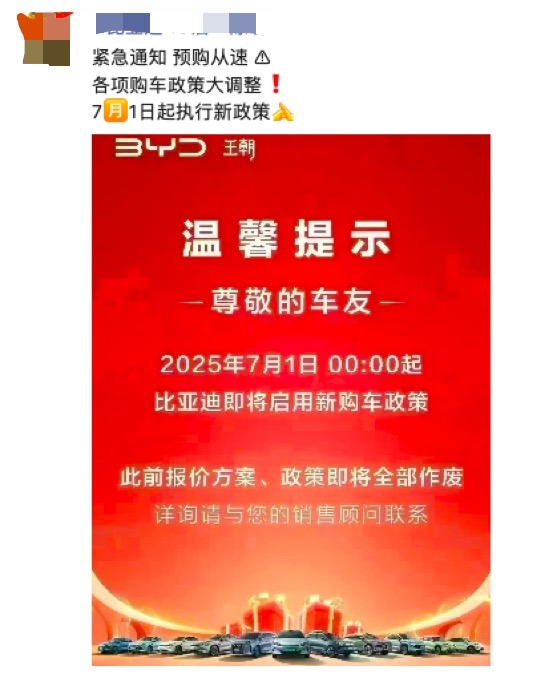
比亚迪叫停“价格战”!7月1日起,全国范围取消限时“一口价”政策
Mei Ri Jing Ji Xin Wen· 2025-06-28 09:16
Core Viewpoint - BYD is set to implement a new car purchase policy starting July 1, 2025, which will invalidate previous pricing schemes and promotional policies [1][3]. Group 1: New Sales Policy - A sales representative confirmed that the limited-time "one-price" policy will be canceled after June 30, 2025, urging customers to make purchases before the deadline [3]. - The new sales policy is expected to be announced in July, with adjustments made quarterly [1][3]. Group 2: Promotional Activities - From May 23 to June 30, BYD launched a promotional campaign offering limited-time "one-price" or subsidies on 22 models, with discounts up to 53,000 yuan [2][4]. - The starting price for the Ocean Network's 10 models under the "one-price" policy is set at 55,800 yuan, with the largest price drop seen in the Seal 07 DM-i model, reduced by 53,000 yuan to 102,800 yuan [4]. Group 3: Market Performance and Future Goals - BYD's cumulative sales of new energy vehicles from January to May reached approximately 1.7634 million units, marking a year-on-year increase of 38.7% and achieving 32% of its annual sales target [6]. - The company aims for an annual sales target of 5.5 million units in 2025, with an overseas sales goal of 800,000 units [5].