Agent

Search documents
揭秘Agent落地困局!93%企业项目卡在POC到生产最后一公里|亚马逊云科技陈晓建@MEET2026
量子位· 2025-12-25 06:08
Core Insights - The true value of Agents lies not in their impressive demonstrations but in their ability to operate effectively in production environments. Data indicates that over 93% of enterprise Agent projects get stuck in the transition from Proof of Concept (POC) to production [1][17]. Group 1: Agent Development and Challenges - A successful Agent requires three essential modules: the model (brain), code (logic), and tools (connecting to the physical world). The effective integration of these three components presents the greatest engineering challenge [7][9]. - The transition from POC to production is hindered by significant obstacles, primarily due to data quality discrepancies and a lack of engineering capabilities [7][17]. - The best time for model customization is during the foundational model training phase, similar to how humans learn languages more effectively at a young age [21][23]. Group 2: Engineering and Deployment Solutions - To address the challenges faced during the deployment and production phases, the company has introduced Amazon Bedrock AgentCore, a comprehensive toolbox designed to manage foundational infrastructure dynamically [20]. - The introduction of Strands Agents simplifies the development process, allowing complex functionalities to be achieved with significantly less code, enhancing efficiency [13][30]. - The company has also launched features to support TypeScript and edge device deployment, expanding the applicability of Agents across various platforms [15][30]. Group 3: Automation and Workflow Integration - The emergence of large models has opened new possibilities for workflow automation, with the development of Amazon Nova Act, which integrates large model capabilities with engineering functionalities for end-to-end automation [29]. - The success rate of automation using Nova Act can reach over 80%, showcasing its effectiveness compared to traditional RPA tools [29]. Group 4: Case Studies and Industry Impact - Blue Origin has built over 2,700 internal Agents using Bedrock and Strands Agents, achieving a 75% improvement in delivery efficiency and a 40% enhancement in design quality [30]. - Sony has developed an internal "Data Ocean" platform, serving over 57,000 internal users and processing up to 150,000 inference requests daily, while also improving compliance review efficiency by 100 times through model fine-tuning [30].



Agent元年复盘:架构之争已经结束!?
自动驾驶之心· 2025-12-24 00:58
Core Insights - The article discusses the evolution of "Agent" technology, highlighting the emergence of "Deep Agent" and "Claude Agent SDK" as leading architectures in the field [3][57]. - It emphasizes that 2025 marks a pivotal year for agents, where technology readiness is evident, but full replacement of traditional methods has not yet been achieved [5][6]. Technical Perspectives - The architecture of agents has converged towards a general form represented by Claude Code and Deep Agent, focusing on their capabilities beyond programming [3][4]. - The article notes that the core capabilities of Claude Code, such as planning and context management, are applicable to various tasks beyond coding, leading to its rebranding as Claude Agent SDK [9]. Industry Recognition - The article asserts that while agent products have generated significant revenue in sectors like recruitment and marketing, the impact is less visible domestically due to a concentration of business in overseas markets [10]. - It identifies a shift in focus from technical architecture to business restructuring, emphasizing the need for industry professionals to adapt traditional workflows to be agent-friendly [10]. Definition and Characteristics of Deep Agent - A "Deep Agent" is characterized by its industry-specific knowledge and long-running capabilities, ensuring stability and reliability in task execution [11][12]. - The article outlines that a Deep Agent must demonstrate high levels of specialization and the ability to perform complex, multi-step tasks without failure [12]. Skills and Context Management - The introduction of "Agent Skills" allows for a more dynamic and efficient way to integrate business knowledge into agents, enhancing their capabilities [22][30]. - The concept of progressive disclosure is highlighted as a key design principle, enabling agents to load information as needed rather than all at once, improving context management [32][34]. Planning and Task Management - Planning is identified as a crucial component for agents to execute long-term tasks effectively, with the ability to decompose tasks into manageable sub-tasks [47][50]. - The article discusses the importance of context isolation and parallel execution in sub-agents, which enhances efficiency and reduces context confusion [50]. System Prompt and File Management - The article emphasizes the significance of detailed system prompts in guiding agent behavior and ensuring effective task execution [52]. - A well-structured file system is proposed as a means to manage context and facilitate collaboration among agents, allowing for long-term memory and efficient information retrieval [53][56]. Conclusion on Agent Technology - The article concludes that the agent technology landscape has reached a point of convergence, with established architectures like Claude Agent SDK and Deep Agent leading the way [57][58]. - It suggests that the future of agent technology will involve further specialization and adaptation to specific business needs, leveraging the strengths of existing frameworks [69][71].

进击的无招,进化的钉钉
Tai Mei Ti A P P· 2025-12-23 09:40
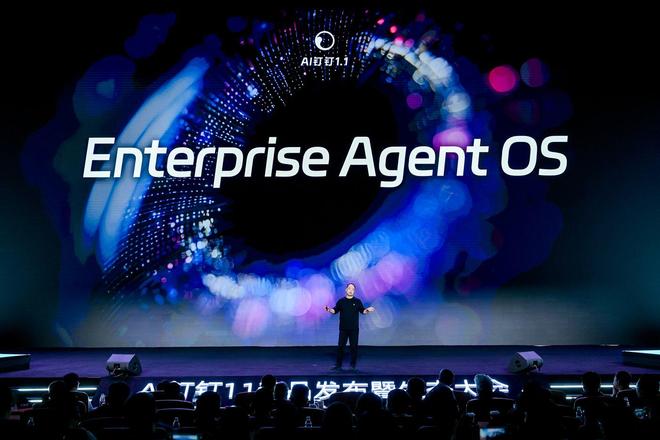
Core Insights - The core idea of the news is the transformation of DingTalk under the leadership of its founder, Wu Zhao, who is redefining the product to be AI-centric, moving from a human-centric approach to one that integrates AI and agents into the workflow [4][21][36] Group 1: Product Transformation - DingTalk has launched AI DingTalk 1.1, which includes over 20 new AI products and features, marking a significant shift in its product strategy [4][36] - The new positioning of DingTalk as "Agent OS" signifies a fundamental change in how the platform will operate, focusing on AI and agents rather than just serving human users [4][21] - The transition from the old DingTalk to the new version is likened to biological evolution, where the platform is undergoing a transformation akin to a tadpole becoming a frog [5][8] Group 2: Organizational Changes - The team structure has been redefined into smaller groups of 5-7 members, fostering innovation in specific scenarios using AI [9][10] - DingTalk mandates that at least 30% of the code must be AI-generated, emphasizing a shift in development practices [9][10] - The organization is encouraged to adopt an entrepreneurial mindset, with a focus on AI-driven innovation [7][9] Group 3: AI Integration - The new AI-driven approach aims to redefine the relationship between humans, AI, and information, with a goal of minimizing direct human interaction with information flows [21][24] - The concept of "Agent OS" is designed to connect AI with the physical world, allowing for autonomous decision-making by AI agents [21][22] - The introduction of a runtime environment for agents within enterprises is crucial for ensuring that AI operates within defined boundaries and permissions [14][15][37] Group 4: Market Positioning - DingTalk aims to leverage the AI revolution to redefine work processes, similar to how previous technological advancements have shaped industries [36][37] - The company is positioning itself to capitalize on the opportunity to define the future of work in the AI era, moving away from being merely a SaaS provider [34][36] - The launch of the Real hardware and software ecosystem is expected to facilitate the deployment of AI solutions within enterprises, breaking down previous barriers to AI integration [37]
双第一!百度智能云领跑2025云厂商大模型中标市场
Sou Hu Cai Jing· 2025-12-23 08:19
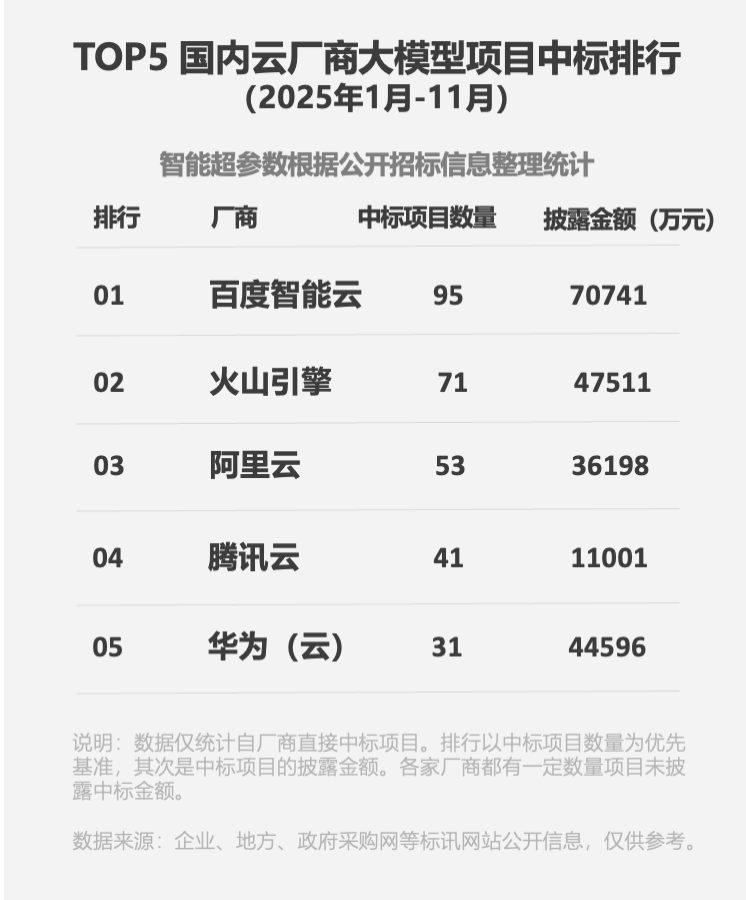
Group 1 - The core viewpoint of the article highlights the rapid penetration of large models into various industries, with significant growth in bidding projects and amounts in 2025 [1] - In the first eleven months of 2025, major cloud vendors in China secured a total of 291 large model-related projects, with a cumulative bid amount exceeding 2.1 billion yuan [1][2] - Baidu Smart Cloud leads the market with 95 projects and a bid amount of 710 million yuan, followed by Volcano Engine and Alibaba Cloud [2] Group 2 - The top five industries for large model bidding projects are finance, telecommunications, energy, government, and education technology, indicating strong demand for intelligent transformation in these sectors [3] - The bidding requirements have evolved, focusing on suppliers' implementation capabilities, reflecting a shift towards the practical application of large models in real production environments [3][4] - The market is transitioning to a new phase of large model bidding, emphasizing system stability, engineering delivery capabilities, and long-term operational costs [4] Group 3 - Competition among cloud vendors is diversifying, moving away from traditional "compute rental" models to full-stack cloud services and specialized model service providers [5] - The emergence of new cloud vendors focused on high-performance AI infrastructure is reshaping the market, with a recognized need for comprehensive AI cloud services [5] - Baidu Smart Cloud has upgraded its AI Infra + Agent Infra to provide integrated solutions for enterprise large model applications, enhancing its competitive edge [5][6] Group 4 - The cloud market is evolving from a focus on basic infrastructure to broader full-stack and platform capabilities, with future competition centered on creating value for businesses through real-world applications [6]

别再卷RAG了,Agent才是「超级生产力」| 极客时间
AI前线· 2025-12-23 07:29
Core Insights - The article emphasizes that 2025 will be a pivotal year for Agents to transition from a technical concept to mainstream commercial use, making it essential for both businesses and individuals to adopt Agents for survival in the era of intelligence [2]. What is an Agent? - An Agent is defined as an "autonomous intelligent entity" capable of perceiving its environment, analyzing objectives, making decisions, and continuously evolving. Unlike traditional AI, which is viewed as a tool, Agents function more like digital assistants [2]. - For programmers, Agents are not merely "chatbots" but "super plugins" that can autonomously break down tasks using frameworks like LLM and reinforcement learning [2]. How to Embrace Agents? - To help developers quickly understand the core technologies behind Agents, a recommended resource is a two-hour video course titled "Agent Development Methodology in the Era of Large Models," created by Peng Jing Tian, a Google Developer Expert [4]. Cognitive Upgrade and Skill Reconstruction - The article suggests a shift in mindset from focusing on "AI replacing jobs" to considering "how to leverage Agents to amplify personal value" [6]. - It highlights the importance of mastering new collaborative languages for working with Agents, such as prompt engineering, goal decomposition, and human-machine collaboration [6]. Additional Resources - The article mentions a series of supplementary learning materials, including a "China AI Agent Product Compass," an "AI Agent Industry Research Report," and course-related materials to provide a more systematic understanding of Agents [8]. - A knowledge base on Agents is also available, offering insights into various frameworks and applications [10]. Industry Applications - The article notes that Agents are gaining traction due to their ability to execute tasks autonomously and their broad applicability across various industries, including healthcare, education, and finance [20].

智能体落地元年,Agent Infra是关键一环|对话腾讯云&Dify
量子位· 2025-12-23 04:16
Core Viewpoint - The year 2025 is anticipated to be the "Agent Year," marking a significant shift in the industry towards practical applications of Agent technology [1][2]. Group 1: Development and Challenges of Agents - The Agent technology has transitioned from a nascent stage to practical engineering applications throughout the year [3][7]. - Key challenges in the implementation of Agents include the need for a robust engineering approach to manage complex systems and the importance of Agent Infrastructure (Infra) [6][21]. - The industry recognizes the value of Agents as they effectively address real-world problems, moving from theoretical discussions to tangible applications [6][12]. Group 2: Perspectives from Industry Leaders - Industry experts highlight a clear divide between traditional narratives from Silicon Valley and practical applications seen in smaller businesses, indicating a shift towards realism in Agent development [8][10]. - The emergence of AI coding tools is noted as a significant development, changing software engineering paradigms and serving as a universal interface for Agents [7][34]. - The consensus among experts is that the capital market is seeking new organizational methods, as the previous internet era's benefits have been largely exhausted [12][13]. Group 3: Engineering and Infrastructure - The concept of Agent Infra is crucial for managing the uncertainties inherent in Agent systems, with a focus on creating a safe and effective operational environment [21][22]. - The development of safety sandboxes and observability tools is essential for addressing the risks associated with autonomous Agent operations [22][23]. - The distinction between essential complexity and incidental complexity in enterprise problem-solving is emphasized, with a focus on building a common subset of solutions for various challenges [27][28]. Group 4: Future Trends and Directions - Future developments in Agent Infra are expected to focus on ensuring safe and reliable operations while optimizing the intelligence of Agents through continuous data utilization [38][39]. - The integration of memory management and semantic context is highlighted as a key area for enhancing Agent capabilities [40]. - The industry anticipates a significant transformation in mobile development ecosystems as Agents become mainstream, necessitating a shift in development methodologies and collaborative practices [41][44].


赵何娟对话张宏江:世界模型已是兵家必争之地|2025 T-EDGE全球对话
Tai Mei Ti A P P· 2025-12-22 14:52
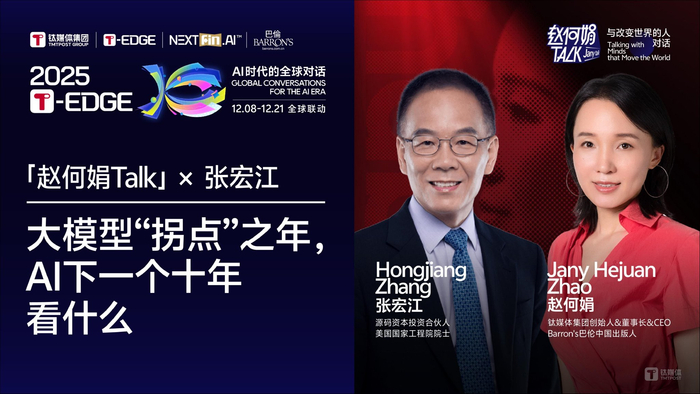
Core Insights - The discussion highlights the transformative impact of AI, particularly the emergence of superintelligence, which may lead to job displacement [2][8] - The conversation emphasizes the high expectations surrounding world models and next-generation AI models, with significant investments being made in startups despite their early stages [4][20] - The debate around the sustainability of scaling laws in AI development is addressed, with experts suggesting that new paths must be explored beyond traditional scaling [19][20] Group 1: AI Development and Trends - The emergence of new AI startups in Silicon Valley has led to valuations reaching $4 billion to $5 billion, indicating strong market confidence in world models [4] - The scaling law, which has been a guiding principle in AI development, is believed to be reaching its limits, prompting calls for new technological pathways [19][20] - The efficiency of scaling laws has diminished over time, suggesting that while progress continues, it may not be as rapid as in previous years [19][20] Group 2: Competitive Landscape - The competition between Google and OpenAI is highlighted, with both companies having distinct advantages; however, it is too early to determine a clear winner [6][41] - The potential for coexistence of multiple systems in the AI era is discussed, drawing parallels to the PC and mobile internet eras [41] - The importance of execution and resource management in AI development is emphasized, particularly in relation to Google's full-stack capabilities [34] Group 3: Infrastructure and Investment - The current phase of AI development is characterized by significant infrastructure investments, including data centers and energy resources, which are essential for future growth [48][49] - Concerns about high debt levels in AI infrastructure investments are raised, with the need for a balance between investment and sustainable returns [50] - The analogy of AI infrastructure investments to historical infrastructure developments, such as railroads and electricity, is presented to argue against the notion of a bubble [48][49]


LangChain Agent 年度报告:输出质量仍是 Agent 最大障碍,客服、研究是最快落地场景
Founder Park· 2025-12-22 12:02
Core Insights - The main obstacle for the practical application of AI Agents in 2025 is not cost but quality, specifically ensuring reliable and accurate content output [1] - By 2026, discussions among enterprises have shifted from whether to implement Agents to how to scale their use effectively and reliably [2] Group 1: Adoption and Implementation - Over half (57.3%) of surveyed industry professionals have already deployed Agents in production, with 30.4% actively developing them with clear launch plans [4][5] - The adoption rate is higher in larger enterprises, with 67% of companies with over 10,000 employees having implemented Agents, compared to 50% in companies with fewer than 100 employees [6] - The most common applications for Agents are in customer service (26.5%) and research/data analysis (24.4%), together accounting for over half of all use cases [10][15] Group 2: Quality and Challenges - Quality remains the primary barrier to widespread Agent adoption, with one-third of respondents identifying it as a major bottleneck, focusing on accuracy, relevance, and consistency of outputs [14][18] - Delay (20%) is the second-largest challenge, particularly in real-time applications like customer service, where response speed is critical [17] - For enterprises with over 2,000 employees, quality issues are the top concern, while security (24.9%) is the second most significant challenge [18] Group 3: Observability and Evaluation - Observability of Agent execution processes has become an industry standard, with 89% of enterprises implementing some form of observability, and 62% having detailed tracking capabilities [21][23] - Over half (52.4%) of companies conduct offline evaluations using test sets, while online evaluations are increasing, now at 44.8% [25][28] - A mixed evaluation approach is common, with nearly a quarter of teams using both offline and online methods, and reliance on human review remains high [33] Group 4: Model Usage and Trends - OpenAI's GPT models dominate usage, but over three-quarters of teams employ multiple models based on task complexity, cost, and latency [36] - More than one-third of organizations are investing in deploying open-source models for cost optimization and compliance reasons [38] - Programming Agents are the most frequently used in daily workflows, followed by research Agents, indicating a strong preference for tools that enhance coding and information synthesis [40][41]

恒生电子首席科学家白硕:Agent之难,无关算力、模型与平台
雷峰网· 2025-12-22 05:52
" 你会关心一个电饭锅能做多少种不同的饭菜,而不是单纯关注炉 子的好坏。 " 作者丨周蕾 编辑丨包永刚 阻碍金融机构把Agent从演示PPT推向核心业务场景的,究竟是什么?是算力成本,是模型能力,抑或是 一个万能的开发平台? 在与恒生电子首席科学家白硕的深度对话中,我们得到了一个不太常见的答案:以上都不是最要紧的。 白硕早年间在中科院计算所从事前沿研究,后长期担任上海证券交易所总工程师,主导核心交易系统升 级,如今作为恒生电子首席科学家,推动AI技术落地。在经过学术前沿、行业监管核心与产业实践这一完 整路径之后,他对当下最热门的Agent话题,给出了具有历史纵深感的、颇具穿透力的洞察。 他指出,缺乏足够"厚度"的业务接口——这里并非指底层技术的API,而是指封装了业务逻辑、能"听 懂"业务人员自然语言指令的能力单元——直接导致现在许多Agent项目陷入"读不懂"真实业务需求当中的 复杂意图,无法解读有业务语义的自然语言的指令,或者只能对原有系统做简单粗暴的封装。他风趣地提 到:你会关心一个电饭锅能支持多少种花式菜谱,至于底下加热组件好不好用,会是你关注的重点吗? 而目前通用型Agent平台的价值,其在整体解决 ...


活动报名:25 年一二级市场年终复盘和 26 年展望|42章经
42章经· 2025-12-21 13:32
Core Viewpoint - The article discusses the ongoing analysis and outlook of the AI market, focusing on the trends and developments in both primary and secondary markets for the years 2025 and 2026, particularly in relation to AI technologies and their implications [5][6]. Group 1 - The collaboration between industry experts has led to insightful discussions and predictions regarding the AI market, with previous analyses proving accurate [5]. - The article highlights the transition from quarterly reviews to more focused online discussions, termed "Tech Ideas," which involve industry professionals sharing insights on key themes [5][6]. - The final event of the year aims to provide a comprehensive review of the AI market and discuss key terms for the upcoming years, including Agent, multimodal AI, AI hardware, embodiment, autonomous driving, and the potential bubble in large models [6]. Group 2 - The event is scheduled for December 27, 2025, at 11:00 AM Beijing time, with a focus on engaging participants who have relevant backgrounds [7]. - The article emphasizes the importance of networking and exchanging ideas among industry peers during these discussions [8].