数字金融

Search documents
网商银行与益禾堂签署战略合作 共同探索产业链数字金融解决方案
Cai Fu Zai Xian· 2025-08-21 09:40
Core Insights - A strategic cooperation agreement has been signed between Wangshang Bank and Yihotang, a leading tea beverage brand, to explore digital financial solutions across the industry chain, enhancing refined operations and intelligent management [1] Company Overview - Yihotang is a prominent chain tea beverage brand in China, covering over 300 cities and having more than 8,000 signed stores [1] - The extensive store network and complex supply chain of Yihotang necessitate high demands for capital management and operational efficiency [1] Partnership Details - The collaboration began in 2023, with Wangshang Bank assisting Yihotang in addressing various payment and settlement issues across all scenarios over the past two years [1] - The partnership aims to transition from digitalization of business scenarios to intelligent management at the group level, ultimately enhancing capital efficiency and supporting stable operations of stores [1] Industry Context - The new tea beverage industry has shifted from a phase of rapid expansion to a focus on supply chain efficiency and refined operational capabilities [1] - Digital technology optimization of capital flow efficiency and improvement of full-chain management levels are critical for brands to build core competitiveness [1] Future Directions - The strategic cooperation marks a new phase, moving beyond traditional payment and settlement services to focus on two main areas: group-level cash management and AI financial analysis [1] - The goal is to enhance the efficiency and precision of capital usage at Yihotang's headquarters and provide more efficient financial status analysis and operational insights through intelligent tools [1]
商业银行数字化转型迈向智能化阶段,如何把握机遇、应对挑战? | 银行家论道
清华金融评论· 2025-08-21 09:32
Core Viewpoint - The article discusses the high-quality development path of Chinese commercial banks in the context of a complex macro environment, emphasizing the importance of digital finance and technological transformation in enhancing service to the real economy [2]. Group 1: Digital Finance Initiatives - The bank emphasizes a return to serving the real economy, advocating for a "good finance" approach and exploring a new financial paradigm with Chinese characteristics [4]. - Key initiatives include strengthening organizational leadership by incorporating the "Five Major Articles" into annual tasks and establishing a dedicated task force led by the chairman [5]. - The bank is enhancing incentive mechanisms by integrating the "Five Major Articles" into performance evaluations and piloting differentiated assessment mechanisms for innovation teams [5]. Group 2: Digital Transformation Achievements - The digital transformation of commercial banks is advancing towards an intelligent phase, achieving significant results in enhancing financial digital infrastructure and upgrading service models [8]. - Automation and intelligence in financial digital infrastructure have been widely adopted, utilizing AI, blockchain, and big data to streamline processes and improve efficiency [8]. - Financial services are becoming more scenario-based and digitalized, integrating financial products with social and economic contexts to better serve small and micro enterprises [9]. Group 3: Challenges in Digital Transformation - The digital transformation faces challenges such as the need for richer data resources, deeper AI application, and stronger digital talent development [12]. - There is a significant gap in the availability of composite talents who understand technology, business, and market dynamics, particularly in cutting-edge fields like AI and big data [12]. Group 4: New Opportunities from Technological Changes - Digital technology is reshaping financial service scenarios, making access more convenient and enhancing service experiences through AI and big data [14]. - The bank is focusing on deepening AI applications to transform from traditional service providers to AI-driven banks, enhancing customer service and risk assessment capabilities [16]. Group 5: Personalized Financial Services - By leveraging big data and AI, banks can gain insights into customer behavior and needs, providing tailored financing solutions to meet diverse customer demands [18]. - The bank is developing a digital inclusive finance service system that offers personalized services to small and micro enterprises, utilizing various data sources for credit assessment [19]. Group 6: Impact of Large Models - The emergence of large models like DeepSeek and ChatGPT is revolutionizing customer interaction and enhancing operational efficiency in financial services [20]. - However, challenges such as algorithm bias, data security, and talent shortages need to be addressed to fully leverage these technologies [21].



RWA:数实融合时代下数字金融的创新探索与实践|金融与科技
清华金融评论· 2025-08-21 09:32
Core Viewpoint - The article emphasizes the significance of Real World Assets (RWA) in linking physical assets with digital assets, facilitating the digital transformation of the real economy and innovation in financial services. It highlights Hong Kong's pioneering role in RWA practices, creating opportunities for mainland Chinese enterprises to utilize offshore financial centers for RWA token issuance [4][10]. Summary by Sections RWA Overview - RWA represents a new asset form that connects tangible and intangible assets from the real world to the digital realm through blockchain technology, enabling more transparent, efficient, and secure asset management and transactions in the digital economy [4][6]. Advantages of RWA - **Transparency and Trust**: RWA ensures asset authenticity and compliance, enhancing investor confidence through real-time tracking of asset operations and returns via blockchain technology [7]. - **Liquidity Improvement**: RWA tokens can be traded globally, overcoming geographical and procedural limitations, thus significantly enhancing asset liquidity and market participation [7]. - **Cost Reduction**: By minimizing intermediary roles and automating processes, RWA reduces transaction costs and increases financing efficiency [7]. - **Risk Management**: RWA leverages blockchain's characteristics for real-time data recording, improving risk assessment and management through smart contracts [8]. Disadvantages of RWA - **Regulatory Gaps**: The legal framework surrounding RWA is still developing, leading to potential disputes regarding asset ownership and transaction rules [9]. - **Technical Risks**: RWA's reliance on blockchain and smart contracts introduces security vulnerabilities, including potential network attacks and coding errors [9]. - **Valuation Challenges**: The diversity of RWA types complicates standardized valuation methods, making accurate asset pricing difficult [9]. - **Market Awareness**: RWA's recognition and acceptance in financial markets remain low, which may hinder market depth and trading activity [9]. Case Studies - **RWA in Renewable Energy**: Companies like Langxin Group and Xiexin Energy are utilizing RWA tokens for financing renewable energy projects, enhancing asset management efficiency and reducing operational risks [11][12]. - **Agricultural RWA Model**: The Malu Grape project explores RWA financing through agricultural data assets, ensuring transparency and traceability while complying with existing regulations [13][15].
滴水成湖,金融活水激活临港新片区澎湃动能——建行上海自贸试验区新片区分行助力新片区拔节生长
2 1 Shi Ji Jing Ji Bao Dao· 2025-08-21 06:46
Core Viewpoint - The article highlights the rapid development of the Lingang New Area as a modern city that supports national strategic missions, with significant progress in institutional innovation, industrial upgrading, and financial openness since its establishment in 2019 [1] Group 1: Financial Support and Innovation - China Construction Bank's Shanghai Lingang New Area Branch has been pivotal in supporting the development of high-tech enterprises, with the number of high-tech companies increasing from 254 to 1,596 between 2019 and May 2025 [2] - The bank has introduced the "Double Innovation Loan" service to address financing challenges for technology enterprises, particularly those in the cultural and creative sectors [2] - The bank successfully facilitated a stock repurchase loan for a biopharmaceutical company, alleviating financial pressure amid market valuation challenges [3] Group 2: Talent Development and Services - The bank has launched a co-branded card talent service project to enhance the living and working conditions for talent in the Lingang New Area, covering various aspects such as government services, transportation, and financial services [4][5] - The bank's services include comprehensive financial solutions for both enterprises and individuals, creating a bridge between government, businesses, and talent [5] Group 3: Green Finance Initiatives - The bank has increased its credit investment in green finance, supporting projects like the 50MW wind power project by Ailong Technology, which aims to provide clean energy and reduce carbon emissions [6][7] - The bank's tailored financial solutions have helped address the cash flow pressures faced by green energy projects, reinforcing its commitment to sustainable development [7] Group 4: Digital Financial Services - The Lingang New Area has made significant strides in digitalization, with the bank implementing digital platforms to streamline financial processes for clients, such as online collection of party fees [8][9] - The bank has also established a digital RMB payment system for fiscal interest subsidies, enhancing efficiency in financial transactions for enterprises [9] Group 5: Future Outlook - By 2035, the Lingang New Area aims to become a trillion-yuan economy, with a focus on achieving world-leading competitiveness in key industries, positioning itself as a crucial engine for Shanghai's development [9]
育儿补贴免征个税;美联储会议纪要:同意维持利率不变丨盘前情报
2 1 Shi Ji Jing Ji Bao Dao· 2025-08-21 00:49
Market Overview - On August 20, the A-share market saw a rebound with the Shanghai Composite Index, Shenzhen Component Index, and ChiNext Index all reaching new highs for the year. The Shanghai and Shenzhen markets had a total trading volume of 2.41 trillion yuan, a decrease of 180.1 billion yuan from the previous trading day, marking six consecutive days of over 2 trillion yuan in trading volume. Over 3,600 stocks rose in the market [2][3] - The Shanghai Composite Index increased by 1.04% to 3766.21 points, the Shenzhen Component Index rose by 0.89% to 11926.74 points, and the ChiNext Index gained 0.23% to 2607.65 points [3] Sector Performance - Chip stocks surged in the afternoon, while consumer stocks such as liquor rebounded. Consumer electronics also showed active performance. Conversely, high-priced stocks collectively fell, with sectors like film, chemical pharmaceuticals, CRO, and vitamins experiencing declines. The top-performing sectors included liquor, semiconductors, AI glasses, and minor metals, while the worst-performing sectors were film, chemical pharmaceuticals, CRO, and vitamins [2] International Market - In the U.S. stock market on August 20, the Dow Jones Industrial Average rose by 16.04 points (0.04%) to 44938.31 points, while the S&P 500 fell by 15.59 points (0.24%) to 6395.78 points, and the Nasdaq Composite dropped by 142.09 points (0.67%) to 21172.86 points [4][6] - In Europe, the FTSE 100 index increased by 98.92 points (1.08%) to 9288.14 points, while the CAC 40 index in France fell by 6.05 points (0.08%) to 7973.03 points, and the DAX index in Germany decreased by 146.10 points (0.60%) to 24276.97 points [4] Commodity Prices - International oil prices rose on August 20, with light crude oil futures for September delivery increasing by $0.86 (1.38%) to $63.21 per barrel, and Brent crude oil futures for October delivery rising by $1.05 (1.60%) to $66.84 per barrel [5] Automotive Market - According to the China Passenger Car Association, from August 1 to 17, the national retail sales of passenger cars reached 866,000 units, a year-on-year increase of 2%. Cumulatively, retail sales for the year reached 13.611 million units, up 10% year-on-year. The retail sales of new energy vehicles during the same period were 502,000 units, a year-on-year increase of 9% [11] Financial Regulations - The National Financial Regulatory Administration has proposed that the proportion of controlling mergers and acquisitions loans should not exceed 70% of the transaction price, while equity funds must account for at least 30%. This aims to mitigate high-leverage merger financing risks [8] Company Announcements - Muyuan Foods reported a net profit growth of 1170% year-on-year for the first half of the year, while Weicai Technology saw a net profit increase of 831% year-on-year. Tianwei Foods is planning to issue H-shares and list on the Hong Kong Stock Exchange [14]





中信百信银行陈龙强:先做数据“细活”,再求服务“质变”
21世纪经济报道· 2025-08-21 00:20
Core Viewpoint - The financial industry's digital transformation is accelerating, with data as the core driver, reshaping financial services and facing challenges in compliance, efficiency, and technology innovation [1][4]. Group 1: Understanding Digital Finance - Digital finance is viewed as the "new infrastructure" of finance, supporting key areas like inclusive finance and green finance, and represents a higher stage of financial technology driven by data [5][6]. - The core of digital banking lies in technology and data, emphasizing the importance of data as the foundational element for digital finance [5][6]. Group 2: Organizational Structure for Digital Finance - The bank has established a dual committee structure to promote digital finance, with a Digital Finance Promotion Committee led by the president and an AI Innovation Application Committee under the IT Committee [6][7]. - The IT and big data departments focus on building a robust data platform and agilely supporting frontline business while ensuring alignment in goals and operational rhythm [6][7]. Group 3: Unique Positioning of the Bank - The bank aims to practice inclusive finance through digital capabilities, focusing on serving small and micro enterprises while maintaining a cautious and prudent approach to business [7][8]. - The bank's strategy emphasizes differentiation in customer base, technology, and product offerings, aiming for a "small but beautiful" model rather than large-scale operations [7][8]. Group 4: AI Model Applications - The application of large models in finance is progressing slowly due to high compliance requirements, with current uses focusing on standardization and efficiency improvements in specific tasks like anti-money laundering [9][10]. - The bank is exploring the use of AI agents to enhance coding efficiency and improve risk control model development, demonstrating the potential of AI in operational tasks [9][10]. Group 5: Customer Interaction Transformation - The bank is evolving its customer interaction from passive response to proactive sensing, aiming for a "one-sentence bank" model where customer needs are identified and addressed seamlessly [11][12]. - Innovations in service delivery include intelligent customer service and card-based service requests, significantly enhancing customer experience [11][12]. Group 6: Balancing Foundation Work and Innovation - Emphasizing the importance of foundational data work, the bank believes that solid data infrastructure is essential for fostering innovation in AI applications [13][14]. - The bank advocates for a balanced approach to AI governance, focusing on establishing safety boundaries and ethical standards while promoting innovation [14][15].

影响市场重大事件:金融监管总局表态,控制型并购贷款占并购交易价款的比例不得高于70%,并购企业间需要有较高的产业协同性
Mei Ri Jing Ji Xin Wen· 2025-08-20 23:03
Group 1: Regulatory Changes in M&A Financing - The National Financial Regulatory Administration has proposed that the proportion of control-type acquisition loans should not exceed 70% of the acquisition transaction price, while equity funds must account for at least 30% [1] - For equity-type acquisition loans, the limit is set at 60% of the transaction price, with a minimum of 40% required in equity funds [1] - The proposed loan terms are a maximum of ten years for control-type loans and seven years for equity-type loans [1] Group 2: Support for Digital Economy and Smart Manufacturing - The Chongqing municipal government has issued a plan to enhance financing support for projects like "future factories" and smart factories, aiming to solidify the digital financial foundation for high-quality development [2] - The plan includes the continuous iteration of digital financial systems and the promotion of digital financial applications to support the construction of a digital economy [2] Group 3: Growth in Foldable OLED Market - Omdia forecasts that global shipments of foldable OLED screens will reach 124.6 million units by 2032, representing 8.6% of the overall OLED market, a significant increase from 23.1 million units in 2024 [3] - The expected shipment volume of foldable phones is projected to increase fivefold from 2024 to 2032, indicating strong market growth potential [3] Group 4: Financing and M&A in Technology Sector - The Chongqing municipal government aims to broaden equity financing channels and enhance the environment for venture capital, encouraging investments in technology and green industries [4] - The government plans to optimize M&A loan services and promote the financing and listing of quality enterprises in the technology sector [4] Group 5: M&A Loan Conditions - The proposed regulations stipulate that acquisition loan applications must meet specific conditions, including the good credit status of the acquirer and the commercial value of the target enterprise [5] - There must be a high degree of industrial relevance or strategic synergy between the acquirer and the target enterprise to facilitate integration and optimization [5] Group 6: International Expansion of Enterprises - The Shanghai Pudong New Area aims to cultivate 400 outbound pioneer enterprises and 100 headquarters for outbound enterprises by the end of the 14th Five-Year Plan [6] - The area is advancing the construction of an international business cooperation zone to support domestic enterprises in their global expansion efforts [6] Group 7: HPV Vaccination Initiative - The Guangxi Zhuang Autonomous Region has launched a free HPV vaccination program for eligible girls, planning to provide vaccinations for approximately 960,000 girls from 2025 to 2027 [7] Group 8: Development of Zhengzhou Commodity Exchange - The Henan Provincial Financial Office has indicated that the Zhengzhou Commodity Exchange is gradually becoming a significant global futures trading and pricing center, reflecting its growth over the past 30 years [8] Group 9: M&A Loan Utilization - The proposed regulations allow acquisition loans to be used for replacing the acquirer's initial payment for the acquisition price, with specific timing restrictions [9] Group 10: Underweight Position in Major Tech Stocks - Morgan Stanley's report highlights that major tech stocks like Nvidia, Microsoft, Apple, and Amazon are underweighted relative to their positions in the S&P 500 index, suggesting potential for a rebound [10]
中信百信银行首席数字官陈龙强:数据要素驱动服务变革 先做数据“细活” 再求服务“质变”
2 1 Shi Ji Jing Ji Bao Dao· 2025-08-20 22:38
Core Insights - The financial industry's digital transformation is accelerating, with data becoming the core driver of change, reshaping financial services and their boundaries [1][2] - Digital finance is viewed as the "new infrastructure" of finance, supporting key areas such as inclusive finance, green finance, and technology finance [2][4] - The development of digital finance requires a robust organizational structure and strategic alignment to adapt to business needs [3][4] Data as the Foundation - Data is recognized as the fundamental element of digital finance, essential for the digital transformation of various financial sectors [2][3] - The industry is moving from conceptual discussions to practical implementations, emphasizing the importance of data in driving financial innovation [2][4] Organizational Structure - The organization of CITIC Baixin Bank includes a Digital Finance Promotion Committee and an AI Innovation Application Committee to ensure strategic alignment and focus on technology innovation [3][4] - The bank aims to create a strong data and technology platform to enhance resource efficiency and support frontline business needs [3][4] AI Model Applications - The application of AI models in finance is still developing, with a focus on creating tailored versions for specific financial needs [5][6] - AI models have shown significant efficiency improvements in tasks such as anti-money laundering, where they can process large volumes of data much faster than manual methods [5][6] Customer Interaction Transformation - The evolution of customer interaction is moving towards a "one-sentence bank" model, allowing customers to express needs simply and receive tailored services [7][8] - The bank is leveraging AI to enhance customer service experiences, making interactions more intuitive and efficient [7][8] Balancing Innovation and Foundation - Emphasis is placed on the importance of foundational data work, which is critical for enabling innovation in AI applications [9][10] - The bank advocates for a balanced approach to innovation, ensuring that foundational data practices are solid before pursuing advanced applications [9][10] AI Governance - AI governance is a complex issue that requires balancing regulation and innovation, with a focus on establishing clear boundaries and responsibilities [10] - The industry is encouraged to develop self-regulatory frameworks to address ethical and legal challenges associated with AI technology [10]
两家期货公司通过DCMM贯标评估
Qi Huo Ri Bao Wang· 2025-08-20 20:21
Group 1 - The China Electronic Information Industry Association recently announced a new batch of companies that have passed the National Data Management Capability Maturity (DCMM) certification, with Shanghai Dongzheng Futures Co., Ltd. receiving the Level 3 certification, indicating a robust data management capability [1] - With this certification, there are now two futures companies recognized for their data management capabilities, the other being Guotai Junan Futures Co., Ltd., marking a significant achievement in the industry [1] - The DCMM is the first national standard in China's data management field, covering eight capability domains and 28 process domains, providing a comprehensive evaluation framework for enterprises [1] Group 2 - The certified companies view participation in the DCMM evaluation as an objective assessment of their data management capabilities and a positive response to the national digital finance strategy [2] - Companies plan to deepen financial technology innovation, optimize digital infrastructure, and enhance data management efficiency to unlock the value of data elements [2] - By integrating artificial intelligence with data applications, companies aim to empower business innovation and upgrade scenarios, contributing to the cultivation of new productive forces and promoting high-quality digital development [2]

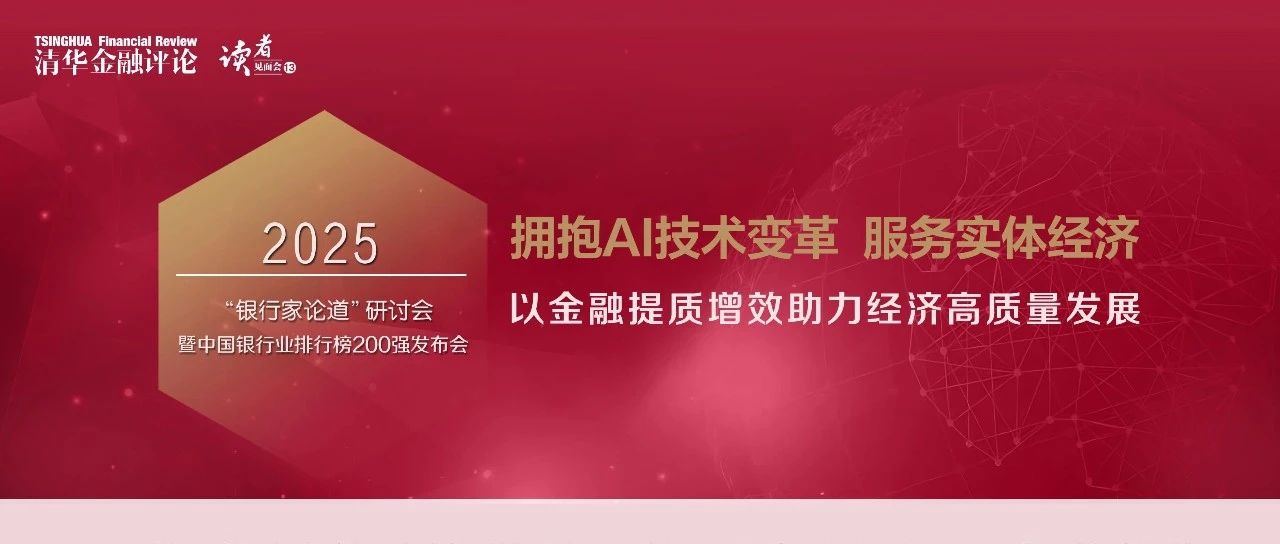
活动报名|2025“银行家论道”研讨会暨中国银行业排行榜200强发布会
清华金融评论· 2025-08-20 10:57
Core Viewpoint - The article emphasizes the importance of the banking sector in supporting the "Five Major Articles" outlined in China's financial strategy, particularly in the context of the 2025 goals for high-quality economic development [2][3]. Group 1: Event Background - The year 2025 marks the end of the "14th Five-Year Plan" and is crucial for laying the foundation for the "15th Five-Year Plan" [2]. - The central financial work meeting has set the goal of building a financial powerhouse, leading to multiple regulatory documents aimed at enhancing the banking sector's support for national strategies [2]. - The "China Banking Industry Top 200" ranking and research reports have been published since 2021 to analyze industry trends and showcase best practices [2]. Group 2: Event Highlights - The event will serve as a platform for multi-dimensional communication within the banking industry [4]. - The "China Banking Industry Top 200" and "Outstanding Cases of Innovation in the Banking Industry" will be released, providing insights into the latest industry trends and best practices [5]. Group 3: Key Discussions - The event will gather top experts from policy regulation, senior bankers, and scholars to discuss pressing domestic and international topics in the banking sector [6]. - In-depth discussions will focus on banking operational logic, exploring areas such as fintech, green finance, inclusive finance, pension finance, and digital finance [7]. - Experts will share insights on the application of artificial intelligence in core banking functions, including risk control, marketing, operations, and product innovation [8]. Group 4: Networking Opportunities - The event aims to facilitate efficient communication and resource matching among banks and industry representatives, promoting cross-industry collaboration and innovation [9].