
关税政策

Search documents
特朗普称“是中国逼我的”,美媒炸锅,美国船商已乖乖向中国交钱
Sou Hu Cai Jing· 2025-10-24 05:46
Group 1 - Trump's recent comments on imposing a 100% tariff on Chinese goods were unexpectedly hesitant, labeling the policy as "unsustainable" [1][3] - The shipping industry in the U.S. has shown signs of compromise in response to China's countermeasures, indicating a growing concern over the impact of tariffs [3][4] - Major corporations, including defense giant Lockheed Martin, have expressed opposition to Trump's tariff proposals, recognizing the potential for escalating tensions and retaliatory actions from China [4][8] Group 2 - The U.S. shipping industry is heavily reliant on Chinese-built vessels, with significant portions of fleets and order books consisting of Chinese ships [9][10] - The introduction of a special port fee for U.S. vessels by China is a direct response to U.S. tariffs, with fees set to increase progressively over the coming years [12][18] - The American shipping association has requested urgent negotiations with the government to address the financial pressures caused by these tariffs and fees, but the government remains firm on its policies [21][23] Group 3 - The ongoing trade conflict has led to a shift in shipping routes, with vessels originally destined for the U.S. now rerouting to the UK and EU, highlighting the disruption caused by tariff policies [8][27] - The uncertainty surrounding the duration of these tariffs and fees is a major concern for the shipping industry, as it complicates long-term planning and operations [10][18] - The imposition of tariffs and fees is expected to increase costs for American consumers, as these expenses are likely to be passed down the supply chain [8][27]

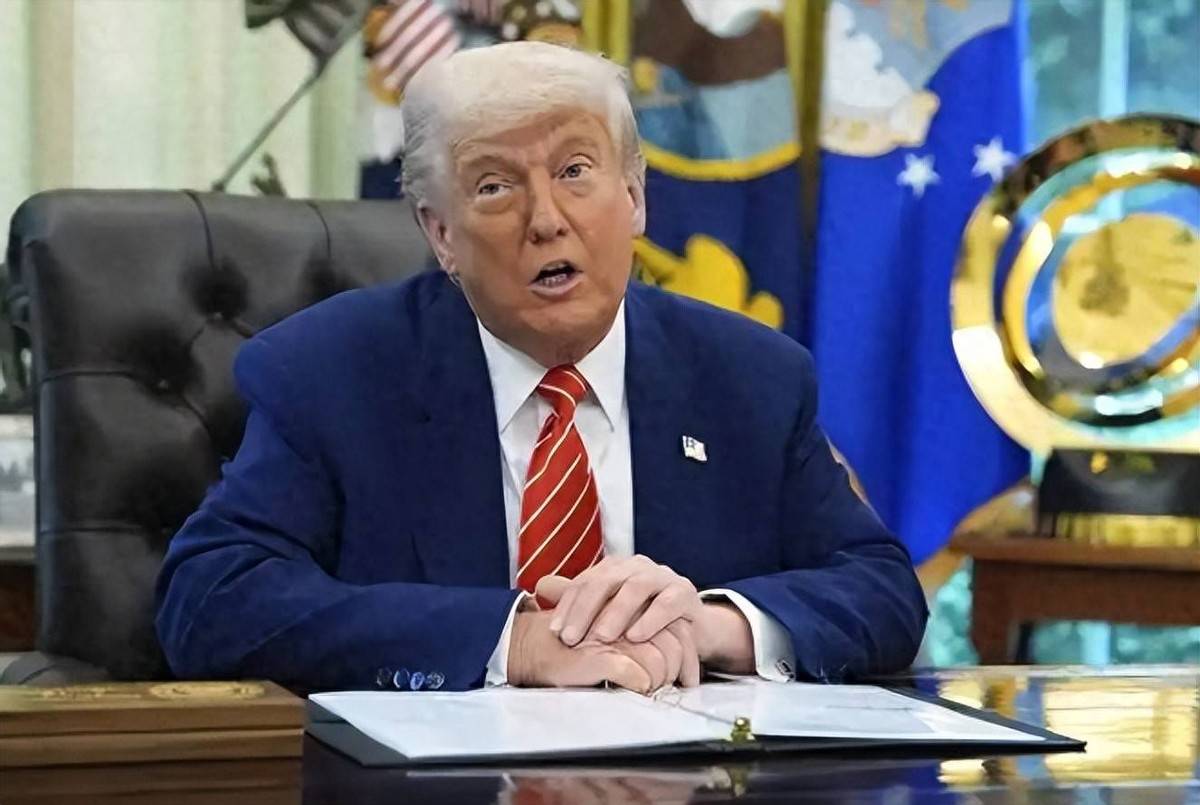
特朗普:美国即刻终止与加拿大所有贸易谈判
Sou Hu Cai Jing· 2025-10-24 04:49
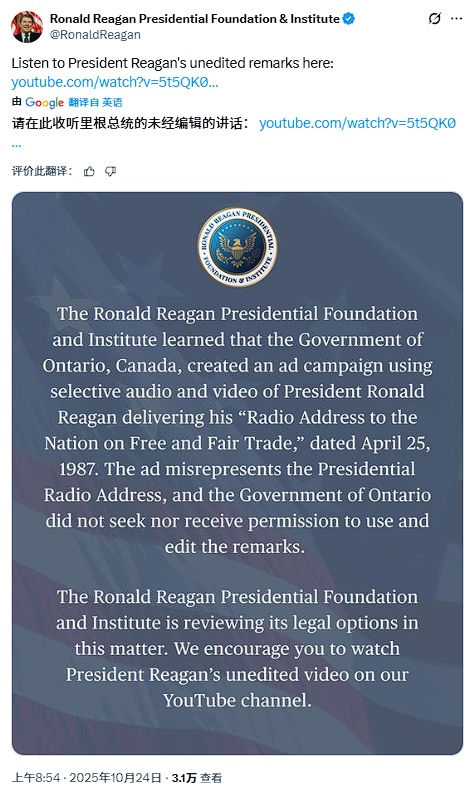
当地时间10月23日深夜,美国总统特朗普通过"真实社交"平台发文称,"罗纳德·里根基金会刚刚宣布, 加拿大在一则广告中欺诈性地使用了美国前总统里根的视频片段,伪造了他反对关税的言论。该广告花 费了7500万美元,他们这么做只是为了干预美国最高法院及其他法院的判决。" 特朗普随后写道,"关税对美国的国家安全和经济至关重要。鉴于加拿大的严重不当行为,美国将立即 终止与加拿大的所有贸易谈判。" "真实社交"平台 他还强调,"加拿大不会主动挑起这场争斗,但必须做好准备,赢下这场战斗。" X平台 另据加拿大CTV新闻网报道,该广告是加拿大安大略省地方政府一项竞选宣传活动的一部分,旨在宣传 该党的对外关税政策,同时反击特朗普政府的关税立场。 据了解,加拿大安大略省由保守党领袖道格·福特(Doug Ford)执政。今年1月,当得知特朗普政府将 继续对加拿大和墨西哥征收25%关税时,他在X平台上表示,"加拿大必须做好准备,立即采取强有力的 反制措施。一美元换一美元,一项关税换一项关税。" 据悉,这则时长60秒的广告引用了里根在1987年的一次广播讲话片段。当时,里根以极其讽刺的口吻解 释自己为何要对日本电子产品征收关税。 但 ...
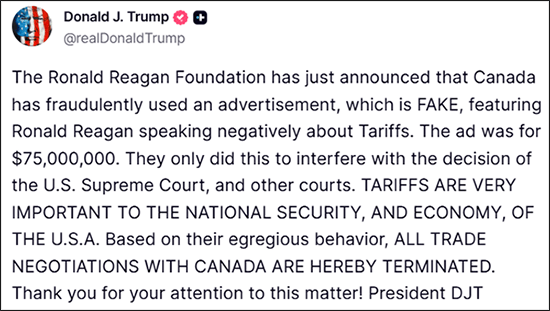
“终止所有与加拿大的谈判”!看电视看到“加拿大反关税广告”,特朗普怒了
Hua Er Jie Jian Wen· 2025-10-24 04:08
Core Points - President Trump's sudden termination of all trade negotiations with Canada highlights the unpredictability of his trade policy during his second term, adding further strain to the already tense U.S.-Canada economic relationship [1] - The decision was triggered by an advertisement from the Ontario provincial government that misused a speech by former President Reagan criticizing tariffs, which Trump labeled as "fraudulent" [1][2] - The termination of negotiations comes at a critical time, as both countries were discussing potential agreements regarding the steel and aluminum industries, amidst ongoing tariffs imposed by Trump on Canadian goods [1][5] Group 1 - The Ontario government plans to spend $75 million on advertising in the U.S. featuring Reagan's criticism of tariffs, which has drawn the ire of President Trump [2] - Trump's statement emphasized the importance of tariffs for U.S. national security and economic interests, leading to the abrupt end of trade talks with Canada [4] - Economists warn that this situation reflects a key risk in Trump's second term, characterized by endless trade wars and fragile negotiations, contributing to economic uncertainty [5] Group 2 - Canadian Prime Minister Mark Carney indicated that Canada would not allow the U.S. to unfairly access its market if trade negotiations fail, and plans to double exports to countries outside the U.S. [1][5] - Currently, Trump imposes a 35% tariff on Canadian imports, with specific tariffs of 50% on metals and 25% on automobiles, which further complicates trade relations [5][6] - The advertisement controversy and subsequent negotiation termination signify increased uncertainty in the U.S.-Canada trade partnership, casting a shadow over North American economic integration [6]
美国只能依赖关税政策吗?美国经济学家:条条大路通罗马
Sou Hu Cai Jing· 2025-10-24 02:48
Core Viewpoint - Jeffrey Schott, a senior researcher at the Peterson Institute for International Economics, expressed that tariffs may not be the best policy for enhancing U.S. manufacturing productivity and achieving economic security and supply chain resilience [3]. Group 1: Tariff Policy Insights - Schott suggested that there are potentially better policy combinations than tariffs to boost U.S. manufacturing productivity [3]. - He emphasized the importance of considering the impact of tariffs on U.S. trade partners, including potential retaliatory actions that could arise from such measures [3]. - Schott noted that few countries currently retaliate against U.S. tariffs, as such actions can increase costs and distort markets for both parties involved [3]. Group 2: National Security and Trade - Schott criticized the broad interpretation of "national security" in the context of trade policies, arguing that it encompasses a wider range of economic activities than necessary [3]. - He mentioned ongoing discussions in the U.S. about narrowing the scope of "non-normal trade investment measures" to focus only on areas that genuinely concern national core security interests [3]. - The current tariff policy's extensive coverage needs to be re-evaluated according to Schott [3]. Group 3: Jeffrey Schott's Background - Jeffrey Schott has been with the Peterson Institute since 1983, focusing on international trade policy and economic sanctions [4]. - He has held academic positions at Princeton University and Georgetown University, and previously worked at the U.S. Treasury Department [4]. - Schott has authored numerous books and articles on trade, including works on the Trans-Pacific Partnership and the North American Free Trade Agreement [4].

期货市场交易指引:2025年10月24日-20251024
Chang Jiang Qi Huo· 2025-10-24 02:25
Report Industry Investment Ratings - **Macro - Finance**: Index futures are long - term bullish and recommended to buy on dips; Treasury bonds are recommended to hold a wait - and - see attitude [1][5] - **Black Building Materials**: Coking coal and rebar are recommended for range trading; Glass is recommended to hold a wait - and - see attitude [1][7][8] - **Non - ferrous Metals**: Copper is recommended to hold long positions cautiously on dips without chasing highs; Aluminum is recommended to layout long positions on dips after a pullback; Nickel is recommended to hold a wait - and - see attitude or short on rallies; Tin, gold, and silver are recommended for range trading [1][10][17][19] - **Energy and Chemicals**: PVC, caustic soda, styrene, rubber, urea, methanol are expected to fluctuate; Polyolefins are expected to have wide - range fluctuations; The 01 contract of soda ash is recommended to take a short - selling approach [1][22][24][32] - **Cotton Textile Industry Chain**: Cotton and cotton yarn are expected to fluctuate; PTA is expected to fluctuate weakly; Apples and jujubes are expected to be slightly bullish [1][34][35][36] - **Agriculture and Animal Husbandry**: Live pigs are recommended to short on rallies; Eggs are recommended to short on rallies; Corn is expected to have wide - range fluctuations; Soybean meal is expected to have range fluctuations; Oils are expected to be slightly bullish [1][39][44][45] Core Views - The overall market shows a complex situation with different trends in various sectors. Some sectors are affected by supply - demand relationships, some by macro - policies, and others by international trade and geopolitical factors. For example, the PVC market is affected by high supply, weak domestic demand, and uncertain export prospects; the oil market is influenced by geopolitical factors and supply - demand relationships [23][47][50] Summary by Directory Macro - Finance - **Index Futures**: May fluctuate in the short - term and are long - term bullish. The market trading volume decreased slightly, and different sectors showed different trends. Pay attention to important financial policies after the conference [5] - **Treasury Bonds**: Are expected to fluctuate. The outcome of Sino - US negotiations is the key factor affecting market risk appetite [5] Black Building Materials - **Double - Coking**: Supply is expected to gradually recover after the holiday, but the recovery is relatively slow. Jm has multi - allocation value, and the first round of coke price increase has started after the holiday [7] - **Rebar**: Futures prices are low - valued, and the price decline space is limited. It is expected to fluctuate at a low level. Pay attention to the opportunity to go long near 3000 for the RB2601 contract [7] - **Glass**: After the holiday, the policy expectation has cooled down, and the supply and demand fundamentals are weak. It is recommended to hold a wait - and - see attitude [8][9] Non - ferrous Metals - **Copper**: The macro - factors cause large fluctuations, but the fundamentals are relatively stable. It is expected to maintain a high - level strong trend. It is recommended to hold long positions cautiously on dips without chasing highs [10][11] - **Aluminum**: The production capacity of alumina and electrolytic aluminum has decreased. The demand in the peak season is weak, and the inventory is decreasing. It is recommended to layout long positions on dips [12] - **Nickel**: The new RKAB policy brings uncertainty to the supply. The medium - and long - term supply is in surplus. It is recommended to hold a wait - and - see attitude or short on rallies [17] - **Tin**: The supply is expected to be more relaxed in the fourth quarter, and the downstream consumption is weak. It is recommended for range trading [18][19] - **Silver and Gold**: Affected by factors such as the delay of US economic data, government shutdown risk, and interest - rate cut expectation, they are expected to have support. It is recommended to trade cautiously and build positions after a full pullback [19][20][21] Energy and Chemicals - **PVC**: The supply is high, the domestic demand is weak, and the export sustainability is uncertain. It is expected to fluctuate, and the 01 contract is temporarily concerned about the range of 4600 - 4800 [22][23] - **Caustic Soda**: The short - term supply pressure is relieved, and the demand is expected to increase. It is expected to fluctuate weakly, and the 01 contract is temporarily concerned about the pressure at 2450 [24][25] - **Styrene**: The cost is under pressure, the supply - demand is weak, and it is expected to fluctuate. The range of 6300 - 6700 is concerned [26] - **Rubber**: The cost has short - term support, and the supply is expected to increase in the long - term. It is expected to fluctuate, and the support at 15000 is concerned [27][28] - **Urea**: The supply decreases, the agricultural demand increases, and the industrial demand is weak. The inventory is increasing. It is expected to fluctuate at the bottom, and the range of 1550 - 1650 is concerned [29] - **Methanol**: The supply increases, the demand from the main downstream is strong, and the inventory is high. It is expected to fluctuate [30][31] - **Polyolefins**: The supply has an increasing expectation, the demand is limited, and the inventory has a pressure to accumulate. The PE and PP main contracts are expected to fluctuate, and the support at 6900 and 6600 is concerned respectively [30][31][32] - **Soda Ash**: The supply is in surplus, the downstream demand is weak, and the inventory is increasing. The 01 contract is recommended to take a short - selling approach [33] Cotton Textile Industry Chain - **Cotton and Cotton Yarn**: The global cotton supply and demand are both expected to increase, and the inventory is decreasing. The price is expected to fluctuate [34][35] - **PTA**: The oil price is low, the supply - demand is balanced, and the inventory accumulation slows down. It is expected to have range fluctuations, and the range of 4350 - 4600 is concerned [35] - **Apples and Jujubes**: The quality of apples decreases, and the delivery cost is expected to increase; the jujube purchase price is relatively stable. Both are expected to be slightly bullish [36][37] Agriculture and Animal Husbandry - **Live Pigs**: In the short - term, the price may fluctuate narrowly. In the medium - and long - term, the supply is high, and the price is under pressure. Different contracts have different trading strategies [39][41] - **Eggs**: In the short - term, the supply is sufficient, and the demand is weak. In the medium - and long - term, the supply pressure is still large. It is recommended to short on rallies [42][43] - **Corn**: The new crop is on the market, and the supply is sufficient. The demand is weak. It is expected to fluctuate weakly. It is recommended to short on rallies and pay attention to the 1 - 5 reverse spread [43] - **Soybean Meal**: The US soybean supply is under pressure, and the domestic supply is improving. It is expected to have range fluctuations. It is recommended to go long on dips and pay attention to trade relations [44] - **Oils**: Affected by factors such as production, export, and supply - demand relationships, the adjustment space is limited. It is recommended to go long after the correction [45][47][50]
液化石油气日报:油价延续涨势,LPG市场弹性有限-20251024
Hua Tai Qi Huo· 2025-10-24 02:22
Report Industry Investment Rating - Unilateral: Neutral, with a short - term focus on waiting and observing [2] Core View - Crude oil prices continued to rebound under the stimulus of news such as increased US sanctions on Russia, driving up the energy sector including PG. However, the fundamentals of the LPG market remained largely unchanged, with a loose supply - demand pattern. The industry was waiting for the results of China - US trade negotiations. Although the PG futures followed the crude oil rebound, the spot market reaction was relatively flat. Given the current window period of undecided major macro - events and frequent news disturbances, caution was advised [1] Summary by Directory Market Analysis - On October 23, regional LPG prices were as follows: Shandong market, 4300 - 4360 yuan/ton; Northeast market, 3830 - 4010 yuan/ton; North China market, 4100 - 4400 yuan/ton; East China market, 4150 - 4250 yuan/ton; Yangtze River region market, 4370 - 4630 yuan/ton; Northwest market, 4000 - 4100 yuan/ton; South China market, 4250 - 4480 yuan/ton [1] - In the second half of November 2025, the CIF prices of frozen propane and butane in East China were 548 dollars/ton (up 5 dollars/ton) and 553 dollars/ton (up 5 dollars/ton) respectively, equivalent to 4278 yuan/ton (up 36 yuan/ton) and 4317 yuan/ton (up 36 yuan/ton) in RMB. In South China, the CIF prices of frozen propane and butane were 542 dollars/ton (up 5 dollars/ton) and 547 dollars/ton (up 5 dollars/ton) respectively, equivalent to 4232 yuan/ton (up 37 yuan/ton) and 4271 yuan/ton (up 37 yuan/ton) in RMB [1] - Spot prices: North China and Shandong civil LPG prices rose yesterday. East China civil LPG and ether - after carbon four mainstream transaction prices remained stable, with a stable market atmosphere and downstream procurement on demand [1] Strategy - Unilateral: Neutral, short - term wait - and - see [2] - Cross - period: None [2] - Cross - variety: None [2] - Spot - futures: None [2] - Options: None [2]
KVB安全吗:市场关注金融稳定性之际,关键CPI报告即将出炉
Sou Hu Cai Jing· 2025-10-24 02:12
Core Insights - The focus of Wall Street is on the upcoming September Consumer Price Index (CPI) report due to the impact of the government shutdown, which has led to a lack of key economic data, increasing the potential for market volatility with any deviations from expectations [1][5]. Market Expectations - Analysts expect the September CPI data to show a month-over-month increase of 0.4%, consistent with August's growth, and a year-over-year increase of 3.1%, slightly higher than August [4]. - The core CPI, excluding food and energy, is also anticipated to remain stable with a month-over-month increase of 0.3% and a year-over-year increase of 3.1%, potentially marking the highest level since January [4]. Investor Sentiment - The absence of complete economic data has heightened investor reliance on the CPI report, which is seen as a critical indicator of market sentiment [3]. - Despite the uncertainty caused by the government shutdown, investors remain cautiously optimistic, with major stock indices near historical highs, although geopolitical uncertainties and fluctuating tariff situations continue to be a concern [5]. Federal Reserve Implications - The CPI report is crucial for market reactions and Federal Reserve policy decisions, with expectations of a 25 basis point rate cut in the upcoming meeting unless the CPI data significantly exceeds expectations [6].
“数据荒”中迎来CPI 今晚市场是惊还是喜?
智通财经网· 2025-10-24 00:29
Group 1 - The core focus of Wall Street is on the September Consumer Price Index (CPI) report, which is expected to significantly influence market trends due to the lack of government data caused by the shutdown [1][2] - Economists predict a 0.4% month-over-month increase in overall CPI for September, maintaining the same level as August, with a year-over-year increase of 3.1%, up 0.2 percentage points from August [1][2] - The report is crucial as it will be the last significant economic data before the Federal Reserve's policy meeting, with expectations of a 25 basis point rate cut [2][4] Group 2 - There are concerns regarding the reliability of the CPI data due to the government shutdown, which has led to a lack of comprehensive economic indicators [4] - The potential impact of tariffs from the Trump administration on prices will be closely monitored, particularly in categories like communication and household goods [3][4] - A significant deviation from expected CPI data could act as a catalyst for market volatility, with higher-than-expected inflation potentially leading to market fluctuations [5]
德国联邦统计局数据显示:今年前8月,中国再成德最大贸易国
Sou Hu Cai Jing· 2025-10-23 23:40
Core Insights - The trade dynamics between Germany and the U.S. have shifted significantly due to U.S. tariff policies, with China becoming Germany's largest trading partner again [1][2][5] Trade Dynamics - In the first eight months of the year, Germany's trade with China reached €163.4 billion, surpassing trade with the U.S. at €162.8 billion [2] - German exports to the U.S. have decreased by 7.4% year-on-year, totaling €99.6 billion, with a notable drop of 23.5% in August alone [2][4] - The decline in exports to the U.S. is attributed to reduced demand for traditional German goods such as automobiles, machinery, and chemicals due to U.S. tariffs [2][4] Sector-Specific Impacts - The automotive sector saw a 23.5% year-on-year decline in exports to the U.S. following the imposition of a 25% additional tariff on imported cars [4] - The machinery sector is also experiencing pessimism, with about one-third of surveyed companies rating the current situation as "bad" or "very bad," potentially leading to job cuts [4] Economic Outlook - Despite a slight increase in exports of pharmaceuticals, IT, and electronics, these gains are insufficient to offset losses in core industries [4] - The Ifo Institute's survey indicates a slight increase in optimism among exporters, but no sustainable improvement is evident [6] - Germany's economic growth forecast for this year is only 0.2%, with a more optimistic outlook of 1.3% for the next year, driven by domestic investments rather than overseas demand [6][7] Bilateral Trade Relations - China's trade with Germany has shown an 8.3% increase in imports, reaching €108.8 billion, while exports from China to Germany grew by 10.9% in September [5] - Analysts express concerns about Germany's increasing dependency on China, although they acknowledge the strong complementary nature of the economic relationship [5][7] - Future cooperation between Germany and China is expected to remain strong in traditional sectors as well as in green transformation, service trade, smart manufacturing, and digitalization [5][7]
一把火烧掉20亿!F-150核心供应商遇火灾 福特(F.US)利润承压但迅速“救火”
智通财经网· 2025-10-23 23:37
Core Viewpoint - A devastating fire at Novelis' aluminum plant, a key supplier for Ford's F-150 pickup, is expected to impact the company's profits by up to $2 billion, overshadowing its previously strong financial performance [1][2]. Financial Performance - Ford's adjusted EBIT for the year is now projected to be between $6 billion and $6.5 billion, significantly down from the previous guidance of up to $7.5 billion, marking a 41% decrease from last year's $10.2 billion [1][2]. - Despite the Novelis incident, Ford's Q3 profits and sales exceeded Wall Street expectations, with adjusted earnings per share at $0.45, surpassing the analyst average of $0.36, and record sales of $50.5 billion, above the expected $43.7 billion [4]. Production Impact - The fire is expected to result in a production loss of approximately 100,000 vehicles this year, but the company plans to recover most of this loss by increasing F-series truck production by 50,000 units by 2026 [1][2]. - Ford plans to hire 1,000 employees at its Michigan and Kentucky plants to support the increased production [2]. Business Segments Performance - Ford Pro, which includes commercial vehicles and logistics services, reported nearly $2 billion in EBIT, an increase from $1.8 billion year-over-year [6]. - The traditional Ford Blue segment, covering internal combustion and hybrid models, achieved $1.5 billion in EBIT, slightly down from $1.6 billion in the previous year [7]. - The electric vehicle unit, Model e, reported a loss of $1.4 billion, widening from a $1.2 billion loss in the same period last year [7]. Tariff Impact - Ford's CFO indicated that the financial loss from tariffs is now expected to be $1 billion, down from a previous estimate of $2 billion, due to recent announcements regarding tariff policies [6].
