卡车制造

Search documents
Why Is Paccar (PCAR) Up 1.2% Since Last Earnings Report?
ZACKS· 2026-02-26 17:30
Core Viewpoint - Paccar's recent earnings report shows a decline in earnings per share and revenues compared to the previous year, raising questions about future performance and investor sentiment [2][3]. Financial Performance - Paccar reported Q4 2025 earnings of $1.06 per share, matching estimates but down from $1.66 per share in Q4 2024 [2]. - Consolidated revenues were $6.8 billion, a decrease from $7.91 billion in the same quarter of the previous year [2]. - Truck segment revenues totaled $4.52 billion, down from $5.69 billion year-over-year but exceeding the estimate of $4.43 billion [3]. - Global truck deliveries were 32,900 units, lower than 43,900 units in Q4 2024 but above the estimate of 32,145 units [3]. - Parts segment revenues increased to $1.74 billion from $1.67 billion year-over-year, though slightly below the estimate of $1.75 billion [4]. - Financial Services segment revenues were $568.7 million, up from $544.3 million year-over-year but below the estimate of $576.8 million [5]. Income and Expenses - Pre-tax income from the Trucks segment was $94.6 million, significantly down 81.2% year-over-year and below the estimate of $237.3 million [3]. - Parts segment pre-tax income was $415 million, down from $428.2 million year-over-year but above the forecast of $332.1 million [4]. - Financial Services pre-tax income increased to $114.9 million from $104 million year-over-year but fell short of the projection of $128.1 million [5]. - Selling, general and administrative expenses rose to $153.8 million from $150.4 million in the prior year [6]. - R&D expenses were $106.2 million, down from $115 million year-over-year [6]. Cash Position and Future Outlook - As of December 31, 2025, Paccar's cash and marketable debt securities totaled $9.25 billion, down from $9.65 billion a year earlier [6]. - Capital expenditures and R&D expenses for 2026 are projected to be between $725-$775 million and $450-$500 million, respectively [6]. - Since the earnings release, consensus estimates have decreased by 16.13%, indicating a downward trend in investor sentiment [7][10]. - Paccar holds a Zacks Rank 3 (Hold), suggesting an expectation of in-line returns in the coming months [10]. Investment Scores - Paccar has an average Growth Score of C and a low Momentum Score of F, but a strong Value Score of B, placing it in the top 40% for value investment strategy [8]. - The aggregate VGM Score for Paccar is C, which is relevant for investors not focused on a single strategy [8].


Paccar (NasdaqGS:PCAR) 2026 Analyst Day Transcript
2026-02-10 15:02
PACCAR 2026 Analyst Day Summary Company Overview - **Company**: PACCAR (NasdaqGS: PCAR) - **Event**: 2026 Analyst Day held on February 10, 2026 - **Key Executives Present**: Preston Feight (CEO), Laura Bloch (SVP), John Rich (CTO), Kevin Baney (President), Brice Poplawski (CFO) Key Points and Arguments Financial Performance - **Revenue Growth**: Increased from $19 billion in 2014 to over $28 billion in 2025, representing a 50% increase [18] - **Net Income Growth**: Rose from $1.4 billion to $2.6 billion, an 86% increase [19] - **Return on Revenue**: Improved from 7.2% to 9.3% [19] - **Parts and Financial Services Contribution**: Grew from 43% of profit to 71%, reducing cyclicality [19] - **Parts Profit Growth**: Increased from $244 million in 2005 to nearly $1.7 billion in 2025 [19] - **Financial Services Profit Growth**: Rose from $200 million to nearly $500 million in the same period [19] Operational Efficiency - **Average Net Income per Truck**: Nearly doubled from $9,500 to $18,000 per truck over five years [21] - **Investment in Manufacturing**: Over $5 billion invested in facilities and products to enhance manufacturing capabilities [21] - **AI Utilization**: Implemented AI in manufacturing and parts management to optimize operations and improve efficiency [23][24] Product Development and Innovation - **Truck Emissions and Efficiency**: Current trucks are 20 times cleaner and 40% more fuel-efficient than those from 20 years ago [7] - **New Product Launches**: Introduction of electric and hybrid models, including the industry's first electric vocational truck [35][49] - **Awards**: DAF's XD and XF electric trucks won the 2026 International Truck of the Year award [50] Market Position and Strategy - **Market Share Growth**: Increased North American market share from 24% in 2005 to 30.4% in 2025 [38] - **Global Parts Market Opportunity**: Total addressable market of $70 billion, with PACCAR aiming to increase its share by 5 percentage points over the next five years [54] - **Financial Services**: PACCAR Financial Services operates in 26 countries, providing tailored financing solutions that enhance market share [66] Sustainability and Community Engagement - **Environmental Initiatives**: 90% of truck components are recyclable, and PACCAR has achieved the lowest GHG emissions in its history [25][26] - **Community Contributions**: Over $250 million donated to education, social services, and the arts since 1951 [27] Future Outlook - **2026 Guidance**: Expected deliveries of around 33,000 units in Q1, with parts sales growth projected at 2%-4% [69] - **Capital Expenditures**: Estimated at $725 million-$775 million for 2026, with R&D spending between $450 million-$500 million [70] - **Profitability Strategy**: Focus on high ROI projects and continuous innovation to maintain competitive advantage [76] Additional Important Insights - **Dealer Network Value**: The independent dealer network is estimated to be a $20 billion asset, providing significant value to customers [28] - **Dividend Policy**: PACCAR has a history of increasing dividends, with an average growth rate of 11% over the past decade [74] - **Safety and Quality**: Achieved an average OSHA score of 1.36, reflecting best-in-class operational safety [38] This summary encapsulates the key insights and strategic directions discussed during PACCAR's 2026 Analyst Day, highlighting the company's robust financial performance, operational efficiencies, product innovations, and commitment to sustainability and community engagement.
PACCAR(PCAR) - 2025 Q4 - Earnings Call Transcript
2026-01-27 18:02
Financial Data and Key Metrics Changes - PACCAR's fourth quarter revenues were $6.8 billion, with a net income of $557 million. For the full year 2025, revenues reached $28.4 billion and adjusted net income was $2.64 billion, marking the fourth highest profit year in company history and the 87th consecutive year of profits. The adjusted after-tax return on revenue was 9.3% [4][5][10] - PACCAR Parts and PACCAR Financial Services achieved quarterly and annual revenue records, contributing to a structurally stronger performance [4][10] Business Line Data and Key Metrics Changes - PACCAR Parts' annual revenues increased by 3% to a record $6.9 billion, with pre-tax profits of $1.67 billion. Fourth quarter revenues rose 4% to a record $1.7 billion, with pre-tax profits of $415 million [10][11] - PACCAR Financial Services achieved record annual revenues of $2.2 billion, with annual pre-tax income growing 11% to $485 million. Fourth quarter revenues were a record $569 million, with quarterly pre-tax income growing 10% to $115 million [11] Market Data and Key Metrics Changes - In the U.S. and Canadian Class 8 truck market, retail sales were 233,000 units, with PACCAR's market share at 30%. The 2026 market is forecasted to be between 230,000-270,000 vehicles [7] - The European above-16-ton truck market was 298,000 units in 2025, with expectations for 280,000-320,000 registrations in 2026. DAF trucks have a competitive advantage with innovative designs [8] Company Strategy and Development Direction - PACCAR is positioned well for upcoming regulatory changes, with a new lineup of trucks and engines that are efficient and high quality. The company is focusing on advanced technology and innovation, including next-generation clean diesel and battery-electric trucks [6][12] - The company aims to enhance profitability through improved customer service and technology, including agentic AI tools to increase vehicle uptime [10][12] Management's Comments on Operating Environment and Future Outlook - Management noted a dynamic year in the North American truck industry, with soft freight markets and uncertainties around tariffs and emissions policies. However, clarity on these issues is expected to improve customer demand [5][6] - The company anticipates 2026 to be a year of accelerated growth for customers, dealers, and PACCAR, with strong order intake and improved margins expected [9][16] Other Important Information - PACCAR declared dividends of $2.72 per share in 2025, resulting in a dividend yield of nearly 3%. The company has paid dividends for 84 consecutive years [10] - The company completed significant capital investments in 2025, totaling $728 million, with plans for similar investments in 2026 [11][12] Q&A Session Summary Question: Can you walk us through the margin improvement expected from 4Q to 1Q despite flat deliveries? - Management explained that margin improvement is expected due to the benefits from the Section 232 tariff and improved order intake, with margins projected to increase to 12.5%-13% in Q1 compared to 12% in Q4 [15][16] Question: What are you seeing in the performance of your aftermarket business in January by region? - Management forecasted a 3% growth year-over-year for Q1, with a mix shift towards required maintenance driving sales [27] Question: How do you think about market share versus unit profitability from a PACCAR standpoint? - Management expressed confidence in gaining market share and improving margins as the year progresses, especially with the clarity provided by the Section 232 tariff [32][33] Question: What is the expected price increase associated with the 2027 NOx regulations? - Management indicated a general expectation of a price increase around ±$10,000, but emphasized that this is subject to change based on further regulatory clarity [84] Question: How are you thinking about the potential for dealer stocking and the risk of an inventory overhang exiting 2026? - Management stated that while an inventory overhang has negative connotations, having inventory going into 2027 may not be problematic, and they are seeing dealers ordering stock trucks [91][92]
PACCAR(PCAR) - 2025 Q4 - Earnings Call Transcript
2026-01-27 18:02
Financial Data and Key Metrics Changes - PACCAR's fourth quarter revenues were $6.8 billion, with a net income of $557 million. For the full year 2025, revenues reached $28.4 billion and adjusted net income was $2.64 billion, marking the fourth highest profit year in company history and the 87th consecutive year of profits. The adjusted after-tax return on revenue was 9.3% [4][10] - PACCAR Parts' annual revenues increased by 3% to a record $6.9 billion, with pre-tax profits of $1.67 billion. Fourth quarter revenues for PACCAR Parts increased 4% to a record $1.7 billion, with pre-tax profits of $415 million [10][11] - PACCAR Financial Services achieved record annual revenues of $2.2 billion, with annual pre-tax income growing 11% to $485 million. Fourth quarter revenues were a record $569 million, with quarterly pre-tax income growing 10% to $115 million [11] Business Line Data and Key Metrics Changes - PACCAR Parts and PACCAR Financial Services each achieved quarterly and annual revenue records, contributing to a structurally stronger performance for the company [4] - The aftermarket parts business is expected to grow by 4%-8% in 2026, with growth accelerating as the year progresses [11] - PACCAR Financial Services increased market share to 27%, a growth of 2 percentage points compared to 2024 [11] Market Data and Key Metrics Changes - In North America, Class 8 truck retail sales were 233,000 units, with PACCAR's market share at 30%. The 2026 U.S. and Canadian Class 8 truck market is forecasted to be in the range of 230,000-270,000 vehicles [7] - The European above-16-ton truck market was 298,000 units in 2025, with expectations for 280,000-320,000 registrations in 2026. DAF trucks have a competitive advantage in Europe, recognized with the International Truck of the Year award [8] - The South American above-16-ton market was 115,000 vehicles in 2025, expected to be in the range of 100,000-110,000 trucks in 2026 [8] Company Strategy and Development Direction - PACCAR is positioned well for upcoming regulatory changes, with a new lineup of trucks and engines that are efficient and of high quality. The company is focusing on advanced technology and innovation projects, including clean diesel and alternative powertrains [6][12] - The company aims to enhance its distribution network through investments by independent dealers, contributing to long-term success [13] Management's Comments on Operating Environment and Future Outlook - Management noted a dynamic year in the North American truck industry, with soft freight markets and uncertainties around tariffs and emissions policies. However, clarity on these issues is expected to improve customer demand [5][6] - The company anticipates 2026 to be a year of accelerated growth for customers, dealers, and PACCAR, with strong order intake and improving freight conditions [9][11] Other Important Information - PACCAR declared dividends of $2.72 per share in 2025, resulting in a dividend yield of nearly 3% [10] - The company completed significant capital investments in 2025, totaling $728 million, with plans for similar investments in 2026 [11][12] Q&A Session Summary Question: Can you walk us through the margin improvement expected from Q4 to Q1 despite flat deliveries? - Management explained that the margin improvement is due to the benefits from the Section 232 tariff and improved order intake, leading to expected margins of 12.5%-13% in Q1 compared to 12% in Q4 [15][16] Question: Can you discuss the performance of the aftermarket business in January by region? - Management forecasted a 3% growth year-over-year for Q1, with a mix shift towards required maintenance driving sales [25][26] Question: How do you see the used truck market evolving over the course of the year? - Management indicated that used truck values could increase due to regulatory changes and a potential uptick in demand, despite a temporary downtick in values [66][69] Question: What are your thoughts on market share versus unit profitability in light of Section 232? - Management expressed confidence in gaining market share and improving margins as the competitive landscape stabilizes [32][33] Question: How do you see pricing evolving through the year as we approach the prebuy? - Management noted that pricing clarity will emerge as competitors adjust to tariff costs, which will positively influence pricing dynamics [114][115]
中国重汽涨超4% 股价创历史新高 花旗此前上调公司净利润预测
Zhi Tong Cai Jing· 2026-01-27 05:53
Core Viewpoint - China National Heavy Duty Truck Group (China National Heavy Duty Truck) shares rose over 4%, reaching a new high of 34.16 HKD, driven by strong fundamentals and positive market outlook [1] Company Summary - Citigroup recently upgraded its dividend forecasts for China National Heavy Duty Truck for the fiscal years 2025 to 2027 to 60%, 70%, and 70% respectively, and increased net profit forecasts by 1% to 2%, reaching 7.1 billion, 8.3 billion, and 9.1 billion RMB [1] - Citigroup raised the target price for China National Heavy Duty Truck from 26.4 HKD to 39.4 HKD while maintaining a "Buy" rating [1] Industry Summary - In December 2025, China's truck market sold a total of 361,000 units, representing a month-on-month increase of 7% and a year-on-year increase of 17% [1] - Heavy-duty truck sales in December reached 102,700 units, showing a month-on-month decline of 9% but a year-on-year increase of 22% [1] - Guotai Junan Securities believes that the domestic logistics environment remains stable, and despite a high replacement base from 2017 to 2021, the decline in heavy truck sales is expected to be limited [1] - Overall wholesale sales are projected to reach 1.16 million units in 2026, reflecting a year-on-year growth of 1.5%, with exports expected to maintain growth [1]

“中国制造”“出海”忙
Ren Min Ri Bao Hai Wai Ban· 2025-12-12 00:55
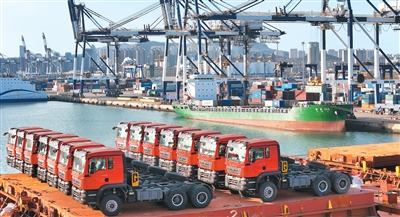
Group 1 - The article highlights the export of domestic wind power equipment from Lianyungang Port in Jiangsu Province, indicating a growing trend in the renewable energy sector [2] - It also mentions the export of domestic trucks from Yantai Port in Shandong Province, showcasing the expansion of the manufacturing industry and its international reach [2]
七年践诺,初心未改|三一重卡第四批英雄车主免费换新圆满收官
Zheng Quan Shi Bao Wang· 2025-11-29 10:49
Core Viewpoint - The company SANY Heavy Truck has successfully fulfilled its commitment to its initial customers by providing free vehicle upgrades, showcasing its growth and dedication to customer relationships over seven years [2][4]. Group 1: Company Commitment - SANY Heavy Truck's chairman, Liang Linhe, expressed gratitude to the first 500 truck drivers who helped realize his dream, emphasizing a promise made seven years ago to provide free vehicle upgrades when sales reached 100,000 units [2]. - The fourth batch of 28 seed users received new vehicles, marking the largest vehicle exchange event in the company's history, reinforcing the company's commitment to its customers [1][4]. Group 2: Customer Experience - Long-time customers shared their experiences, highlighting the transition from initial uncertainty to a strong trust in SANY Heavy Truck, as they witnessed the company's growth from one oil truck to multiple electric trucks [3]. - The event featured heartfelt interactions between the chairman and customers, including gratitude videos and personalized gifts, creating a warm atmosphere that emphasized the bond between the brand and its users [4]. Group 3: Industry Position - SANY Heavy Truck has navigated industry changes, from traditional fuel vehicles to leading in electric vehicle technology, achieving consecutive sales championships and reaching a scale of 10 billion [2]. - The company aims to continue its journey alongside its customers, promoting the narrative of "trucks delivering love" as it moves forward in the transportation industry [4].
中国重汽何以成为海外重卡市场“硬核力量”
Da Zhong Ri Bao· 2025-11-28 01:55
Core Insights - China National Heavy Duty Truck Group (Sinotruk) has demonstrated its leadership in heavy truck exports with a sales volume of 111,000 units from January to September, marking a year-on-year increase of 24.5% [1] - The company has established a presence in over 150 countries across six continents, with a global market share exceeding 1 million units [1] Group 1: International Expansion Strategy - Sinotruk initiated its internationalization strategy in 2004, becoming one of the first domestic truck manufacturers to adopt a "technology licensing + component export" model [2] - The company has successfully leveraged its 21 years of experience in building overseas networks, allowing it to maintain a competitive edge in a challenging global market [2] - Sales in traditional markets have shown steady growth, with significant increases in Africa (37.4%) and Southeast Asia (41.5%), as well as a 28.7% growth in the Middle East high-end market [2] Group 2: Localization and Operational Efficiency - Sinotruk has established a comprehensive operational chain overseas, including manufacturing, service, and talent development, to enhance its competitiveness [3] - The establishment of an assembly plant in the Philippines has reduced local delivery times, while 30 overseas KD factories have achieved a 60% localization rate [3] - The company has built a robust service network in Vietnam with 35 service stations and has tailored products for the Australian market, leading to strong customer acceptance [3] Group 3: Competitive Advantage through Resource Integration - Sinotruk has created a unique competitive advantage by integrating internal and external resources, transforming individual strengths into a powerful system [4] - The company benefits from a collaborative ecosystem with international suppliers to enhance the adaptability of core components, ensuring stable growth amid global supply chain disruptions [5] - Sinotruk aims to export 250,000 heavy trucks, 100,000 light trucks, 50,000 light vehicles, and 3,000 mining trucks by 2030, with a target of $1 billion in overseas aftermarket revenue [5]
小马智行-W与三一重卡、东风柳汽达成合作,将联合打造第四代自动驾驶卡车家族
Zhi Tong Cai Jing· 2025-11-19 00:09
Core Insights - The company announced a collaboration with SANY Heavy Truck and Dongfeng Liuzhou Motor to develop a fourth-generation autonomous truck family [1][2] - The fourth-generation autonomous truck system features a platform-based design with strong adaptability for various vehicle models, aiming for mass production of two initial models by 2026 [1] - The new autonomous truck suite will utilize 100% automotive-grade components, significantly reducing the bill of materials (BOM) cost by approximately 70% compared to the previous generation [1] Cost and Efficiency - The "1+4" platooning autonomous driving scheme is projected to reduce freight costs by 29% per kilometer compared to traditional freight, while increasing freight profit by 195% [1] - The mass production of these trucks is expected to facilitate a leap in the industry towards large-scale unmanned commercial operations [1] Safety and Reliability - The fourth-generation autonomous trucks will incorporate a fully redundant design and safety standards, enhancing the safety and reliability of autonomous freight logistics [2] - The system is designed for a lifespan of 20,000 hours and can support up to 1 million kilometers of freight operations [2] - The trucks will undergo rigorous testing to ensure performance in complex road conditions and adverse weather, further improving safety in autonomous freight operations [2] Market Context - China is the largest long-distance truck freight market globally and is accelerating the transformation towards intelligent logistics [2] - Since 2018, the company has been developing autonomous truck technology, currently operating around 200 autonomous trucks with a freight volume exceeding 10 billion ton-kilometers [2]
不到24小时就变脸!加拿大突然发起调查,要对中国企业重拳出击
Sou Hu Cai Jing· 2025-10-27 10:09
Core Insights - Recent trade negotiations between Canada and the U.S. have gained attention following Trump's abrupt termination of talks, leading Canada to initiate anti-dumping investigations against Chinese companies within 24 hours, indicating a calculated political and economic strategy [1][3] Trade Relations - Canada relies heavily on the U.S. for trade, with exports to the U.S. consistently accounting for 75.9% of its total exports. In 2022, the trade volume between the two countries exceeded $1 trillion, with key industries like steel, aluminum, and automotive tightly integrated into U.S. supply chains [1] U.S. Tariff Concerns - Trump's halt in negotiations was ostensibly due to a protest against a CAD 75 million anti-tariff advertisement from Ontario, but it also relates to the legality of tariffs, as the U.S. Supreme Court is set to review compliance issues that could result in the government needing to refund nearly $1 trillion in tariffs [3] Canadian Strategy - Canada's anti-dumping investigation against Chinese firms is seen as a risky balancing act, aiming to demonstrate loyalty to the U.S. while seeking leverage in negotiations. However, past experiences, such as the significant drop in electric vehicle exports to China, highlight the potential backlash from such actions [3][5] Domestic Impact - The investigation into truck body components poses significant risks, as nearly 40% of parts required by Canadian truck manufacturers come from China. Imposing anti-dumping duties could increase costs, adversely affecting consumers and exacerbating inflationary pressures [5] Geopolitical Positioning - Canada’s role in the trade dynamics is increasingly precarious, as the U.S. seeks to leverage allies to pressure China. As a member of the "Five Eyes" alliance, Canada’s position is crucial in diminishing China's market share in North America while providing a model for other allies [5] Future Challenges - Canada faces the challenge of navigating its foreign policy to maintain a balance between U.S. pressures and its economic interests with China. The current anti-dumping investigation could jeopardize Canada's strategy to diversify exports away from the U.S. and may lead to economic repercussions if not managed carefully [7]