
人民币国际化

Search documents
石油美元的黄昏?人民币撬动中东的三种姿势
Sou Hu Cai Jing· 2025-10-24 05:11
Core Insights - The International Monetary Fund (IMF) reported that as of the end of Q2 2025, the US dollar's share in global foreign exchange reserves has dropped to 56.32%, the lowest since 1995, while the Chinese yuan has made significant inroads in international energy settlements, particularly with Saudi Arabia [3] - The structural weakening of the petrodollar system is accelerating, highlighted by Saudi Arabia's shift towards multi-currency settlement mechanisms and the completion of the first oil transaction using digital yuan, significantly reducing transaction times [3][4] - The transition from a petrodollar system to a multi-currency framework is driven by concerns over the risks associated with dollar dependency and the strategic diversification efforts of oil-producing countries [4][5] Group 1: Energy Settlement Changes - The shift in the Middle Eastern energy settlement system is rooted in a profound change in the stance of oil-producing countries, particularly Saudi Arabia, which has expressed openness to using currencies other than the dollar for oil transactions [4] - The geopolitical risks associated with the dollar system, especially following the financial sanctions against Russia, have prompted oil-producing nations to seek alternatives to reduce reliance on a single currency [4][5] - China's position as the largest energy importer and its growing trade with Saudi Arabia, which reached $107.53 billion in 2024, underscores the importance of diversifying currency use in energy transactions [4] Group 2: Financial Circulation and Investment - Establishing a financial circulation system that allows yuan to flow in and out of the Middle East is crucial for the yuan's acceptance as a stable currency [10] - The issuance of yuan-denominated sovereign bonds by China in the Middle East, which saw a subscription rate of nearly 20 times the amount offered, reflects strong investor confidence in Chinese credit [10][12] - The expansion of the Cross-Border Interbank Payment System (CIPS) and the establishment of currency swap agreements with over 40 countries facilitate the use of yuan in international trade and investment [11][12] Group 3: Economic Cooperation and Trust - The deepening of economic cooperation between China and Middle Eastern countries, moving beyond oil trade to infrastructure and technology, is essential for building trust in the yuan [14][15] - Projects like the China-Saudi Arabia Special Economic Zone and the Jizan Economic City highlight the growing demand for yuan-denominated transactions in various sectors [14][15] - The collaboration in green energy and high-tech sectors further solidifies the reliability of China as a partner, enhancing the yuan's stability and acceptance [15][16] Group 4: Historical Context and Future Challenges - The decline of the petrodollar system is influenced by historical factors, including the US's use of financial sanctions, which have raised concerns among traditional allies about the risks of dollar dependency [19][20] - Despite the weakening of the petrodollar, the dollar's entrenched position in global trade and finance presents challenges for the yuan's internationalization [20][22] - The geopolitical dynamics and the US's potential response to the de-dollarization trend could pose significant hurdles for the yuan's rise as a global currency [20][22] Conclusion - The transition towards a multi-currency system is underway, with the yuan gaining traction in the Middle East, signaling a shift away from dollar dominance and towards a more balanced international monetary order [22][23]


外汇局最新发声!|宏观经济
清华金融评论· 2025-10-24 04:56
Core Viewpoint - The National Foreign Exchange Administration aims to enhance the foreign exchange management system in Shanghai, focusing on making it more convenient, open, secure, and intelligent to support the city's development as an international financial center [3][5]. Group 1: Financial Market Opening - The administration has been steadily expanding financial market openness, enhancing the interconnectivity of domestic and foreign financial markets, and improving the Qualified Foreign Institutional Investor (QFII) system, which has increased foreign investment attractiveness [3][4]. - China's bond and stock markets rank second globally, with foreign holdings of RMB financial assets exceeding 10 trillion RMB, significantly boosting Shanghai's international competitiveness [3][4]. Group 2: Cross-Border Trade and Investment Policies - A series of innovative cross-border trade and investment facilitation policies have been introduced, particularly in the Shanghai Free Trade Zone and Lingang New Area, establishing a replicable "Shanghai experience" [4][6]. - The administration supports high-tech enterprises in Shanghai to access cross-border financing more easily, enhancing the efficiency of global fund management for companies [4]. Group 3: Headquarters Economy - Currently, 170 multinational companies have established funding pools in Shanghai, managing over 250 billion USD in external debt and over 80 billion USD in overseas loans, which has significantly improved global fund management efficiency [4]. Group 4: Enhancing Foreign Exchange Services - The administration is guiding banks in Shanghai to reform foreign exchange operations, resulting in a 50% reduction in processing time for foreign exchange transactions for high-quality clients [4][6]. - The focus is on balancing convenience and risk prevention through institutional reforms, continuous innovation, and technology empowerment [4][6]. Group 5: Future Considerations - Future plans include further expanding high-level institutional openness in the foreign exchange sector, promoting cross-border trade and investment facilitation, and ensuring that financial openness is underpinned by security measures [5][6]. - The administration emphasizes a dual approach of macro-prudential and micro-regulatory management to prevent risks across regions, markets, and borders, ensuring that effective risk prevention supports high-quality development and openness [6].

刘斌:统筹人民币国际化与资本项目高质量开放,强化本外币一体化管理
Sou Hu Cai Jing· 2025-10-24 03:09
Group 1 - The core viewpoint of the conference is to embrace changes and establish a new order and new technology in the context of foreign exchange management [1] - The State Administration of Foreign Exchange (SAFE) aims to enhance the foreign exchange management system to be more convenient, open, secure, and intelligent, supporting the development of Shanghai as an international financial center [1] - The first focus is on steadily expanding high-level institutional opening in the foreign exchange sector, emphasizing the integration of RMB internationalization and high-quality capital account opening [1] Group 2 - The second focus is on promoting the convenience of cross-border trade and investment financing, adhering to the principle of "the more honest, the more convenient" for compliant entities [2] - The third focus is on balancing financial openness with security, emphasizing the need for a dual management approach of macro-prudential and micro-regulation to prevent risk transmission across regions and markets [2]
拉卡拉三季度科技服务收入同比增长108.75%
Zhong Guo Jing Ji Wang· 2025-10-24 03:09
Core Insights - Lakala reported a revenue of 1.417 billion yuan for Q3 2025, a year-on-year increase of 0.72%, and a net profit of 110 million yuan, up 17.46% year-on-year [1] - For the first three quarters, the company achieved a total revenue of 4.068 billion yuan and a net profit of 339 million yuan, with a total transaction volume of 2.99 trillion yuan in domestic and cross-border payments [1] - The cross-border payment volume reached 60.2 billion yuan, reflecting a robust year-on-year growth of 77.56% [1] - The company is actively pursuing a "Payment + SaaS" transformation, with technology service revenue growing by 108.75% year-on-year in Q3 [1] Financial Performance - In Q3 2025, Lakala's revenue was 1.417 billion yuan, with a net profit of 110 million yuan [1] - For the first three quarters, total revenue was 4.068 billion yuan and net profit was 339 million yuan [1] - The company reported a total transaction volume of 2.99 trillion yuan, maintaining a leading position in the industry [1] Cross-Border Payment Growth - Cross-border payment volume reached 60.2 billion yuan, with a year-on-year increase of 77.56% [1] - The number of cross-border payment merchants and transaction amounts grew by 71.91% and 77.56% respectively in the first three quarters [2] - Lakala is the only domestic independent third-party payment institution with full brand foreign card acquiring qualifications, with foreign card transaction coverage increasing by nearly 20% year-on-year [2] SaaS and Digital Transformation - The company is focusing on the "Payment + SaaS" strategy, particularly in high-stickiness verticals like dining and retail [3] - Lakala's restaurant SaaS has served over 80,000 mid-to-high-end active dining stores, contributing to a 108.75% year-on-year increase in technology service revenue [3] - The retail SaaS product has also shown steady growth, serving over 100,000 merchants and significantly increasing the number of quality clients [3] AI Integration - Lakala is integrating AI technology into its payment and SaaS systems, being the first in the industry to launch an AI wallet [3] - As of September 30, the AI wallet had nearly 8 million registered users, with 1.5 million monthly active users [3]

人民币支付占比冲到 3.17%!跨境花钱不用换汇,这些变化太实在
Sou Hu Cai Jing· 2025-10-24 01:54
你别说,这事儿背后不是偶然。以前总听人说人民币国际化是大企业的事儿,跟咱小老百姓没关系,现在才 发现早渗透到生活里了。我去年去东南亚旅游,在夜市买芒果糯米饭,老板直接问能不能给人民币,当时还 觉得新鲜,现在想想,这就是支付占比涨起来的底气啊。银行的朋友说,现在跨境收付差不多一半都用人民 币,不用经过美元中转,省了不少麻烦。 对了,企业那边的变化更明显。铜陵有家公司往香港放款,直接用人民币走 CIPS 系统,五百万一下就转过 去了。以前这种跨境资金调动,光手续就得办好几天,还得担心汇率波动。现在企业省事了,咱们消费者也 跟着沾光 —— 那些进口的化妆品、母婴用品,成本降了,价格自然也更实在。 其实最让人省心的是汇率风险。我闺蜜做代购,前几年总吐槽 "一天一个价",有时候货囤着没卖出去,汇率 跌了就白忙活。现在好多供货商都接受人民币结算,她直接按当天价付款,再也不用熬夜盯着外汇牌价了。 这就是专家说的 "减少货币错配风险" 吧?不过咱不用懂那些术语,知道花钱更踏实了就行。 当然了,这 3.17% 的占比跟美元欧元比还有差距,但涨得挺快的,比八月多了不少。而且不只是消费,现在 八十多个国家的央行都把人民币当储备货币 ...

人民币位列全球第五大活跃货币,全球支付占比进一步提升
Huan Qiu Wang· 2025-10-24 01:12
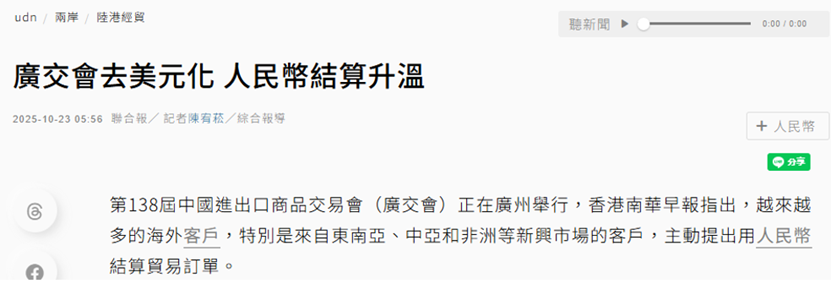
【环球网财经综合报道】环球银行金融电信协会(SWIFT)日前发布报告显示,2025年9月,在基于金额统计的全球 支付货币排名中,人民币全球支付占比为3.17%,位列全球第五大活跃货币,前值为2.93%。 联合新闻网近日发文称,第138届中国进出口商品交易会(广交会)正在广州举行,众多海外客户,尤其是来自东南 亚、中亚和非洲的新兴市场客户主动要求使用人民币进行贸易结算,推动了人民币结算量的增长。 香港文汇报也报导,此次广交会掀起"人民币结算热",许多企业主动"去美元化"。 报道还提到,今年中国人民银行已与八家外国央行签署(含续签)了双边本币互换协议,促进了人民币国际结算趋 势,有助于解决像南美客户缺美元支付货款的问题,显示了人民币国际化和去美元化的进展。 ...
从四方面入手提升人民币资产吸引力
Qi Huo Ri Bao Wang· 2025-10-24 00:55
Core Insights - The global attractiveness of RMB assets has significantly increased, with overseas entities holding over 10 trillion RMB in domestic financial assets, and RMB bonds and stocks being included in major global asset indices [1][2] Group 1: RMB Internationalization Progress - The internationalization of RMB is progressing through three stages: trade settlement currency, investment currency, and reserve currency, with trade advantages being crucial for becoming a settlement currency [1] - As of mid-2025, the total cross-border RMB payment amount reached 35 trillion RMB, a year-on-year increase of 14%, with goods trade accounting for 6.4 trillion RMB, representing 28% of total cross-border payments [1] - The "14th Five-Year Plan" emphasizes a market-driven approach to RMB internationalization, promoting a new type of mutually beneficial cooperation based on the free use of RMB [2] Group 2: Growth in Foreign Investment - The scale of foreign investment in RMB assets continues to expand, with overseas institutions and individuals holding 10.4 trillion RMB in domestic financial assets as of June this year, including 3.1 trillion RMB in stocks and 4.3 trillion RMB in bonds [2] - RMB stocks and bonds have been included in major global asset indices, enhancing their international profile [2] - Over 80 countries and regions have included RMB in their foreign exchange reserves, with 30% of surveyed central banks indicating plans to increase RMB asset allocations [2] Group 3: Benefits for Domestic Entities - The increased global attractiveness of RMB assets directly benefits Chinese enterprises by allowing them to engage in "local currency financing," significantly reducing exchange rate risks and enhancing bargaining power in global trade [3] - As RMB becomes the second-largest trade financing currency, Chinese companies can settle trade with countries involved in the Belt and Road Initiative directly in RMB, reducing reliance on the US dollar [3] Group 4: Strategies for Enhancing RMB Attractiveness - Strengthening the economic fundamentals is essential to solidify the "value anchor" of RMB assets, which includes promoting domestic demand and addressing potential risks in sectors like real estate and local debt [4] - Deepening financial market openness is crucial for attracting international capital, which involves expanding market access and developing innovative RMB-denominated financial products [5] - Improving financial infrastructure is necessary to enhance the liquidity and convenience of RMB assets, including upgrading cross-border payment systems and expanding investment channels [6] - Strengthening international cooperation can broaden the usage scenarios for RMB assets, such as through currency swaps and pricing commodities in RMB [7]
全球交易量跃升至8.5%,推进人民币国际化新机遇窗口已至
Sou Hu Cai Jing· 2025-10-23 22:27
人民币国际化进程再迈出关键一步。国际清算银行(BIS)近期发布的三年一度的调查显示,人民币全 球交易量已飙升至每日8170亿美元,在全球汇市交易中占比升至8.5%。这一进展显现出人民币国际化 的稳健势头。近年来,人民币国际化在多层次推进,实现了在贸易结算、投融资领域等方面的新突破。 业内认为,随着国际货币体系多极化趋势明朗,人民币或许迎来向国际化推进的重要机遇窗口。(上证 报) ...
股市必读:优博讯(300531)10月23日董秘有最新回复
Sou Hu Cai Jing· 2025-10-23 21:24
Core Viewpoint - The company, Youbo Xun, is actively involved in digital payment solutions and has established partnerships with major e-commerce and logistics firms, including potential collaborations with JD.com for blockchain technology and digital currency solutions [2]. Group 1: Company Developments - As of October 23, 2025, Youbo Xun's stock closed at 18.06 yuan, with a slight increase of 0.06% and a trading volume of 56,700 shares, amounting to a turnover of 101 million yuan [1]. - The company has developed smart financial POS systems that support real-time settlement and data traceability for stablecoin transactions, having passed the Hong Kong Monetary Authority's sandbox testing [2]. - Youbo Xun has accumulated extensive technical expertise in digital currency, collaborating with several banks on digital RMB technology development [2]. Group 2: Market Position and Strategy - The internationalization of the RMB is seen as beneficial for the company, as it may reduce foreign exchange risk and enhance financial stability while providing new business opportunities, particularly in emerging markets [2]. - The company is focused on optimizing risk control and resource allocation to enhance its international operations in response to the evolving global financial landscape [2]. Group 3: Financial Flows - On October 23, 2025, the net outflow of funds from major investors was 1.4236 million yuan, while retail investors experienced a net outflow of 2.1602 million yuan, indicating varied investor sentiment [3]. - Conversely, speculative funds saw a net inflow of 3.5839 million yuan, suggesting interest from short-term traders [3].

全球交易量跃升至8.5% 推进人民币国际化新机遇窗口已至
Shang Hai Zheng Quan Bao· 2025-10-23 18:39
Core Insights - The internationalization of the Renminbi (RMB) has made significant progress, with daily global trading volume reaching $817 billion, accounting for 8.5% of the global foreign exchange market [1] - The RMB is now the fifth most traded currency globally, with its share rapidly closing in on the British Pound, which has decreased from 12.9% to 10.2% [1] - The RMB's status as a settlement and investment currency has improved, with cross-border RMB payments reaching 35 trillion yuan, a 14% year-on-year increase [2] Dimension 1: Settlement Currency - The RMB has become the largest settlement currency for China's external payments and the second-largest trade financing currency globally [2] - In the first half of 2025, RMB cross-border payment amounts reached 6.4 trillion yuan, representing 28% of total cross-border payments, marking a historical high [2] Dimension 2: Investment Currency - As of July 2023, foreign entities held over 10 trillion yuan in domestic RMB financial assets, with RMB bonds and stocks included in major global asset indices [2] - Offshore RMB deposits reached 1.6 trillion yuan, with offshore RMB bonds and Panda bonds issued by foreign institutions totaling approximately 2 trillion yuan [2] Dimension 3: Reserve Currency - Over 80 foreign central banks have included the RMB in their foreign exchange reserves, with its share in global reserves rising to 2.88% in Q1 2025, up from 1.08% in 2016, reflecting a growth of over 270% [2] New Opportunities for RMB Internationalization - The current trend towards a multipolar international monetary system presents new opportunities for RMB internationalization [3] - The decline of the US dollar's dominance in global reserves and payments is paving the way for non-USD currencies like the RMB to gain traction [3] - China's economic stability and financial market openness provide a solid foundation for RMB internationalization [3] Expansion of RMB's Network - As of September 30, 2023, the People's Bank of China has signed bilateral currency swap agreements with 32 countries, totaling approximately 4.5 trillion yuan, enhancing RMB liquidity globally [4] Unique Path for RMB Internationalization - The RMB internationalization process is market-driven, focusing on facilitating trade and investment while removing barriers to RMB usage [5] - The offshore RMB market is expected to become a key arena for RMB internationalization, particularly in direct foreign investment [5] Offshore RMB Market Development - Recommendations include increasing the supply of offshore RMB safe assets and expanding onshore markets to enhance the availability of RMB as a reserve currency [6] - The digital RMB is anticipated to create new pathways for RMB internationalization, optimizing resource allocation and reducing transaction costs [6] Conclusion - With ongoing economic development, financial market openness, and international cooperation, the RMB is poised to play a more significant role in the global monetary system, contributing to the diversification of the global financial landscape [7]